Kubernetes has become the standard platform for running containerized applications in production.
If you want to grow as a DevOps Engineer, SRE, Platform Engineer, or Cloud Engineer, the Certified Kubernetes Administrator (CKA) is one of the most powerful certifications you can add to your profile. In this guide, we will walk step by step through what CKA is, who should take it, the skills you will gain, real projects you should be able to handle, preparation plans, common mistakes, and how to connect CKA with broader career paths like DevOps, DevSecOps, SRE, AIOps/MLOps, DataOps, and FinOps.
What is Certified Kubernetes Administrator (CKA)?
Certified Kubernetes Administrator (CKA) is a hands-on, performance-based certification focused on real cluster administration tasks in Kubernetes. It validates your ability to install, configure, manage, and troubleshoot Kubernetes clusters and workloads in production-like environments. The CKA program ensures that certified professionals can handle cluster architecture, networking, storage, security, workloads, and troubleshooting with confidence.
CKA Certification Snapshot
What it is
CKA is a practical certification that tests your skills by giving you real tasks inside a live Kubernetes environment.
Instead of multiple-choice questions, you solve administration problems such as deployments, networking, storage, security, and troubleshooting under time pressure.
Who should take it
- DevOps Engineers managing containerized workloads
- SREs and Platform Engineers responsible for uptime, reliability, and scaling
- Cloud Engineers building Kubernetes-based platforms on AWS, Azure, GCP, or on‑prem
- Software Engineers who deploy and operate microservices at scale
- Technical Leads and Engineering Managers who want practical understanding of Kubernetes operations
Skills you’ll gain
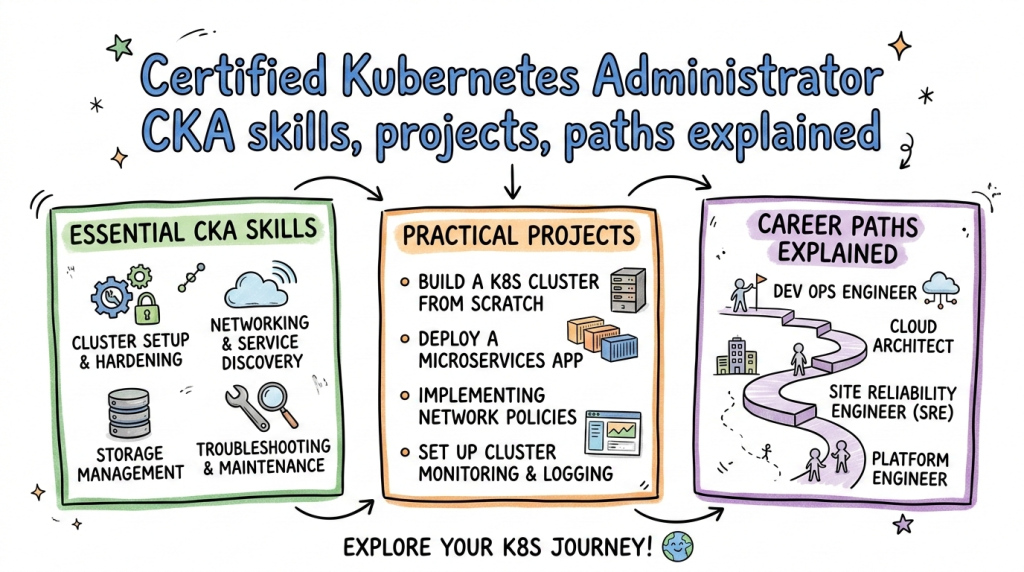
- Cluster architecture, installation, and configuration (for example, with kubeadm)
- RBAC, authentication, and authorization for secure clusters
- Workloads and scheduling: Deployments, DaemonSets, Jobs, CronJobs, rolling updates and rollbacks
- Services and networking: ClusterIP, NodePort, LoadBalancer, Ingress, NetworkPolicies, CoreDNS
- Storage: PersistentVolumes, PersistentVolumeClaims, StorageClasses, dynamic provisioning
- Logging, monitoring basics, and resource usage analysis
- Troubleshooting nodes, control plane components, workloads, and network issues
Real-world projects you should be able to do after CKA
After preparing for CKA, you should be able to handle projects like:
- Set up a production-ready Kubernetes cluster with multi-node architecture using kubeadm
- Configure RBAC, namespaces, and NetworkPolicies for multi-team environments
- Deploy microservices with rolling updates, autoscaling, ConfigMaps, and Secrets
- Design and implement storage for stateful applications using PV, PVC, and StorageClasses
- Configure Ingress controllers and routing for multiple domains and services
- Diagnose and fix failed pods, crashed control plane components, and network misconfigurations
- Plan and execute cluster upgrades and basic backup/restore for critical components
Preparation plan (7–14 days / 30 days / 60 days)
You can pick a preparation window based on your current level and available time.
7–14 days (crash plan, experienced users)
Best for engineers already working daily with Kubernetes in production.
- Spend 2–3 hours per day revising core concepts and commands.
- Follow a strict, task-based lab routine focused on exam domains: cluster setup, workloads, networking, storage, troubleshooting.
- Practice under time pressure by solving scenario-based tasks in 5–10 minutes each.
- Focus on weak areas by repeating labs until you can do them without documentation.
30 days (standard plan)
Good for working professionals with some prior Docker/Kubernetes exposure.
- Week 1: Fundamentals
- Architecture, nodes, control plane, pods, ReplicaSets, Deployments
- Hands-on: create and scale deployments, implement rolling updates and rollbacks
- Week 2: Networking and storage
- Services, Ingress, NetworkPolicies, PV/PVC, StorageClasses, dynamic provisioning
- Week 3: Security and troubleshooting
- RBAC, service accounts, secrets, logging, monitoring, common error patterns
- Week 4: Mock exams
- Time-bound practice labs aligned with CKA-style scenarios, full mock tests on alternate days
60 days (deep plan)
Ideal for those who are new to Kubernetes or coming from a non-DevOps background.
- Month 1: Strong foundation in containers, Kubernetes basics, YAML, Linux shell
- Month 2: Focused CKA syllabus study, daily labs, and weekly mock tests
- Use one day every week only for review and note-making to improve retention.
Common mistakes
- Ignoring the exam environment shortcuts and not learning how to work fast in the terminal
- Spending too much time reading theory without enough hands-on labs
- Not practicing end-to-end tasks like cluster bootstrap, upgrade, and troubleshooting
- Failing to bookmark important documentation sections and search efficiently
- Weakness in networking and storage because of focusing only on workloads
Best next certification after this
After CKA, you can consider:
- A deeper Kubernetes or platform track such as advanced Kubernetes or service mesh from the same provider
- Cloud-specialized Kubernetes learning (EKS, AKS, GKE) through advanced DevOps courses
- Role-focused certifications in SRE, DevSecOps, or MLOps from DevOpsSchool and partner institutions to build a broader platform engineering profile
Certification Table: CKA in Your Roadmap
| Certification name | Track | Level | Who it’s for | Prerequisites | Skills covered (high level) | Recommended order |
|---|---|---|---|---|---|---|
| Certified Kubernetes Administrator (CKA) | DevOps / SRE / Platform | Intermediate–Advanced | DevOps, SRE, Platform, Cloud, Software Engineers | Basic Linux, containers, YAML, some Kubernetes exposure | Cluster setup, RBAC, workloads & scheduling, services & networking, storage, logging, monitoring, troubleshooting | After basic Docker/K8s foundations |
You can place CKA as the core technical certification in your container and platform engineering roadmap, and then connect other domain certifications around it.
Choose Your Path: 6 Learning Paths Around CKA
CKA is not the end of the journey. It is a strong technical anchor that can connect to multiple career tracks.
1. DevOps Path
- Start with containers and CI/CD basics, then move to Kubernetes fundamentals.
- Take CKA to validate your Kubernetes operations skills.
- Add broader DevOps certifications to cover CI/CD, infrastructure as code, monitoring, and release automation.
2. DevSecOps Path
- Use CKA as your strong base in Kubernetes platform operations.
- Learn how to secure images, containers, and clusters (scanning, admission control, policies).
- Add DevSecOps-focused training that teaches shift-left security, compliance, and runtime protection for Kubernetes workloads.
3. SRE Path
- Combine CKA with SRE principles like SLIs, SLOs, error budgets, and incident management.
- Use your Kubernetes skills to design reliable services, good rollouts, and strong observability.
- Consider SRE certifications from specialized institutions after CKA for a full reliability profile.
4. AIOps / MLOps Path
- Use CKA to understand how to run complex workloads like ML pipelines on Kubernetes.
- Learn tools that run on Kubernetes such as Kubeflow, MLflow integrations, or custom ML pipelines.
- Combine with AIOps/MLOps certifications to manage monitoring, automation, and ML lifecycle at scale.
5. DataOps Path
- CKA gives you the skills to run stateful workloads and data pipelines on Kubernetes clusters.
- Build on that with DataOps training focused on data pipelines, reliability, and governance.
- Use Kubernetes as the execution platform for data services and ETL workloads.
6. FinOps Path
- CKA teaches you the technical knobs to control resource usage in clusters (requests, limits, autoscaling).
- FinOps training helps you connect these technical controls with actual cloud cost optimization.
- Together, they help you design Kubernetes clusters that are both reliable and cost-efficient.
Role → Recommended Certifications (with CKA in the Map)
Here is a simple mapping of roles and where CKA fits.
| Role | How CKA helps | Recommended sequence with CKA |
|---|---|---|
| DevOps Engineer | Core platform skills for container orchestration and CI/CD integration | Basic DevOps → Docker/K8s fundamentals → CKA → advanced DevOps/automation |
| SRE | Strong foundation to keep Kubernetes workloads reliable and observable | SRE basics → CKA → SRE-focused reliability and incident management training |
| Platform Engineer | Central cert to design and operate Kubernetes-based platforms | Linux/Cloud basics → CKA → advanced platform, GitOps, service mesh |
| Cloud Engineer | Adds deep Kubernetes layer on top of cloud provider knowledge | Cloud cert (AWS/Azure/GCP) → CKA → cloud-native Kubernetes patterns |
| Security Engineer | Helps understand the platform that needs to be secured | Security fundamentals → CKA → DevSecOps/Kubernetes security specializations |
| Data Engineer | Enables running data and streaming workloads on Kubernetes | Data engineering basics → CKA → DataOps/Kubernetes data platforms |
| FinOps Practitioner | Gives technical understanding of cluster resource usage and cost drivers | Cloud fundamentals → CKA → FinOps training focused on cost governance for Kubernetes |
| Engineering Manager | Improves technical decision-making around platforms and team skills | General cloud knowledge → CKA (for hands-on exposure) → leadership-focused training |
Next Certifications After CKA (3 Options)
Once you complete CKA, you can plan your next steps in three directions:
- Same track (deep technical)
- Advanced Kubernetes, service mesh, GitOps, or platform engineering programs from DevOpsSchool or partner schools.
- Cross-track (breadth across domains)
- Move into SRE, DevSecOps, AIOps/MLOps, or DataOps certifications that build on your Kubernetes platform knowledge.
- Leadership (team and architecture)
- Choose leadership-oriented programs focused on architecture, platform strategy, and managing DevOps/SRE teams, while still using your CKA knowledge for realistic decisions.
Top Training Institutions for CKA (Training + Certification Support)
DevOpsSchool
DevOpsSchool is a leading training provider for DevOps and Kubernetes, offering instructor-led and online batches for CKA-focused programs.
They provide hands-on labs, real project scenarios, and exam-focused practice that align closely with CKA objectives.
Learners also get access to recordings, notes, PDFs, test banks, and community forums for continuous support.
Cotocus
Cotocus focuses on DevOps and cloud-native upskilling with structured programs that cover Kubernetes administration and related technologies.
They often partner with expert trainers and industry practitioners to deliver practical, job-ready skills around CKA and platform operations.
Their programs are designed for working professionals who need flexible schedules and mentorship.
ScmGalaxy
ScmGalaxy offers DevOps and configuration management training with coverage of Kubernetes concepts and administration.
They provide guided sessions, lab exercises, and curated learning paths that connect CKA with broader DevOps practices.
Engineers can use their programs to build confidence in workflows from code to container to cluster.
BestDevOps
BestDevOps runs focused DevOps-oriented courses, including Kubernetes topics that support CKA preparation.
Their content emphasizes real-world environments, common production problems, and how to operate clusters at scale.
This makes them suitable for engineers who want both certification readiness and operational maturity.
devsecopsschool.com
devsecopsschool.com combines DevOps and security, helping learners understand secure Kubernetes operations.
They cover topics like container image scanning, policy enforcement, runtime security, and secure cluster configurations that complement CKA skills.
This is helpful if you plan to align CKA with a DevSecOps career path.
sreschool.com
sreschool.com focuses on Site Reliability Engineering, resilience, and production excellence.
They use Kubernetes as a core platform to teach concepts like SLOs, error budgets, observability, and incident response on real clusters.
Combining CKA with SRE training from sreschool.com creates a strong reliability-focused profile.
aiopsschool.com
aiopsschool.com works on the intersection of automation, monitoring, and AI/ML-assisted operations (AIOps).
Their programs show how to run intelligent monitoring and automation pipelines on Kubernetes environments.
This is especially relevant if you want to use CKA as a base for AIOps or MLOps roles.
dataopsschool.com
dataopsschool.com focuses on DataOps and data platform reliability.
They help you understand how to operate data pipelines and services, many of which now run on Kubernetes-based infrastructure.
Combining CKA with DataOps training makes sense for data engineers and platform engineers working with analytics workloads.
finopsschool.com
finopsschool.com specializes in FinOps and cloud cost optimization.
They help you connect Kubernetes resource usage and scaling decisions with financial impact across environments.
With CKA plus FinOps training, you can design clusters that are both technically robust and cost-aware.
FAQs on Certified Kubernetes Administrator (CKA)
1. Is CKA difficult to pass?
CKA is challenging because it is fully hands-on and time-bound, but it is manageable with structured labs and mocks.
Most engineers who regularly work with Kubernetes and practice tasks aligned with the exam domains can clear it with focused preparation.
2. How much time do I need to prepare for CKA?
If you already use Kubernetes in your daily work, 2–4 weeks of focused preparation with labs and mock exams is often enough.
If you are new to Kubernetes, plan for 6–8 weeks, including fundamentals of containers, YAML, and Linux.
3. What are the prerequisites for CKA?
You do not need an official prerequisite certification, but you should be comfortable with Linux commands, Docker basics, and YAML.
Some prior exposure to Kubernetes concepts and a practice cluster will save you a lot of time.
4. Do I need coding skills for CKA?
You do not need heavy programming skills, but basic understanding of YAML, CLI, and simple scripting can help.
The main focus is on cluster administration tasks, not on application development.
5. How valuable is CKA for my career?
CKA is highly respected in DevOps, SRE, and cloud roles because it proves that you can operate real Kubernetes clusters.
It can help you stand out in interviews and move into platform, SRE, or senior DevOps positions.
6. What kind of jobs can I get after CKA?
After CKA, you can target roles like Kubernetes Administrator, DevOps Engineer, SRE, Platform Engineer, or Cloud-Native Engineer.
Your exact opportunities will depend on your previous experience and other skills like CI/CD, cloud, and monitoring.
7. How should I practice for the CKA exam?
Use a real or cloud-based Kubernetes cluster and follow a domain-wise checklist that covers architecture, workloads, networking, storage, and troubleshooting.
Practice solving tasks under time pressure and get comfortable with kubectl commands and common patterns.
8. Can I prepare for CKA while working full-time?
Yes, many working professionals prepare by dedicating 1–2 hours on weekdays and more on weekends over 4–8 weeks.
Choosing a structured course from institutions like DevOpsSchool or partner schools can help you stay on track.
Conclusion
Certified Kubernetes Administrator (CKA) is not just another exam; it is a practical benchmark that proves you can run real Kubernetes clusters in demanding environments.
For DevOps Engineers, SREs, Platform Engineers, Cloud Engineers, and even managers, CKA provides a strong foundation to build modern, scalable, and reliable systems.
By following a clear preparation plan, avoiding common mistakes, and choosing the right training partner such as DevOpsSchool and its associated institutions, you can turn CKA into a real career accelerator.
From there, you are ready to grow into DevSecOps, SRE, AIOps/MLOps, DataOps, or FinOps paths and take on larger responsibilities in the engineering ecosystem.