Introduction
Quantum computing is completely changing how we think about processing information. Among its many mind-bending principles, few concepts capture the imagination quite like quantum teleportation. It sounds like something pulled straight from a late-night sci-fi movie marathon, but it is a real, experimentally verified scientific phenomenon. To understand this concept, we have to clear up a major myth right away: quantum teleportation does not move physical matter across space. It does not transport people or objects from one room to another. Instead, it is a method of quantum information transfer. It allows us to move the precise state of a subatomic particle from one location to another without moving the particle itself. If you want to master the foundational concepts of this emerging field, QuantumUting.com serves as an accessible educational learning resource designed for students, developers, and tech enthusiasts alike.
What Is Quantum Teleportation?
Definition and Core Concept
At its core, quantum teleportation is a protocol that transmits the exact quantum state of a particle (like an electron or a photon) to another distant particle. This transfer happens using classical communication channels combined with a unique physics phenomenon called quantum entanglement. The original state of the sender’s particle is destroyed during the process and perfectly recreated at the receiver’s end.
Historical Background
The concept was first proposed theoretically in 1993 by a team of physicists including Charles Bennett, Gilles Brassard, Claude Crépeau, Richard Jozsa, Asher Peres, and William Wootters. A few years later, experimental physicists successfully demonstrated the process in a laboratory setting using photons. Since then, scientists have managed to teleport quantum states across increasingly long distances, including from Earth to orbiting satellites.
Why It Matters in Quantum Computing
In traditional computers, information is moved along copper wires or fiber-optic cables as electrical pulses or flashes of light. In a quantum computer, standard wires will not work because the fragile quantum states would collapse upon touching a traditional material. Quantum teleportation gives researchers a reliable way to move delicate data between different sections of a quantum processor or across a quantum networking system without destroying the information.
Fundamentals You Should Know First
Before looking at the step-by-step process of teleportation, we need to break down a few essential pillars of quantum mechanics for beginners.
+-------------------------------------------------------------+
|                     QUANTUM FOUNDATIONS                     |
+-------------------------------------------------------------+
|  [Qubits]       -> Basic units of quantum data              |
|  [Superposition]-> Existing in multiple states at once       |
|  [Entanglement] -> Deeply linking two distant particles     |
|  [Measurement]  -> Observing a particle, forcing a choice   |
+-------------------------------------------------------------+
Qubits
A standard computer relies on bits, which can only exist as a 0 or a 1. A quantum computer uses qubits (quantum bits). A qubit can represent a 0, a 1, or both possibilities simultaneously. This expanded capability allows quantum computers to process complex calculations at incredible speeds.
Superposition
Superposition is the ability of a qubit to exist in multiple states at the exact same time. Think of a coin spinning on a table. While it is spinning, it isn’t purely heads or purely tails; it is a blur of both possibilities. Only when you slap your hand down on the coin does it stop spinning and settle into a definitive state of heads or tails.
Quantum Entanglement
Often called “spooky action at a distance,” quantum entanglement occurs when two or more particles become deeply interconnected. When two particles are entangled, their properties are perfectly linked, no matter how far apart they are. If you change or measure the state of one particle, the other particle reacts instantly, even if it is on the opposite side of the universe.
Quantum States
A quantum state is the mathematical description of a quantum system’s properties, such as its spin, polarization, or position. When we talk about teleportation, the quantum states are the actual data payloads we want to send from one point to another.
Quantum Measurement
In classical computing, you can check the value of a bit without changing it. In the quantum world, the act of looking at a particle forces it out of its delicate superposition state. Quantum measurement causes the particle to choose a fixed reality (either a 0 or a 1), destroying any complex quantum information it held previously.
Classical Communication
Quantum systems cannot do all the work alone. To complete a quantum state transfer, we still need traditional infrastructure. Classical communication refers to standard data transmission methods, like sending an email, making a phone call, or transmitting radio signals. This information is bound by traditional physics and cannot travel faster than the speed of light.
How Quantum Teleportation Works
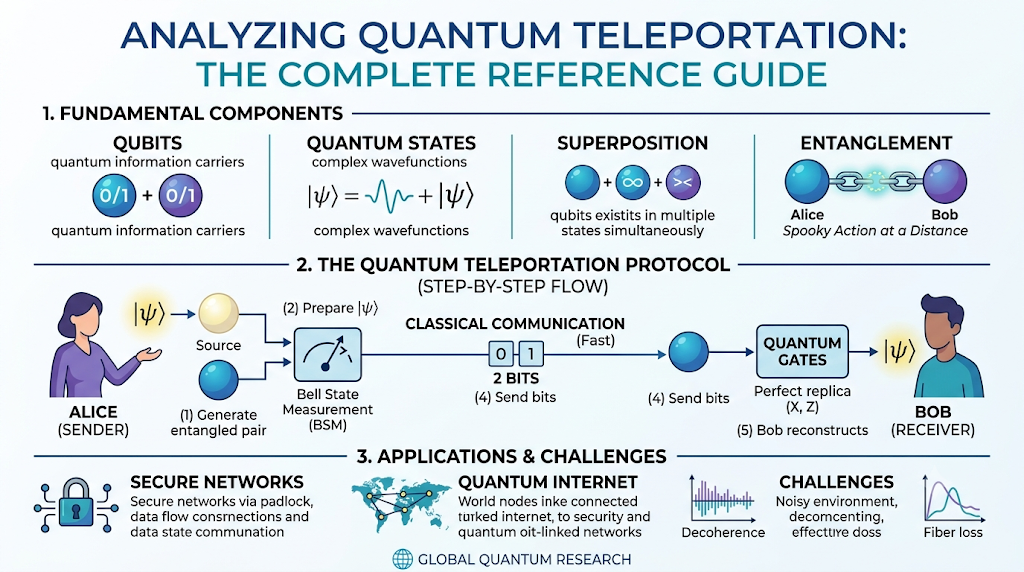
To see how these concepts fit together, let’s look at a classic educational scenario involving three parties: Alice (the sender), Bob (the receiver), and the Source that sets up the system. Alice wants to send an unknown quantum state to Bob.
[Source] --- Creates Entangled Pair ---> (Particle A to Alice) & (Particle B to Bob)
   |
   v
[Alice]  --- Measures (Unknown Particle X + Particle A) ---> Destroys Original State
   |
   +-------- Sends 2 Classical Bits of Data -------> [Bob]
                                                       |
                                                       v
                                            Applies Quantum Gates
                                            to Recreate Original State
Step 1: Creating an Entangled Pair
The process begins at a central source, which generates a pair of entangled particles (let’s call them Particle A and Particle B). The source sends Particle A to Alice and Particle B to Bob. Because these particles are entangled, Alice and Bob now share a subterranean, invisible connection through physics.
Step 2: Preparing the Unknown Quantum State
Alice receives a third particle (Particle X) that holds an unknown quantum state. This is the specific data package she needs to send to Bob. Alice does not know what state Particle X is in, and if she tries to look at it directly, her measurement will destroy the data.
Step 3: Performing Quantum Measurement
Alice takes Particle X (the data) and Particle A (her half of the entangled pair) and interacts them inside her quantum processor. She then performs a specialized measurement on both particles together. This action links Particle X to Particle A, but it also strips away their quantum properties, reducing them to standard classical data. Crucially, because Particle A was entangled with Bob’s Particle B, Alice’s measurement instantly alters the properties of Bob’s particle far away.
Step 4: Sending Classical Information
Alice’s joint measurement yields a simple result: two standard, classical bits of information (which could be 00, 01, 10, or 11). Alice takes these two classical bits and sends them to Bob using a traditional communication channel, like a fiber-optic message or a radio signal.
Step 5: Reconstructing the Original Quantum State
Bob receives the two classical bits from Alice. At this moment, Bob’s Particle B is in a modified state that closely resembles Alice’s original Particle X, but it might be rotated or inverted. The two classical bits act as an instruction manual telling Bob exactly how to adjust his particle. By applying specific operations (quantum gates) based on Alice’s message, Bob restores Particle B into a perfect replica of Alice’s original state. The teleportation is complete!
QuantumUting.com Guide to Quantum Teleportation
Navigating the landscape of quantum physics can feel overwhelming for beginners. The specialized educational resources at QuantumUting.com help learners break down these barriers through a structured approach to quantum concepts.
Understanding Quantum Information
Traditional computing tracks data via voltage levels on silicon chips. Quantum information science treats data as physical states built into nature. Learning through structured guides helps you see how nature’s smallest elements can be used to store and manipulate complex calculations that traditional computers cannot solve.
Learning Entanglement Concepts
Entanglement is the core engine behind most quantum algorithms and protocols. By studying how particles share instantaneous connections, students move past the initial confusion of “spooky action” and start recognizing entanglement as a practical tool for building quantum networks.
Exploring Quantum Communication
Communication systems are transitioning from local laboratory experiments into real-world infrastructure. Learning the mechanics of quantum state transfers prepares students to understand modern engineering breakthroughs, such as secure satellite relays and metropolitan fiber loops.
Building Strong Quantum Foundations
Mastering the basics early saves significant time later. By focusing heavily on concepts like superposition and measurement before diving into intense mathematics, learners build an intuitive mental model of the quantum world that makes advanced study much easier.
Preparing for Advanced Quantum Computing Topics
Once you understand how a single quantum state can be teleported between two users, you have the foundational knowledge needed to tackle complex subjects like quantum error correction, fault-tolerant design, and advanced quantum algorithm design.
Real-World Applications
Quantum teleportation is not just an interesting laboratory party trick; it is a foundational mechanism for several practical future technologies.
- Quantum Communication Networks: Modern fiber networks can carry quantum states across small distances. Teleportation allows network nodes to pass along quantum data over longer distances without losing fidelity.
- Quantum Internet: A global quantum internet will link quantum computers together, allowing them to share resources and solve massive problems collectively. Quantum teleportation is the primary method used to move data across this network safely.
- Quantum Cryptography: Because measuring a quantum state changes it permanently, information transferred via quantum protocols is highly secure against eavesdropping. Any attempt by an outside hacker to intercept the data will instantly alter the system and alert the users.
- Distributed Quantum Computing: Individual quantum computers have physical space limits on how many qubits they can house. By using teleportation to connect multiple smaller quantum processors together, engineers can build a giant distributed computer system.
- Secure Information Transfer: Government agencies, banking institutions, and defense organizations require absolute data privacy. Teleportation protocols provide a pathway toward unhackable secure information transfer channels.
Quantum Teleportation vs Science Fiction Teleportation
To avoid confusion, it helps to contrast the real physics concept with the versions popularized by television shows and movies.
| Feature | Quantum Teleportation | Science Fiction Teleportation |
| What Is Transferred | Quantum information | Physical objects or people |
| Uses Entanglement | Yes | Usually fictional |
| Requires Classical Communication | Yes | Usually no |
| Moves Physical Matter | No | Yes |
| Scientific Status | Experimentally demonstrated for quantum states | Fictional concept |
Benefits of Quantum Teleportation
- Absolute Security: Because data is not sent along a physical wire as raw code, it is fundamentally protected against traditional wiretapping and line interception methods.
- Zero Cloning: Quantum physics states that you cannot make an exact copy of an unknown quantum state. Teleportation moves the state safely while destroying the original, ensuring only one copy ever exists.
- Overcoming Material Limits: Traditional cables degrade signals over long distances. Teleportation uses entanglement pairs to bypass physical signal degradation issues across transmission lines.
- Enables Advanced Scale: It provides a predictable framework for interconnecting separate quantum computing nodes, allowing infrastructure to scale outward efficiently over time.
Common Challenges
Developing reliable quantum communication hardware comes with a unique set of technical hurdles.
Maintaining Quantum Entanglement
Entangled particles are incredibly fragile. Keeping two particles linked requires isolating them from outside interference, which becomes significantly harder as the distance between the two particles increases.
Quantum Decoherence
When a quantum particle accidentally interacts with its surrounding environment—such as a tiny temperature change or a stray electromagnetic wave—it loses its quantum properties. This destructive process is called decoherence, and it destroys the data packet before it can be teleported.
Noise in Quantum Systems
Every piece of hardware creates a small amount of systemic interference, known as noise. In quantum systems, even minor noise can scramble the delicate state of a qubit, resulting in errors during the reconstruction step.
Long-Distance Communication
As photons travel through standard fiber-optic cables over long distances, they run a high risk of being absorbed or scattered by the glass material. Overcoming these transmission losses requires specialized hardware solutions.
Hardware Limitations
To build a functional wide-scale system, researchers need highly efficient single-photon sources, ultra-precise detectors, and reliable quantum memory modules. Much of this essential hardware is still transitioning from experimental prototypes into mature commercial products.
Best Practices for Beginners
If you are a student or developer looking to get started in this field, keep these strategic tips in mind:
- Learn quantum mechanics fundamentals first: Do not skip ahead to complex applications. Focus on understanding waves, particles, and basic physics probabilities first.
- Understand qubits before studying teleportation: Make sure you can comfortably explain how a single qubit functions before you attempt to track multiple interacting particles.
- Practice with quantum simulators: Use free online open-source software tools and visual simulators to build simple quantum circuits and watch how measurements work in real time.
- Focus on concepts before mathematics: Build a clear mental picture of what the particles are doing before you immerse yourself in complex linear algebra and matrix operations.
- Study quantum communication alongside quantum algorithms: Learning how information moves helps you better understand how quantum computers process code internally.
Career Opportunities
As investments in quantum technology grow, companies are actively searching for talented individuals to fill specialized roles:
- Quantum Computing Engineer: Focusing on designing, building, and refining the physical processors that run quantum logic gates.
- Quantum Communication Researcher: Working in laboratory environments to test new methods for extending the distance and speed of quantum data transfers.
- Quantum Software Developer: Writing code and creating algorithms designed to run on simulated or physical quantum hardware architectures.
- Quantum Information Scientist: Studying the core theoretical principles of how information is processed and preserved on a subatomic scale.
- Quantum Network Engineer: Developing, managing, and securing the physical fiber and satellite infrastructure that will power the future quantum internet.
Future of Quantum Teleportation
Looking ahead, we can expect to see quantum systems integrate more deeply into our global tech infrastructure.
[Local Lab Experiments] ---> [City-Wide Fiber Loops] ---> [Satellite Links] ---> [Global Quantum Internet]
Early efforts will focus on expanding localized city-wide quantum networks. From there, satellite-based communication arrays will scale up to bridge continents, allowing for secure cross-ocean data routing. As researchers develop better methods for managing noise and maintaining entanglement, these networks will move out of university research labs and enter industrial environments, opening up a whole new era of secure global communication.
Common Misconceptions
Misconception: Quantum Teleportation Moves People Instantly
Reality: It only moves information, not matter. It cannot be used to travel or transport physical objects.
Misconception: Quantum Teleportation Breaks the Speed of Light
Reality: The process cannot work without classical communication bits to finish the state reconstruction. Because these classical bits travel at normal speeds, the overall process is strictly limited by the speed of light.
Misconception: Entanglement Alone Transfers Information
Reality: Entanglement establishes a connection, but it cannot transfer usable data by itself. Without the accompanying classical data from Alice, Bob only holds random, unreadable noise.
Misconception: Quantum Teleportation Is Only Theoretical
Reality: It has been repeatedly tested and verified by research teams worldwide over fiber networks, open-air setups, and satellite links.
FAQ Section
- Can quantum teleportation be used to teleport humans?
No. Quantum teleportation only transfers the abstract quantum states of subatomic particles, not physical matter. It cannot transport human beings or macroscopic objects.
- Does quantum teleportation allow faster-than-light communication?
No. To complete the process, the receiver needs classical data sent via traditional methods (like fiber optics). Because this classical information obeys standard physics, the transmission cannot exceed the speed of light.
- What is the difference between quantum teleportation and sci-fi teleportation?
Sci-fi teleportation physically disassembles an object and moves its matter elsewhere. Quantum teleportation leaves the physical matter behind and moves only the informational data state to a new particle.
- Why do we need classical communication if the particles are entangled?
Entanglement creates a link, but measuring one particle leaves the other in a random configuration. The classical bits tell the receiver exactly how to adjust their particle to match the original state.
- What happens to the original particle after teleportation?
The original particle’s quantum state is completely altered during the measurement step. This satisfies the No-Cloning Theorem, which states an unknown quantum state cannot be copied; it can only be moved.
- What materials are used to perform quantum teleportation?
Most real-world experiments use photons (particles of light) travelling through fiber-optic cables or open air, though it can also be done using electrons or trapped ions inside a computing lab.
- How far has quantum teleportation reached so far?
Scientists have successfully teleported quantum states across hundreds of kilometers using ground-based fiber systems, as well as over thousands of kilometers using satellite-to-earth laser links.
- Is quantum teleportation completely secure against hacking?
Yes, in terms of physics principles. Any attempt by an outside hacker to look at or intercept the quantum state changes it instantly, ruining the hack and alerting the network administrators.
- Do I need an advanced physics degree to understand this topic?
Not at all. While the underlying mathematics is highly advanced, the core concepts can be understood by anyone using simple analogies, logical workflows, and step-by-step guides.
- How can I start practicing quantum computing concepts at home?
You can start by reading beginner guides on educational hubs like QuantumUting.com, using free drag-and-drop cloud-based quantum circuit builders, and experimenting with open-source software libraries.
Final Summary
Quantum teleportation stands out as an amazing milestone in modern physics, proving that information can be moved independent of its physical host. By pairing quantum entanglement with traditional communication channels, it offers a secure, reliable way to move data across quantum networks without disrupting its delicate state. As hardware limitations clear up and engineering methods mature, this protocol will serve as the structural framework for a global quantum internet, ultra-secure financial systems, and powerful distributed supercomputing hubs.
