Introduction
The era of manually sifting through thousands of log lines to find a root cause is over. As systems have evolved from monolithic servers to distributed, containerized microservices, the operational noise has become deafening. This is where AIOps (Artificial Intelligence for IT Operations) steps in—not just as a buzzword, but as the necessary evolution of DevOps.If you are a working engineer or manager looking to future-proof your career, the AiOps Certified Professional (AIOCP) is the definitive credential to bridge the gap between traditional operations and AI-driven automation. This guide covers everything you need to know about this certification, from the curriculum to the career outcomes.
Certification Snapshot
Below is the essential breakdown of the AiOps Certified Professional program.
| Feature | Details |
|---|---|
| Certification Name | AiOps Certified Professional (AIOCP) |
| Track | AIOps / MLOps / DevOps |
| Level | Professional (Intermediate to Advanced) |
| Target Audience | DevOps Engineers, SREs, System Admins, AI Engineers, Technical Leads |
| Prerequisites | Basic Infrastructure Management Knowledge (Linux/Cloud basics) |
| Key Skills Covered | Python, TensorFlow, PyTorch, Kubernetes, Prometheus, Moogsoft, Elastic SIEM, GitOps |
| Recommended Order | Take after mastering basic DevOps (CI/CD, Linux) |
Deep Dive: AiOps Certified Professional (AIOCP)
What is it?
The AiOps Certified Professional (AIOCP) is a comprehensive certification program designed to teach you how to apply Artificial Intelligence and Machine Learning to IT Operations. Unlike standard DevOps courses that focus only on CI/CD pipelines, this program integrates data science (Python, TensorFlow) with operational tools (Kubernetes, Prometheus, Moogsoft) to automate incident management, root cause analysis, and self-healing systems.It moves beyond simple “if-this-then-that” scripting. It teaches you to build systems that learn from your infrastructure’s behavior. You aren’t just deploying code; you are deploying intelligence that watches your code.
Who Should Take It?
This certification is built for professionals who feel the pain of modern infrastructure complexity:
- DevOps Engineers: If you are tired of writing static alert thresholds that constantly need updating, this course teaches you dynamic thresholding.
- Site Reliability Engineers (SREs): Ideally suited for SREs looking to reduce toil and alert fatigue using Machine Learning models that filter noise.
- System Administrators: For admins aiming to modernize their skill set for cloud-native environments where manual checks are impossible.
- Managers & Architects: Leaders who need to understand how to implement AIOps strategies to lower Mean Time To Resolution (MTTR) in their organizations.
- Data Engineers: Who want to apply their data pipeline skills (Kafka, Airflow) specifically to the domain of IT Operations.
Skills You Will Gain
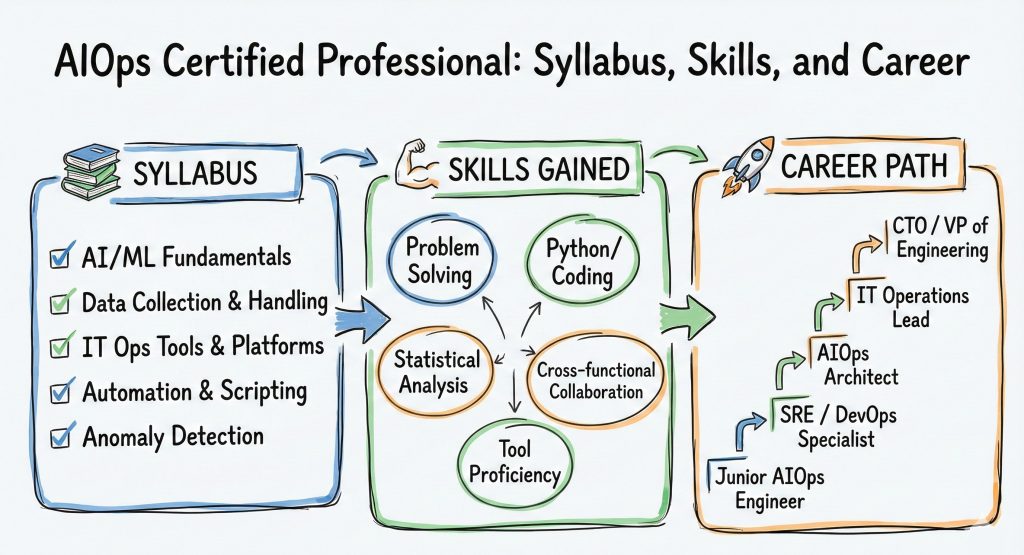
The curriculum is vast, covering the intersection of three major fields: DevOps, Data Science, and Cloud Security.
- Core AIOps: Understanding the philosophy of AIOps, including Event Correlation, Noise Reduction, and Predictive Analytics.
- Machine Learning Engineering: Building and training models with TensorFlow, PyTorch, and scikit-learn specifically for time-series data (logs and metrics).
- Data Pipelines: Managing real-time streams with Apache Kafka and orchestrating complex data workflows with Apache Airflow.
- Cloud & Containers: Advanced AWS services (EC2, Lambda, S3), Docker containerization, and Kubernetes orchestration.
- Observability: Visualizing metrics with Grafana and monitoring infrastructure with Prometheus.
- Incident Automation: Integrating PagerDuty and Moogsoft for automated incident response and ticket enrichment.
- Infrastructure as Code: Managing state and cloud providers with Terraform.
- Security (DevSecOps): Using Elastic SIEM for threat detection and anomaly identification in logs.
Real-World Projects You Should Be Able to Do
The value of the AIOCP is in its practical application. After completing this certification, you will be able to execute projects such as:
- Build a Self-Healing System: Create a pipeline that detects high CPU usage trends via Prometheus and automatically scales pods or restarts services using Kubernetes and Rundeck commands without human intervention.
- Automate Incident Triage: Deploy a Moogsoft or custom ML solution that correlates thousands of raw alerts into a single actionable incident, reducing operational noise drastically.
- Predictive Maintenance Model: Train a TensorFlow model on historical server log data to predict disk failures or memory leaks days before they happen, allowing for preventative maintenance.
- Secure ML Pipelines: Implement DevSecOps practices within an MLOps lifecycle using Elastic SIEM to detect malicious patterns in network traffic automatically.
Preparation Plan (60 Days)
This is an intensive course. To succeed, you need a structured approach.
- Days 1–14 (Foundations):
- Focus on Bash Scripting and Linux internals.
- Dive deep into Python. Learn data manipulation with Pandas and NumPy. Do not skip this; Python is the language of AIOps.
- Days 15–30 (Core DevOps & Cloud):
- Master AWS core services.
- Build Docker containers and orchestrate them with Kubernetes.
- Set up your first K8s cluster and deploy a microservice application.
- Days 31–45 (Data & ML):
- Focus on Jupyter Notebooks, TensorFlow, and PyTorch.
- Understand the difference between training and serving a model.
- Practice training a simple model on a CSV of server CPU logs.
- Days 46–55 (AIOps Tools):
- Configure Prometheus for scraping metrics.
- Build Grafana dashboards to visualize those metrics.
- Set up Moogsoft or similar tools to ingest alerts.
- Days 56–60 (Integration):
- Build a final capstone project.
- Integrate a Python app, monitoring stack, and automated response script into a single cohesive workflow.
Common Mistakes
- Ignoring the “Ops” in AIOps: Many students focus too much on building complex ML models and forget that the goal is to improve operations and uptime. The model doesn’t need to be perfect; it needs to be useful.
- Skipping the Prerequisites: Attempting to learn TensorFlow without a solid grasp of Python or Linux file systems is a recipe for failure.
- Over-complicating Models: Starting with deep neural networks when a simple regression model or rule-based automation would solve the operational issue faster and cheaper.
- Neglecting Data Quality: Failing to clean the log data before training models. Garbage in, garbage out.
Best Next Certification
Once you have mastered the AIOCP, consider these paths for further growth:
- Leadership Track: Master in DevOps Engineering (MDE) – helps you manage teams and broader strategies.
- Specialist Track: Certified Kubernetes Security Specialist (CKS) – deepens your container security expertise.
Choose Your Path
The IT landscape is vast. Here is where the AIOCP fits into the bigger picture of modern engineering paths. It is not just for one role; it enhances many.
1. DevOps Path
- Focus: Speed of delivery, CI/CD, Culture.
- Role: Automating the software delivery lifecycle.
- AIOCP Fit: Adds intelligence to pipelines to detect failed builds or deployment anomalies automatically. It turns a “dumb” pipeline into a “smart” one.
2. DevSecOps Path
- Focus: Security integration, Compliance.
- Role: “Shifting left” on security.
- AIOCP Fit: Uses AI to detect security anomalies and threats in real-time logs (SIEM). It moves security from reactive scanning to proactive threat hunting.
3. SRE (Site Reliability Engineering) Path
- Focus: Reliability, Scalability, Uptime.
- Role: Treating operations as a software problem.
- AIOCP Fit: Critical. AIOps is the primary toolkit SREs use to manage massive scale without adding more humans. It automates the “runbook.”
4. AIOps / MLOps Path
- Focus: Managing AI/ML lifecycle & IT Ops data.
- Role: Bridging data science and operations.
- AIOCP Fit: This is the core certification for this specific path. It is the foundation of your entire career here.
5. DataOps Path
- Focus: Data quality, Pipeline efficiency.
- Role: Ensuring data flows correctly for analytics.
- AIOCP Fit: Teaches tools like Kafka and Airflow which are essential for DataOps. It helps you monitor the health of your data pipelines.
6. FinOps Path
- Focus: Cloud cost optimization.
- Role: Managing cloud spend.
- AIOCP Fit: Using predictive analytics to forecast cloud bills and identify waste automatically. It helps in predicting budget overruns before they happen.
Role → Recommended Certifications
| Role | Recommended Certification Path |
|---|---|
| DevOps Engineer | Certified DevOps Professional $\rightarrow$ AIOCP |
| SRE | CKA (Kubernetes) $\rightarrow$ AIOCP |
| Platform Engineer | CKA $\rightarrow$ AIOCP $\rightarrow$ Terraform Associate |
| Cloud Engineer | AWS Solutions Architect $\rightarrow$ AIOCP |
| Security Engineer | CKS $\rightarrow$ DevSecOps Certified Professional $\rightarrow$ AIOCP |
| Data Engineer | AIOCP (for Airflow/Kafka/Python skills) |
| Engineering Manager | Master in DevOps Engineering $\rightarrow$ AIOCP (Overview) |
| FinOps Practitioner | Cloud Practitioner $\rightarrow$ AIOCP (for forecasting skills) |
Top Training Institutes for AIOCP
These institutions provide training that aligns with the AiOps Certified Professional curriculum.
- DevOpsSchool: The primary provider for this certification. Known for huge course depth, lifetime LMS access, and experienced trainers. They offer comprehensive hands-on labs that are critical for AIOps.
- Cotocus: Focuses heavily on corporate training and consulting-led transformation. Their training is great if you are looking for practical insights into enterprise AIOps adoption and cultural shifts.
- Scmgalaxy: A community-driven platform excellent for finding tutorials, community support, and foundational materials. It is a great resource for pre-study and post-certification networking.
- BestDevOps: Specializes in curating top-tier DevOps courses with a focus on emerging trends like AIOps and SRE. They often bundle courses for a complete learning path.
- devsecopsschool: Ideal if you want to approach AIOps with a security-first mindset. Their curriculum blends threat detection with operational intelligence.
- sreschool: Focuses strictly on reliability engineering. Their training emphasizes the “Auto-remediation” and “Self-Healing” aspects of AIOps, perfect for aspiring SREs.
- aiopsschool: A niche provider dedicated entirely to Artificial Intelligence for IT Operations. They offer deep domain expertise and focus solely on this evolving field.
- dataopsschool: Best for those wanting to focus on the data pipeline aspects (Kafka, Airflow) within the AIOps ecosystem. Great for Data Engineers moving into Ops.
- finopsschool: Connects AIOps concepts to cloud cost management and financial operations. Good for managers looking to optimize cloud spend using AI.
Frequently Asked Questions (FAQs)
1. Is coding required for the AiOps Certified Professional?
Yes. You will need a working knowledge of Python and Bash scripting. The course covers these, but a willingness to read and write code is essential for customizing models and automation scripts.
2. How long does it take to complete the certification?
For a working professional, a realistic timeline is 45–60 days if you dedicate consistent weekly hours to study and labs.
3. Do I need to be a Data Scientist?
No. You do not need to know the complex math behind the algorithms, but you do need to know how to implement, train, and tune models using libraries like TensorFlow and scikit-learn.
4. What is the difference between this and a standard DevOps cert?
Standard DevOps focuses on “How to deploy” (CI/CD). AIOCP focuses on “How to operate intelligently” using data and ML to make decisions after deployment.
5. Can I take this if I am a fresh graduate?
It is possible, but it will be challenging. We recommend having at least a basic familiarity with Linux and Cloud concepts first. Internships or personal projects in these areas will help.
6. Does this certification cover Cloud platforms?
Yes, it covers AWS extensively, along with cloud-agnostic tools like Terraform and Kubernetes. The concepts are applicable to Azure and GCP as well.
7. Is the certification recognized globally?
Yes, skills in AIOps are in high demand globally. The curriculum is aligned with current industry requirements in the US, Europe, and India.
8. What is the salary impact of this certification?
AIOps professionals typically command a premium over standard DevOps engineers due to the specialized data science and automation skills involved.
9. Are there any prerequisites for the exam?
Technically no, but functionally yes. You should be comfortable with the command line. If you struggle with basic Linux commands, you will struggle with the course.
10. What tools will I strictly need to install?
You will need a laptop capable of running Docker. Most of the heavy lifting (Kubernetes, TensorFlow) can be done in cloud labs provided by the training, but a local environment helps.
11. Does this course cover Generative AI (LLMs)?
Most modern AIOps courses are beginning to include modules on using LLMs for log analysis and incident summarization, though the core focus remains on predictive metrics and anomaly detection.
12. How does this help with “Alert Fatigue”?
This is a primary goal. You learn to group related alerts into a single “Incident” so you get 1 notification instead of 500. This directly improves work-life balance for on-call engineers.
FAQs on AiOps Certified Professional (AIOCP)
1. What is the difference between a DevOps Engineer and an AiOps Certified Professional?
A DevOps Engineer focuses on automating the “deployment” of software (getting code from a laptop to a server). An AiOps Certified Professional focuses on automating the “operation” of that software (keeping it running without human help). While DevOps builds the pipeline, AIOps builds the brain that watches the pipeline, predicting failures before they happen.
2. Do I need to be good at math or statistics to pass this certification?
No, you do not need to be a mathematician. While AIOps uses math (algorithms) in the background, this certification teaches you how to use tools and libraries that do the math for you. You need to understand the logic (like “what is an anomaly?”), but you do not need to write complex formulas from scratch.
3. I am a manual tester/QA. Can I take this course to switch careers?
Yes, but it will be a steep learning curve. The AIOCP requires you to understand how servers and clouds work. If you are coming from manual testing, we recommend taking a fundamental “Linux Basics” and “DevOps Fundamentals” course first. Once you understand the infrastructure, AIOps is a powerful next step to boost your career.
4. Does this certification focus on one specific tool like Moogsoft or Splunk?
No. The AIOCP is vendor-neutral. It teaches you the concepts using open-source tools (like Prometheus, Grafana, and Python libraries) that apply to any environment. While you might use specific tools in labs, the skills you gain allow you to work with any AIOps platform (Splunk, Datadog, Dynatrace, etc.) in the real world.
5. How much time should I set aside for the labs and projects?
The labs are the most important part of this course. We recommend setting aside at least 4 to 6 hours per week specifically for hands-on practice. Reading the theory is easy, but actually training a model to detect errors in log files takes trial and error. You cannot pass this certification by just watching videos.
6. Will this certification help me if my company uses a legacy (old) on-premise data center?
Absolutely. In fact, AIOps is often more valuable in older data centers because they generate so much noise and disconnected data. This certification teaches you how to collect logs from old servers, clean that data, and use AI to find the root cause of crashes that usually take humans days to figure out.
7. Is Python the only programming language used in this course?
Python is the primary language because it is the standard for AI and Machine Learning. You will use it for 90% of the automation tasks. However, you will also touch on Bash (for Linux commands) and YAML (for configuring Kubernetes and Docker). If you know Python, you are ready for the course.
8. Does the AIOCP certification expire?
Certifications in fast-moving fields like AI often need renewal, but the core knowledge of AIOps (concepts, architecture, and data pipelines) stays relevant for a long time. Check the official provider’s policy on renewal, but generally, the value lies in the portfolio of projects you build during the course, which proves your skills forever.
Testimonials
“I was stuck in a loop of handling 50+ incidents a week. It was burnout city. The AIOCP training opened my eyes to how I could use Moogsoft and Python to automate the triage. My team now sleeps through the night, and our MTTR dropped by 60%.”
— Rohan M., Sr. DevOps Engineer
“The depth of this course is insane. It didn’t just teach me a tool; it taught me the entire ecosystem from Kafka to Grafana. I walked in a sysadmin and walked out an Automation Engineer. The lifetime LMS access has been a lifesaver for reference.”
— Sarah J., SRE Lead
“I was skeptical about the ‘AI’ part, thinking it was just hype. But learning how to predict server failures before they happened changed my career. I implemented a predictive scaling solution that saved my company significant costs in AWS.”
— Amit K., Cloud Architect
Conclusion
The transition from DevOps to AIOps is not a matter of “if,” but “when.” As systems grow in complexity, human intervention simply cannot scale. Manual logs, manual alerts, and manual fixes are relics of the past. The AiOps Certified Professional (AIOCP) provides the structured, rigorous, and practical path needed to master this transition. By gaining these skills, you are not just learning a new tool—you are positioning yourself as a leader in the next generation of IT operations. You are moving from a reactive “fix-it” role to a proactive “predict-it” strategist.