Introduction
Search problems represent one of the most fundamental challenges in computer science. From finding a specific record in an unindexed database to solving complex combinatorial puzzles, our ability to locate target information efficiently defines how well modern software performs. On classical hardware, finding an item in a completely unsorted collection requires examining entries one by one, which scales linearly with the size of the dataset. In quantum computing, researchers approach this problem through a fundamentally different paradigm. By exploring QuantumUting.com, learners can see how quantum algorithms for search problems rely on quantum mechanics to evaluate solution spaces in ways classical systems cannot duplicate. This guide breaks down the core concepts behind quantum search. We will explore how classical search operates, examine foundational quantum principles like superposition and interference, walk step-by-step through Grover’s algorithm, and realistically evaluate what quadratic speedup means for future computing.
What Is a Search Problem?
At its core, a search problem involves locating one or more specific items within a broader collection of possibilities based on a defined condition or target value.
Classical computers encounter two distinct categories of search scenarios:
- Structured Search: The data follows an organized pattern, such as an alphabetically sorted list or a balanced binary search tree. Classical algorithms can navigate structured data rapidly, often finding answers in logarithmic time, $O(\log N)$, using binary search.
- Unstructured Search: The data has no inherent order, indices, or predictable organization. Finding a specific file among billions of randomly named records is a classic unstructured search task.
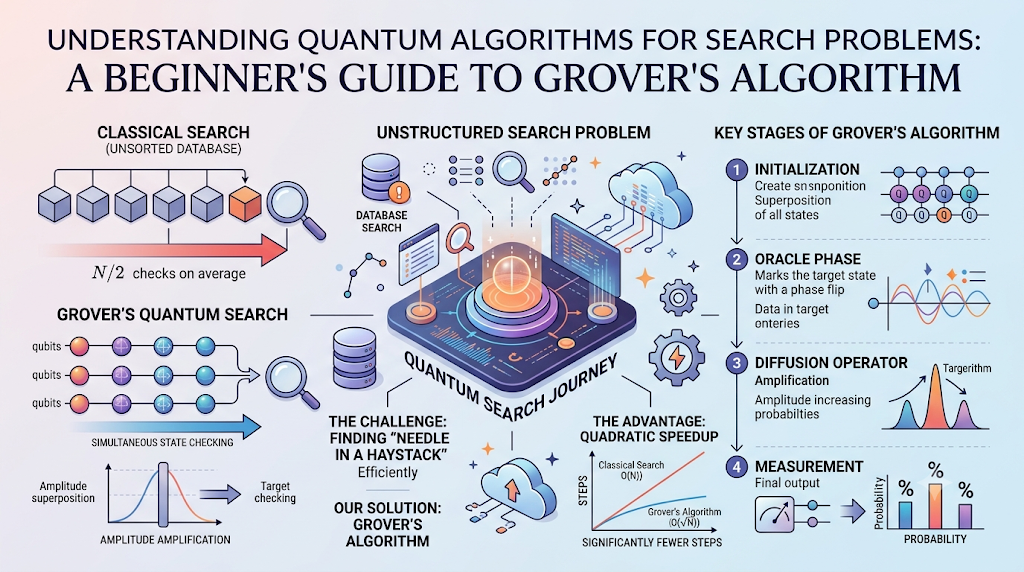
For an unstructured space containing $N$ possibilities, a classical algorithm has no shortcuts. In the worst-case scenario, it must evaluate all $N$ items. On average, it checks roughly $N/2$ items before finding the target. When $N$ grows into billions or trillions of items, linear search becomes computationally demanding.
Unstructured search is precisely the domain where quantum search algorithms provide a theoretical advantage.
What Makes Quantum Search Different?
A common misconception is that a quantum computer simply checks all possible answers at the exact same moment and instantly hands you the correct one. In reality, quantum computing relies on careful wave-like manipulation of quantum states.
Understanding quantum search requires four fundamental building blocks:
Qubits
A classical bit exists strictly as a 0 or a 1. A quantum bit, or qubit, can exist in a linear combination of both states until it is measured. This mathematical state is described using probability amplitudes.
Superposition
When multiple qubits are placed into an equal superposition, the quantum system represents a balanced combination of all possible configurations simultaneously. However, you cannot simply read out all these values. Extracting information requires measurement, which collapses the system.
Quantum Interference
Quantum amplitudes can have positive, negative, or complex values. Just like physical water waves, quantum states can experience constructive interference (where amplitudes reinforce each other) or destructive interference (where amplitudes cancel each other out).
Measurement
Measuring a quantum register forces it to choose a single classical outcome. The probability of measuring any specific outcome is proportional to the square of its amplitude. Quantum search algorithms work by systematically manipulating these amplitudes so that the correct answer has an exceptionally high probability of being measured.
Understanding Grover’s Algorithm
Introduced by Lov Grover in 1996, Grover’s algorithm is the foundational quantum search algorithm for unstructured domains. It solves the search problem in approximately $O(\sqrt{N})$ operations, offering a quadratic speedup over classical linear search.
The execution of Grover’s algorithm follows a structured sequence:
- State Initialization: The quantum register is initialized to a baseline state, typically all zeros ($\vert{}00\dots 0\rangle$).
- Superposition Creation: Hadamard logic gates are applied to every qubit, creating a uniform superposition where every possible state has the exact same probability amplitude.
- The Oracle Call: The quantum oracle acts as a recognition function. It evaluates the states and flips the mathematical sign (phase) of the target state’s amplitude, leaving all incorrect states unchanged.
- The Diffusion Operator (Inversion About the Average): A specialized quantum circuit reflects all amplitudes around their mean value. Because the target state was flipped to a negative value by the oracle, this transformation dramatically boosts the target’s amplitude while reducing the amplitudes of incorrect states.
- Iterative Repetition: Steps 3 and 4 form a single Grover iteration. This sequence is repeated roughly $\frac{\pi}{4}\sqrt{N}$ times.
- Final Measurement: The register is measured, collapsing the state into the target answer with near-certain probability.
How Amplitude Amplification Works
Amplitude amplification is the underlying engine of Grover’s search. Rather than testing items one at a time, it systematically alters the statistical likelihood of observing the correct state upon measurement.
Imagine a sound mixing board with 1,000 sliders. Initially, all sliders are set to a low, equal level. You cannot hear which slider holds your desired sound profile.
First, the oracle reaches in and pulls the single correct slider downward below the baseline (a phase inversion). Next, the diffusion operator calculates the average height of all sliders and flips every slider across that average line.
Because the target slider was pulled far below the average, flipping it across the mean pushes it far above the rest. Meanwhile, all other sliders drop slightly lower. Repeating this process several times amplifies the target state’s amplitude until it towers over the non-target states, making its selection virtually guaranteed when measured.
Classical Search vs. Quantum Search
To put the two computational models into perspective, we must compare their operational constraints:
- Query Complexity: Classical unstructured search requires $O(N)$ operations, whereas quantum search completes in $O(\sqrt{N})$.
- Nature of the Speedup: Grover’s speedup is strictly quadratic, not exponential. While Shor’s algorithm for factoring provides an exponential speedup, Grover’s algorithm provides a polynomial enhancement.
- Algorithmic Approach: Classical computing reads and checks discrete values sequentially. Quantum computing choreographs phase shifts and wave interference across a composite quantum register.
- Sensitivity to Noise: Classical search routines run reliably on standard hardware. Quantum search routines require high gate fidelities and low decoherence rates; environmental noise can destroy the interference pattern before measurement occurs.
Practical Example
Consider an unsorted directory containing $1,000,000$ items ($N = 10^6$).
A classical computer searching for a single unique entry without an index must check items one by one. In the worst case, it executes $1,000,000$ checks. On average, it requires approximately $500,000$ operations.
A quantum computer utilizing Grover’s algorithm calculates the necessary iterations using the square root of the search space:
$$\sqrt{1,000,000} = 1,000$$
Applying the scaling factor ($\frac{\pi}{4} \times 1,000$), the quantum algorithm identifies the target item in approximately $785$ oracle queries.
While this numerical difference is striking on paper, real-world execution requires accounting for the physical runtime of individual quantum gates compared to ultra-fast classical clock cycles.
Applications
While often described as a database search routine, Grover’s algorithm is rarely applied to simple disk-based text databases because loading classical data into quantum states carries significant computational overhead. Instead, it serves as a powerful algorithmic subroutine in mathematical and computational domains:
- Constraint Satisfaction Problems: Accelerating solutions for boolean satisfiability (SAT) and graph coloring where potential solutions can be evaluated algorithmically.
- Optimization Subroutines: Enhancing heuristic algorithms used in logistics, route planning, and financial portfolio optimization.
- Cryptographic Analysis: Assessing the resilience of symmetric encryption keys. For example, AES-128 theoretically provides 64 bits of security against a fully realized quantum attack using Grover’s search, leading modern standards to recommend AES-256.
- Quantum Machine Learning: Speeding up nearest-neighbor searches and pattern classification routines within larger quantum workflows.
Limitations and Challenges
Translating theoretical quantum search into practical utility involves significant technological hurdles:
- Hardware Noise and Decoherence: Physical qubits interact with their external environments, leading to loss of quantum information before long sequences of Grover iterations finish executing.
- Circuit Depth and Gate Errors: As the search space grows, the number of sequential quantum gates increases. Without fault-tolerant quantum error correction, accumulated gate errors degrade search accuracy.
- Oracle Construction Overhead: Building a functional quantum oracle that evaluates candidate solutions in real time is computationally non-trivial and adds substantial gate complexity to the circuit.
- I/O and Data Loading Bottlenecks: Loading large classical datasets into coherent quantum memory (QRAM) remains an open engineering challenge that can negate theoretical speedups.
- Constant Factor Overheads: Classical processors operate at gigahertz clock speeds. If an individual quantum operation is significantly slower than a classical operation, the quadratic advantage only becomes practical for very large problem instances.
Best Practices for Learning Quantum Search Algorithms
For developers, researchers, and students beginning their exploration of quantum algorithms, structured learning yields the best results:
- Master the Classical Basics First: Ensure a firm understanding of time complexity, Big-O notation, and classical search limits.
- Study Single-Qubit and Multi-Qubit Math: Build comfort with state vectors, matrix multiplication, and unitary transformations.
- Understand Phase Inversion: Focus deeply on how quantum gates apply negative signs to probability amplitudes without immediately changing measurement probabilities.
- Trace Small Circuits on Paper: Walk through a 2-qubit (4-state) Grover search manually to see the exact state vector evolution at every step.
- Use Open-Source Quantum Frameworks: Implement 2-qubit and 3-qubit Grover circuits using platforms like Qiskit, Cirq, or Pennylane via local simulators.
- Analyze the Oracle Function: Practice designing simple oracles for known bitstrings before attempting dynamic constraint oracles.
Future Trends
Research into quantum algorithms for search problems continues to mature alongside hardware development:
- Fault-Tolerant Quantum Computing: Progress in logical qubits and surface codes will enable the deep circuit depths required for meaningful Grover iterations.
- Hybrid Quantum-Classical Solvers: Combining classical heuristic algorithms with quantum amplitude amplification subroutines to tackle optimization challenges.
- Algorithmic Optimizations: Development of fractional-query and fixed-point search algorithms that reduce sensitivity to iteration over-rotation.
- Specialized Quantum Hardware: Exploration of hardware architectures tailored specifically for high-connectivity oracle evaluations.
FAQs
- What is a quantum search algorithm?
A quantum search algorithm is a computational procedure that utilizes quantum mechanical principles, such as superposition and interference, to find specific solutions within a search space faster than classical search routines.
- What is Grover’s algorithm?
Grover’s algorithm is a quantum search algorithm developed by Lov Grover in 1996 that provides a quadratic speedup for finding a unique item in an unsorted database or unstructured solution space.
- Does Grover’s algorithm provide an exponential speedup?
No. Grover’s algorithm provides a quadratic speedup ($O(\sqrt{N})$ compared to classical $O(N)$), which is polynomial rather than exponential.
- What is a quantum oracle?
A quantum oracle is a black-box quantum operation that recognizes the target state in a search problem and marks it, typically by flipping its mathematical phase.
- What is amplitude amplification?
Amplitude amplification is the core technique in Grover’s algorithm that repeatedly increases the probability amplitude of the marked target state while suppressing the amplitudes of non-target states.
- Can Grover’s algorithm instantly search the internet or disk databases?
No. Grover’s algorithm requires structured quantum inputs or algorithmically defined search spaces. Loading large classical databases from disks into quantum memory creates bottlenecks that eliminate practical advantages on current architectures.
- Why is the algorithm repeated in iterations?
Repeated iterations gradually rotate the quantum state closer to the target state. Stopping too early or performing too many iterations reduces the probability of measuring the correct answer.
- What happens if you run too many Grover iterations?
Running too many iterations causes over-rotation, where the probability amplitude of the correct answer peaks and then begins to decrease, lowering the chance of a successful measurement.
- Can current quantum computers run large-scale Grover searches?
Current noisy, intermediate-scale quantum (NISQ) systems can only execute Grover’s algorithm on toy problems with a few qubits due to gate errors, noise, and decoherence.
- What is the primary classical counterpart to Grover’s algorithm?
The primary counterpart is classical unstructured linear search, which checks possibilities one by one until the target condition is satisfied.
Conclusion
Quantum algorithms for search problems demonstrate how quantum mechanical phenomena can resolve computational bottlenecks that limit classical hardware. By leveraging superposition, phase inversion, and amplitude amplification, Grover’s algorithm transforms unstructured search from a linear $O(N)$ query process into a quadratic $O(\sqrt{N})$ operation. While hardware noise, circuit depth limits, and data-loading constraints mean that practical, large-scale deployment remains a future milestone, understanding the mechanics of quantum search provides essential insight into the design, logic, and potential of quantum information science.
