Introduction
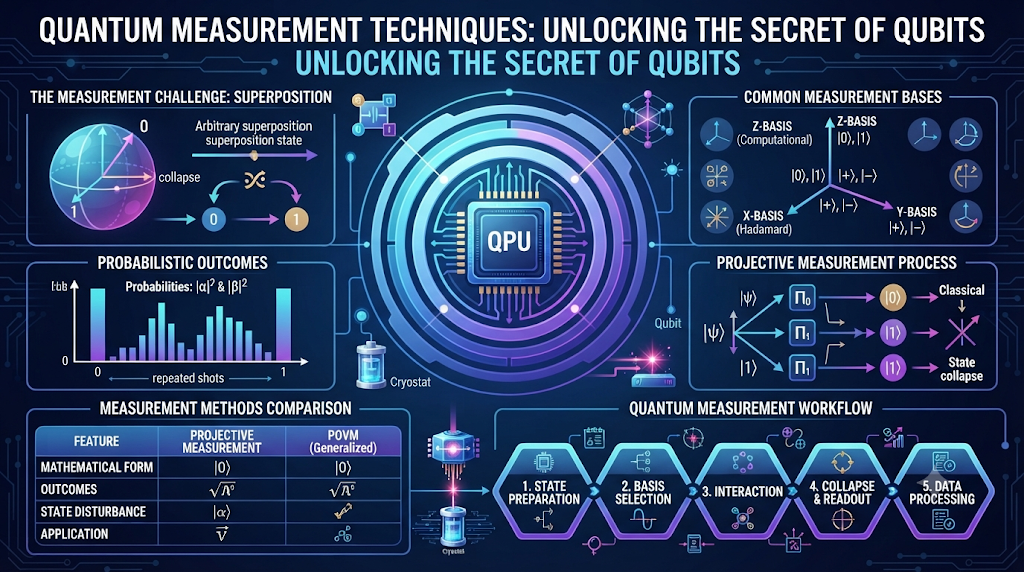
In classical computing, reading data is straightforward because a bit is always a definite 0 or 1 that you can inspect repeatedly without alteration. Quantum computing operates differently, as qubits can exist in a delicate superposition of both states before they are read. This comprehensive Beginner’s Guide to Quantum Measurement Techniques explores how measurement acts as the vital bridge converting quantum information into readable classical data, while noting that the process is inherently probabilistic and actively changes the quantum state. To deepen your foundational knowledge of these workflows, you can explore tutorials and learning resources on QuantumUting.
What Is Quantum Measurement?
At its core, quantum measurement is the process of extracting classical data from a quantum system.
When you perform a quantum measurement, you interact with the qubit using physical equipment. This interaction forces the qubit to abandon its superposition and yield a definite classical outcome—either a 0 or a 1.
- What is being measured: The physical state or property of a qubit, such as its energy level or polarization.
- What an outcome means: A definitive classical value (0 or 1) that you can store in ordinary computer memory.
- Why outcomes are probabilistic: Because superposition states do not store single fixed answers, nature resolves them according to underlying mathematical probabilities.
- Mathematical representation: Measurements can be represented using mathematical operators. For a standard projective measurement, the probability of an outcome is determined by a projection operator acting on the state vector.
Why Measurement Matters in Quantum Computing
Without measurement, a quantum computer would be a closed box. You could perform complex calculations, but you would never be able to read the final answer.
Quantum algorithms follow a specific workflow to turn abstract states into useful information:
- Prepare Qubits (Initialize them in a known baseline state like 0)
- Apply Quantum Gates (Manipulate them into superpositions and entanglements)
- Create Quantum State (The computational working space)
- Measure (Extract classical outcomes)
- Classical Bits (Store 0s and 1s)
- Interpret Results (Analyze histograms and probabilities)
Measurement ensures that the hidden power of quantum circuits translates into concrete, usable data.
Qubit Measurement Basics
To understand how outcomes are determined, we look at the mathematical description of a qubit. A general qubit state is written as:
∣ψ⟩=α∣0⟩+β∣1⟩
- α and beta are complex numbers known as probability amplitudes.
- Their squared magnitudes determine the actual probabilities of seeing each outcome.
- The sum of their squared probabilities always equals 1: ∣α∣2+∣β∣2=1.
For a standard computational-basis measurement:
- Probability of getting 0 = ∣α∣2
- Probability of getting 1 = ∣β∣2
A single measurement gives you only one of these values, never both at once.
Measurement in the Computational Basis
The most common starting point for learners is the computational-basis measurement (often called the Z-basis measurement).
In matrix form, the basis states are:
∣0⟩=[10],∣1⟩=[01]
The corresponding projection operators are:
P0=∣0⟩⟨0∣,P1=∣1⟩⟨1∣
Together, they satisfy the completeness relation:
P0+P1=I
This means that summing all possible projection outcomes gives you the identity matrix, covering all logical possibilities.
Understanding Measurement Probabilities
Let us look at a simple example. Suppose a qubit is in an equal superposition state:
∣ψ⟩=21∣0⟩+2
1∣1⟩
If we calculate the probabilities:
- Probability of 0 = (1/2
)2=1/2=50%
- Probability of 1 = (1/2
)2=1/2=50%
If you perform repeated measurements on this exact state, roughly half your shots will yield 0 and half will yield 1. However, any single individual measurement shot will return only one definitive result.
What Happens to a Qubit After Measurement?
A common misconception is that measurement simply “reads” a pre-existing hidden value. In standard quantum mechanics, the act of measurement actively changes the system. This is known as state collapse or state update.
If a computational-basis measurement yields 0, the post-measurement state becomes ∣0⟩. If it yields 1, it becomes ∣1⟩.
Because the state has now collapsed to a definitive value, measuring that exact same qubit an immediate second time will yield the exact same result with 100% certainty (in an ideal, noiseless scenario).
Measurement in Different Bases
Measurement is not restricted to the computational basis alone. Just as you can view an object from the front, side, or top, you can measure qubits in different directions:
- Z basis: Distinguishes between ∣0⟩ and ∣1⟩.
- X basis: Distinguishes between superposition states like ∣+⟩ and ∣−⟩.
- Y basis: Distinguishes between complex phase states.
For example, the X-basis states are defined as:
∣+⟩=21(∣0⟩+∣1⟩),∣−⟩=2
1(∣0⟩−∣1⟩)
You can perform an X-basis measurement by applying a specific unitary transformation (like a rotation or a gate) to change the basis before running a standard computational measurement.
How the Hadamard Gate Helps With Measurement
Many physical quantum computers only offer direct computational-basis measurements. To measure a qubit in the X basis, engineers use a Hadamard gate (H):
H=21[111−1]
The conceptual workflow is:
- Qubit State
- Hadamard Gate (H)
- Computational-Basis Measurement
Applying a Hadamard gate before measurement rotates the state, effectively turning an X-basis measurement into a standard Z-basis readout. This is an essential practical technique in quantum algorithms.
Projective Measurements
A projective measurement is the standard theoretical model for sharp, ideal quantum measurements. It consists of a set of projection operators {Π0,Π1,…,Πm−1} that sum to the identity:
k∑Πk=I
For a pure quantum state, the probability pk of obtaining a specific outcome k is calculated using the projector:
pk=⟨ψ∣Πk∣ψ⟩
Projective measurements provide a clean, mathematical framework for understanding how quantum states project onto classical outcomes.
Observables and Measurement
In physics, measurable properties—such as position, momentum, or spin—are called observables.
An observable is represented by a Hermitian operator. Measuring an observable corresponds to looking at its eigenvectors and eigenvalues.
- The possible measurement outcomes correspond to the eigenvalues of the operator.
- The state of the system collapses into one of the corresponding eigenvectors upon measurement.
This connects abstract linear algebra directly to physical laboratory results.
Measuring Multiple Qubits
When you work with multiple qubits, measurement applies across the entire joint system. For a two-qubit system, the computational basis outcomes are:
- 00
- 01
- 10
- 11
For n qubits, there are 2n possible computational-basis outcomes. However, a single measurement sweep still returns only one single bit string (e.g., a specific sequence like 10110), not all 2n values simultaneously.
Measurement Shots
Because quantum measurements are probabilistic, running a circuit once is rarely enough. Quantum computing relies on shots—the number of times a circuit is executed from start to finish.
- One shot: Quantum Circuit → One Measurement → One Classical Result (e.g., 0)
- Repeated shots: 1,000 Circuit Executions → 1,000 Measurement Results → Statistical Counts
Running hundreds or thousands of shots allows researchers to build an accurate probability distribution of the algorithm’s output.
Measurement Counts and Histograms
After running multiple shots, the results are typically visualized using a histogram. For example, a two-qubit circuit might yield these counts over 1,000 shots:
- 00→480
- 01→20
- 10→30
- 11→470
To convert these counts into an approximate probability, divide the individual count by the total number of shots:
P(00)≈1000480=0.48
Histograms turn raw hardware data into clear, interpretable probabilities.
Measurement Noise
Real-world quantum hardware is imperfect. Physical devices experience measurement noise, meaning the hardware might occasionally misidentify a physical state during readout (e.g., reading a 1 as a 0).
Key hardware challenges include:
- Readout errors: Misclassifying physical signals.
- Crosstalk: Interference from neighboring qubits during measurement.
- Calibration drift: Hardware parameters shifting over time.
It is important to distinguish between quantum-state evolution errors (errors that happen during gate execution) and readout errors (errors that happen strictly during the final measurement phase).
Readout Error Mitigation
To combat hardware inaccuracies, scientists use measurement error mitigation. This is a post-processing technique rather than full hardware error correction. The workflow involves:
- Characterizing the measurement error rates of the device.
- Building an error matrix model.
- Comparing observed results against expected calibration behaviors.
- Applying a mathematical correction to clean up the final probability distribution.
While mitigation improves accuracy, it does not completely eliminate physical hardware errors.
Generalized Measurements and POVMs
Projective measurements are useful, but they are not the most general form of measurement. Positive Operator-Valued Measures (POVMs) offer a broader framework.
A POVM consists of a set of positive semidefinite operators {Mk} that sum to the identity:
k∑Mk=I
The probability of outcome k for a density matrix state ρ is given by:
pk=Tr(ρMk)
POVMs are essential for distinguishing non-orthogonal quantum states and analyzing complex physical measurements.
Projective Measurement vs POVM
| Feature | Projective Measurement | POVM |
|---|---|---|
| Mathematical objects | Projectors | Positive operators |
| Completeness | Sum to identity | Sum to identity |
| Generality | More restricted | More general |
| Outcomes | Basis/eigenspace based | Flexible outcomes |
| Common use | Standard quantum circuits | General quantum tasks |
| Beginner difficulty | Easier | More advanced |
Projective measurements are simply a special, restricted case of the broader POVM framework.
Weak Measurements
A weak measurement extracts very little information from a qubit, leaving the quantum state largely undisturbed rather than forcing a total collapse.
While weak measurements are valuable in specialized research—such as tracking continuous quantum trajectories—they do not completely bypass disturbance. Extracting information from a quantum system always carries a trade-off with system disruption.
Mid-Circuit Measurement
Traditional quantum circuits measured qubits only at the very end. Mid-circuit measurement allows measurements to happen while the circuit is still running:
Gate→Measurement→Conditional Gate→Measurement
This capability enables dynamic circuits, real-time classical feedback, and advanced quantum error correction protocols where future gate operations depend on earlier measurement outcomes.
Measurement and Classical Control
Measurement serves as the crucial link between quantum hardware and classical computers.
When a quantum measurement produces a classical bit, that bit can trigger a classical decision. For example, if a measurement yields a 1, a classical controller can instantly apply a corrective quantum gate to a separate qubit. This dynamic feedback loop is vital for fault-tolerant quantum computing.
Measurement in Quantum State Tomography
Quantum state tomography is the process of experimentally reconstructing an unknown quantum state.
Because a single measurement basis only reveals one perspective of a state, tomography requires preparing identical states, measuring them across multiple different bases (Z, X, and Y), collecting statistical data, and using classical computing to piece together a complete picture of the quantum state.
Measurement for Expectation Values
Many practical quantum algorithms—such as the Variational Quantum Eigensolver (VQE)—do not require full state reconstruction. Instead, they calculate expectation values of observables:
⟨O⟩=Tr(ρO)
By repeating measurements across specific configurations, algorithms estimate these expectation values to guide classical optimization loops.
Measurement Techniques in Quantum Algorithms
Measurement is integrated into every major quantum algorithm workflow:
- Variational Algorithms (VQE, QAOA): Repeated measurements provide cost function values for classical optimizers.
- Quantum Machine Learning: Readout statistics act as classified outputs or features.
- Quantum Simulation: Measurements sample physical properties of simulated molecules.
Algorithms use statistical outcomes rather than single isolated shots to drive meaningful calculations.
Measurement in Quantum Error Correction
Quantum error correction protects fragile data from environmental noise. Instead of measuring the actual logical data directly (which would destroy the superposition), error correction uses syndrome measurements.
The conceptual cycle involves:
- Prepare Logical State
- Perform Syndrome Measurements (using auxiliary qubits)
- Identify Error Information without destroying data
- Classical Processing/Decoding
- Apply Hardware Correction
This lets systems catch and fix errors on the fly.
Measurement in Quantum Cryptography
In quantum key distribution (QKD), measurement is used to detect eavesdropping. Because quantum states are sensitive to measurement, an interceptor trying to read transmitted photons inevitably alters the quantum state.
Through statistical comparison of measurement bases and outcomes, communicating parties can detect interference and secure their keys.
Hardware Behind Quantum Measurement
Different physical hardware platforms use completely different engineering mechanisms for readout:
- Superconducting qubits: Use microwave resonator readouts coupled to transmission lines.
- Trapped ions: Use laser-induced fluorescence (glowing ions scatter light when in specific states).
- Photonic systems: Use single-photon avalanche detectors (SPADs).
- Neutral atoms: Use high-resolution microscopic imaging of trapped atom arrays.
Despite these physical differences, all platforms ultimately convert physical signals into classical bits.
Measurement Errors on Real Quantum Hardware
| Problem | Possible Effect |
|---|---|
| Readout error | Wrong classical result |
| Calibration drift | Measurement accuracy changes over time |
| Crosstalk | Nearby qubits influence readout signals |
| Noise | Results become statistically less reliable |
| Limited shots | Statistical uncertainty increases |
Because of these factors, real hardware measurements must always be interpreted statistically rather than taken as absolute individual facts.
How Quantum Measurement Techniques Work in a Quantum Circuit
Let us trace a simple quantum circuit:
Plaintext
q ───H─── M ───
         │
c ───────┘
- Start: The qubit begins in the baseline state ∣0⟩.
- Hadamard Gate: Applying H puts the qubit into a clean superposition state.
- Measurement (M): The measurement device interacts with the qubit.
- Classical Result: The output register (c) records either 0 or 1 with equal probability over many runs.
Beginner Example: Measuring a Superposition
Consider a qubit prepared in the equal superposition state:
∣+⟩=21∣0⟩+2
1∣1⟩
- A single measurement shot returns either 0 or 1.
- Running the circuit across 1,000 repeated shots produces an approximately 50/50 distribution.
- Measurement never reveals both classical values simultaneously; it forces a choice.
Beginner Example: Changing the Measurement Basis
Suppose you prepare a qubit in the ∣+⟩ state, but you run a standard Z-basis measurement.
- Because ∣+⟩ is an equal mix of ∣0⟩ and ∣1⟩, you will see a random 50/50 split of 0 and 1 outcomes.
- However, if you apply a Hadamard gate right before the measurement, you rotate the basis. This transforms the measurement into an X-basis check, allowing you to cleanly identify the ∣+⟩ state.
Common Beginner Mistakes
Avoid these frequent pitfalls when studying quantum measurement:
- Thinking measurement reveals the entire multi-qubit quantum state in one glance.
- Assuming superposition means multiple classical answers are directly readable at once.
- Confusing probability amplitudes with actual physical probabilities.
- Forgetting that measurement actively changes the quantum state.
- Treating a single shot as the absolute, true probability distribution.
- Ignoring hardware measurement noise.
- Confusing projective measurements with all possible quantum measurements.
- Assuming POVMs are simply “better” rather than more general.
- Ignoring statistical uncertainty in small sample sizes.
- Assuming quantum simulators and physical hardware behave identically.
Simulator vs Real Hardware Measurement
| Feature | Simulator | Real Hardware |
|---|---|---|
| Noise profile | Idealized or configurable noise | Physical, unideal noise |
| State access | Exact state simulation available | Direct internal state access is limited |
| Statistics | Clean probability generation | Includes hardware imperfections |
| Learning value | Excellent for learning concepts | Necessary for physical validation |
| Debugging | Easier software debugging | Hardware calibration matters greatly |
Simulators are fantastic tools for mastering the theory of quantum measurement without interference from physical errors.
Step-by-Step Learning Roadmap
- Step 1: Understand qubits and superposition basics.
- Step 2: Learn computational-basis measurement.
- Step 3: Understand Born’s rule for probabilities.
- Step 4: Practice running repeated shots and analyzing probability distributions.
- Step 5: Learn X, Y, and Z measurement bases.
- Step 6: Understand projective measurements.
- Step 7: Learn how measurement fits into quantum circuits.
- Step 8: Study measurement noise and hardware limitations.
- Step 9: Learn basic error mitigation techniques.
- Step 10: Advance to POVMs, weak measurements, tomography, and mid-circuit measurement.
Practical Quantum Measurement Checklist
- [ ] I understand what a qubit measurement does.
- [ ] I can calculate basic measurement probabilities from amplitudes.
- [ ] I understand computational-basis measurement.
- [ ] I understand measurement shots and why they matter.
- [ ] I can read and interpret a measurement histogram.
- [ ] I understand X, Y, and Z measurement bases.
- [ ] I know what a projective measurement is.
- [ ] I know what a POVM is at a conceptual level.
- [ ] I understand readout errors.
- [ ] I understand why repeated measurements are necessary.
- [ ] I understand the difference between simulators and real hardware.
How QuantumUting.com Helps Beginners
QuantumUting.com serves as a dedicated educational resource for readers exploring the foundations of quantum computing. Whether you are investigating quantum simulators, building clean quantum circuits, understanding physical hardware constraints, or examining complex quantum algorithms and noise models, clear educational content makes complex topics approachable.
By breaking down technical concepts into manageable guides, readers can build a solid foundation in quantum programming, operations, and measurement theory without unnecessary friction.
Future of Quantum Measurement
The field of quantum measurement is advancing rapidly. Emerging research directions include:
- Faster quantum readout technologies.
- Improved measurement fidelity across physical platforms.
- Advanced mid-circuit measurement capabilities.
- Real-time classical feedback loops for dynamic circuits.
- More efficient error mitigation protocols.
These advancements will continue to narrow the gap between theoretical quantum algorithms and practical, fault-tolerant hardware execution.
Frequently Asked Questions
What is quantum measurement?
Quantum measurement is the physical process of extracting classical data (0 or 1) from a qubit, which forces its superposition state to resolve into a definite outcome.
How does quantum measurement work?
It involves interacting with a qubit using physical hardware sensors, which projects the quantum state onto a specific measurement basis and yields a probabilistic classical result.
What happens when a qubit is measured?
The qubit’s superposition collapses into a definite classical state corresponding to the measurement outcome, meaning subsequent immediate measurements yield consistent results.
What is the computational basis?
The computational basis is the standard reference frame for quantum measurement, consisting of the basic orthogonal states ∣0⟩ and ∣1⟩.
What are X, Y, and Z measurements?
They are measurements performed along different directional axes of the Bloch sphere, allowing observers to extract different properties from the quantum state.
What is a projective measurement?
A projective measurement is an ideal mathematical model where measurement operators project a quantum state onto orthogonal subspaces, satisfying completeness rules.
What is a POVM in quantum computing?
A Positive Operator-Valued Measure (POVM) is a generalized mathematical framework for quantum measurements that extends beyond standard projective measurements.
Why are multiple measurement shots needed?
Because individual quantum measurements are probabilistic, running multiple shots is necessary to build an accurate statistical picture of outcome probabilities.
What is measurement error in quantum computing?
Measurement error occurs when physical hardware incorrectly reads a qubit state, such as misidentifying a 1 as a 0 due to environmental noise or calibration drift.
How can beginners learn quantum measurement techniques?
Beginners can start by studying superposition, computational-basis readouts, Born’s rule, and using quantum simulators to practice building and analyzing measurement circuits.
Conclusion
Quantum measurement remains the essential mechanism connecting delicate quantum states with actionable classical information, driving everything from basic circuits to advanced error correction. By understanding that measurements yield probabilistic outcomes, require repeated shots, and depend on computational or generalized bases, beginners can effectively analyze real-world quantum data. Remembering the core workflow of Prepare $\rightarrow$ Operate $\rightarrow$ Measure $\rightarrow$ Repeat $\rightarrow$ Analyze ensures a solid footing for mastering quantum computing. Continue expanding your technical expertise with further educational guides available directly on QuantumUting.
