Introduction
Imagine building a house out of playing cards on a shaky table during a minor earthquake. Every tiny vibration threatens to bring the whole structure crashing down. This is very close to the daily reality of working with quantum computers. Quantum computing promises to revolutionize fields from medicine to cybersecurity by processing complex data at speeds unimaginable with standard computers. However, these machines are incredibly delicate. The slightest temperature change, stray electromagnetic wave, or minor vibration can corrupt their calculations. To unlock their true potential, scientists rely on a groundbreaking framework called Quantum Error Correction. Without it, the future of advanced computation would crumble under its own sensitivity.
What Is Quantum Error Correction?
Definition
Quantum Error Correction (QEC) is a collection of physics and engineering techniques used to protect quantum information from errors caused by environmental noise and imperfect hardware components.
Purpose
The primary purpose of QEC is to enable fault-tolerant quantum computing. This means creating a system where quantum calculations can run continuously and accurately, even when the underlying physical components occasionally misbehave or fail.
Basic Concept
In everyday life, if you are shouting a message across a noisy room, you might repeat yourself multiple times to make sure the other person understands. QEC operates on a similar principle. It takes a single piece of quantum data and spreads it across a wider, interconnected web of components. If a few parts of that web get corrupted by noise, the system can still figure out the original message by looking at the remaining pieces.
Why It Differs from Classical Error Correction
Standard computers use bits (0s and 1s) to store information. If a bit flips from a 0 to a 1 due to an electrical surge, classical error correction fixes it by keeping simple backups—like storing three copies of the data (000) and using a majority vote if one changes (001).
Quantum computers use qubits, which can exist in a state of 0, 1, or both at the same time (known as superposition). Because of the laws of quantum mechanics, we face two major roadblocks that classical systems don’t have:
- The No-Cloning Theorem: It is physically impossible to make an exact copy of an unknown quantum state. We cannot simply duplicate our qubits to create a backup.
- The Measurement Collapse: Looking directly at a qubit to see if it has an error will destroy its delicate quantum state, erasing the calculation in progress.
Therefore, QEC must detect and fix errors blindly, without ever looking inside the qubits themselves.
Understanding Quantum Errors
To fix a problem, we must first understand what goes wrong. In quantum systems, errors are much more complex than a simple on-off switch flipping.
Bit-Flip Errors
This is the closest relative to a classical error. A bit-flip occurs when a qubit in the $\vert{}0\rangle$ state accidentally flips to the $\vert{}1\rangle$ state, or vice versa.
Phase-Flip Errors
This error is entirely unique to the quantum world. Qubits rely on a property called phase, which describes the mathematical relationship between the 0 and 1 states during a superposition. A phase-flip error reverses this relationship (flipping a plus sign to a minus sign), which completely derails quantum algorithms without ever changing the basic 0 or 1 value.
Decoherence
Think of a spinning top. As long as it spins smoothly, it maintains its balance. If you nudge it, it starts to wobble and eventually falls over. Decoherence is the process where a qubit loses its fragile quantum properties because it interacted with the outside world. It is the ultimate enemy of quantum longevity.
Environmental Noise
Quantum chips must be kept in specialized dilution refrigerators at temperatures colder than deep space. Even the tiniest leak of thermal energy, stray radiation, or stray magnetic fields from nearby Wi-Fi signals constitutes environmental noise that can corrupt quantum circuits.
Measurement-Related Challenges
Reading the final answer out of a quantum computer requires highly sensitive instruments. Sometimes, the hardware reads a 0 when the qubit was actually a 1, or the act of reading the data introduces new errors to neighboring qubits.
Why Quantum Error Correction Is Important
[ Fragile Physical Qubits ] ---> [ Quantum Error Correction ] ---> [ Stable Fault-Tolerant System ]
Reliable Quantum Computation
For a quantum computer to be useful, it must yield the correct answer consistently. QEC bridges the gap between unreliable laboratory hardware and dependable, commercial-grade computation.
Improved Accuracy
By catching and isolating errors in real time, QEC drastically improves the mathematical accuracy of everyday operations performed by quantum gates.
Protecting Quantum Information
Data is valuable. Whether it is a cryptographic key or a molecular simulation, QEC ensures that quantum information remains uncorrupted from the moment a program starts to the moment it finishes.
Long-Running Quantum Algorithms
Complex tasks require millions of sequential computational steps. Without error correction, errors accumulate so quickly that long programs degenerate into meaningless random noise within milliseconds.
Building Scalable Quantum Systems
We cannot simply build larger quantum computers by adding more raw, unprotected qubits. As systems grow, noise increases exponentially. QEC provides the blueprint for scaling up systems safely.
How Quantum Error Correction Works
The execution of QEC can be broken down into a structured, continuous cycle.
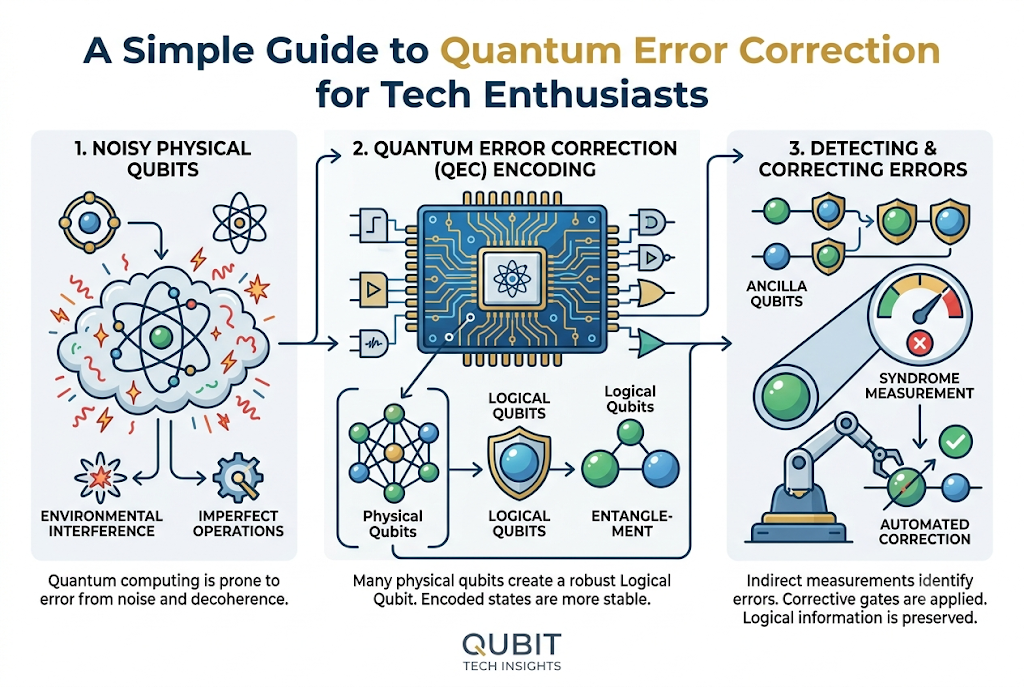
1. Encode (Spread 1 Logical Qubit across many Physical Qubits)
       │
       ▼
2. Monitor (Use Ancilla Qubits to sniff out anomalies silently)
       │
       ▼
3. Measure Syndrome (Identify the specific type and location of error)
       │
       ▼
4. Correct (Apply target Quantum Gates to fix the error instantly)
Step 1: Logical Qubits vs. Physical Qubits
Because we cannot copy quantum data, we distribute the information of one single, highly protected “logical qubit” across an array of multiple, fragile “physical qubits.”
Step 2: Encoding Quantum Information
By tangling the physical qubits together using quantum entanglement, the system creates a collective state. The true data lives in the relationships between the qubits, rather than inside any single one.
Step 3: Detecting Errors (Syndrome Measurements)
To find errors without destroying the data, scientists use helper qubits called ancilla qubits. These ancillas interact briefly with the physical qubits, acting like forensic investigators. They sniff out changes in the system’s patterns and report back with a snapshot called an “error syndrome,” without ever revealing the actual computational data.
Step 4: Correcting Errors
Once the error syndrome points to the exact problem (e.g., “Physical Qubit #4 suffered a bit-flip”), the system automatically applies corrective quantum gates to reverse the damage immediately.
Step 5: Maintaining Quantum States
This cycle repeats thousands of times per second, constantly cleaning the system so that the overarching logical qubit remains perfectly preserved.
6. Types of Quantum Error Correction Codes
Engineers use different strategies, known as error correction codes, to organize physical qubits and protect data.
Bit-Flip Code
The simplest conceptual code. It uses three physical qubits to protect one logical qubit against bit-flips by utilizing basic entanglement patterns. It cannot, however, protect against phase flips.
Phase-Flip Code
A variations of the three-qubit code designed specifically to detect and reverse phase-flip errors by altering the basis of the quantum states.
Shor Code
Invented by Peter Shor, this historic code combines the bit-flip and phase-flip concepts. It uses 9 physical qubits to protect a single logical qubit against any type of single-qubit error, proving to the world that QEC was physically possible.
Steane Code
An elegant upgrade that uses 7 physical qubits. It is a part of the CSS codes family and allows certain quantum operations to be performed much more easily without dismantling the error protection.
Surface Code
The current darling of industrial quantum hardware design. It arranges physical qubits in a two-dimensional grid like a checkerboard. Because it only requires qubits to interact with their immediate neighbors, it is highly practical for real-world microchip manufacturing.
CSS Codes
Named after Calderbank, Shor, and Steane, this broad class of codes cleverly imports the mathematical logic of traditional classical codes directly into the quantum realm.
Key Components of Quantum Error Correction
- Logical Qubits: The reliable virtual qubits that run your actual software programs.
- Physical Qubits: The actual, imperfect physical components (like superconducting loops or trapped ions) on the chip.
- Syndrome Measurements: The diagnostic readouts that tell engineers exactly what kind of error occurred and where it happened.
- Ancilla Qubits: Dedicated assistant qubits used exclusively to collect error data without disturbing the primary calculation.
- Quantum Gates: The operational tools used to manipulate qubits and execute both the primary calculations and the correction fixes.
- Error Detection Circuits: Specialized pathways built within quantum circuits designed to automate the search for system disruptions.
Benefits of Quantum Error Correction
Improved Reliability
It changes quantum computing from an unpredictable physics experiment into a dependable piece of engineering infrastructure.
Better Computational Accuracy
Algorithms can run longer and tackle deeper mathematical problems because the background noise is constantly ironed out.
Scalable Quantum Systems
It provides a predictable pathway to expand chips from hundreds of physical qubits to millions without collapsing under the weight of accumulated errors.
Enhanced Fault Tolerance
Hardware defects no longer mean complete system failure; the software layer can dynamically route around damaged physical components.
Future-Ready Quantum Hardware
It allows hardware manufacturers to focus on scaling up manufacturing grids, knowing that perfect physical perfection isn’t required to achieve perfect results.
Challenges and Limitations
Despite its brilliance, implementing QEC is one of the hardest technical challenges humanity has ever faced.
- High Hardware Requirements: To get one single, clean logical qubit, you might need anywhere from 100 to 10,000 physical qubits working behind the scenes.
- Resource Overhead: A massive amount of a quantum computer’s processing power must be spent solely on self-cleaning, leaving fewer resources for the actual calculation.
- Error Accumulation: If the raw error rate of the physical qubits is too high, the process of checking for errors will actually introduce more noise than it fixes. This tipping point is known as the fault-tolerance threshold.
- Complexity: Designing control electronics that can handle millions of rapid syndrome measurements every second requires unprecedented computing architecture.
Real-World Applications
Once QEC unlocks true fault-tolerant computing, it will supercharge dozens of industries.
Scientific Research & Materials Science
Scientists will be able to simulate the interactions of atoms perfectly, leading to the discovery of lighter structural metals, next-generation solar panels, and highly efficient batteries.
Drug Discovery
Instead of relying on years of trial-and-error laboratory testing, researchers can accurately model complex molecular behaviors on a quantum computer, designing lifesaving targeted medications in days.
Cryptography
Fault-tolerant systems will have the capacity to break traditional encryption models, while simultaneously helping to create unbreakable quantum-encrypted communication networks.
Financial Modeling
Global financial institutions can process massive, interconnected market variables instantly to optimize risk management and build hyper-accurate economic forecasts.
Optimization & Artificial Intelligence
From solving global shipping logistics routes to training massive neural networks with unmatched efficiency, quantum computing will redefine computer science limits.
Future Trends
As we look toward the horizon of the late 2020s and beyond, the roadmap for QEC is accelerating rapidly.
- Hardware-Efficient Codes: Researchers are finding new mathematical ways to lower the ratio of physical-to-logical qubits, aiming to need dozens of physical qubits per logical unit instead of thousands.
- AI-Assisted Decoding: Artificial intelligence models are being integrated into the control systems to read error syndromes and calculate corrective actions in real time.
- Commercial Quantum Processors: Tech giants are actively shipping chips with built-in, automated hardware error tracking layers, moving us closer to commercially viable systems.
Best Practices for Learning Quantum Error Correction
If you want to dive deeper into this fascinating field, here are a few tips to get started:
- Start with Classical Linear Algebra: Quantum computing is written in the language of vectors and matrices. Understanding basic matrix multiplication makes QEC codes infinitely easier to comprehend.
- Use Visual Simulators: Platforms like IBM Quantum Composer or open-source Python libraries like Qiskit allow you to build, test, and break simple error-correcting circuits visually.
- Focus on the Three-Qubit Code First: Do not jump straight to advanced surface codes. Master how the basic bit-flip code works mathematically before moving forward.
- Read Open-Source Tutorials: Websites like Qiskit Textbook or the Quantum Computing Stack Exchange offer fantastic, beginner-friendly community deep dives.
Comparison Tables
Types of Quantum Error Correction Codes
| Error Correction Code | Purpose | Advantages | Limitations | Common Use Cases |
| Bit-Flip Code | Detects simple 0-to-1 flips | Simple to learn; requires only 3 physical qubits | Cannot detect phase changes | Educational demonstrations |
| Shor Code | Protects against all single-qubit errors | Historically proved QEC is completely possible | High overhead (9 physical qubits per 1 logical) | Foundational theory studies |
| Steane Code | Fixes arbitrary phase and bit errors | Works beautifully with specific, common quantum gates | Requires complex structural alignment | Advanced algorithm research |
| Surface Code | Protects large physical grids | Requires only nearest-neighbor qubit connections | Requires a massive total number of physical qubits | Modern commercial hardware layout |
Classical Error Correction vs. Quantum Error Correction
| Feature | Classical Error Correction | Quantum Error Correction | Key Difference |
| Basic Unit | Bits (0 or 1) | Qubits (0, 1, or Superposition) | Quantum systems process infinitely more complex data states. |
| Cloning Ability | Allowed (Can make infinite copies) | Forbidden (No-Cloning Theorem) | Classical systems duplicate data for safety; quantum systems cannot. |
| Error Types | Bit-flips only | Bit-flips, Phase-flips, and Decoherence | Quantum errors occur in multiple mathematical dimensions simultaneously. |
| Detection Method | Direct checking of values | Indirect measurement (Syndrome checks) | Looking at a qubit destroys its data; looking at a bit is perfectly safe. |
FAQs
Q: Can we just build perfect quantum hardware that doesn’t make errors?
A: Realistically, no. The laws of physics dictate that subatomic particles will always interact with their surrounding environment to some degree. While hardware quality improves every year, error correction software will always be necessary to achieve true computational perfection.
Q: What is the difference between a physical qubit and a logical qubit?
A: A physical qubit is a single, real-world component on a quantum chip (like an atom or a superconducting loop) that is highly prone to noise. A logical qubit is a reliable, virtual qubit made by linking many physical qubits together through error correction codes.
Q: Does measuring an error destroy the entire quantum calculation?
A: Not if it is done correctly. Standard measurements do destroy data, but Quantum Error Correction uses specialized “syndrome measurements” via ancilla qubits. This allows the system to see where the faults are without looking at the actual calculation data.
Q: What is the No-Cloning Theorem?
A: It is a fundamental law of quantum mechanics stating that it is physically impossible to create an identical, independent copy of an unknown quantum state. This means quantum computers cannot use simple copy-and-paste backup systems to prevent data loss.
Q: How many physical qubits are needed to make one logical qubit?
A: It depends on the code and the quality of the hardware. Currently, it can take anywhere from 100 to tens of thousands of physical qubits to create a single, perfectly stable logical qubit, though scientists are actively working to lower this number.
Q: What exactly is decoherence?
A: Decoherence is what happens when a qubit accidentally interacts with the outside world (like a microscopic change in temperature). This interaction causes it to lose its quantum properties (superposition and entanglement) and revert to a standard, non-quantum state.
Q: What is a phase-flip error?
A: A phase-flip error is a uniquely quantum glitch where the mathematical relationship between the 0 and 1 states in a superposition gets reversed. The basic value doesn’t change, but the altered alignment ruins the math of the algorithm.
Q: What is fault-tolerant quantum computing?
A: It is a state of computing where a quantum machine can successfully complete long, complex calculations even if its physical components experience continuous errors behind the scenes, thanks to active error correction layers.
Q: Is quantum error correction implemented in hardware or software?
A: It is an active combination of both. It requires specialized hardware layouts (like grid arrangements on a chip) working alongside complex algorithmic software layers that interpret error readouts instantly.
Q: Why is the Surface Code so popular in modern research?
A: The surface code is popular because it organizes qubits on a simple, flat 2D grid and only requires physical qubits to interact with their immediate neighbors. This makes it much easier to build using modern microchip manufacturing techniques.
Conclusion
Quantum computing holds the key to solving some of humanity’s most complex challenges, but its power is tethered to an extreme vulnerability to noise. Quantum Error Correction serves as the vital bridge overcoming this hurdle. By ingeniously routing around the laws of quantum mechanics to clean data without destroying it, QEC transforms erratic physical components into ultra-reliable computational systems. As researchers continue to refine these codes and lower hardware overhead, we move closer every day to a future defined by stable, scalable, and genuinely transformative fault-tolerant quantum computing.
