Introduction
The global landscape of healthcare is shifting rapidly. In many Western countries, the rising cost of medical care, prolonged waiting lists, and strict insurance limitations leave thousands of families searching for alternative options. When serious medical conditions arise, finding immediate, affordable, and high-quality treatment becomes an urgent priority. For an international patient, traveling to an unfamiliar country for complex surgery can feel overwhelming. Balancing clinical quality, surgeon expertise, and financial planning requires clear, accurate data. For instance, consider a patient from the United States or the United Kingdom who is told they need a major orthopedic or cardiac procedure. Facing a bill of tens of thousands of dollars out-of-pocket—or an agonizing multi-month wait—they begin comparing treatment costs and clinical standards internationally. By analyzing accredited institutions, verifying specialist credentials, and utilizing transparent healthcare research platforms like MyMedicPlus, patients can confidently bridge the gap between financial practicality and exceptional medical care.
What Is Medical Tourism in India?
Medical tourism in India refers to international patients traveling to India to access world-class clinical treatments, surgeries, and specialized medical care. This growing ecosystem combines internationally accredited hospitals, highly skilled English-speaking specialists, and cutting-edge medical technology at a fraction of the cost found in Western nations.
Understanding Medical Tourism in India
What Is Medical Tourism?
Medical tourism is the practice of traveling outside one’s home country to receive medical, dental, or surgical care. Historically, individuals traveled from developing nations to major Western medical centers. Today, that flow has reversed. Patients from highly developed economies regularly travel to global medical hubs to access premium care without the prohibitive price tags or long administrative delays.
Why India Has Become a Leading Medical Tourism Destination
India’s rise to the top tier of global healthcare delivery is built on sustained capital investment, rigorous academic training, and international quality frameworks. Major urban centers like New Delhi, Mumbai, Bengaluru, Chennai, and Hyderabad house expansive medical campuses designed specifically to cater to international clinical standards.
Growth of International Patient Care
Every year, hundreds of thousands of international patients from North America, Europe, the Middle East, Africa, and neighboring Asian countries enter India. The country’s medical infrastructure has adapted dynamically, establishing dedicated international patient divisions that handle everything from visa invitations to cross-border continuity of care.
Key Advantages of Seeking Treatment in India
To understand why India is consistently chosen over other destinations, it helps to look at a direct structural comparison.
| Factor | India | Typical High-Cost Healthcare Destinations |
| Average Surgery Costs | $70\%$ to $80\%$ lower than Western averages | Extremely high out-of-pocket costs or high insurance premiums |
| Waiting Times | Near-zero wait times for major elective surgeries | Weeks, months, or even years under public health systems |
| Hospital Accreditation | Hundreds of JCI and NABH accredited facilities | High standards, but heavily burdened by operational volume |
| Language & Accessibility | Universal English fluency among clinical and support staff | Variable; complex medical jargon can present a barrier |
Special Patient Education Framework
- In Simple Terms: Medical tourism in India means traveling to access top-tier doctors and modern hospitals for major operations without draining your life savings or waiting months in pain.
- Real-World Example: An independent contractor in Canada needs an intricate spinal fusion. The public waitlist is fourteen months, during which they cannot work. By choosing to travel, they book the surgery in India within two weeks, returning home fully recovered in a fraction of the time.
- Why It Matters: Time-sensitive medical conditions do not wait. Quick access to affordable care preserves long-term quality of life and prevents preventable clinical deterioration.
- Key Takeaways:
- India integrates premium clinical quality with profound cost efficiencies.
- Near-immediate scheduling eliminates dangerous clinical delays.
- Comprehensive international patient desks make cross-border transitions predictable.
Why International Patients Choose India
Cost Advantages
The primary driver for medical travel is economic viability. Because of lower structural operating costs, favorable currency exchange rates, and localized manufacturing of pharmaceuticals and medical implants, Indian hospitals offer complex surgeries at an incredibly lower price point. This financial relief allows uninsured or underinsured patients to access premium care safely.
Highly Qualified Specialists
Indian doctors are recognized globally for their clinical precision. A vast majority of senior consultants and department heads have completed fellowships, residences, or advanced degrees in the United States, the United Kingdom, or Europe. Furthermore, due to the high population density, Indian surgeons manage an immense volume of cases, gaining unparalleled practical experience in highly complex clinical scenarios.
Advanced Medical Technology
Indian hospitals utilize top-tier diagnostic and surgical infrastructure. Patients have access to CyberKnife robotic radiosurgery, DaVinci robotic surgical suites, proton beam therapy, advanced dual-source CT scanners, and highly sophisticated hybrid cardiac catheterization laboratories.
English-Speaking Healthcare Environment
Language barriers add immense stress to a medical journey. In India, English is the primary language of instruction in medical schools and the universal language of communication across all major hospital networks. This ensures direct, clear, and comforting dialogue between the patient, the family, and the clinical team.
Wide Range of Treatment Options
From complex multi-vessel heart bypass surgeries and living-donor liver transplants to advanced oncology protocols and total joint replacements, India’s medical ecosystem covers the entire spectrum of modern medicine.
Best Hospitals in India for International Patients
What Makes a Hospital Suitable for International Patients?
Not every hospital is equipped to manage the logistical and emotional needs of an international traveler. The best hospitals in India for international patients operate like self-contained ecosystems, offering end-to-end support alongside clinical intervention.
[International Patient Entry]
       │
       ▼
[Dedicated Case Manager Assigned]
       │
       ▼
[Pre-Surgical Testing & Specialist Consult]
       │
       ▼
[Clinical Intervention / Surgery]
       │
       ▼
[In-Hospital Rehab & Recovery]
       │
       ▼
[Discharge & Remote Follow-Up Planning]
Accreditation Standards
When evaluating options, international accreditations provide an objective measure of safety.
- Joint Commission International (JCI): The gold standard for global healthcare auditing, ensuring strict compliance with patient safety goals, infection control, and clinical protocols.
- National Accreditation Board for Hospitals & Healthcare Providers (NABH): The premier Indian accrediting body, establishing rigorous quality benchmarks across clinical outcomes and operational systems.
International Patient Departments (IPD)
Top-tier facilities house specialized IPD teams. These professionals manage administrative and personal details, including:
- Processing medical visa invitation letters.
- Organizing complimentary airport pick-ups and local transport.
- Coordinating multi-currency billing, insurance clearance, and wire transfers.
- Arranging certified in-hospital language interpreters for non-English speakers.
Specialist Availability, Technology, and Infrastructure
Premium hospitals feature dedicated centers of excellence (e.g., a dedicated Heart Institute or Orthopedic Center). This ensures that structural assets, dedicated intensive care units (ICUs), and highly specialized nursing staff are clustered together to maximize patient safety and recovery speed.
Hospital Evaluation Checklist for International Families
- Does the facility hold an active JCI or premium NABH accreditation?
- Is there a dedicated, single-point-of-contact International Patient Desk?
- Are the senior operating surgeons board-certified with international fellowships?
- Does the hospital provide clear, transparent, all-inclusive pre-cost quotes?
- Are there integrated rehabilitation facilities on-site for post-operative recovery?
- What are the specific protocols for emergency readmissions or step-down care?
Treatment Cost in India Explained
Why Treatment Costs Vary
When reviewing a medical quote, it is vital to know that the final cost of care is dynamic. It is influenced by your specific health profile, medical history, and choices regarding your hospital stay.
Factors Affecting Medical Expenses
- Room Category: Options range from shared twin-sharing rooms to private deluxe suites and executive apartments.
- Co-morbidities: Pre-existing conditions such as advanced diabetes, chronic kidney disease, or hypertension require additional specialist consultations, extended ICU stays, or custom medication adjustments.
- Implants and Consumables: Choosing a premium, internationally imported FDA-approved implant (like a specific titanium joint or drug-eluting cardiac stent) impacts the base cost.
- Geographic Location: Hospitals situated in tier-1 metropolitan cities (such as Mumbai or Delhi) may have slightly higher operational overheads compared to tier-2 healthcare hubs.
| Cost Factor | Impact on Treatment Cost | Patient Strategy |
| Implant Selection | High impact on long-term outcomes and initial cost | Request explicit details on implant origin and FDA approval status. |
| Room Selection | Moderate day-to-day impact on the total bill | Balance the need for family privacy with your financial parameters. |
| ICU Days Required | Significant escalations based on clinical necessity | Confirm if the initial package includes standard post-op ICU days. |
| Pre-Op Testing | Low to moderate cost impact | Compile and share up-to-date medical records early to minimize repeated diagnostics. |
Knee Replacement Surgery Cost in India
Understanding Knee Replacement Procedures
Total Knee Replacement (TKR) involves resurfacing a severely damaged, arthritic knee joint with biocompatible artificial components. For individuals suffering from advanced osteoarthritis, this surgery restores mobility and provides relief from chronic pain.
Cost Factors
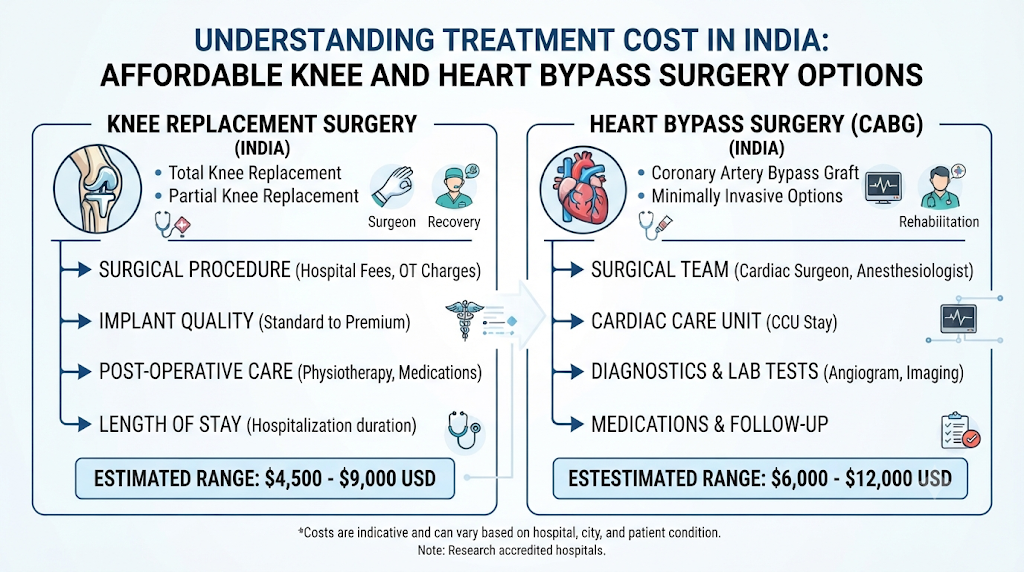
The total knee replacement surgery cost in India is remarkably lower than in Western countries. While a single knee replacement can easily exceed $30,000 to $40,000 in the United States, the equivalent procedure in an elite JCI-accredited Indian hospital generally ranges between $4,000 and $7,000. This estimate usually includes the cost of the high-grade implant, surgeon fees, operating room charges, and standard physical therapy.
Hospital Selection Considerations
When addressing severe orthopedic issues, look for hospitals that feature advanced computer-assisted navigation systems or robotic-arm assisted surgery. These technologies enhance implant alignment precision, potentially extending the lifespan of the artificial joint.
Recovery and Rehabilitation Planning
Orthopedic success depends heavily on post-operative physical therapy. Indian hospitals integrate daily physiotherapy sessions right into the recovery package. This ensures that before you board a flight back home, you have achieved safe, functional mobility.
Special Patient Education Framework
- In Simple Terms: Knee replacement surgery removes worn-out bone in your knee and replaces it with a smooth, durable artificial joint, letting you walk without pain.
- Real-World Example: A 62-year-old retired teacher from the UK faces severe knee degradation. Unable to climb stairs and looking at a long waiting list under local care, they travel to India. They receive a premium, FDA-approved knee implant, undergo one week of intensive daily inpatient physical therapy, and fly home walking comfortably.
- Why It Matters: Prolonged immobility ruins overall physical health, often accelerating cardiovascular decline and muscle wasting. Restoring motion early preserves long-term vitality.
- Key Takeaways:
- The cost of a knee replacement in India is a small fraction of Western costs.
- Specialized computer navigation helps optimize surgical precision.
- Structured physical rehabilitation is vital for securing long-term mobility.
Heart Bypass Surgery Cost in India
Understanding Cardiac Surgery
Coronary Artery Bypass Grafting (CABG), commonly referred to as heart bypass surgery, restores normal blood flow to the heart muscle when obstructions choke critical coronary arteries. This highly intricate procedure requires an expert surgical team, advanced cardiopulmonary support, and rigorous post-operative ICU care.
Cost Components
The heart bypass surgery cost in India typically ranges from $5,500 to $9,000, depending on the complexity of the case (such as a double, triple, or quadruple bypass) and whether it is performed as an “off-pump” (beating heart) or traditional “on-pump” procedure. In sharp contrast, the identical surgery in Western medical centers can easily exceed $100,000. The Indian package usually covers the specialized cardiac operating theater, perfusionist fees, essential ICU monitoring, and foundational cardiac rehabilitation.
Choosing Cardiac Specialists
Given the critical nature of open-heart surgery, patients should prioritize dedicated cardiac institutes that perform thousands of bypass operations annually. Look for senior cardiothoracic surgeons who have a proven track record of managing high-risk cases with excellent survival rates.
Recovery and Follow-Up Care
Following a major bypass, patients spend several days in a dedicated Cardiac ICU before stepping down to a standard ward. The total hospital stay typically spans 7 to 10 days, followed by an additional week of local recovery at a nearby hotel to confirm healing before travel.
Special Patient Education Framework
- In Simple Terms: Heart bypass surgery creates a new pathway around blocked arteries, restoring rich blood flow to your heart and significantly lowering the risk of a heart attack.
- Real-World Example: An uninsured 55-year-old small business owner in the United States experiences severe, unstable angina. Facing a $120,000 medical estimate locally, they coordinate a trip to a top cardiac institute in India through a clear, upfront care plan. The surgery goes smoothly, and they return home with a healthy heart without facing financial ruin.
- Why It Matters: Major arterial blockages require swift medical intervention. Financial barriers should not force a patient to delay life-saving cardiac care.
- Key Takeaways:
- India offers exceptionally cost-effective options for complex open-heart surgery.
- Top-tier facilities utilize advanced “off-pump” beating-heart techniques to ease recovery.
- Built-in cardiac rehabilitation ensures a safer transition back to daily life.
Comparing India with Other Medical Tourism Destinations
While India is an exceptional healthcare destination, patients frequently evaluate it alongside options like Thailand, Turkey, Singapore, or the UAE. Here is how India compares across core medical travel metrics:
| Destination | Cost Advantage | Treatment Availability | International Patient Support |
| India | Highest savings ($70\% – 80\%$) | Complete range, specialized in complex tertiary surgeries | Highly structured, dedicated IPD units across major cities |
| Thailand | Moderate to high savings ($50\% – 60\%$) | Exceptional cosmetic, dental, and elective treatments | Excellent hospitality and resort-style recovery environments |
| Turkey | Moderate savings ($40\% – 50\%$) | Renowned for hair transplants, aesthetics, and orthopedics | Good European connectivity, but can present language barriers outside major centers |
| Singapore | Minimal savings ($10\% – 20\%$) | Elite niche therapies and specialized oncology protocols | High-end infrastructure, but carries a premium price point |
| UAE | Minimal to no cost savings | Rising regional hub for standard elective care | Luxury patient support services, though operating costs remain high |
How to Choose the Right Hospital
Evaluate Accreditation
Never compromise on foundational quality standards. Focus your research exclusively on hospitals holding valid JCI and advanced NABH certificates. These recognitions ensure the facility adheres to international safety protocols.
Review Specialist Experience
Look beyond the hospital brand and research your specific operating surgeon. Review their professional history, international board certifications, and clinical focus areas.
Compare Treatment Costs
Always request a comprehensive, line-by-item financial quotation. Ensure the estimate explicitly states what is covered (such as surgeon fees, accommodation, implants) and outlines potential extra fees for extended ICU stays or unexpected complications.
Understand Support Services
Confirm that the hospital has a dedicated international patient team. A responsive, empathetic coordinator makes a world of difference when managing foreign logistics.
[Hospital Selection Matrix]
├── Clinical Quality (JCI / NABH Accreditations)
├── Surgeon Profile (International Fellowships, Success Rates)
├── Financial Clarity (All-Inclusive, Transparent Package Quotes)
└── Practical Logistics (Dedicated IPD Team, Interpreter Services)
How to Choose the Right Doctor
Selecting your primary physician is a highly personal and critical decision. Use this structured approach to evaluate specialists:
Qualifications and Credentials
Verify that the specialist holds advanced medical degrees (e.g., MS, MCh, or international equivalents like FRCS or American Board Certifications) relevant to your condition.
Experience in Specific Procedures
Ask clear, direct questions: How many procedures of this exact type do you perform every year? What are the documented success and complication rates within your department?
Communication Skills and Treatment Philosophy
A great doctor explains complex medical realities in straightforward, reassuring language. Schedule a preliminary video consultation to assess their communication style and ensure you feel comfortable with their approach before making travel arrangements.
Doctor Evaluation Checklist
- Does the physician hold verified, advanced post-graduate specialization degrees?
- Has the doctor practiced or completed specialized fellowships at recognized international medical institutions?
- Can the provider share clear, anonymized data regarding long-term surgical success rates?
- Is the doctor available for a pre-travel video consultation to map out your treatment path?
- Does the physician communicate clearly in your preferred language without relying on complex jargon?
Planning Your Medical Journey
A successful medical trip requires systematic planning. This structured roadmap details each step from your initial inquiry to your final recovery:
[Phase 1: Research] ──► [Phase 2: Consultation] ──► [Phase 3: Coordination]
                             Medical Records           Visa & Travel
                             Shared Remote             Bookings Confirmed
                                                              │
                                                              ▼
[Phase 6: Continuity] ◄── [Phase 5: Treatment] ◄── [Phase 4: Arrival]
   Remote Follow-up         Surgery & In-Hospital     Airport Pickup &
   with Local Doctor        Rehabilitation            Clinical Admission
- Initial Research: Gather your complete medical history, imaging scans, and current prescriptions.
- Treatment Consultation: Share your diagnostic files with your chosen international hospital team to receive a preliminary treatment plan and an all-inclusive cost estimate.
- Travel Preparation: Secure a dedicated Medical Visa (MED Visa), arrange flights that accommodate medical passengers, and coordinate local lodging for any traveling companions.
- Treatment and Recovery: Arrive at the hospital, complete pre-operative evaluations, undergo your procedure, and follow the structured inpatient recovery plan.
- Follow-Up Care: Obtain comprehensive discharge summaries, prescriptions, and imaging reports. Establish a clear remote connection between your Indian specialist and your primary care physician back home.
How MyMedicPlus Helps Patients
Navigating an international medical journey independently can feel daunting. This is where MyMedicPlus serves as an essential resource for families. As an independent, patient-first research and discovery platform, MyMedicPlus streamlines the entire evaluation process.
Hospital Discovery and Treatment Research
The platform compiles comprehensive data on leading accredited hospitals across India, allowing patients to compare world-class institutions side by side. Instead of navigating dozens of confusing individual websites, users access organized insights regarding hospital infrastructure, clinical specialties, and international patient amenities.
Cost Awareness and Transparency
MyMedicPlus stands against hidden fees. The platform provides clear information on treatment costs in India, helping families understand baseline costs for procedures like knee replacements or heart bypass surgeries. This level of cost awareness ensures families can budget confidently without worrying about unexpected charges.
Empowering Independent Decisions
MyMedicPlus operates as a neutral informational resource, not a rigid gatekeeper. By offering transparent access to verified hospital credentials, specialist track records, and clear cost breakdowns, the platform gives patients the tools they need to make informed healthcare choices.
Real-World Patient Scenarios
Scenario 1: International Patient Seeking Knee Replacement
- Challenge: A 65-year-old retired civil servant from East Africa suffers from severe bilateral knee arthritis. They rely heavily on a wheelchair, but local advanced joint replacement options are limited and cost-prohibitive.
- Research Process: The family utilizes online resources to compare accredited orthopedic departments in India, focusing on JCI credentials and package clarity.
- Decision Factors: They select a specialized joint replacement institute in Chennai that offers robotic-assisted total knee replacement at an all-inclusive package price.
- Outcome: The surgery is highly successful. Following ten days of intensive, hands-on physical therapy, the patient returns home walking with minimal assistance, completely reclaiming their physical independence.
Scenario 2: Cardiac Surgery Patient
- Challenge: A 48-year-old expatriate living in the Middle East is diagnosed with triple-vessel coronary artery disease. Their local insurance policy excludes pre-existing cardiac conditions, leaving them facing an unmanageable out-of-pocket financial burden.
- Research Process: The patient researches elite cardiac care centers in Mumbai and New Delhi, focusing on senior surgeons with extensive experience in beating-heart bypass surgeries.
- Decision Factors: They choose a prominent heart institute based on its verified low complication rates and clear, comprehensive billing structure.
- Outcome: The patient undergoes a smooth, off-pump coronary bypass surgery. After a disciplined nine-day hospital stay and a brief outpatient review period, they return safely to work with restored cardiac function.
Common Mistakes Patients Make
Avoid these frequent pitfalls to ensure your international medical journey is smooth and secure:
- Choosing Based Only on Price: Selecting a facility solely because it offers the lowest bid can compromise safety. Always balance cost considerations with verified hospital accreditations and surgeon experience.
- Ignoring Hospital Quality and Accreditations: Opting for unaccredited neighborhood clinics increases the risk of infection and clinical complications. Stick to JCI or advanced NABH accredited institutions.
- Not Understanding the Full Scope of Costs: Patients sometimes look only at the base surgical fee, overlooking auxiliary expenses like local accommodation, extended ICU days, medications, or travel insurance.
- Skipping Post-Operative Follow-Up Planning: Healing continues long after you leave the operating room. Ensure you have a clear plan for local physical therapy or remote check-ins with your surgeon once you return home.
Medical Tourism Planning Checklist
Before Choosing a Hospital
- Confirm the facility holds active JCI or premium NABH quality accreditations.
- Ensure the hospital has extensive experience managing international cases.
- Verify that the facility features a dedicated, single-point-of-contact International Patient Desk.
Before Choosing a Doctor
- Research the surgeon’s specific credentials, board certifications, and fellowships.
- Confirm how often the specialist performs your exact procedure each year.
- Schedule an initial video consultation to discuss your treatment plan and expectations.
Before Traveling
- Secure a valid Medical Visa (MED Visa) for yourself and any travel companions.
- Gather all physical and digital copies of your medical reports, scans, and prescriptions.
- Obtain a comprehensive, written financial quote detailing what is included in your package.
Future of Medical Tourism in India
The landscape of international patient care in India is evolving rapidly, driven by technological innovation and a deep commitment to patient safety:
- Digital Healthcare Platforms: Advanced online portals allow international patients to easily compare hospital packages, read verified reviews, and securely transmit medical files across borders.
- AI-Assisted Healthcare Research: Artificial intelligence tools help match a patient’s specific health profile with the most suitable specialists and institutions, streamlining the early research phases.
- Enhanced Telemedicine Networks: Virtual consultations are becoming a standard part of care, enabling seamless pre-travel planning and comprehensive post-operative follow-ups from the comfort of home.
- Greater Cost Transparency: Driven by forward-thinking platforms and international demand, Indian hospitals are moving toward highly standardized, all-inclusive pricing models that eliminate financial surprises.
FAQ Section
What is medical tourism in India?
Medical tourism in India involves international patients traveling to the country to receive high-quality medical, surgical, or dental treatments. This thriving ecosystem blends advanced hospital networks, globally trained specialists, and cutting-edge technology with remarkable cost efficiencies, making it a top choice for patients worldwide.
Why do international patients choose India?
International patients choose India because it offers a rare combination of world-class healthcare and affordability. The country features numerous JCI-accredited hospitals, highly experienced English-speaking doctors, near-zero waiting times for critical surgeries, and treatment costs that are typically $70\%$ to $80\%$ lower than in Western nations.
How much does treatment cost in India?
The total cost of treatment in India varies based on the specific procedure, hospital choice, room category, and the patient’s overall health profile. However, across almost all major medical specialties—including orthopedics, cardiology, oncology, and neurosurgery—costs remain significantly more affordable than equivalent care in the US, UK, or Europe.
What is the knee replacement surgery cost in India?
The total knee replacement surgery cost in India generally ranges from $4,000 to $7,000 for a single knee. This comprehensive package typically includes a premium, internationally approved implant, surgeon fees, operating room charges, standard hospital stay, and initial physical therapy sessions.
What is the heart bypass surgery cost in India?
The heart bypass surgery cost in India generally falls between $5,500 and $9,000. The final figure depends on the complexity of the blockages, the number of grafts required, and whether the procedure is performed using an off-pump or traditional on-pump technique.
How do I choose the best hospital in India?
To find the right hospital, focus on facilities that hold valid JCI or advanced NABH accreditations. Additionally, look into the reputation of their specialist teams, the availability of advanced medical technology, and the responsiveness of their dedicated international patient support desk.
How can I compare treatment costs?
You can compare treatment costs by requesting clear, all-inclusive financial quotes from multiple accredited institutions. Ensure each estimate details the costs for surgeon fees, room accommodation, necessary implants, medications, and potential extra charges for extended ICU care.
Is India safe for medical tourism?
Yes, India is a safe and highly reliable destination for medical travel, provided patients choose established, accredited hospitals. Top-tier medical centers follow strict international safety guidelines, infection control protocols, and patient care standards to ensure excellent clinical outcomes.
How does MyMedicPlus help patients?
MyMedicPlus serves as an independent, patient-first discovery and informational platform. It provides clear, organized details on top accredited hospitals, treatment choices, and medical costs across India, helping families research options and make healthcare decisions with confidence.
What should I consider before traveling for treatment?
Before finalizing your travel plans, ensure you have secured a valid Medical Visa and obtained a detailed, written financial estimate from your hospital. It is also important to compile all your diagnostic records and arrange for a local doctor back home to handle your post-operative follow-up care.
Final Summary
Medical tourism in India provides a vital solution for families facing high healthcare costs or long waiting lists in their home countries. By combining internationally accredited hospitals, highly skilled specialists, and state-of-the-art technology, India delivers world-class clinical outcomes at a fraction of the cost found in Western nations. Whether you are researching a total knee replacement or complex heart bypass surgery, navigating this journey successfully requires focusing on accredited institutions, verifying doctor credentials, and maintaining absolute cost transparency.
