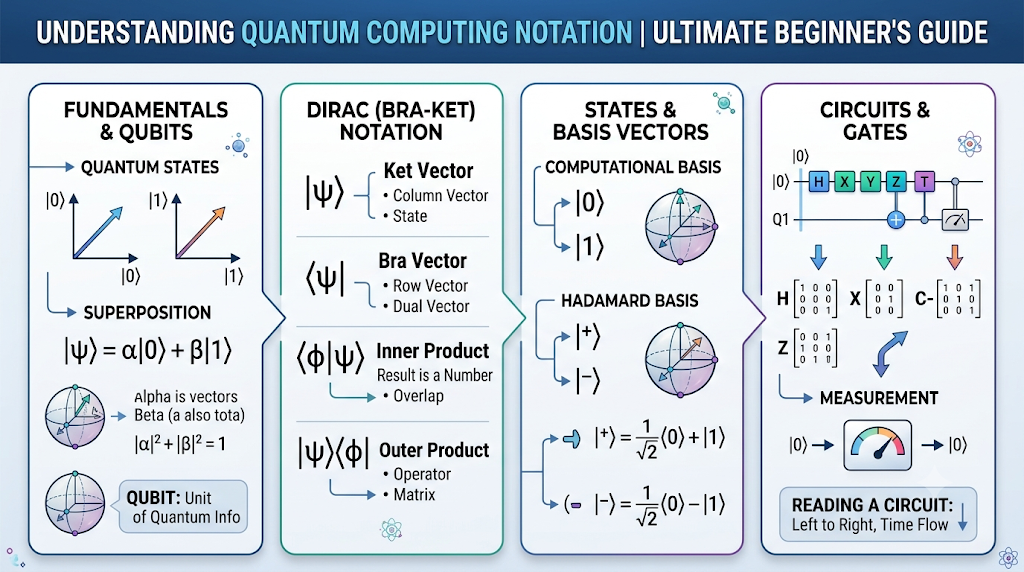
Introduction
Entering the world of quantum mechanics can feel like arriving in a foreign country where you do not speak the local language. In classical computing, we are comfortable with bits, bytes, and standard logic gates like AND, OR, and NOT. But when you step into the quantum realm, you are suddenly greeted by strange brackets, Greek letters, and unfamiliar diagrams. This specialized language is known as quantum computing notation. Learning this notation is the single most critical step for anyone aspiring to understand how quantum computers work. Without it, reading a quantum algorithm or understanding a hardware design is almost impossible. If you want to dive deeper into high-quality educational resources, tutorials, and insights into the quantum landscape, head over to QuantumUting.com, your go-to hub for accessible quantum education.
What Is Quantum Computing Notation?
At its core, quantum computing notation is a standardized mathematical and visual framework used to describe the state of quantum information and the operations performed on it.
Just as musical notation uses staves and notes to represent sounds and timing, quantum notation uses symbols to represent the delicate states of qubits (quantum bits).
The primary purpose of this notation is simplification. Quantum mechanics deals with vectors, complex numbers, and multi-dimensional matrices. Writing these out explicitly every time you want to program a quantum computer would be incredibly slow and prone to errors.
In quantum computing, notation bridges the gap between abstract physics equations and real-world software operations. It allows developers and researchers to trace exactly what happens to a qubit when it undergoes processes like superposition or entanglement.
Why Quantum Computing Uses Special Notation
Classical computers use binary notation. A classical bit is either a $0$ or a $1$. Representing this requires nothing more than simple boolean algebra. You can look at a classical register and say it holds the string 1011.
Quantum systems are fundamentally different because they do not operate in a simple “either-or” fashion. A qubit can exist in a combination of states simultaneously—a phenomenon known as superposition. Furthermore, multiple qubits can become linked through entanglement, meaning the state of one instantly depends on the state of another.
Because a qubit carries an infinite number of possible combinations of $0$ and $1$ before it is measured, classical binary strings are entirely inadequate. We need a standardized system that can track:
- The probability of a qubit collapsing into a $0$ or a $1$.
- The hidden phases and orientations of the quantum state.
- The way multiple qubits interact in a multi-dimensional mathematical space.
By using special notation, the quantum community has established a universal shorthand. It allows a developer in India, a researcher in Canada, and an enterprise architect in Germany to look at the same sequence of symbols and understand the exact same physical reality.
Understanding the Building Blocks of Quantum Notation
Before looking at the advanced math symbols, let’s establish the fundamental concepts that this notation is designed to describe.
Qubits
A qubit is the fundamental unit of quantum information. While a classical bit is like a light switch that can only be turned ON or OFF, a qubit is like a spinning coin. While it spins, it possesses a blend of both heads and tails.
Quantum States
The “state” of a quantum system is simply its configuration at a specific moment in time. Notation allows us to write down a snapshot of this configuration. For example, we use symbols to declare whether a qubit is purely in the $0$ state, purely in the $1$ state, or somewhere in a balanced mix of both.
State Vectors
Mathematically, a quantum state is represented as a arrow pointing somewhere in a mathematical space. This arrow is a state vector. If the arrow points straight up, it might represent a $0$. If it points straight down, it represents a $1$. If it points sideways, it represents a superposition.
Probability Amplitudes
When a qubit is in superposition, it doesn’t mean it is literally “both numbers at once” in a chaotic way; it means it has a calculated mathematical weight assigned to each possibility. These weights are called probability amplitudes. When we square these amplitudes, they tell us the precise statistical likelihood of finding a $0$ or a $1$ when we finally measure the qubit.
Measurement Results
The act of reading a qubit is called measurement. Measurement forces the spinning coin to land flat on the table, instantly destroying its quantum properties. The notation must clearly differentiate between the fragile quantum state before measurement and the static classical result after measurement.
Introduction to Dirac (Bra-Ket) Notation
The most famous and widely used language in quantum computing is Dirac notation, also popularly known as bra-ket notation. It was invented by the legendary physicist Paul Dirac in 1939 to make quantum mechanics calculations cleaner and faster.
The name is a brilliant play on words. It comes from the word bracket, which is split into two parts: a bra and a ket. Together, they form a complete mathematical bracket.
Understanding Kets
A ket is represented by a vertical line and a right-angled bracket, looking like this: $\lvert\cdot\rangle$. Inside the ket, we place a label that identifies the quantum state.
Mathematically, a ket represents a column vector. If you see $\lvert\psi\rangle$ (pronounced “ket psi”), it simply means “the quantum state vector named psi.” It is the default way to write down the state of a qubit.
Understanding Bras
A bra is the mirror image of a ket, written with a left-angled bracket and a vertical line: $\langle\cdot\rvert$. For example, $\langle\psi\rvert$ is pronounced “bra psi.”
Mathematically, a bra represents a row vector, specifically the complex conjugate transpose of the corresponding ket. Don’t let the phrase “complex conjugate transpose” worry you—conceptually, if a ket is a vertical column of numbers, its matching bra is simply that same list turned sideways into a horizontal row, with a minor mathematical adjustment made to any imaginary numbers.
Bra-Ket Combinations
When you snap a bra and a ket together, they form a closed bracket: $\langle\phi\vert\psi\rangle$.
This combination represents an inner product (or dot product) between two vectors. In quantum computing, evaluating a bra-ket gives you a single number. This number tells you how similar the two states are, or the probability amplitude of state $\lvert\psi\rangle$ collapsing into state $\lvert\phi\rangle$ during an operation.
Why Dirac Notation Is Important
Dirac notation acts as an incredible mental filter. It hides the messy details of long arrays of numbers and lets you focus entirely on the relationships between states. It turns complex multi-line linear algebra problems into simple symbolic manipulations that you can solve like basic algebra.
Common Quantum Symbols and Their Meanings
To help you navigate articles and papers, let’s break down the most common symbols you will encounter in quantum information theory.
| Symbol | Name / Meaning | Practical Interpretation |
| $\lvert0\rangle$ | Ket Zero | The ground state of a qubit; equivalent to classical bit 0. |
| $\lvert1\rangle$ | Ket One | The excited state of a qubit; equivalent to classical bit 1. |
| $\lvert\psi\rangle$ | Ket Psi | A general variable name used to describe any unknown quantum state. |
| $\langle\psi\rvert$ | Bra Psi | The horizontal, dual vector counterpart to the vertical $\lvert\psi\rangle$ vector. |
| $\alpha, \beta$ | Alpha and Beta | Greek letters used as variables representing probability amplitudes. |
| $\langle\psi\vert\phi\rangle$ | Inner Product | A single number indicating the overlap or similarity between two states. |
| $\otimes$ | Tensor Product | A symbol indicating the combination of multiple distinct qubits into a single system. |
| $\lvert\psi\rangle\langle\phi\rvert$ | Outer Product | An operation that yields a matrix; often used to describe quantum gates or operations. |
Let’s look closely at the tensor product ($\otimes$). When you have one qubit in state $\lvert\psi\rangle$ and a second qubit in state $\lvert\phi\rangle$, their combined system is written as $\lvert\psi\rangle \otimes \lvert\phi\rangle$.
To save time, developers usually drop the circle symbol entirely and write it as $\lvert\psi\rangle\lvert\phi\rangle$ or compress it into a single ket like $\lvert\psi\phi\rangle$. If you see $\lvert01\rangle$, it simply means the first qubit is $0$ and the second qubit is $1$.
Quantum States and Superposition Notation
Let’s look at how we write down a qubit that is experiencing the magic of superposition.
In a classical computer, a bit is written as a static value:
bit = 0orbit = 1
In a quantum system, a general state vector $\lvert\psi\rangle$ is written as a linear combination of both possibilities:
$$\lvert\psi\rangle = \alpha\lvert0\rangle + \beta\lvert1\rangle$$
This formula is the heart of quantum computing notation. Let’s break down exactly what it is telling us:
- $\lvert\psi\rangle$ is the current state of our qubit.
- $\lvert0\rangle$ and $\lvert1\rangle$ are the baseline states (called the computational basis).
- $\alpha$ (alpha) is the probability amplitude telling us how much “$0$” is mixed into the state.
- $\beta$ (beta) is the probability amplitude telling us how much “$1$” is mixed into the state.
The Probability Rule
Because a qubit must always collapse into something when measured, the total probability must equal 100%. Mathematically, we express this using the absolute squares of our amplitudes:
$$\lvert\alpha\rvert^2 + \lvert\beta\rvert^2 = 1$$
A Practical Example
Imagine a qubit in an equal superposition, where it has an exact 50/50 chance of landing on heads or tails. In quantum notation, we write this specific state (often called the “plus state,” or $\lvert+\rangle$) like this:
$$\lvert+\rangle = \frac{1}{\sqrt{2}}\lvert0\rangle + \frac{1}{\sqrt{2}}\lvert1\rangle$$
If we square the amplitude for the zero state:
$$\left(\frac{1}{\sqrt{2}}\right)^2 = \frac{1}{2} = 50\% \text{ chance of measuring } 0$$
The notation elegantly tracks the underlying square-root relationship of quantum mechanics while remaining clean and readable.
Quantum Gates and Notation
In classical programming, we use logic gates to change bits (like turning a $0$ into a $1$ with a NOT gate). In quantum computing, we use quantum logic gates to alter the state vector of a qubit. These gates are written as capital letters acting directly on a ket.
Pauli-X Gate ($X$)
The $X$ gate is the quantum equivalent of a classical NOT gate. It flips a qubit’s state. In notation, its action looks like this:
$$X\lvert0\rangle = \lvert1\rangle \quad \text{and} \quad X\lvert1\rangle = \lvert0\rangle$$
Pauli-Y Gate ($Y$)
The $Y$ gate rotates the qubit’s state around the Y-axis of a geometric sphere (the Bloch sphere). It flips the baseline states and introduces an imaginary mathematical phase factor ($i$).
Pauli-Z Gate ($Z$)
The $Z$ gate is a phase-flip gate. It leaves the $\lvert0\rangle$ state completely untouched, but flips the sign of the $\lvert1\rangle$ state:
$$Z\lvert0\rangle = \lvert0\rangle \quad \text{and} \quad Z\lvert1\rangle = -\lvert1\rangle$$
Hadamard Gate ($H$)
The Hadamard gate is the most important single-qubit gate because it creates superposition. If you send a pure $\lvert0\rangle$ through a Hadamard gate, it transforms into the balanced $\lvert+\rangle$ state:
$$H\lvert0\rangle = \frac{1}{\sqrt{2}}\lvert0\rangle + \frac{1}{\sqrt{2}}\lvert1\rangle$$
CNOT Gate (Controlled-NOT)
The CNOT gate operates on two qubits simultaneously: a control qubit and a target qubit. If the control qubit is in state $\lvert0\rangle$, nothing happens to the target. If the control qubit is in state $\lvert1\rangle$, the target qubit is flipped. This gate is essential for creating quantum entanglement.
Quantum Circuit Notation
When developers design quantum algorithms, they don’t just write out formulas; they use a visual blueprint called a quantum circuit diagram. This graphical notation behaves like a sheet of musical music, tracking operations across time.
How to Read a Circuit Diagram
When analyzing a quantum circuit, keep these fundamental structural rules in mind:
- Horizontal Lines (Wires): Each single horizontal line represents a single qubit. The line tracks that qubit’s life cycle as time moves forward.
- Left-to-Right Flow: Time always flows from left to right. The operations placed furthest to the left happen first.
- Initialization: On the far left, you will typically see the starting state of the qubits, usually initialized to $\lvert0\rangle$.
- Gate Boxes: Single-qubit operations like $X$, $Z$, or $H$ are represented as small boxes sitting directly on top of the qubit line. When the timeline passes through a box, that gate is applied to the qubit.
- Controlled Operations (CNOT): A CNOT gate is drawn as a vertical line connecting two wires. It features a solid dot ($\bullet$) on the control qubit line and a larger crosshair symbol ($\oplus$) on the target qubit line.
- The Measurement Meter: At the end of the circuit (on the far right), you will see a square icon containing a dial or a pointer symbol. This represents the measurement step. Once the timeline hits this icon, the quantum state collapses, and the single solid quantum wire turns into a double horizontal line, indicating that the data is now standard, classical binary information.
Mathematical Concepts Behind Quantum Notation
While you don’t need a PhD in mathematics to begin using quantum software frameworks, understanding the simple geometry behind the notation makes you significantly more confident.
Vectors
As shown in the coordinate graph above, a ket is simply a vector—a directional arrow pointing to a specific coordinate in a space. In a single qubit system, our space has two core dimensions, corresponding to the axes of the baseline states $\lvert0\rangle$ and $\lvert1\rangle$.
Matrices
Quantum gates are mathematically represented as square matrices (grids of numbers). When we write a symbol like $H\lvert\psi\rangle$, behind the scenes, the computer is performing matrix multiplication. The matrix acts as a transformation rule that tilts, rotates, or flips our state vector arrow to point in a new direction.
Inner Products vs. Outer Products
- Inner Product ($\langle\phi\vert\psi\rangle$): Row vector multiplied by a column vector. The result is a single number. It measures projection or overlap.
- Outer Product ($\lvert\psi\rangle\langle\phi\rvert$): Column vector multiplied by a row vector. The result is a full matrix grid. It represents an operation or a transition pathway from one state to another.
Common Mistakes Beginners Make
When you are learning this new language, it is incredibly easy to cross your wires. Watch out for these four common pitfalls:
1. Confusing Bits and Qubits
Beginners often look at the symbol $\lvert0\rangle$ and treat it exactly like a classical variable holding a permanent zero. Remember that $\lvert0\rangle$ is a vector, not a number. A qubit can look like it contains $\lvert0\rangle$ on paper while actually possessing a complex phase shift or being deeply entangled with another system entirely.
2. Misunderstanding Bra-Ket Orientation
Writing $\lvert\psi\rangle\langle\phi\rvert$ means something entirely different than writing $\langle\phi\vert\psi\rangle$. Flipping the brackets turns a single numerical value (an inner product) into a massive multi-dimensional transformation matrix (an outer product). Always pay attention to which way the angle brackets point.
3. Ignoring Probability Amplitudes
It is tempting to look at a state like $0.6\lvert0\rangle + 0.8\lvert1\rangle$ and assume the qubit has a 60% chance of being $0$. Remember, you must square the amplitude to get the actual probability ($0.6 \times 0.6 = 0.36$, or a 36% chance).
4. Misreading Chronological Flow
In a visual circuit diagram, operations are read left-to-right. However, when written out as text equations, operations are read from right-to-left. For example, if you see the equation $XH\lvert0\rangle$, it means the Hadamard gate ($H$) is applied to the qubit first, and the Pauli-X gate ($X$) acts on the result second.
Practical Applications of Quantum Computing Notation
Why invest time in mastering this notation? Because it is the foundation of every major branch of quantum information science.
Quantum Algorithm Development
Whether you are studying Shor’s algorithm for cryptography or Grover’s algorithm for database searching, the steps are universally mapped out using Dirac notation and circuit diagrams. Knowing the notation allows you to trace how an algorithm achieves computational speedups.
Quantum Simulation
Quantum computers excel at simulating chemistry and molecular bonds—tasks that cause classical supercomputers to crash. Scientists use notation to map out the complex, interacting energy states of electrons and atoms directly onto qubit architectures.
Quantum Machine Learning (QML)
Modern developers are combining classical neural networks with quantum systems to accelerate optimization tasks. Quantum notation is used to describe high-dimensional quantum states that store complex training datasets.
Quantum Communication
In secure communication protocols like Quantum Key Distribution (QKD), notation tracks the polarized states of photons. It allows engineers to design systems where any attempt at eavesdropping instantly alters the quantum symbols, alerting the users.
Best Practices for Learning Quantum Notation
To build rapid fluency without getting overwhelmed, follow this structured roadmap:
- Learn Notation Gradually: Don’t try to memorize every single gate matrix on day one. Focus entirely on feeling comfortable with reading a single qubit superposition state first.
- Practice Reading States Out Loud: When you see $\lvert\psi\rangle = \alpha\lvert0\rangle + \beta\lvert1\rangle$, read it as: “The state psi is a combination of zero and one, weighted by amplitudes alpha and beta.” Verbalizing symbols builds cognitive familiarity.
- Study Simple Circuits First: Use open-source drag-and-drop quantum cloud platforms. Build a circuit with a single Hadamard gate, look at the visual diagram, and match it to the written mathematical equation.
- Focus on Concepts Before Mathematics: Always prioritize the geometric intuition. Think of gates as rotations on a sphere rather than grids of complex numbers. The mathematical proficiency will follow naturally once the concept makes sense.
Future Importance of Quantum Computing Literacy
We are currently witnessing a global shift in advanced computing infrastructure. Governments, tech giants, and research institutions are pouring billions of dollars into scaling up fault-tolerant quantum hardware.
As these systems leave the lab and enter enterprise cloud architectures, the demand for quantum-literate professionals is skyrocketing. Understanding quantum notation is no longer an academic niche—it is a powerful professional differentiator.
Just as assembly language literacy opened doors at the dawn of digital computing, quantum literacy will define the architects of tomorrow’s software ecosystems. Learning this language now positions you at the absolute forefront of the next technological frontier.
Career Opportunities in Quantum Computing
Mastering quantum fundamentals unlocks a highly specialized, rapidly expanding job market across several exciting roles:
- Quantum Software Developer: Writing code and implementing algorithms using open-source quantum frameworks (like Qiskit, Cirq, or Pennylane) that compile down to quantum hardware layouts.
- Quantum Research Scientist: Exploring new quantum mechanics frontiers, designing novel error-correction codes, and discovering advanced algorithmic shortcuts.
- Quantum Engineer: Working closely with the physical hardware, optimizing pulse sequences, and managing the cryogenic control environments of real quantum processors.
- Quantum Algorithm Specialist: Translating complex real-world industry problems (such as logistics routing or financial portfolio risk analysis) into abstract quantum circuit structures.
- Quantum Systems Analyst: Helping enterprise corporations identify exactly how quantum computational advantages can optimize their existing supply chains, security frameworks, and data pipelines.
FAQ Section
1. Is Dirac notation used in classical computing?
No, classical computing does not require Dirac notation because classical bits exist in plain, discrete states ($0$ or $1$) and can be fully managed using standard boolean logic and basic binary algebra.
2. What does the vertical line mean in a ket symbol?
The vertical line acts as the left-hand wall of the shorthand container. It simply signals to the reader that the text or number immediately following it is the name of a quantum state vector.
3. Can a qubit have negative probability amplitudes?
Yes. Amplitudes like $\alpha$ and $\beta$ can be negative or even complex numbers. This is a critical feature because negative amplitudes allow quantum states to cancel each other out during an algorithm, a vital process known as destructive interference.
4. Why is a combined quantum system written using a tensor product?
The tensor product ($\otimes$) is the mathematical tool used to combine the individual vector spaces of multiple independent qubits into a single, comprehensive vector space that can accurately represent all combined possibilities simultaneously.
5. How do I know if a quantum circuit diagram is read from left to right?
All standard quantum circuit diagrams follow a universal convention where the horizontal axis represents time. This means you always read the diagram sequentially from left to right, just like a line of text or a musical score.
6. Do I need to be a math expert to learn quantum computing notation?
Not at all. While the underlying math relies on linear algebra, you only need to understand the foundational concepts of vectors, matrices, and basic probability to comfortably read and write quantum notation.
7. What is the difference between a bra and a ket?
A ket ($\lvert\psi\rangle$) represents a traditional column vector describing a quantum state, while a bra ($\langle\psi\rvert$) represents a horizontal row vector that serves as the complex conjugate transpose of that same state.
8. What happens to quantum notation symbols when a measurement occurs?
When a measurement occurs, the fragile quantum notation collapses. The abstract symbols are replaced by standard classical numbers ($0$ or $1$), and the circuit line changes from a single wire to a double wire.
9. What does the symbol $\lvert+\rangle$ represent?
The $\lvert+\rangle$ (plus) symbol is a common shorthand representation for a state in an equal superposition, containing an exact 50% chance of collapsing into a $0$ and a 50% chance of collapsing into a $1$ upon measurement.
10. Where can I practice creating and reading quantum circuit diagrams?
You can practice on various open-source cloud platforms and interactive web simulators, which allow you to drag gates onto wires, see the visual notation change in real-time, and run basic quantum programs.
Final Summary
Quantum computing notation is not an arbitrary roadblock designed to keep people out; it is an empowering language built to make exploring the quantum world possible. By transforming long, complex matrix equations into clean symbols like $\lvert\psi\rangle$, Dirac notation allows us to reason about, design, and execute cutting-edge algorithms with remarkable efficiency. From understanding basic qubit superpositions to reading multi-qubit circuit blueprints, mastering this notation gives you the key to unlocking the future of computing. Take it one symbol at a time, prioritize the conceptual intuition behind the vectors, and don’t be afraid to practice writing out states yourself. As you continue expanding your technical literacy and exploring the incredible shifts occurring across this industry, make sure to stay connected with the latest educational guides and expert insights over at QuantumUting.com. Dive in, keep practicing, and welcome to the quantum era.
