Introduction
Interest in quantum computing is growing at an incredible pace. As traditional silicon chips reach their physical limits, the tech industry is looking toward a revolutionary alternative. To truly understand this new era of technology, you must understand its core engine: quantum circuits. Just as conventional electronics rely on standard circuit boards, quantum computation relies entirely on quantum circuits to process information. However, the logic guiding these systems operates on completely different physics principles than the phone or laptop you are using right now. Whether you are a computer science student, a curious software developer, or a technology enthusiast, grasping the basics of quantum circuits is your gateway to quantum programming. In this educational guide powered by QuantumUting.com, we will break down the foundational concepts, compare them to traditional hardware, and explore how these systems solve complex problems.
What Are Quantum Circuits?
In the simplest terms, a quantum circuit is a model for quantum computation in which a compilation of sequential operations is performed on quantum data. Think of it as a step-by-step recipe or a structural map that guides information from an initial state to a final calculated answer.
While a traditional circuit uses copper wires and silicon transistors to manipulate electric currents, a quantum circuit uses specialized sequences of electromagnetic pulses to manipulate quantum states.
The primary purpose of a quantum circuit is to execute quantum algorithms. It serves as the bridge between abstract mathematical theory and real-world execution on advanced quantum hardware.
Understanding the Building Blocks of Quantum Circuits
Before analyzing how a circuit operates, we need to understand the fundamental components that reside within it.
Qubits
The fundamental unit of quantum information processing is the quantum bit, or qubit. While a standard bit can only represent a strict 0 or 1, a qubit can exist in a far more flexible state, allowing it to hold significantly more computational potential.
Quantum States
A quantum state refers to the mathematical condition or mathematical expression of a qubit at any given moment. These states are manipulated throughout the circuit run to perform calculations.
Superposition
Imagine spinning a coin on a table. While it is spinning, it is not strictly heads or strictly tails; it is a blend of both possibilities at the same time. This is superposition. It allows quantum circuits to evaluate millions of possibilities simultaneously.
Entanglement
Entanglement is a unique connection where two or more qubits become deeply linked. When qubits are entangled, the physical state of one instantly influences the state of the other, no matter how far apart they are. This allows circuits to share and sync data across processing units instantly.
Measurement
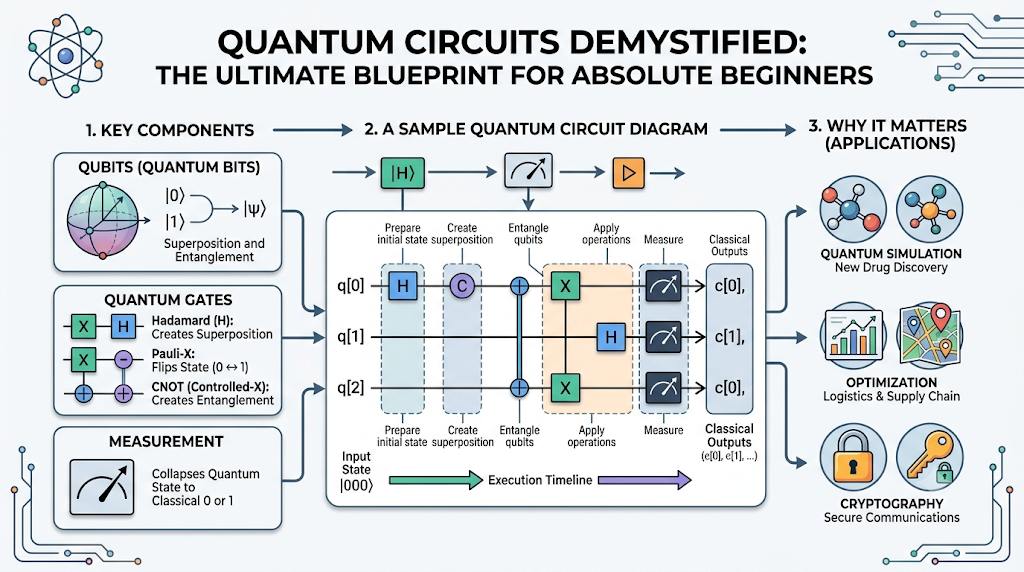
Measurement is the final step in a circuit. Going back to our spinning coin analogy, measuring a qubit is like slapping your hand down on the coin to stop it. The superposition collapses, and the qubit is forced to choose a definite classical state: a standard 0 or 1 that a traditional computer can read.
Classical Circuits vs Quantum Circuits
To appreciate the power of quantum computing concepts, it helps to see how they stack up against the technology we use every day.
- Logic Types: Classical systems use deterministic boolean logic (True/False). Quantum systems use probabilistic logic based on quantum mechanics.
- Data Reversibility: Most classical gates lose information during calculation (e.g., an AND gate outputs 1 bit from 2 inputs). Quantum gates are completely reversible, meaning you can reconstruct the inputs from the outputs.
- Computational Scaling: Adding bits to a classical computer increases power linearly. Adding qubits to a quantum circuit increases processing capacity exponentially.
Comparison Table
| Feature | Classical Circuits | Quantum Circuits |
| Basic Unit | Bit (0 or 1) | Qubit (0, 1, or a superposition of both) |
| Core Element | Transistors / Silicon Wires | Quantum Logic Gates / Micro-pulses |
| Operational Logic | Boolean Algebra | Quantum Mechanics (Superposition & Entanglement) |
| Reversibility | Irreversible (Information can be lost) | Strictly Reversible (Information is preserved) |
| Output Type | Exact, deterministic value | Probabilistic distribution before measurement |
Understanding Quantum Gates
Quantum logic gates are the physical operations that alter the state of qubits as they pass through the circuit. Let’s look at the most common types:
Pauli-X Gate
Often called the quantum NOT gate, the Pauli-X gate flips the state of a qubit. If a qubit is in state 0, the X gate switches it to 1, and vice versa.
Pauli-Y Gate
The Pauli-Y gate performs a state flip similar to the X gate, but it also applies a mathematical phase shift. Think of it as rotating a point on a sphere to the exact opposite side along a different axis.
Pauli-Z Gate
The Pauli-Z gate leaves the value of the qubit alone if it is 0 or 1, but it flips the mathematical phase of a qubit that is currently in a superposition state.
Hadamard Gate
The Hadamard gate (H gate) is the tool used to create a superposition. It takes a definite 0 or 1 state and forces it into a perfectly balanced 50/50 blend of both possibilities.
CNOT Gate
The Controlled-NOT (CNOT) gate is a two-qubit operation used to create entanglement. It looks at a “control” qubit: if the control qubit is 1, the CNOT gate flips the “target” qubit. If the control qubit is 0, the target qubit remains unchanged.
Phase Gates
Phase gates adjust the precise angle of a qubit’s superposition state without changing the underlying probabilities of it collapsing into a 0 or 1. This fine-tuning is vital for delicate calculations.
How Quantum Circuits Work
Executing a quantum program follows a very structured, step-by-step workflow:
- Input Qubits: The circuit initializes a set of qubits into a clean, baseline state (usually represented as 0).
- Gate Operations: The qubits are passed through a series of quantum gates according to the algorithm’s design.
- State Transformations: As gates act upon the qubits, they enter states of superposition and become entangled with one another, performing vast parallel calculations.
- Output Measurement: The system triggers a measurement event, forcing the complex quantum states to collapse into standard binary code.
- Iteration: Because quantum outputs are probabilistic, the circuit is often run hundreds of times to confirm the statistical accuracy of the result.
Designing a Simple Quantum Circuit
Designing a circuit is highly visual and usually read from left to right, matching the timeline of the computation.
Imagine drawing two horizontal lines; each line represents a qubit tracking through time. You place an H gate box on the first line to put it into superposition. Next, you draw a vertical line connecting both qubits using a CNOT gate to entangle them. Finally, you draw a dial icon at the end of both lines to represent measurement.
When executed, this simple setup creates a “Bell State”—a perfectly entangled pair of qubits that will always yield matching results when measured.
Applications of Quantum Circuits
Quantum computation shines brightest when tackling problems that would take traditional supercomputers thousands of years to calculate.
- Quantum Cryptography: Designing unhackable security channels using the principle that observing a quantum state changes it instantly.
- Optimization Problems: Helping logistics corporations calculate the absolute most efficient shipping routes across global supply chains.
- Drug Discovery: Simulating molecular interactions at an atomic level to drastically shorten the timeline for creating lifesaving medications.
- Machine Learning: Enhancing artificial intelligence models by processing massive, complex datasets at speeds previously thought impossible.
- Scientific Simulations: Modeling complex chemical reactions and materials science properties to create better solar panels or batteries.
- Financial Modeling: Running deep risk analysis and portfolio optimization scenarios for major investment systems.
Challenges in Quantum Circuit Design
Building these circuits isn’t easy; engineers face major physical hurdles everyday.
- Quantum Noise: Minor environmental interferences like temperature changes or stray electromagnetic fields can ruin a calculation.
- Decoherence: Qubits can lose their quantum properties and slip back into boring classical states if they aren’t kept perfectly isolated.
- Error Rates: Because quantum hardware is highly sensitive, modern systems require complex error-correction circuits just to keep computations accurate.
- Hardware Limitations: Real-world quantum processors must be cooled to temperatures colder than deep space to function properly.
- Scalability Concerns: Linking thousands of stable physical qubits together without increasing systemic noise remains a massive engineering challenge.
Popular Tools for Building Quantum Circuits
You don’t need a multi-million dollar lab to start building quantum circuits; there are great software tools available to anyone with an internet connection:
- Qiskit: An open-source software development kit created by IBM for working with quantum circuits at the level of pulses, gates, and application modules.
- Cirq: A Python software framework developed by Google for writing, manipulating, and optimizing quantum circuits designed for noisy intermediate-scale quantum processors.
- PennyLane: A cross-platform Python library tailored for quantum machine learning and computing applications.
- IBM Quantum Composer: A visual, drag-and-drop web interface that lets you build circuits graphically and run them on actual cloud-connected quantum hardware.
Best Practices for Learning Quantum Circuits
If you want to master quantum circuit basics, follow this practical learning roadmap:
- Learn Fundamentals First: Get comfortable with basic linear algebra and vector matrices before jumping into code.
- Practice with Simulators: Use local classical computer simulators to run circuits before trying to deploy them on real quantum hardware.
- Study Quantum Gates: Focus on deeply understanding how single-gate adjustments alter qubit probabilities.
- Build Simple Projects: Recreate classic beginner setups, like the Bell State or simple teleportation protocols, to build confidence.
- Understand Algorithms Gradually: Move step-by-step from basic circuit logic up to famous setups like Grover’s Search Algorithm.
Future of Quantum Circuit Technology
As technology progresses, we will see an evolution toward fault-tolerant quantum computing systems. Engineers are actively designing more stable quantum hardware capable of running deeper, more complex circuits without collapsing.
As error rates drop, advanced quantum algorithms will shift from theoretical laboratory concepts into practical, commercial tools used across global enterprises daily.
Career Opportunities in Quantum Computing
The expanding quantum landscape has created a demand for specialized professional roles:
- Quantum Software Developer: Writing code and building software applications that compile into quantum circuit structures.
- Quantum Research Scientist: Discovering new ways to manipulate quantum states and optimizing basic hardware mechanics.
- Quantum Engineer: Designing the physical processors, wiring, and cooling mechanisms required to keep systems running.
- Quantum Algorithm Specialist: Creating high-level mathematical solutions optimized specifically for quantum execution.
- Quantum Systems Analyst: Helping enterprises figure out how to integrate quantum acceleration into their existing classical infrastructure.
Common Misconceptions About Quantum Circuits
Let’s clear up some common confusion that beginners often face when exploring this field:
Myth: Quantum circuits will completely replace classical computer processors.
Reality: Quantum circuits are accelerators. They excel at specific, highly complex mathematical tasks but are entirely impractical for everyday tasks like browsing the web or word processing.
Myth: Qubits can hold infinite data because they exist in superposition.
Reality: While a qubit holds complex probabilities during a calculation, it only yields a single standard bit of information (a 0 or a 1) the moment it is measured.
FAQ Section
1. Do I need an advanced physics degree to understand quantum circuit basics?
No, you do not need a PhD. While the underlying hardware relies on quantum mechanics, learning how to design and program the circuits themselves mainly requires basic linear algebra and regular logic principles.
2. Can I write quantum programming code on my normal laptop?
Yes, you can write and test code locally. Frameworks like Qiskit and Cirq run inside standard Python environments on ordinary laptops, using your CPU to simulate how a quantum system would respond.
3. What is the difference between a quantum circuit and a quantum algorithm?
An algorithm is the high-level conceptual plan or mathematical strategy used to solve a problem. A quantum circuit is the specific arrangement of qubits and gates used to actually execute that strategy on a machine.
4. Why must quantum circuits be kept at ultra-low temperatures?
Superconducting qubits are incredibly sensitive to heat. Even tiny amounts of thermal energy can cause quantum decoherence, ruining the calculation by forcing qubits out of their delicate states of superposition.
5. How long does a qubit stay in a superposition state inside a circuit?
Not very long at all. This timeframe is known as coherence time, and in modern systems, it is usually measured in microseconds or milliseconds before the state naturally degrades.
6. Are quantum circuits used in modern artificial intelligence systems?
Researchers are actively developing quantum machine learning models. While not widely used in consumer AI today, quantum circuits are expected to speed up complex data sorting and model training in the future.
7. What exactly is a reversible gate in a quantum circuit?
A reversible gate is an operation that preserves all input data. Because no information is thrown away or overwritten during the process, you can run the operation backward to perfectly recreate the initial input states.
8. Can a quantum circuit instantly solve any mathematical problem?
No, they are highly specialized. They offer massive advantages for specific math tasks—like factoring large numbers or analyzing molecular models—but offer little to no benefit for basic daily calculations.
9. What does it mean when a quantum circuit collapses?
A circuit collapses when a measurement command is executed. The act of measuring forces the delicate quantum states of superposition to resolve into definite, standard binary values.
10. How can I run my first circuit on a real, physical quantum computer?
You can use cloud services like IBM Quantum Experience. They offer free, open public access to cloud-based systems, letting beginners run custom-built designs directly on actual quantum processors.
Final Summary
Quantum circuits are the structural foundations of the next generation of computing technology. By moving past the rigid limits of traditional binary code and using the natural principles of superposition and entanglement, they open up entirely new ways to process information. While engineering hurdles like quantum noise and decoherence still exist, the tools available today make it easier than ever for beginners to jump in. If you want to stay ahead of the curve in emerging technology, now is the time to start experimenting with simulators and building your own logic models.
