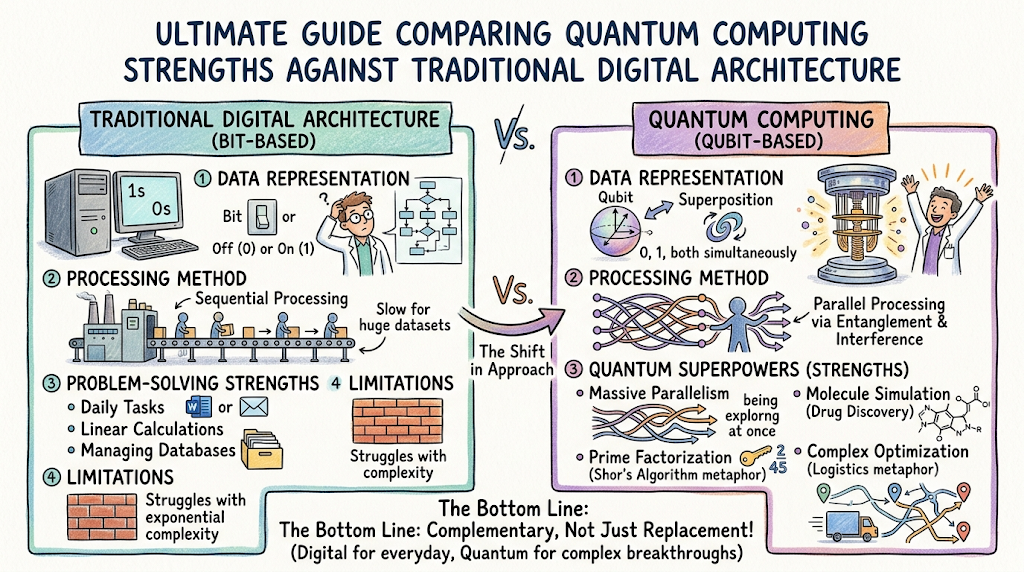
A traditional computer handles this by trying one path at a time. It walks down a hallway, hits a dead end, backs up, and tries the next path. It repeats this process sequentially until it finds the correct exit.
For decades, silicon chips and traditional transistors have powered our digital world. They run our smartphones, stream our favorite videos, and guide spacecraft to distant planets. Yet, some problems remain so complex that even the most powerful supercomputers would take billions of years to solve them. This is where advanced processing models step in to change the landscape completely.
In simple terms, classical computing relies on clear, definitive answers, while quantum computing embraces possibilities. One operates through a series of rigid switches, while the other utilizes the fluid laws of physics to process information in ways that previously seemed impossible.
Throughout this comprehensive guide, we will unpack the core mechanics of both systems. You will learn how information is stored, how processing occurs, and why these two technologies approach problem-solving from entirely different mindsets. We will break down complex concepts into everyday analogies so you can easily understand this technological shift.
If you want to dive deeper into these emerging technologies and master the skills needed for the future of digital processing, check out the educational programs at QuantumUting. Let us begin our journey by looking back at how our current computational world came to be.
The Evolution of Computing
The Origins of Classical Computing
The story of modern digital systems began with simple mechanical switches. Early inventors looked for ways to automate mathematical calculations to reduce human error. Over time, these mechanical gears evolved into vacuum tubes, which eventually gave way to the modern silicon transistor.
At its core, traditional computing relies on binary logic. This means every piece of data, from a high-definition photograph to a complex financial spreadsheet, is broken down into zeros and ones. These units are known as bits. A transistor acts as a tiny light switch that can either be off (zero) or on (one).
For more than half a century, engineering teams focused on making these switches smaller and faster. As microchips grew more dense, our phones became more powerful than the room-sized computers of the past. This steady path of development created the stable digital foundation we use every single day.
The Scientific Search for New Computational Models
Despite the incredible speed of modern microchips, traditional processors face a physical wall. As transistors shrink to the size of just a few atoms, the strange rules of physics begin to interfere with their operation. Electricity can leak across these tiny barriers, causing computational errors.
Beyond these physical limits, certain mathematical problems grow exponentially complex. For instance, when a logistics company tries to calculate the best delivery routes for hundreds of vehicles, the number of combinations becomes astronomical. A standard computer must calculate each route one after another.
Most beginners find this concept confusing at first because we assume fast computers can solve anything. However, when the number of variables increases, the time required to find an answer can outlast the lifespan of our universe. This harsh reality forced researchers to look beyond silicon and binary logic for a completely new approach to information.
The Emergence of Quantum Computing
The theoretical foundation for this new approach emerged when physicists realized that nature does not operate on zeros and ones. At the atomic and subatomic levels, particles behave in ways that defy our everyday experiences.
Scientists asked a fascinating question: What if we could build a computer that uses these atomic principles to process data? Instead of forcing a system to use rigid on-and-off switches, we could use the natural behavior of microscopic particles to hold and manipulate information.
This realization birthed a new field of research. Instead of replacing traditional chips for basic daily tasks, this new system was designed to handle the specific, highly complex mathematical problems that leave standard supercomputers completely paralyzed.
Understanding Classical and Quantum Computing
The Core Architecture of Classical Computers
To understand the contrast between these systems, we must first look under the hood of a standard computer. The entire architecture is built on predictability and certainty. Every action follows a strict, predetermined path.
- Bits: The basic unit of information, representing either a 0 or a 1.
- Processors: The central hub that executes instructions by flipping these bits millions of times per second.
- Memory: Temporary storage spaces that hold bits in specific arrangements while tasks are performed.
- Deterministic Computing: A system where the same input will always produce the exact same output without variation.
This structure ensures that your word processor or banking app functions reliably every time you open it. The system handles data in a structured, linear fashion, making it highly efficient for everyday administrative and media tasks.
The Core Architecture of Quantum Computers
The architecture of a quantum system looks nothing like the motherboard inside your laptop. It resembles an intricate chandelier made of copper cables, gold-plated plates, and superconducting wires housed inside a massive cooling vat.
- Qubits: The quantum equivalent of a bit, which can exist in multiple states simultaneously.
- Superposition: The physical property that allows a qubit to hold a mix of both 0 and 1 at the same time.
- Quantum States: The fragile environmental conditions where particles are manipulated using lasers or microwaves.
- Superconducting Environments: Extreme isolation chambers cooled to temperatures colder than deep space to keep the system stable.
This setup allows the machine to hold massive amounts of information in a fluid state. It does not rely on static switches; instead, it uses controlled environments to guide changing probabilities toward a final answer.
Classical Logic vs. Quantum Logic
Traditional systems process data using basic logical doors like AND, OR, and NOT. These doors take standard bits, combine them, and output a definitive result based on strict rules. It is a highly ordered system that moves step by step.
Quantum logic operates on an entirely different plane. It uses specialized manipulation tools to shift the probabilities of a qubit’s state. By twisting, tilting, and combining these states, the system can cancel out wrong answers and amplify the correct ones.
In simple terms, while classical logic carves a single path through stone, quantum logic creates a wave of possibilities that flows around obstacles to find the open path.
The Computational Mindset Difference
The fundamental divergence between these systems comes down to how they view a problem. A standard computer breaks a challenge down into a long list of sequential tasks. It is incredibly disciplined, fast, and thorough, but it is bound by linear time.
The quantum mindset ignores sequential steps. It looks at a problem as a whole landscape of possibilities all at once. It sets up an environment where all potential answers exist simultaneously, allowing mathematical interference to reveal the optimal solution.
This becomes important when computational complexity increases dramatically, shifting the focus from how fast a machine can click through options to how efficiently it can see the entire picture.
The 7 Core Differences Between Quantum and Classical Computing
1. Bits vs. Qubits
The most basic difference lies in how these two systems store and express data. A standard bit is completely binary. It is a light switch that can only be up or down, representing a 1 or a 0. There is no middle ground, no hesitation, and no flexibility.
A quantum bit, or qubit, can represent a 0, a 1, or any fractional blend of both at the same time. Think of a coin sitting flat on a desk; it must show either heads or tails. Now think of that same coin spinning rapidly on the table. While it spins, it is a blur of both heads and tails simultaneously. That spinning coin represents a qubit.
2. Deterministic Processing vs. Superposition
Traditional chips operate deterministically. This means there is no guesswork involved. If you send a specific set of electrical signals through a circuit, the outcome is always certain and repeatable. This predictability is perfect for writing code, saving files, and running software.
Quantum processors use superposition to hold a vast spectrum of possibilities. The machine does not lock a value into place until the final calculation is complete. This allows the system to hold complex variables in suspension, working with probabilities rather than absolute fixed values during the calculation process.
3. Sequential Computation vs. Quantum Parallelism
When a standard supercomputer faces a difficult problem with millions of options, it tackles them sequentially. It checks option A, then option B, then option C. Even if it has thousands of processing cores working together, each core is still running a step-by-step checklist.
Quantum systems utilize parallelism natively through their fluid states. By holding millions of possibilities in superposition at once, the system processes a massive web of options simultaneously. It does not need to check options one by one because the entire problem space is evaluated in a single computational moment.
4. Traditional Correlation vs. Quantum Entanglement
In the everyday digital world, bits are completely independent. Changing the value of a bit on one side of a memory chip has absolutely no effect on a bit located elsewhere unless you write a specific piece of software to connect them.
Quantum entanglement links pairs or groups of qubits in a deep, physical way. When two qubits become entangled, the state of one instantly influences the state of the other, no matter how far apart they are. This close connection allows qubits to share information instantly, radically increasing the processing power of the system with every qubit added.
5. Conventional Algorithms vs. Quantum Algorithms
Traditional software algorithms are like baking recipes. They give the processor a clear list of instructions: add this number, move that data, and save the result. The computer follows these directions blindly and precisely until it reaches the end of the script.
Quantum algorithms use advanced mathematical strategies designed around wave interference. They create a matrix of probabilities where incorrect paths naturally cancel each other out, while the correct answers reinforce one another. It is closer to manipulating waves in a pool than following a traditional step-by-step recipe.
6. Error Handling and Stability
Errors in standard computers are incredibly rare. Silicon chips are highly stable, and background radiation rarely flips a bit out of place. Standard error-correcting code easily handles these minor hiccups, allowing computers to run for years without physical issues.
Quantum processors, however, are exceptionally sensitive. The slightest temperature change, magnetic field, or stray vibration can disrupt a qubit’s fragile state, causing an issue known as decoherence. Because of this sensitivity, quantum systems require massive infrastructure to catch and correct errors continuously.
7. Real-World Applications and Limitations
Standard devices excel at everyday work. They are perfect for browsing websites, managing inventory databases, streaming high-definition media, and playing video games. They are cheap to build, highly reliable, and operate easily at room temperature.
Quantum systems are highly specialized machines built for specific scientific and mathematical challenges. They will not make your web browser load faster or your video games run smoother. Instead, they live in specialized laboratories, focusing on complex chemistry simulations, massive logistics models, and advanced encryption systems.
Key Quantum Computing Concepts Every Beginner Must Know
Qubits, Superposition, and Entanglement — Explained Simply
Most beginners find this concept confusing at first because these terms sound like science fiction. Let us break them down into simple terms using clear, everyday ideas:
- The Qubit: This is your basic tool, acting like a spinning coin that holds multiple possibilities instead of just one static choice.
- Superposition: This is the act of spinning that coin, allowing the system to work with a fluid blend of options simultaneously.
- Entanglement: This is like having two magic coins. When you spin one in New York and it lands on heads, the other coin spinning in Tokyo instantly drops onto heads as well, linking their behavior perfectly.
Quantum Gates and Quantum Circuits
In standard electronics, physical gates direct the flow of electricity to perform calculations. They take incoming currents and route them to create basic binary outputs.
Quantum gates do not turn currents on or off. Instead, they act as controllers that manipulate the probabilities of qubits. They rotate the state of a spinning particle, changing the likelihood of whether it will land on a 0 or a 1 when the final measurement occurs. These gates are strung together to create complex calculation paths.
Quantum Algorithms
A quantum algorithm is a specialized mathematical strategy designed to run on a quantum processor. Instead of working through data linearly, it uses physical properties to sift through massive amounts of information.
For example, Shor’s algorithm can rapidly break down massive numbers into their prime components, a task that would take classical systems thousands of years. Grover’s algorithm can search through unsorted databases at incredible speeds. These tools give researchers an entirely new way to approach complex problem-solving.
Quantum Computing and Cryptography
Our modern digital security relies on difficult math problems. When you visit a secure website, your data is locked using mathematical codes that are easy to create but take traditional supercomputers centuries to crack through brute force.
Because quantum systems can run specialized algorithms like the ones mentioned above, they have the potential to unravel these traditional security codes quickly. This reality is forcing security experts to develop a new generation of quantum-resistant encryption tools to protect global data.
Quantum Computing and Artificial Intelligence
Artificial intelligence requires processing mountains of data to find hidden patterns. Standard processors spend massive amounts of time and energy sorting through these data clusters to train neural networks.
Quantum systems can analyze these vast collections of data points simultaneously. By mapping complex data structures into quantum states, these machines can help AI models spot intricate connections far more efficiently, accelerating research in machine learning and pattern recognition.
The Four Pillars of Quantum Computing
To build a functional quantum ecosystem, four foundational elements must work together seamlessly:
┌─────────────────────────────────────────────────────────────┐
│             THE FOUR PILLARS OF QUANTUM COMPUTING           │
├──────────────┬──────────────────┬──────────────┬────────────┤
│    QUBITS    │    ALGORITHMS    │   HARDWARE   │   ERROR    │
│              │                  │              │ CORRECTION │
└──────────────┴──────────────────┴──────────────┴────────────┘
Without stable qubits, the system has no data foundation. Without specialized algorithms, the machine is just an expensive cooler. Reliable physical hardware protects the system from environmental noise, while robust error correction manages the fragile nature of quantum information.
Classical Computing vs. Quantum Computing — What’s the Real Difference?
The Philosophy Difference
The core difference between these two technologies comes down to a philosophical choice in how we process our world. Classical computing is built on absolute certainty. It demands that every input has an immediate, clear, and unchanging value. It views the world as a structured collection of distinct, verifiable points.
Quantum computing embraces probability. It recognizes that nature operates through waves, tendencies, and interconnected fields. It does not demand an immediate answer; instead, it nurtures a collection of possibilities, allowing mathematical balance to reveal the truth.
Roles & Responsibilities Compared
As these technologies develop, the professional paths within the tech sector are shifting. The work environments, tools, and daily responsibilities look very different across these fields.
- Software Engineers: They build systems using traditional languages like Python or C++, focusing on logical structures, user interfaces, and reliable data storage for standard devices.
- Data Scientists: They analyze massive data collections using statistical models, running their operations on traditional cloud networks and standard database structures.
- Quantum Researchers: They operate at the intersection of advanced physics and computer science, designing specialized algorithms, managing qubit stability, and writing code for cryogenic hardware environments.
Can Classical and Quantum Computing Work Together?
A common misconception is that these two systems are rivals competing for dominance. In reality, the future belongs to a hybrid model where both systems work hand in hand.
Imagine a large research facility. A traditional computer handles the user interface, manages the database, and prepares the incoming data. It then sends a specific, incredibly difficult mathematical problem to a quantum processor. Once the quantum machine solves that specific piece, it hands the answer back to the classical system to display the results.
Which Problems Are Better Suited for Quantum Computing?
Quantum systems are not general-purpose machines. They are highly specialized tools built for specific challenges. Knowing when to use each system is critical for research and industry development.
Imagine solving a maze by exploring many paths at once; this is where quantum shines. If a problem involves sorting through millions of shifting combinations—like molecular reactions or complex distribution networks—quantum tools are ideal. If the task involves basic calculations, data display, or running business logic, standard computers remain the best choice.
Real-World Applications of Quantum Computing
Drug Discovery and Scientific Research
Developing new medications currently takes years of trial and error. Scientists must simulate how complex chemical molecules interact with human proteins. Because molecules are quantum systems themselves, standard computers struggle to simulate them accurately.
Quantum systems can simulate these molecular structures naturally because they operate on the same physical principles. This allows researchers to test thousands of chemical combinations virtually, dramatically reducing the time it takes to discover life-saving treatments.
Financial Modeling and Risk Analysis
The financial world is a massive web of moving variables. Stock markets, currency values, and global economic shifts influence one another constantly, making accurate risk management incredibly difficult for standard systems.
Quantum algorithms can analyze these vast networks of shifting probabilities simultaneously. Investment firms and banks can use these tools to build highly accurate forecasting models, helping them optimize global portfolios and manage market risks far more effectively.
Supply Chain and Logistics Optimization
Shipping packages across the globe involves managing a massive number of variables, including weather patterns, fuel costs, traffic delays, and customs regulations. A standard computer quickly becomes overwhelmed trying to calculate the absolute best route for thousands of delivery vehicles.
Quantum parallelism allows logistics networks to evaluate millions of routes and schedules at the exact same moment. This enables transportation companies to cut fuel consumption, reduce delivery times, and build resilient distribution networks that adapt instantly to disruptions.
Cybersecurity and Encryption
As quantum processors grow more powerful, their ability to navigate complex math will change the cybersecurity landscape. Legacy encryption models that secure our global banking, medical records, and government data will require an upgrade.
This challenge is driving the creation of post-quantum cryptography. Organizations are using quantum principles to build entirely new security networks that are fundamentally unhackable, ensuring long-term data protection in an evolving digital age.
Artificial Intelligence and Machine Learning
Modern machine learning models require massive amounts of time and energy to analyze complex datasets. Sorting through these huge matrices of information can create significant processing bottlenecks on traditional server farms.
Quantum processors can accelerate these calculations by handling vast datasets in parallel. This can drastically reduce AI training times, allowing neural networks to spot deep, intricate patterns that would take standard systems much longer to identify.
Common Misconceptions About Quantum Computing
Misconception 1 — Quantum Computers Will Replace All Classical Computers
Many people assume that once quantum systems are widely available, traditional laptops and smartphones will become obsolete. This is simply not true.
Your daily digital activities—like writing documents, watching videos, or checking social media—do not require quantum mechanics. Standard silicon chips are highly efficient and cost-effective for these tasks. Quantum systems will remain specialized machines accessible through cloud networks for specific, highly complex challenges.
Misconception 2 — Quantum Computing Is Faster for Every Problem
It is easy to assume that a quantum machine is simply a super-fast version of a standard computer. However, for basic tasks, a quantum system can actually be slower than your phone.
These machines only excel at specific mathematical problems that can leverage quantum algorithms. For everyday tasks like opening an app or calculating a basic spreadsheet, traditional chips are much faster and far more practical.
Misconception 3 — Quantum Computing Is Only for Scientists
Because this field relies heavily on advanced physics, many assume that it only matters inside university research labs. In reality, its impact will be felt across many industries.
Logistics managers, financial analysts, automotive designers, and cybersecurity experts are all actively exploring how these tools can solve practical business challenges. The industry is rapidly moving from pure scientific research to practical commercial application.
Misconception 4 — Quantum Systems Are Fully Mature Technologies
With all the excitement in the news, it is easy to think that fully functional quantum computers are already running major parts of our global infrastructure.
The truth is that we are still in the early stages of development. Today’s systems are small, highly sensitive to environmental noise, and prone to calculation errors. Researchers around the world are working hard to scale up this hardware and improve error correction systems.
Misconception 5 — Learning Quantum Computing Requires Advanced Physics Degrees
Many interested students and developers shy away from this field because they believe they need a PhD in physics to understand it.
While the underlying hardware relies on complex physics, learning to program quantum systems is becoming much more accessible. Modern software development kits allow you to write quantum programs using standard languages like Python, focusing on logic rather than raw quantum mechanics.
Misconception 6 — Quantum Computing Has No Practical Applications Yet
Some skeptics believe that because these machines are still evolving, they have no real-world value today.
In reality, major corporations are already partnering with technology providers to run experimental trials. They are testing quantum code for early-stage drug discovery, battery chemistry research, and financial risk models, building a strong head start for the future.
Essential Technologies Supporting Quantum Computing
Quantum Hardware Platforms
Building a reliable quantum processor is an incredible engineering challenge. Different research teams use different physical systems to create and control qubits, and each approach has its own unique strengths.
Some systems use superconducting circuits that loop tiny electrical currents at near-absolute zero temperatures. Others use trapped ion systems, holding individual atoms in place using precise electrical fields and manipulating them with lasers. Each platform represents a different path toward stable, scalable hardware.
Quantum Programming Languages
You do not need to build a quantum processor to write code for one. The industry has created advanced open-source software kits that make programming these machines accessible to developers worldwide.
Tools like Qiskit allow programmers to build quantum circuits using Python. These frameworks let you design quantum logic gates, assemble complex algorithms, and test your code on simulated environments or actual cloud-connected hardware.
Quantum Simulation Technologies
Because physical quantum hardware is still scarce and sensitive, simulation tools play a vital role in early-stage development and education.
A quantum simulator is a traditional software program that mimics the behavior of qubits on a standard computer. This allows students and developers to test their logic, debug their algorithms, and understand quantum principles without needing direct access to a physical quantum laboratory.
Quantum Networking and Communication
Just as we connected traditional computers to create the internet, researchers are developing ways to connect quantum devices together.
Quantum networking uses entangled photons to transmit data between separate systems. Because entangled particles are deeply linked, any attempt to intercept or spy on the data instantly disrupts the connection. This enables the creation of highly secure communication channels that are physically impossible to intercept.
Quantum Research and Development Ecosystems
The rapid growth of this field relies on close collaboration between academic institutions, technology companies, and open-source development communities.
Universities provide the foundational scientific research, while technology companies build the massive cryogenic infrastructure required to scale the hardware. Open-source communities build accessible software tools, ensuring that anyone with an internet connection can learn and contribute to this field.
Becoming a Quantum Computing Professional
Essential Skills Every Quantum Enthusiast Needs
If you want to enter this exciting field, building a balanced foundation of core skills is an excellent place to start.
- Mathematics: Focus on linear algebra, probabilities, and complex numbers, which form the core language of quantum mechanics.
- Programming: Master standard languages like Python, which serve as the foundation for modern development kits.
- Quantum Fundamentals: Understand the core mechanics of superposition, entanglement, and logic gate operations.
- Analytical Thinking: Develop strong problem-solving skills to translate real-world challenges into quantum algorithm models.
Step-by-Step Learning Path
Starting your educational journey can feel overwhelming, but a structured approach can help you progress smoothly from beginner to advanced concepts.
First, build a solid foundation in basic programming and linear algebra. Next, explore quantum logic gates using online simulation tools to see how qubits behave visually. Once comfortable, practice writing simple programs with open-source development kits, and eventually move on to running experimental code on cloud-connected hardware.
Certifications and Learning Programs Worth Exploring
As the industry expands, structured educational courses are becoming incredibly valuable for building career credibility.
Look for programs that offer hands-on coding projects, clear theoretical modules, and practical hardware access. Building a portfolio of verified projects on platforms like GitHub is a fantastic way to showcase your skills to potential employers in the technology sector.
Educational Resources with QuantumUting
Finding the right guidance makes a world of difference when exploring a complex field. Working with structured learning platforms can help you turn confusing jargon into clear, practical knowledge.
If you are ready to build your skills, explore the comprehensive educational pathways provided by QuantumUting. Their structured courses, hands-on tutorials, and mentor-guided programs are designed to help learners of all backgrounds master the foundations of tomorrow’s technology.
The Future of Quantum Computing
Advancements in Quantum Hardware
Over the coming years, hardware developers will focus heavily on scaling up physical systems. Engineering teams are working to increase the number of operational qubits while drastically reducing error rates.
As these systems become more stable, we will transition out of the current experimental era into an era of reliable, fault-tolerant processing. This hardware evolution will unlock the full potential of advanced algorithms, turning theoretical research into practical reality.
Quantum Advantage Across Industries
The ultimate goal of this research is achieving quantum advantage—the point where a quantum system can solve a real-world problem faster, cheaper, or more efficiently than any classical supercomputer.
As hardware stabilizes, we will see this milestone reached in specific fields like molecular chemistry and large-scale industrial optimization. This shift will give pioneering organizations a powerful tool to solve challenges that were once considered impossible.
Quantum and Artificial Intelligence Convergence
The intersection of quantum processing and artificial intelligence represents one of the most exciting research frontiers in modern technology.
By combining the parallel processing power of quantum hardware with the adaptive nature of machine learning, researchers can create highly advanced AI models. This convergence will accelerate breakthroughs in automated scientific discovery, complex pattern recognition, and autonomous systems.
Skills That Will Matter Most in Future Quantum Careers
As the ecosystem matures, the demand for practical, hands-on talent will continue to rise across the technology sector.
Professionals who can bridge the gap between abstract mathematics and practical business logic will be highly sought after. Mastering quantum programming, algorithm design, and error management strategies will position you at the absolute forefront of this technological shift.
FAQ Section
- What is the simplest way to explain how quantum computing differs from classical computing?
Traditional computers process information using bits, which act like simple light switches that are either off (0) or on (1). Quantum computers use qubits, which can exist as a blend of both 0 and 1 simultaneously. This allows a quantum system to look at a massive number of possibilities all at once, whereas a traditional system must check them one by one.
- Will a quantum computer replace my everyday laptop or smartphone?
No, quantum computers are not meant to replace standard devices for daily tasks. Classical computers are highly efficient and affordable for activities like web browsing, streaming, and office work. Quantum systems are specialized, industrial tools designed to solve specific, highly complex mathematical problems that are impossible for standard chips to handle.
- What industries will feel the biggest impact from quantum technology?
The biggest impacts will occur in fields that deal with massive numbers of variables and complex combinations. This includes medicine and pharmaceuticals for drug discovery, finance for advanced risk modeling, logistics for global route optimization, and cybersecurity for building next-generation encryption networks.
- Do I need a PhD in advanced physics to learn quantum programming?
Absolutely not. While the physical hardware relies on advanced physics, software development kits allow you to write quantum programs using standard languages like Python. If you have a basic understanding of programming and linear algebra, you can start learning to build and run quantum circuits.
- Why do quantum computers require such extreme cooling systems?
Qubits are incredibly fragile and sensitive to their surroundings. The slightest bit of heat, vibration, or electromagnetic noise can cause them to lose their quantum state and ruin a calculation. To prevent this, the processors are housed in specialized cooling vats that keep them at near-absolute zero temperatures.
- What is quantum entanglement and why does it matter?
Quantum entanglement is a physical connection where two or more qubits become deeply linked. When this happens, the state of one qubit instantly influences the state of the other, regardless of the distance between them. This connection allows qubits to share data instantly, dramatically increasing the system’s processing capacity with every qubit added.
- What exactly is a quantum algorithm, and how does it work?
A quantum algorithm is a set of step-by-step instructions designed to run on a quantum computer. Unlike standard software that processes data sequentially, a quantum algorithm uses wave interference to cancel out incorrect paths and amplify the correct answer out of millions of possibilities simultaneously.
- Can classical computers and quantum computers work together on the same problem?
Yes, this approach is known as a hybrid quantum-classical model. In this setup, a traditional computer manages the data inputs, user interface, and simpler tasks, while handing off the most complex, mathematically overwhelming part of the problem to the quantum processor to solve.
- What does the term “quantum advantage” actually mean?
Quantum advantage refers to the specific milestone where a quantum computer can solve a real-world problem faster, cheaper, or more efficiently than the absolute most powerful classical supercomputer on Earth. It marks the transition from theoretical research to practical commercial value.
- How long will it take for quantum computing to become widely accessible in business?
Cloud-based access to early-stage quantum processors is already available for testing today. However, building large-scale, fault-tolerant quantum systems that can handle commercial workloads reliably is a gradual engineering process that industries are actively scaling up step by step.
Final Summary
Understanding how quantum computing differs from classical computing highlights an amazing shift in our approach to processing information. Traditional computers remain the reliable workhorses of our daily digital lives, executing binary logic with incredible precision. Yet, when faced with the immense complexity of natural systems, logistics webs, and deep data structures, we need a completely different kind of tool.
By utilizing the principles of superposition and entanglement, quantum systems offer a fresh, fluid approach to problem-solving. They allow us to explore a vast horizon of possibilities all at once, opening doors to scientific and mathematical discoveries that once seemed completely out of reach.
