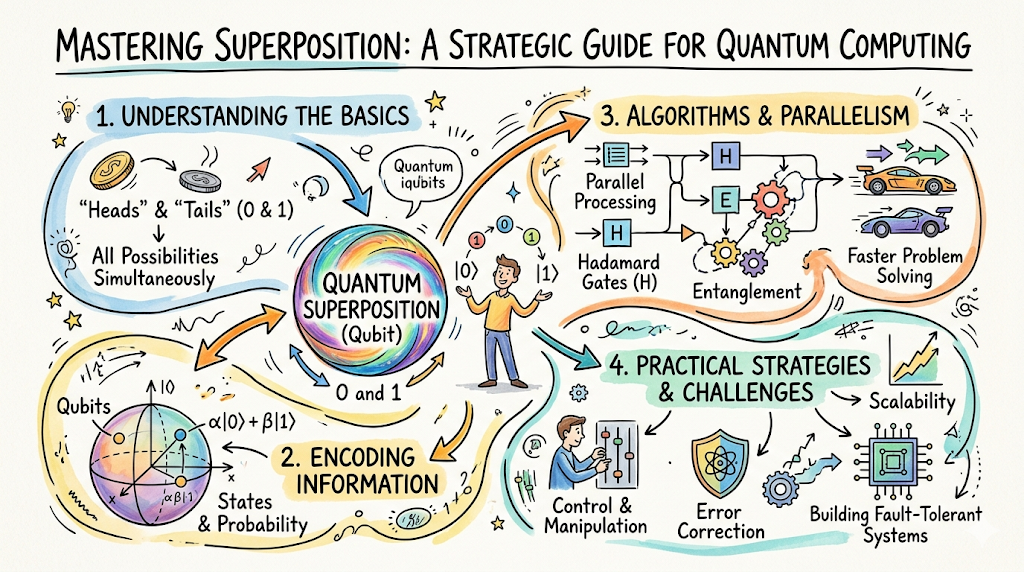
Introduction
Superposition stands as the core principle that grants quantum computing its transformative power, enabling systems to move far beyond the rigid binary limitations of traditional technology. By allowing quantum bits to exist in multiple states simultaneously, this concept enables machines to explore millions of potential outcomes at once rather than processing them sequentially. Understanding this foundational principle is the essential first step toward unlocking the future of computational science and mastering the physics that drive next-generation hardware. For those who want to dive deeper into these complex topics, QuantumUting.com provides excellent resources and structured educational paths. This guide breaks down what superposition is, how it functions within quantum systems, and why it is poised to redefine the absolute limits of modern technology.
Understanding Quantum Computing Basics
What is Quantum Computing?
Quantum computing is a revolutionary approach to processing information that uses the laws of quantum mechanics—the physics of the very small—to solve problems that classical computers find impossible. While traditional computers use silicon chips to process data, quantum computers harness the behavior of subatomic particles like electrons or photons. By utilizing these particles, quantum systems can perform complex calculations that would take today’s most powerful supercomputers thousands of years to complete.
Classical Computing vs Quantum Computing
A classical computer uses bits, which are essentially tiny switches that are always either a 0 or a 1. Think of it as a series of light bulbs—each one is either lit or dark. A quantum computer uses “qubits.” Because of the unique laws of quantum mechanics, a qubit can exist in a state that represents 0, 1, or a complex mixture of both at the same time. This is the difference between walking through a maze one path at a time and being able to see every path simultaneously to find the exit instantly.
Why Quantum Mechanics Matters in Computing
Our current silicon-based technology is reaching physical limits. As transistors get smaller, they become harder to control, leading to heat and energy issues. Quantum computing doesn’t just make things faster; it changes the underlying rules of information processing. It allows us to simulate nature—such as the way molecules interact—in a way that was previously thought to be impossible, paving the way for breakthroughs in medicine, materials science, and cryptography.
What is Superposition?
Simple Definition of Superposition
Superposition is the ability of a quantum system to be in multiple states at once until it is measured. It is not that the system is “random” or switching back and forth rapidly; it is that the system mathematically holds all potential possibilities in a single, unified state. In the quantum realm, until you interact with or observe a particle, it occupies a spectrum of potential positions or values.
Classical Bit vs Quantum Qubit Behavior
Think of a classical bit as a ball in a box. It is either in the left corner or the right corner—there is no middle ground. A qubit is more like a mist that fills the whole box. The ball inside the mist isn’t “choosing” a side; it exists as a probability wave across the entire space. This fundamental difference allows quantum computers to maintain a density of information that classical hardware simply cannot replicate.
Real-Life Analogy of Superposition (Coin Spin Example)
Think of a coin lying flat on a table. It is definitively heads or tails. Now, flick it so it spins rapidly. While it spins, you cannot say it is heads or tails—it is effectively both. This “spinning” state is exactly how a qubit behaves before you stop it to look at the result. The spin is the superposition, and the moment you slam your hand down to stop the coin, you force it to “collapse” into a single, classical state.
How Superposition Works in Quantum Systems
Qubits in Multiple States at Once
When a qubit is in superposition, it exists as a complex mathematical value that accounts for both the 0 and 1 state simultaneously. By combining many qubits in superposition, a quantum computer can represent a vast amount of data at once. While two classical bits can represent only one of four states (00, 01, 10, or 11) at a time, two qubits in superposition can represent all four states simultaneously.
Probability Amplitudes Explained Simply
You can think of probability amplitudes as the “weight” given to each possible outcome. When a qubit is in superposition, it has a specific probability of becoming a 0 and a specific probability of becoming a 1 upon observation. Our goal as quantum programmers is to manipulate these weights through algorithms so that the “correct” answer has the highest probability when we finally look at it.
Measurement and Collapse of State
The moment you measure a qubit to see its value, the superposition “collapses.” The spinning coin hits the table and becomes heads or tails. This is the transition from the quantum world of infinite possibilities to the classical world of certainty. Because measurement causes this collapse, quantum engineers must design their operations to happen entirely within the superposition state before the final answer is revealed.
Example of Superposition in Action
If you are searching for a specific item in a massive, unsorted database, a classical computer looks at each item one by one. A quantum computer places all items into a superposition, allowing the system to “check” all of them in a single computational step. By using interference patterns, it amplifies the probability of the correct answer and cancels out the wrong ones.
Key Principles Behind Superposition
Quantum States Explained
A quantum state is the mathematical description of a particle’s properties, such as its spin or polarization. In superposition, these states are added together to create a new, larger state that contains all the information of the individual parts. It is this capacity to “add” states that gives quantum computers their massive memory and processing potential.
Linear Combination of States
In quantum mechanics, if you have two possible states, the system can be in a “linear combination” of both. This is just a fancy way of saying the system is a mix of both states at the same time, weighted by their probabilities. This mathematical structure allows quantum computers to perform operations on the superposition itself, effectively changing millions of values in one movement.
Role of Uncertainty in Quantum Systems
Uncertainty is not a flaw in quantum computing; it is a feature. By embracing the fact that we don’t know the exact state until measurement, we allow the computer to do the heavy lifting of processing multiple outcomes at once. We don’t need the computer to know the state at every moment; we only need it to have the correct state available at the end of the calculation.
Why Superposition is Powerful
The power grows exponentially. With two qubits in superposition, you can hold four states. With three qubits, you hold eight. By the time you reach 300 qubits, you can represent more states simultaneously than there are atoms in the entire visible universe. This exponential scaling is why quantum computers can tackle problems that would take a classical computer until the end of time to solve.
Real-World Examples of Superposition
Quantum Search Algorithms
Superposition allows for algorithms that can search through unstructured, massive datasets with incredible speed. For instance, if you had a list of 1 billion unindexed items, a quantum algorithm could find a specific item much faster than a standard linear search by querying the entire database in a state of superposition.
Optimization Problems
Businesses need to find the best route for 1,000 trucks, the most efficient electricity grid layout, or the best portfolio of stocks. Superposition lets the computer test all those combinations simultaneously to find the “best” global solution, whereas classical computers often have to settle for “good enough” because they cannot check every option.
Cryptography Applications
Many of the security codes we use today rely on math that is extremely hard for classical computers to reverse-engineer. Superposition enables algorithms to factorize huge numbers or solve complex patterns, which is why global security experts are currently racing to develop “quantum-proof” encryption to stay ahead.
Scientific Simulations
Simulating a new drug molecule is incredibly difficult because of the complex electron interactions between atoms. Superposition allows quantum computers to model these interactions naturally because the computer itself is working with quantum states, mirroring how nature actually functions at the molecular level.
Benefits of Superposition in Quantum Computing
- Parallel Processing Power: Perform calculations on massive datasets at once rather than one by one.
- Faster Problem Solving: Reduce the time for incredibly complex calculations from years to minutes.
- Improved Optimization: Find the most efficient solution among billions of choices for logistics and supply chains.
- Advanced Simulation: Model nature, physics, and chemistry with perfect accuracy for new material development.
Challenges of Superposition
Fragility of Quantum States
Superposition is incredibly delicate. Even a tiny change in ambient temperature, a stray photon, or a slight vibration can cause the state to collapse, leading to errors. This is known as “quantum noise.”
Decoherence Issues
Decoherence is the process where a quantum system loses its “quantumness” because it interacts with the surrounding environment. Keeping a qubit in superposition is a constant fight against the universe trying to force the qubit back into a classical state.
Measurement Limitations
Since measurement forces a qubit to collapse, we have to be very clever about how we extract information. We can’t just “peek” at the qubits during the calculation, or we would ruin the result.
Technical Hardware Constraints
Building the hardware to maintain superposition at scale is currently the biggest hurdle in the field. Most quantum computers require “dilution refrigerators” that keep the hardware colder than outer space to prevent heat from collapsing the quantum states.
Superposition vs Classical Computing
Single State vs Multiple States
Classical computers operate in a binary world where everything is a single, defined state (0 or 1). Quantum computers operate in a multidimensional world where qubits exist as a range of values, allowing for a much denser representation of information.
Sequential vs Parallel Exploration
Classical computers are inherently sequential, processing one instruction at a time. While they are very fast, they hit a wall with complexity. Quantum systems, by leveraging superposition, explore paths in parallel, effectively checking every branch of a decision tree at once.
Accuracy vs Probability-Based Results
Classical computers are deterministic; you run the same input, you get the same output. Quantum computers are probabilistic; you run the same input, and the quantum system gives you the answer that has the highest probability of being correct. We run the calculation multiple times to ensure the result is reliable.
Real-World Performance Differences
For simple tasks like writing a document or browsing the web, classical computers are superior and more stable. However, for massive-scale simulations, weather forecasting, or chemical discovery, quantum computers use superposition to achieve results that are literally millions of times faster.
Technologies That Enable Superposition
Quantum Hardware Systems
These are the physical devices—like quantum processors—that hold the qubits in a stable, isolated environment. They are essentially the “brains” of the quantum machine.
Superconducting Qubits
Using tiny loops of superconducting wire, these systems use electrical currents to create quantum states. These are currently the most common approach and are used by some of the biggest names in tech.
Ion Trap Systems
These systems use electromagnetic fields to hold individual charged atoms in a vacuum. By using lasers to “wiggle” these atoms, scientists can create and manipulate superposition in a highly controlled, precise way.
Quantum Algorithms
These are the specialized instructions—the software—that tell the quantum hardware how to leverage superposition to arrive at the right answer. Without the algorithm, the physical hardware wouldn’t know how to manipulate the qubits to solve a problem.
Career Opportunities in Quantum Computing
Required Skills
To work in this field, you need a mix of physics, computer science, linear algebra, and programming skills. Proficiency in Python is the industry standard for interacting with quantum development kits.
Popular Job Roles
Roles include Quantum Software Engineer, Quantum Hardware Researcher, Algorithms Developer, and Systems Architect.
Learning Pathways
Most professionals start with a strong degree in physics, math, or computer science, followed by specialized certificates in quantum information science.
Learning Resources from QuantumUting.com
We provide curated tutorials and conceptual guides that bridge the gap between basic interest and professional expertise, helping you understand both the hardware and the software sides of the field.
Future of Superposition in Quantum Computing
Quantum AI Integration
Superposition will allow AI models to learn from massive datasets in seconds, leading to smarter, more intuitive artificial intelligence that can recognize patterns humans would never see.
Next-Gen Computing Systems
We expect to see hybrid systems where classical computers handle the basics while quantum computers take on the “impossible” tasks, working together in a seamless workflow.
Breakthrough Scientific Discoveries
By simulating new materials and medicines, superposition-based computing will likely solve some of the world’s biggest health and climate problems, such as carbon capture or long-lasting batteries.
Scalable Quantum Machines
As we solve the decoherence problem, we will move from small-scale experimental machines (which have dozens of qubits) to large, reliable quantum mainframes (with thousands or millions of qubits).
FAQ Section
1. Is superposition the same as parallel processing?
It is similar in spirit but different in reality. Classical parallel processing uses many chips to do many things. Quantum superposition allows a single qubit to hold multiple values at once.
2. Can I see superposition with my own eyes?
No, superposition is a quantum phenomenon that only occurs at the subatomic scale. It does not happen to everyday objects.
3. Does superposition mean the computer is just guessing?
Not at all. The computer uses interference patterns to ensure the “wrong” answers cancel out and the “right” answer emerges with the highest probability.
4. Why is it so hard to build a quantum computer?
Maintaining superposition requires absolute isolation from heat, light, and electromagnetic noise, which is extremely difficult to achieve.
5. Will quantum computers replace my laptop?
Probably not for daily tasks like email, but they will eventually power the cloud services and research that support our daily lives.
6. Is there a limit to how many states can be in superposition?
In theory, the number of states grows exponentially with every qubit added, but we are limited by our ability to keep those qubits stable.
7. Can superposition be used to travel back in time?
No, superposition is a property of how quantum information is stored, not a way to manipulate the fabric of time.
8. What happens if you look at a qubit in superposition?
You force it to “choose” a state (0 or 1), which destroys the superposition and the quantum advantage.
9. Are all quantum computers powered by superposition?
Yes, superposition is one of the fundamental pillars required for a computer to be considered “quantum.”
10. How can I start learning more about this?
Begin with conceptual articles and educational platforms like QuantumUting.com to build a strong foundation before jumping into the complex math.
Conclusion
Superposition is more than just a scientific curiosity; it is the engine of a new era of human discovery. By allowing us to process information in ways that mirror the complexity of the natural world, it opens doors to breakthroughs in medicine, logistics, and artificial intelligence that we are only just beginning to imagine. While the challenges of building these machines are real, the progress being made every day is proof that we are on the right path. To stay informed and continue your education in this exciting field, keep exploring the resources at QuantumUting.com.
