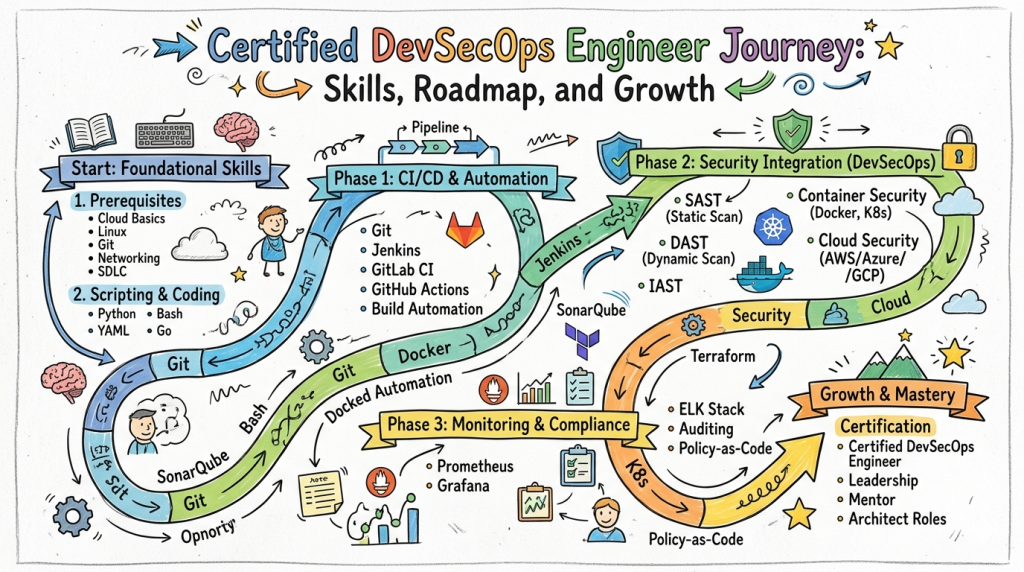
Security is now part of everyday engineering work. Teams ship faster, use cloud, containers, and microservices, and face more security risks at the same time. A Certified DevSecOps Engineer role brings development, operations, and security together in a practical way so that security becomes part of the pipeline, not a late-stage blocker. This guide is written for working engineers, software developers, SREs, and managers in India and globally. It will help you understand what the Certified DevSecOps Engineer certification is, how it fits into your career, how to prepare, and which related certifications and learning paths make sense next.
Certification overview table
This table gives you a quick view of the Certified DevSecOps Engineer certification and how it fits into your journey.
| Track | Level | Who it’s for | Prerequisites | Skills covered | Recommended order |
|---|---|---|---|---|---|
| DevSecOps | Intermediate to advanced | Software engineers, DevOps engineers, SREs, security engineers, cloud engineers, platform engineers, technical leads, managers | Basic Linux and Git, CI/CD basics, scripting familiarity, basic cloud concepts, awareness of common security principles | Secure SDLC, CI/CD security, SAST/DAST/SCA, container and Kubernetes security, secrets management, policy-as-code, compliance automation, cloud security basics | After DevOps / cloud fundamentals, before advanced security or architecture certifications |
Deep dive into Certified DevSecOps Engineer
What it is
Certified DevSecOps Engineer is a hands-on, role-focused certification that teaches you how to embed security in every stage of the delivery pipeline. It covers both concepts and practical implementation using real tools and workflows.
Instead of treating security as a separate step, this certification shows you how to make it part of code changes, builds, tests, deployments, and production operations.
Who should take it
- Software engineers who want to write and ship secure applications and APIs
- DevOps engineers who manage CI/CD pipelines and cloud infrastructure
- SREs who own reliability, availability, and incident response
- Security engineers who want to work closely with DevOps and engineering teams
- Cloud engineers who design and maintain modern, cloud-native architectures
- Platform engineers and technical leads who define delivery platforms and guardrails
- Engineering managers who oversee delivery and security outcomes
Skills you will gain
- Understanding of secure SDLC and how to shift security left
- Designing and securing CI/CD pipelines across different stacks
- Integrating SAST, DAST, SCA, and container scans into pipelines
- Applying secrets management and secure configuration in code and environments
- Hardening containers, images, and Kubernetes clusters
- Implementing policy-as-code and automated gatekeeping rules
- Building dashboards and reports for vulnerabilities, risks, and trends
- Communicating security findings and trade-offs with non-security stakeholders
Real-world projects you should handle after this certification
- Build a CI/CD pipeline that runs automated security checks on each commit and pull request
- Implement container image scanning and enforce policies before deployment
- Configure secrets management for applications, pipelines, and cloud resources
- Deploy applications to Kubernetes with network policies, RBAC, and basic hardening
- Set up policy-as-code rules that block risky changes or configurations automatically
- Create and maintain a lightweight security dashboard for teams and management
Preparation plans for Certified DevSecOps Engineer
You can choose a fast, standard, or deep-dive plan depending on your experience and available time.
7–14 day fast-track plan
This is suitable if you already work with DevOps tools and basic security:
- Day 1–2: Refresh Git, CI/CD concepts, pipelines, and cloud basics
- Day 3–4: Learn secure SDLC, DevSecOps fundamentals, and threat awareness
- Day 5–6: Practice SAST, DAST, and SCA tools in a demo pipeline
- Day 7–8: Explore container and Kubernetes security basics, image scanning, and policies
- Day 9–10: Implement secrets management and simple policy-as-code rules
- Day 11–12: Build an end-to-end mini project that includes code, pipeline, security scans, and deployment
- Day 13–14: Revise all topics, review notes, and solve practice questions or scenarios
30 day standard plan
This is ideal for most working professionals:
- Week 1: DevOps fundamentals, Git workflows, CI/CD pipelines, basic scripting and cloud concepts
- Week 2: Secure SDLC, foundational application security concepts, OWASP-style risks, DevSecOps practices
- Week 3: Tooling labs for SAST, DAST, SCA, container scanning, and secrets management in pipelines
- Week 4: Kubernetes security basics, policy-as-code, compliance automation, building small end-to-end projects, mock tests, and revision
60 day deep-dive plan
Choose this if you are new to DevOps or security and want deeper comfort:
- First 30 days: Follow the 30 day plan with slower pace and extra lab time
- Next 30 days:
- Build 2–3 mini projects using different tech stacks and tools
- Experiment with multiple scanners and policy tools, compare their outputs
- Simulate real scenarios such as breaking builds on high severity vulnerabilities
- Prepare a small learning portfolio to showcase your DevSecOps work
- Do weekly practice sessions with scenario-based questions
Common mistakes to avoid
- Thinking DevSecOps is just “adding a security tool” to CI/CD
- Learning tools without understanding why and where to use them
- Ignoring application security and focusing only on infrastructure
- Skipping hands-on labs and relying only on theory or slides
- Not documenting projects, so you cannot show your work to managers or interviewers
- Trying to cover too many tools at once and not going deep on any pattern
Next certifications to take
Once you finish Certified DevSecOps Engineer, you can grow in three clear directions.
Same track (DevSecOps / security)
Pick an advanced DevSecOps, cloud security, or application security certification that goes deeper into architecture, governance, and advanced threat management. This helps you become a go-to person for secure design and secure delivery.
Cross-track (platform and reliability)
Choose a Kubernetes, SRE, or cloud platform certification. This strengthens your understanding of how secure workloads run in production and how to connect reliability, performance, and security.
Leadership (architecture and decision-making)
Aim for a security, architecture, or engineering leadership program. This will help you guide teams, define policies, and make balanced decisions about risk, cost, and delivery.
Choose your path – 6 learning paths
Below are six learning paths showing how Certified DevSecOps Engineer fits into different career goals.
DevOps path
- Start: Linux, Git, scripting, CI/CD basics, and cloud fundamentals
- Then: Core DevOps or cloud engineer certification
- Next: Certified DevSecOps Engineer to add strong security to your pipelines
- Later: Kubernetes, SRE, monitoring, and observability certifications
DevSecOps path
- Start: Programming basics, application development, and simple DevOps practices
- Then: Introductory application security or general security certification
- Next: Certified DevSecOps Engineer as your main DevSecOps badge
- Later: Advanced DevSecOps, cloud security, and security architecture certifications
SRE path
- Start: Linux, networking, monitoring, alerting, and reliability concepts
- Then: SRE-focused certification or training
- Next: Certified DevSecOps Engineer to bring security into reliability and operations
- Later: Advanced SRE, chaos engineering, and cloud reliability programs
AIOps / MLOps path
- Start: DevOps basics, data pipelines, and ML workflows
- Then: MLOps or AIOps-oriented training or certifications
- Next: Certified DevSecOps Engineer to secure ML services, APIs, and data pipelines
- Later: Data security, model security, and governance-focused programs
DataOps path
- Start: Data engineering basics, ETL, data warehousing, and analytics tools
- Then: Data engineering or DataOps certification
- Next: Certified DevSecOps Engineer to secure data pipelines, APIs, and platform components
- Later: Data privacy, data governance, and analytics platform certifications
FinOps path
- Start: Cloud fundamentals and cloud cost management basics
- Then: FinOps practitioner certification or course
- Next: Certified DevSecOps Engineer to design secure and cost-aware architectures and pipelines
- Later: Cloud governance, architecture, and advanced FinOps training
Role → Recommended certifications
| Role | Recommended certifications (including Certified DevSecOps Engineer) |
|---|---|
| DevOps Engineer | DevOps / cloud fundamentals, container and Kubernetes certification, Certified DevSecOps Engineer, monitoring and observability certification |
| SRE | SRE certification, Kubernetes or platform certification, Certified DevSecOps Engineer, incident management or reliability program |
| Platform Engineer | Cloud platform and Kubernetes certification, infrastructure-as-code certification, Certified DevSecOps Engineer, security or compliance-focused program |
| Cloud Engineer | Core cloud provider certification, container or serverless certification, Certified DevSecOps Engineer, cloud security specialization |
| Security Engineer | General security or application security certification, cloud security certification, Certified DevSecOps Engineer, advanced DevSecOps or security architecture certification |
| Data Engineer | Data engineering certification, DataOps or analytics platform certification, Certified DevSecOps Engineer (for securing data platforms), data security or privacy certification |
| FinOps Practitioner | FinOps practitioner certification, cloud fundamentals certification, Certified DevSecOps Engineer (for secure and efficient designs), cloud governance or architecture certification |
| Engineering Manager | Cloud and DevOps awareness training, Certified DevSecOps Engineer (for understanding secure delivery), leadership or architecture-focused certification |
Top institutions for DevSecOps training and certification support
DevOpsSchool
DevOpsSchool provides practical DevOps and DevSecOps training designed for working professionals. Their programs focus on real-world labs, guided projects, and scenarios that match how teams actually build and ship software. They also help learners connect training directly with career growth.
Cotocus
Cotocus offers specialized DevOps, cloud, and security training and consulting. They work closely with individuals and teams to design learning paths that align with current roles and future goals. The training is structured, mentor-led, and focused on applied skills rather than just exams.
Scmgalaxy
Scmgalaxy focuses on software configuration management, DevOps, and automation practices. Their courses help you understand how version control, build pipelines, and deployment workflows connect with security. They include real examples from common tools and environments.
BestDevOps
BestDevOps provides learning content and training around DevOps and DevSecOps topics. Their goal is to simplify complex ideas so that working engineers can adopt them quickly. They cover tools, practices, trends, and career advice for people at different stages.
devsecopsschool.com
DevSecOpsSchool is dedicated to DevSecOps training and certifications. Their Certified DevSecOps Engineer program is centered on real pipelines, tools, and security patterns. The learning flow moves from foundations to implementation, with strong focus on hands-on labs and practical checklists.
sreschool.com
SRESchool specializes in Site Reliability Engineering and production operations. Their training connects reliability practices with security considerations such as secure configuration, secure rollouts, and guarded changes. This is useful for SREs who want to understand and apply DevSecOps principles.
aiopsschool.com
AIOpsSchool focuses on AI-driven operations, automation, and intelligent monitoring. Their programs help you use data and automation to manage complex systems at scale. They also show how to integrate security signals into operations for smarter decisions.
dataopsschool.com
DataOpsSchool helps engineers and teams design reliable, automated, and secure data pipelines. Their training connects DataOps principles with DevSecOps ideas, especially when data platforms hold sensitive or regulated information. This is useful if you work in analytics, BI, or data engineering.
finopsschool.com
FinOpsSchool focuses on cloud cost management and financial operations. They help engineers, architects, and finance teams understand cost drivers and optimize cloud usage. They also highlight how security, architecture, and cost decisions must work together in modern cloud environments.
FAQs about Certified DevSecOps Engineer
1. What exactly does a Certified DevSecOps Engineer do?
They design and maintain secure development and delivery pipelines. They integrate security checks, manage vulnerabilities, guide teams on secure practices, and work closely with developers, operations, and security stakeholders.
2. How difficult is the Certified DevSecOps Engineer certification?
It is moderate for someone with basic DevOps and security knowledge. It becomes easier if you are already comfortable with CI/CD, code repositories, and cloud basics, and harder if you are new to all three.
3. How long does preparation usually take?
Most people need between 30 and 60 days with steady effort. If you already work with pipelines and security tools, a focused 7–14 day plan can also work.
4. What are the prerequisites before starting?
You should know basic Linux, Git, CI/CD concepts, and one programming or scripting language. A basic understanding of security principles, such as authentication, authorization, and common vulnerabilities, is also helpful.
5. Do I need prior security experience?
Deep security experience is not mandatory, but you should be ready to learn application and cloud security basics. The certification itself will guide you through where and how security fits into DevOps practices.
6. In what order should I take related certifications?
A simple sequence is: DevOps or cloud fundamentals → Certified DevSecOps Engineer → advanced security, SRE, or architecture certifications. You can adjust this based on your role and interest.
7. How does this certification help my career?
It makes you more valuable because you can reduce risk while keeping delivery speed high. Companies actively look for people who can bridge DevOps and security, and this certification proves you are on that path.
8. Is this certification useful for managers?
Yes, managers gain a clear view of how security should integrate into delivery. It helps them make better decisions about tools, budgets, processes, and team structure.
9. Can early-career engineers or freshers take this certification?
They can, if they first learn basic DevOps and programming. The value grows when you apply the concepts to at least one real project or intern-level experience.
10. What kind of real-world work can I do after this certification?
You will be able to design and implement secure pipelines, manage vulnerability scans, help teams fix issues, and improve security posture over time. You can also contribute to security reviews and audits.
11. How should I practice for the exam?
Create small demo projects and build pipelines with security checks. Experiment with different scanners, secrets tools, and policies. Take notes as you go and revise them regularly.
12. What is the best next step after passing?
Pick one of the three directions: go deeper into DevSecOps, strengthen your platform skills with Kubernetes or SRE, or move toward leadership and architecture-focused programs.
FAQs specifically on Certified DevSecOps Engineer
1. Is Certified DevSecOps Engineer more about tools or mindset?
It is about both, with a strong focus on mindset and repeatable patterns. Tools may change over time, but the way you integrate security into pipelines and processes remains similar.
2. Do I need to learn multiple programming languages?
No, you do not need many languages. Comfort with one main language and some scripting is usually enough for pipelines and automation tasks.
3. Will this help me move from pure DevOps to a security-focused role?
Yes, it is a common path. Many DevOps engineers use this certification to move into DevSecOps or security engineer roles.
4. Can this certification help me work with compliance teams?
Yes, because you will understand how to automate checks, gather evidence, and report on security posture. This makes it easier to work with compliance and audit teams.
5. Is a strong math background needed?
No, a strong math background is not required. Logical thinking, curiosity, and comfort with tools and scripts matter more.
6. What if my company does not use all the tools covered?
That is normal. You are learning categories and patterns, not just specific tools. You can map the concepts to whatever tools your company uses.
7. Can this certification help me in interviews?
Yes, especially if you bring concrete examples of projects and pipelines you have built or improved. Interviewers look for real stories, not just certificates.
8. How often should I update my skills after this?
You should update your skills regularly by learning new tools, patterns, and cloud services. DevSecOps is an active, evolving area, so continuous learning is part of the journey.
Conclusion
Certified DevSecOps Engineer is a practical and powerful certification for software engineers, DevOps engineers, SREs, cloud engineers, security engineers, and managers. It teaches you how to bring security into your daily workflows instead of treating it as a separate, late-stage activity. This shift is critical for modern teams that rely on automation, cloud, containers, and continuous delivery. By choosing a clear preparation plan, following a learning path that matches your role, and learning with the help of trusted institutions, you can build a solid DevSecOps foundation. This will help you protect systems, build trust with stakeholders, and open new career opportunities in a competitive market.
