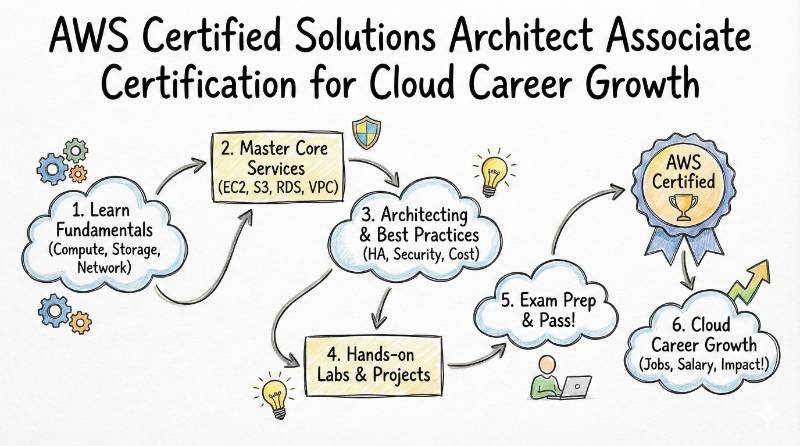
Introduction
Cloud computing is no longer a “future” trend. It is the bedrock of modern engineering. Having seen the industry shift from physical data centers to virtualized infrastructure and now to serverless and AI-driven clouds, I can tell you that the AWS Certified Solutions Architect – Associate is the single most important milestone for any serious professional. Whether you are an engineer looking to build better systems or a manager trying to understand your team’s stack, this guide is designed to give you a clear, no-nonsense path to mastering AWS architecture.
AWS Certification Overview Table
Here is a breakdown of the primary AWS certification tracks. This helps you see where the Solutions Architect – Associate fits into the bigger picture.
| Track | Level | Who it’s for | Prerequisites | Skills Covered | Recommended Order |
| Foundational | Foundational | Beginners, Sales, Managers | None | Cloud basics, Billing | 1st |
| Solutions Architect | Associate | Engineers, Architects | Basic IT knowledge | System design, VPC, S3, EC2 | 2nd |
| Developer | Associate | Software Developers | Basic Coding | CI/CD, SDKs, Lambda | 3rd |
| SysOps Administrator | Associate | System Admins | Ops experience | Monitoring, Troubleshooting | 4th |
| Solutions Architect | Professional | Senior Architects | Associate Level | Complex multi-tier design | 5th |
| DevOps Engineer | Professional | DevOps Professionals | Assoc. Dev or SysOps | Automation, SDLC | 6th |
| Security | Specialty | Security Engineers | Associate Level | Encryption, IAM, Compliance | After Associate |
Deep Dive: AWS Certified Solutions Architect – Associate
What it is
The AWS Certified Solutions Architect – Associate is a certification that validates your ability to design and deploy secure and robust applications on AWS technologies. It focuses on the “Well-Architected Framework” to ensure your designs are cost-effective and resilient.
Who should take it
This is for Software Engineers, Cloud Architects, and Technical Managers. If you are responsible for making decisions about which AWS services to use for a project, this is for you.
Skills you’ll gain
- Designing resilient architectures (High Availability and Fault Tolerance).
- Designing high-performing architectures (Scalability and Elasticity).
- Designing secure applications (IAM, VPC Security, Data Encryption).
- Designing cost-optimized architectures (Right-sizing, Spot Instances).
Real-world projects you should be able to do
- Building a multi-tier web application using EC2, Auto Scaling, and Load Balancers.
- Setting up a secure, private network using VPC with public and private subnets.
- Creating a serverless data processing pipeline using S3, Lambda, and DynamoDB.
- Implementing a disaster recovery strategy with multi-region backups.
Preparation Plan
- 7–14 Days (The Crash Course): Best for those with heavy hands-on experience. Focus 4 hours a day on “Exam Readiness” digital training and taking 5-10 full-length practice exams.
- 30 Days (The Balanced Path): Ideal for working engineers. Spend 1.5 hours daily. Weeks 1-2 on core services (Compute, Storage, Networking). Week 3 on Security and Databases. Week 4 on Mock Exams.
- 60 Days (The Deep Learner): Best for beginners. Spend 1 hour daily. Include hands-on labs for every service you study. Read whitepapers like the “Well-Architected Framework” in detail.
Common Mistakes
- Only studying theory: The exam is scenario-based; you must know how services interact.
- Ignoring Networking: VPC and Subnetting are usually the hardest parts for developers.
- Over-focusing on EC2: AWS is moving toward serverless (Lambda/Fargate); don’t ignore them.
- Not using practice exams: The phrasing of AWS questions can be tricky.
Best next certification after this
If you want to stay in architecture, move to AWS Certified Solutions Architect – Professional. If you want to focus on automation, go for AWS Certified Developer – Associate.
Choose Your Path: 6 Learning Journeys
Cloud expertise isn’t one-size-fits-all. Depending on your career goals, you should align your AWS knowledge with a specific discipline:
1. DevOps Path
Focuses on the intersection of development and operations. You will learn to use AWS CodePipeline, CodeBuild, and CloudFormation to automate the entire software delivery life cycle.
2. DevSecOps Path
Takes DevOps and adds a heavy layer of security. You’ll master AWS GuardDuty, Inspector, and WAF to ensure security is integrated into the CI/CD pipeline from day one.
3. SRE (Site Reliability Engineering) Path
Focuses on system uptime and performance. You will dive deep into CloudWatch, X-Ray, and AWS Health to build self-healing systems that meet strict Service Level Objectives (SLOs).
4. AIOps / MLOps Path
The focus here is on managing Machine Learning models at scale. You’ll work with Amazon SageMaker and Bedrock to build and monitor AI-driven applications and automate model deployments.
5. DataOps Path
Designed for those managing data lakes and pipelines. You will master AWS Glue, Redshift, and Athena to ensure data is clean, accessible, and flowing efficiently through the organization.
6. FinOps Path
Focuses on cloud financial management. You’ll learn to use Cost Explorer, AWS Budgets, and Savings Plans to ensure the organization gets the most value out of every dollar spent on the cloud.
Role → Recommended Certifications Mapping
| Role | Primary Certification | Secondary / Specialty |
| DevOps Engineer | Solutions Architect – Associate | DevOps Engineer – Professional |
| SRE | Solutions Architect – Associate | SysOps Admin – Associate |
| Platform Engineer | Solutions Architect – Associate | Advanced Networking – Specialty |
| Cloud Engineer | Solutions Architect – Associate | Developer – Associate |
| Security Engineer | Solutions Architect – Associate | Security – Specialty |
| Data Engineer | Data Engineer – Associate | Solutions Architect – Associate |
| FinOps Practitioner | Cloud Practitioner | Solutions Architect – Associate |
| Engineering Manager | Cloud Practitioner | Solutions Architect – Associate |
Next Certifications to Take
Once you have your Associate badge, where do you go? Here are three distinct directions:
- Same Track (Vertical Growth): AWS Certified Solutions Architect – Professional. This is the “Gold Standard” for senior architects.
- Cross-Track (Horizontal Growth): AWS Certified Developer – Associate. This helps you understand the “How” of building, not just the “Where.”
- Leadership (Strategy): AWS Certified Security – Specialty. Security is a top priority for CTOs; having this specialty makes you a strategic asset to any leadership team.
Top Training Institutions for AWS
If you are looking for structured training to pass the AWS SAA exam, these institutions are highly recommended:
DevOpsSchool
A premier institute specializing in end-to-end cloud and DevOps training. They offer expert-led sessions, comprehensive study materials, and a strong focus on real-world hands-on labs that prepare you for the actual job, not just the exam.
Cotocus
Known for its high-quality technical workshops and corporate training. They provide personalized mentorship and have a track record of helping engineers transition into high-paying cloud roles through specialized AWS curriculum.
Scmgalaxy
A community-driven platform that provides deep technical insights and training in Software Configuration Management and Cloud. Their AWS programs are designed for practical implementation, making them a favorite for working professionals.
BestDevOps
Focuses specifically on the “Best Practices” of cloud architecture. They provide focused training modules that simplify complex AWS concepts, making it easier for managers and senior engineers to grasp architectural nuances.
DevSecOpsSchool
The go-to place for security-conscious cloud training. Their AWS programs emphasize the security-first mindset, teaching you how to build architectures that are compliant and protected against modern threats.
Sreschool
Specializes in training engineers for reliability and performance. Their AWS courses go beyond standard syllabus topics, focusing on monitoring, observability, and incident response within the AWS ecosystem.
Aiopsschool
If you are looking to merge AI with Cloud Operations, this is the place. They provide cutting-edge training on using AWS AI/ML services to automate and optimize cloud infrastructure.
Dataopsschool
Focuses on the data side of the cloud. Their training helps you master AWS data services, teaching you how to build scalable data architectures and efficient pipelines.
Finopsschool
A unique institution dedicated to the financial side of the cloud. They teach you the art of cloud cost optimization, a skill that is increasingly demanded by large-scale enterprises globally.
FAQs (Frequently Asked Questions)
1. How difficult is the AWS Solutions Architect – Associate exam?
It is moderately difficult. It’s not a memory test; it’s a design test. You need to understand how services work together to solve specific business problems.
2. How much time do I need to prepare?
For someone with basic IT knowledge, 60 to 80 hours of study is typical. Working professionals usually take 4 to 8 weeks.
3. Are there any prerequisites for the SAA exam?
Officially, none. However, having a basic understanding of IT concepts (Servers, IP addresses, Databases) is highly recommended. Many people take the Cloud Practitioner exam first.
4. What is the value of this certification in the job market?
It is one of the most recognized certifications in tech. It often leads to immediate salary hikes and is frequently a requirement for Cloud Architect and Senior Engineer roles.
5. In what sequence should I take AWS exams?
Start with Cloud Practitioner (optional), then Solutions Architect – Associate. From there, you can branch into Developer or SysOps depending on your daily role.
6. Does this certification expire?
Yes, it is valid for 3 years. You can recertify by retaking the exam or passing the Professional level exam.
7. Can a manager benefit from this technical certification?
Absolutely. It gives you the “technical vocabulary” to understand your team’s challenges and helps you make better budgeting and architectural decisions.
8. What kind of career outcomes can I expect?
Common roles include Cloud Architect, Solutions Architect, and Cloud Engineer. In India and globally, these roles are among the highest-paid in the IT sector.
9. Is hands-on experience necessary to pass?
While you can pass using just theory, you will struggle in the real world. Hands-on labs are essential to truly understand the “Well-Architected” principles.
10. What is the passing score for the exam?
The passing score is 720 out of 1000. The exam consists of 65 multiple-choice or multiple-response questions.
11. Which is better: Solutions Architect or DevOps Engineer?
They serve different purposes. Solutions Architect is about “Designing the house,” while DevOps is about “Building the factory that makes the house.” Both are highly valuable.
12. Are the questions mostly about coding?
No. This exam is about infrastructure and architecture. You don’t need to be a coding expert, but you should understand how applications behave.
Frequently Asked Questions (FAQs)
1. Is the AWS Certified Solutions Architect – Associate exam suitable for beginners?
It is the gold standard for those starting their professional cloud journey. While the Cloud Practitioner is more basic, the Solutions Architect – Associate is the first real “technical” milestone. If you have a foundational understanding of IT (like networking and servers), you can jump straight into this.
2. How long does the certification remain valid?
The certification is valid for three years. To maintain your status, you can either retake the latest version of the Associate exam or “level up” by passing the AWS Certified Solutions Architect – Professional exam, which automatically renews your Associate-level certification.
3. What is the passing score, and how many questions are there?
The exam consists of 65 questions (multiple-choice or multiple-response) to be completed in 130 minutes. The passing score is 720 out of 1000. It’s important to note that some questions are unscored and used by AWS for data gathering, but you won’t know which ones they are.
4. Can I take the exam from home, or do I need to go to a center?
You have both options. You can take it at a physical Pearson VUE testing center or via an online proctored exam from your home or office. If you choose the online option, ensure you have a stable internet connection and a private, quiet space.
5. How much does the exam cost?
The registration fee is 150 USD. However, once you pass any AWS exam, you typically receive a 50% discount voucher from AWS that you can apply to your next recertification or a higher-level exam.
6. Do I need to know how to code to pass this exam?
Not extensively. This is an architecture exam, not a developer exam. While you should be able to read simple JSON (for IAM policies) and understand the logic of how applications connect to databases, you won’t be asked to write complex code in Python or Java.
7. Which domains are covered most in the exam?
The exam is divided into four main domains:
- Design Resilient Architectures (26%) * Design High-Performing Architectures (24%) * Design Secure Applications and Architectures (30%) * Design Cost-Optimized Architectures (20%) As you can see, Security and Resiliency carry the most weight.
8. What happens if I fail the exam on the first try?
Don’t worry—it happens to the best of us. You must wait 14 days before you are eligible to retake the exam. You can take the exam as many times as you need, but you will have to pay the full registration fee for each attempt.
Testimonials
“I had been working as a System Admin for 10 years, but I felt stuck. Getting the AWS SAA certification was the turning point. It gave me the confidence to apply for Architect roles, and I haven’t looked back since.” — Senior Cloud Engineer, Bangalore
“As an Engineering Manager, I needed to understand why our AWS bills were so high. This certification taught me about cost optimization and helped me lead my team to reduce our cloud spend by 30%.” — Engineering Manager, USA
Conclusion
The AWS Certified Solutions Architect – Associate is more than just a certificate on your wall; it is a fundamental shift in how you view technology. It moves you from “fixing things” to “designing things.” Whether you are just starting your cloud journey or you are a veteran looking to formalize your years of experience, this path is the most rewarding one you can take.
