Introduction
Classical computers run on plain switches. A bit stays firmly off as a 0 or flips on as a 1.
A quantum circuit feels more like a musical score. Each line represents a qubit, and each note is a gate guiding how these states play together.
Learning how to arrange these notes is what quantum circuit design is all about. You do not need a physics degree to make these parts work.
Platforms like QuantumUting.com help new developers pick up quantum programming skills through clear visual tools and guided practice.
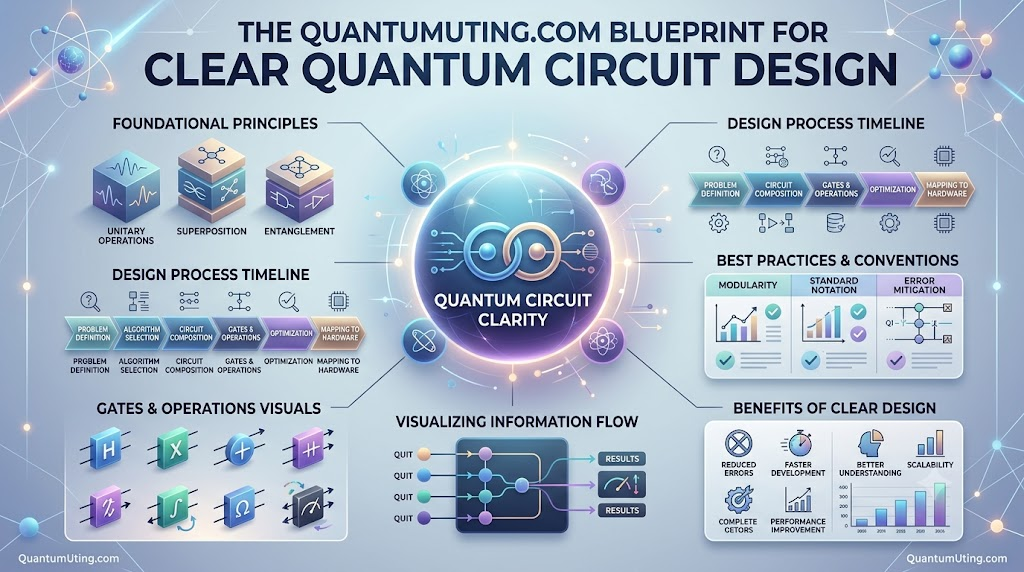
This guide breaks down every wire, gate, and measurement step so you can build your first working quantum circuit today.
Simple Definition & Basics
A quantum circuit is a step-by-step routine that moves quantum information along wires and changes it using quantum logic gates.
You read a quantum circuit diagram just like a sentence, strictly from left to right. Horizontal lines represent individual qubits that carry quantum states forward through time.
As the qubits move across the wires, gates sit in their path to change their values. At the far right end, a measurement box checks the final result and turns it into ordinary data.
Core Building Blocks of a Quantum Circuit
Every quantum circuit relies on a few fundamental parts to hold, change, and read information.
Qubit Wires
- Carrying States: Horizontal lines track the life of each qubit from start to finish.
- Starting State: Most wires automatically initialize in the base 0 state.
Classical Register Lines
- Double Lines: These distinct tracks sit below qubit wires to hold regular data.
- Storing Output: They save the standard 0 or 1 values captured during readout.
Single-Qubit Gates
- Local Changes: Square boxes placed on a single wire modify only that one qubit.
- State Shifts: They flip states or place a qubit into a balanced split between 0 and 1.
Multi-Qubit Entangling Gates
- Connected Wires: Vertical lines link two or more horizontal qubit tracks together.
- Shared Logic: These gates make one qubit react based on what another qubit is doing.
Measurement Operations
- Meter Symbols: Small gauge icons show where quantum behavior ends.
- Data Conversion: They turn fragile quantum states into plain computer numbers you can print.
Beginner’s Guide to Quantum Circuit Design
Building circuits requires learning how basic quantum gates change data on a wire.
The X gate works just like a NOT gate in regular hardware. If a qubit enters as a 0, the X gate flips it into a 1. If it enters as a 1, the gate flips it back to a 0. It is the most direct switch you can place on a wire.
The Hadamard gate, or H gate, creates balance. Think of it like spinning a coin on a flat table. While spinning, the coin is not purely heads or tails. The H gate places a 0 qubit into an even 50-50 mix of both 0 and 1 at the same time.
The CNOT gate brings two wires together for teamwork. It uses a control qubit and a target qubit. If the control qubit is 1, the gate flips the target qubit. If the control qubit is 0, the target qubit stays completely untouched.
Measurement acts as the final stop. When you measure a qubit, the spinning coin lands. The fragile state collapses instantly into a solid 0 or 1, and the result transfers to a classical bit.
Circuit depth measures how many gates run in sequence along your longest wire. More gates increase your gate count, which creates trouble on modern hardware. Extra depth gives background noise more time to slip in and cause errors before your run finishes.
QuantumUting.com Guide to Circuit Design
Designing circuits does not require building hardware in a lab. Modern browser tools let you drag and drop gates directly onto wires in real time.
You can drop an H gate on wire zero, snap a CNOT across both wires, and watch a state visualizer display the odds immediately.
When you want to write code, Python libraries like Qiskit let you define wires and gates in simple script files. You write a few lines to add gates, link wires, and set up your measurement registers.
You can then run your file through a cloud simulator for free. A simulator tests your logic without errors before you send jobs to real hardware.
Real-World Applications
Simple circuit patterns serve as the base for larger, practical tasks.
- Small Molecule Modeling: Chemists arrange gates to simulate how electrons interact inside simple chemical bonds.
- Security Research: Researchers test how quantum logic handles prime numbers to plan stronger future encryption tools.
- Portfolio Optimization: Financial teams use small sample circuits to test better ways to balance risk and return.
- Database Search Testing: Basic search routines use repetitive gate steps to find specific items in unordered lists faster.
Comparison Table: Classical Digital Circuits vs. Quantum Circuits
| Feature | Classical Digital Circuits | Quantum Circuits |
| Basic Unit | Regular bit (0 or 1) | Quantum bit or qubit |
| Fundamental Gate Type | AND, OR, NOT gates | X, H, CNOT gates |
| Reversibility | Most gates lose old input data | Almost all gates are fully reversible |
| State Reading | Can read wire values anytime | Reading collapses the quantum state |
| Output Certainty | Deterministic fixed output | Probabilistic statistical output |
Why Learning Circuit Design Early Matters
High-level software libraries are beginning to hide low-level circuit steps. Yet, understanding raw wires and gates keeps you ahead of common bugs.
When you know how gates alter states, you know why some operations create heavy hardware noise. You can spot unnecessary gates and trim your circuit depth yourself.
Developers who understand low-level logic write cleaner code that runs reliably on today’s noisy hardware.
Common Beginner Mistakes & How to Fix Them
Measuring Too Early
- The Mistake: Placing a measurement box in the middle of your circuit stops all quantum effects before the rest of your gates can run.
- The Fix: Keep all measurement operations at the very right end of your wires unless you are testing special dynamic circuits.
Stacking Deep Gate Chains
- The Mistake: Adding dozens of gates to a single wire causes noise to destroy your fragile quantum states.
- The Fix: Check your circuit depth regularly and combine steps to keep your wire pathways short.
Forgetting Classical Bit Registers
- The Mistake: Setting up gates without adding classical storage lines leaves your final measurement data with nowhere to go.
- The Fix: Always pair your qubit wire count with an equal number of classical output bits.
5 Easy Steps to Build and Run Your First Quantum Circuit
- Open Your Workspace: Start a new Python file or open a visual drag-and-drop circuit canvas.
- Set Up Wires: Create a circuit containing two qubit wires and two classical bit lines.
- Add a Hadamard Gate: Place an H gate on your first qubit wire to create a balanced state.
- Connect a CNOT Gate: Set your first wire as the control and your second wire as the target to link them.
- Measure and Read: Place measurement icons on both wires and run the file on a local simulator.
Career Paths in Quantum Software
- Quantum Circuit Engineer: Designs low-level gate layouts to make routines run with minimal hardware noise.
- Quantum Software Developer: Builds clean code libraries and interfaces that connect everyday software to quantum backends.
- Quantum Step-by-Step Rule Researcher: Invents new mathematical procedures that solve complex problems using fewer gates.
- Quantum Simulation Specialist: Tests how chemical reactions and material properties behave inside simulated quantum systems.
- Applications Engineer: Helps businesses find real tasks where hybrid quantum routines provide useful test results.
Future Trends in Quantum Circuit Tools
- Automated Circuit Optimizers: Smart compilers that automatically detect long gate paths and compress them into shorter steps.
- Visual Web Debuggers: In-browser tools that highlight where noise or state loss occurs along a wire in real time.
- Built-in Error Correction: Modular circuit designs that group many fragile qubits together to build one clean, protected logical qubit.
Common Myths Debunked
- Myth 1: You need advanced physics to wire a circuit. You only need basic logic, familiar coding skills, and simple probability concepts.
- Myth 2: Quantum circuits speed up every computing task. Circuits only speed up specific tasks like search routines and molecular modeling.
- Myth 3: You cannot run quantum code on normal laptops. Standard laptops can easily simulate circuits that use up to twenty qubits.
- Myth 4: A qubit is just 0 and 1 at the exact same moment. A qubit holds a smooth combination of chances that collapse only when read.
FAQ Section
1. What is the main goal of quantum circuit design?
The main goal is arranging gates on wires to guide quantum states toward a correct answer. It lets you process complex combinations of data before reading the final result.
2. Can I design quantum circuits on a normal computer?
Yes, you can design and test circuits using your standard web browser or local code editors. Modern laptop simulators easily handle simple circuits without needing real quantum hardware.
3. What does an H gate do in simple terms?
An H gate acts like a spinning coin by turning a certain 0 into an even mix of 0 and 1. It gives the qubit an equal chance of landing on either value upon measurement.
4. Why does circuit depth matter so much?
Circuit depth tracks the longest chain of gates running along any single wire. Shorter circuits finish faster and help prevent environmental noise from ruining the fragile quantum state.
5. What is the difference between a qubit and a classical bit?
A classical bit stays locked as either a 0 or a 1. A qubit can hold a blend of both states until a measurement forces it to pick one.
6. What is a CNOT gate used for?
A CNOT gate connects two qubits so they work together. It flips the second qubit only when the first qubit is set to 1.
7. Why do quantum circuits need classical bits at the end?
Qubits lose their quantum properties the moment you observe them. Classical bits are needed to store the standard numbers produced by the measurement step.
8. Are quantum gates reversible?
Yes, almost every quantum gate can be run backward to return to the original input state. Only the measurement step is irreversible because it collapses the state.
9. What programming language is best for quantum circuit design?
Python is the most popular choice for quantum developers today. Libraries like Qiskit let you build, modify, and simulate circuits with plain coding scripts.
10. How many qubits do I need to start learning?
You only need two or three qubits to learn every essential circuit concept. Two qubits are plenty to explore entanglement, logic gates, and measurement basics.
Getting started with quantum circuits does not require complex lab equipment or difficult physics equations. Once you see wires as timelines and gates as simple switches, building custom circuits becomes as intuitive as everyday coding. Explore sample layouts, test your own gate patterns on QuantumUting.com, and enjoy watching your first quantum states take shape.
