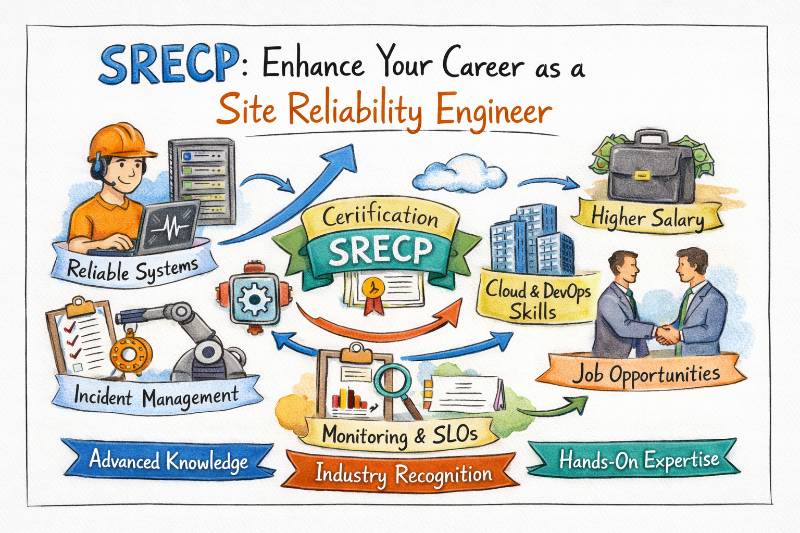
Introduction
The traditional “throw it over the wall” approach between development and operations is a relic of the past. As systems scale to millions of users, the cost of failure becomes astronomical. Reliability isn’t something you can “bolt on” later—it must be engineered from the ground up. Site Reliability Engineering (SRE) is the discipline that treats operations as a software problem. If you’ve worked with large-scale distributed systems, you know that manual intervention is the enemy of uptime. This guide walks you through the Site Reliability Engineering Certified Professional (SRECP)—a program designed for those who want to master the art of building systems that are both fast and incredibly stable.
Why SRE is the Modern Standard for Operations
Modern businesses demand 99.99% availability, and you cannot achieve that with spreadsheets and manual patching. SRE uses code to manage infrastructure, automate response patterns, and use data to balance the need for new features against the requirement for stability.
By becoming an SRECP, you shift your focus from manual “toil” to creating systems that manage themselves. This is the standard for companies like Google, Amazon, and Netflix. It’s about being proactive rather than reactive—predicting failures before they impact the user.
Deep Dive: Site Reliability Engineering Certified Professional (SRECP)
What it is
The SRECP is an advanced certification that validates your ability to design, build, and run large-scale, fault-tolerant systems. It goes beyond tools; it focuses on the SRE Mindset. You will master the math of reliability (SLIs/SLOs), the psychology of blameless cultures, and the technical rigors of automated scaling.
Who should take it
- Software Engineers: Learn to build “production-ready” code that handles real-world stress.
- System Administrators & Ops: Transition from manual maintenance into high-level automation roles.
- DevOps Engineers: Master the production-end of the delivery lifecycle.
- Engineering Managers: Gain the technical depth needed to lead elite reliability teams.
Skills you’ll gain
- Advanced Observability: Go beyond CPU graphs to implement “Golden Signals” (Latency, Traffic, Errors, Saturation) and distributed tracing.
- SLOs and Error Budgets: Learn to set targets that business stakeholders understand and use them to drive release velocity.
- Toil Reduction: Identify repetitive manual tasks and write the automation code necessary to eliminate them.
- Incident Response: Build a structured framework for responding to failures and conducting blameless postmortems.
- Chaos Engineering: Proactively inject faults into your system to prove that your failover mechanisms actually work.
Real-world projects you should be able to do
- Full-Stack Monitoring Suite: Design an observability dashboard that alerts specifically on business-critical SLO breaches.
- Automated Incident Runbooks: Write scripts that automatically trigger self-healing actions when a service becomes unhealthy.
- Blameless Postmortem Reports: Lead high-stakes review sessions that identify systemic root causes without assigning blame.
- Elastic Scaling Infrastructure: Build a system that automatically grows or shrinks based on real-time traffic demand.
Preparation plan
The 7–14 Day Plan: The Expert Sprint
This path is for senior engineers or those already working in a DevOps/SRE role. You already know the tools; you just need to master the SRE mindset.
- Days 1–3: The Core Theory. Focus on the “Google SRE” definitions. Understand the math behind Service Level Indicators (SLIs) and Service Level Objectives (SLOs). Practice calculating Error Budgets.
- Days 4–6: Cultural Shifts. Study the concept of “Blameless Post-Mortems.” Learn how to identify “Toil” (manual work) and the strategies used to eliminate it.
- Days 7–10: Advanced Scenarios. Work through case studies. How do you handle a massive outage? How do you balance a developer’s need for speed with the system’s need for stability?
- Days 11–14: Practice Exams. Take at least three mock tests. Focus on the questions you got wrong and read the documentation for those specific areas again.
The 30-Day Plan: The Professional Path
Week 1: Foundations of Reliability
Spend your first week learning why SRE exists. Read the history of SRE and how it differs from traditional IT operations. Master the “Four Golden Signals” of monitoring: Latency, Traffic, Errors, and Saturation.
Week 2: Measuring Success (SLIs, SLOs, and SLAs)
This is the most important week. You must be able to design a reliability strategy.
- Hands-on: Build a small dashboard in Grafana that tracks the uptime of a simple web application.
- Theory: Understand how an “Error Budget Policy” works. What happens when the budget is zero? (Hint: You stop all new releases).
Week 3: Toil and Automation
SRE is about writing code to do your job for you.
- Hands-on: Use Ansible or Python to automate a task you usually do manually, like clearing logs or restarting services.
- Key Concept: Understand that SREs should spend at least 50% of their time on this type of engineering work.
Week 4: Incident Management and Review
Learn how to handle the “pager” when it goes off at 2 AM.
- Study: The Incident Command System. Who is the “Incident Commander”? Who is the “Scribe”?
- Practice: Write a blameless post-mortem for a recent issue you had at your current job. Focus on the process failure, not the human error.
The 60-Day Plan: The Foundation Builder
If you are transitioning from a different field or are a junior engineer, take your time. This path ensures you don’t just pass the test, but you actually learn the craft.
- Days 1–20: Linux and Cloud Basics. You cannot be an SRE if you don’t understand the operating system. Master the Linux command line, file permissions, and basic networking. Launch and manage servers on AWS or Azure.
- Days 21–40: Monitoring and Containers. Learn Docker and Kubernetes. These are the “homes” of modern SRE. Set up Prometheus to monitor your containers.
- Days 41–55: The SRECP Core. Now, dive into the SRECP curriculum. Follow the 14-day plan above but spend more time on each topic.
- Days 56–60: Final Review. Focus on your weak spots. If you struggle with math, spend more time on SLO calculations. If you struggle with culture, re-read the “Seeking SRE” case studies.
Common mistakes
- Aiming for 100% Uptime: This is a rookie mistake. 100% is impossible and too expensive. SRE is about choosing the right level of reliability.
- Tooling Without Culture: Buying a monitoring tool won’t save you if your team still blames individuals for outages.
- Ignoring Technical Debt: SREs must balance short-term fixes with long-term system health to prevent “rot.”
Best next certification after this
After SRECP, the AIOps Certified Professional (AIOCP) is the perfect step to learn how Machine Learning can automate the maintenance of complex systems.
Comprehensive Certification List
| Track | Level | Who it’s for | Prerequisites | Skills Covered | Recommended Order |
| SRE | Professional | Engineers, Managers | Basic DevOps Knowledge | SLIs/SLOs, Observability, Toil | 1 |
| DevOps | Professional | Software/Ops Engineers | IT Fundamentals | CI/CD, Infrastructure as Code | 1 |
| DevSecOps | Professional | Security/DevOps | DevOps Basics | Security Automation, Compliance | 2 |
| AIOps | Advanced | SREs, Data Engineers | SRE Knowledge | ML for Ops, Anomaly Detection | 3 |
| DataOps | Professional | Data Engineers | SQL/Data Basics | Data Pipelines, Data Quality | 2 |
| FinOps | Professional | Cloud/Finance | Cloud Basics | Cost Optimization, Cloud Billing | 2 |
Choose Your Path: 6 Learning Journeys
Every engineer’s journey is different. Pick the path that matches your professional goals:
- DevOps Path (Speed): Focus on the pipeline and getting features to users as fast as possible.
- DevSecOps Path (Safety): Ensure security is built-in from the first line of code.
- SRE Path (Stability): Become the guardian of the production environment and user experience.
- AIOps/MLOps Path (Intelligence): Use AI to predict failures and manage ML models at scale.
- DataOps Path (Flow): Ensure data moves safely and quickly across your organization.
- FinOps Path (Efficiency): Balance high performance with a smart, optimized cloud bill.
Role → Recommended Certifications
| If your role is… | You should take… | Why? |
| DevOps Engineer | DevOps Certified Professional | Validates your core CI/CD and automation skills. |
| SRE | SRE Certified Professional | Proves you can manage reliability at enterprise scale. |
| Platform Engineer | SRECP + Kubernetes Administrator | Essential for building internal developer platforms. |
| Cloud Engineer | SRECP + Cloud Specialist | Merges reliability principles with cloud-specific knowledge. |
| Security Engineer | DevSecOps Certified Professional | Ensures you can automate security, not just audit it. |
| Data Engineer | DataOps Certified Professional | Focuses on the unique reliability needs of data pipelines. |
| FinOps Practitioner | FinOps Certified Professional | Validates your ability to link cloud spending to business value. |
| Engineering Manager | SRECP + DevOps Manager | Gives you the depth to lead high-performing teams. |
Next Certifications to Take
The SRECP is a major milestone, but the landscape is always evolving. Consider these three growth options:
- Same Track (Deepen): Look into specialized certifications for Chaos Engineering or advanced Kubernetes administration to master your platform.
- Cross-Track (Broaden): Take the DevSecOps Certified Professional (DSOCP). Reliability is useless if your system is compromised. Adding security to your SRE skills is a massive career booster.
- Leadership (Growth): If you want to move into executive roles, the Certified DevOps Manager (CDM) is essential for learning how to manage culture and scale teams.
Training & Certification Support Institutions
Choosing the right training partner is as critical as the certification itself. These institutions provide deep support for the SRECP:
- DevOpsSchool: A leading global provider known for its exhaustive curriculum and heavy focus on real-world labs. Their trainers are active practitioners who bring practical “war stories” to the classroom.
- Cotocus: Specialized in high-end consulting and training, excellent for corporate teams looking to modernize their operations at scale.
- Scmgalaxy: A massive community-driven platform providing technical insights, tutorials, and support for SRE tools like Ansible and Terraform.
- BestDevOps: Known for high-intensity bootcamps that focus on getting you job-ready through simulated production environments.
- devsecopsschool: The place to go if you want to ensure your reliability practices are built on a “security-first” foundation.
- sreschool: A specialized portal dedicated entirely to SRE principles and Google-style reliability standards.
- aiopsschool: Prepares you for the future of SRE by integrating Machine Learning into your daily operations.
- dataopsschool: Focuses on the “reliability of data,” a growing field that combines SRE with data engineering.
- finopsschool: Teaches the financial side of operations, helping you understand cloud economics and cost optimization.
FAQs (General)
- How difficult is the SRECP exam?
It is a professional-level exam. It requires a solid grasp of both SRE theory (SLOs) and practical tools (monitoring/automation). - How much time should I dedicate to study?
Most professionals spend 30 to 45 days of consistent study and lab practice. - Are there any hard prerequisites?
No, but you will find it easier if you understand basic Linux and how web servers work. - In what sequence should I take these?
Start with DevOps to understand “Change,” then SRECP to understand “Stability.” - Is this certification valued globally?
Yes, SRE is a high-demand role worldwide, and this certification validates the specific mindset recruiters want. - Will this help me get a salary hike?
SRE roles typically command a 20–30% premium over traditional sysadmin or standard developer roles. - Is the exam online?
Yes, online proctored exams are available worldwide for your convenience. - Does the certification expire?
Yes, it is usually valid for 2–3 years to ensure you stay current with technology. - Can a manager take this course?
Absolutely. Managers need this knowledge to set realistic KPIs and prevent team burnout. - Do I need to know how to code?
You don’t need to be a full-stack dev, but you must be comfortable reading code and writing scripts for automation. - What is the passing score?
Generally around 65–70%. - Are labs included in the training?
Yes, reputable institutions like DevOpsSchool provide dedicated lab environments.
SRECP Specific FAQs
- What is the core focus of SRECP?
Engineering reliability into systems through automation and data-driven metrics. - Does SRECP cover Kubernetes?
Yes, it is the primary platform used to teach scaling and self-healing concepts. - SRE vs DevOps?
DevOps is a cultural philosophy; SRE is the prescriptive way to implement it for production. - Will I learn about on-call?
Yes, including how to structure on-call rotations to ensure fast resolution without burnout. - What tools are covered?
Concepts are applicable to many tools, with common hands-on examples using Prometheus, Grafana, ELK, and Ansible. - Is it for developers?
Yes, it helps you write “production-ready” code that is easier to maintain and run. - What are SLIs and SLOs?
Indicators (metrics) and Objectives (targets). They are the fundamental language SREs use to measure success. - How does it help my career?
It moves you from a “generalist” to a “specialist,” making you a critical asset to any company that relies on uptime.
Conclusion
Reliability is not an accident; it is the result of deliberate engineering. In my time in this field, I’ve seen countless tools come and go, but the core principles of SRE—automation, monitoring, and a blameless culture—have only become more critical. The SRECP is your gateway to mastering these principles. It won’t just make you a better engineer; it will change the way you think about software entirely. Stop fighting fires and start building systems that can’t be burned down.