Introduction
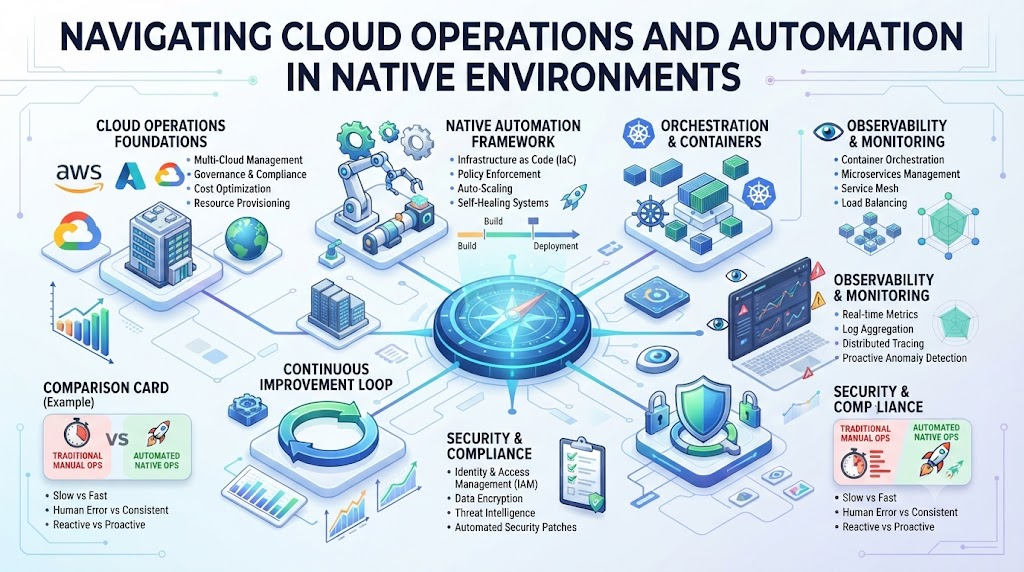
Managing distributed cloud environments often exposes engineering teams to unexpected friction, ranging from silent performance degradation to runaway infrastructure costs. When manual administrative tasks overload engineering pipelines, system reliability naturally suffers. Addressing these operational challenges requires robust cloud operations management, a discipline that bridges the gap between infrastructure deployment and continuous delivery. This article explores how organizations can transition away from reactive firefighting toward resilient, automated lifecycle management. Readers will learn core architectural frameworks, multi-provider strategies, observability fundamentals, and practical steps to optimize enterprise workloads.
2. What Is Cloud Operations Management?
Cloud operations management represents the continuous set of practices, tooling, and governance models used to maintain application health, security, and performance across cloud environments. Its core purpose is to codify manual operational tasks into predictable, software-defined workflows.
Within modern CloudOps, engineers manage compute, storage, and networking layers through continuous automated feedback loops. Engineering teams rely on these strategies to prevent configuration drift, enforce compliance, and maintain service-level agreements. Platform engineers, system reliability specialists, and DevOps personnel benefit directly by gaining clear visibility into system behavior and resource utilization.
3. How Does Cloud Operations Management Work?
The operational lifecycle of cloud systems relies on continuous telemetry, declarative configuration, and automated execution. Understanding this workflow helps teams design predictable infrastructure pipelines.
- Infrastructure Provisioning: Engineers define architecture using declarative templates, translating raw requirements into version-controlled resource manifests.
- Configuration Deployment: Continuous integration pipelines push application code and system configurations to target environments without manual intervention.
- Telemetry Collection: Monitoring agents and logging daemons stream real-time metrics, system logs, and distributed traces to centralized backends.
- State Evaluation: Observability platforms evaluate telemetry against predefined service health baselines and alerting thresholds.
- Automated Remediation: Event-driven automation triggers self-healing routines, autoscaling adjustments, or alert escalations when anomalies occur.
4. Core Components of Cloud Operations Management
Infrastructure as Code (IaC)
Declarative provisioning tools define infrastructure blueprints, ensuring that development, staging, and production environments remain structurally identical. This eliminates human error introduced through manual console clicks.
Monitoring and Observability
Granular metrics, structured logs, and distributed traces give operators deep visibility into internal application states, allowing teams to isolate bottlenecks quickly.
Security and Governance
Continuous compliance tooling and policy engines enforce least-privilege access, encryption standards, and structural configurations across all deployed assets.
5. Role of AWS, Azure, and GCP
Operating workloads across major hyperscalers requires understanding their native operational paradigms. Amazon Web Services provides deep building blocks via AWS CloudTrail, CloudWatch, and AWS Systems Manager for configuration control. Microsoft Azure integrates native telemetry and governance through Azure Monitor, Azure Policy, and Azure Arc for hybrid visibility. Google Cloud Platform emphasizes robust container orchestration and global scale utilizing Google Cloud Operations Suite (formerly Stackdriver) alongside Anthos for hybrid deployments. While each hyperscaler uses proprietary APIs, standardizing management abstractions reduces vendor lock-in.
6. Cloud Operations and Automation Considerations
Modern cloud automation replaces error-prone shell scripts and manual change tickets with immutable infrastructure patterns. By integrating continuous integration and continuous deployment pipelines with version-controlled configuration repositories, teams ensure that every environment modification undergoes automated validation. Automated policy enforcement checks templates for security misconfigurations before deployment takes place. Furthermore, autoscaling policies dynamically adjust compute capacities based on incoming user demand, optimizing resource allocation without requiring direct human intervention.
7. Monitoring, Observability, and Reliability
Achieving high availability requires distinguishing between traditional monitoring and modern observability. While monitoring tells an engineer whether a system is working, observability explains why it is failing. Teams define Service Level Indicators (SLIs) and Service Level Objectives (SLOs) to quantify user experience. When anomalies breach defined thresholds, automated alert routing systems notify on-call engineers with contextual log snippets and trace graphs, drastically shortening Mean Time to Resolution (MTTR).
8. Security and Governance
Effective cloud governance secures infrastructure without impeding engineering velocity. Implementing identity and access management under the principle of least privilege ensures that human users and service accounts possess only the permissions required for their specific tasks. Centralized secrets management prevents credentials from being hardcoded into source repositories. Continuous posture management tools scan cloud estates for public storage buckets, unencrypted data volumes, and outdated security groups, maintaining compliance readiness for regulatory frameworks.
9. Cloud Operations Best Practices
- Codify All Infrastructure: Manage compute, networking, and storage through version-controlled declarative templates to maintain structural consistency and auditability.
- Implement Least-Privilege Access: Restrict user and service account permissions to absolute minimum requirements, regularly auditing access keys and roles.
- Establish Unified Observability: Centralize logs, metrics, and traces across all environments to maintain complete visibility into application health.
- Automate Remediation Workflows: Use event-driven automation to handle routine scaling events, backup rotations, and known infrastructure faults.
- Enforce Tagging Standards: Mandate strict resource tagging policies to allocate cloud costs accurately and track workload ownership.
- Test Disaster Recovery Routines: Regularly execute automated failover and backup restoration drills to validate recovery time objectives under real-world failure conditions.
10. Common Mistakes
- Relying on Manual Console Modifications: Making direct adjustments inside cloud provider web consoles creates untracked configuration drift that breaks deployment pipelines.
- Ignoring Resource Sprawl: Failing to decommission temporary test clusters and orphaned storage volumes leads to bloated cloud expenditure.
- Overloading On-Call Teams with Noise: Configuring overly sensitive alerting rules causes alert fatigue, increasing the likelihood that critical production signals get ignored.
- Neglecting Cost Visibility: Treating cloud budgeting as an afterthought rather than a core operational metric results in unexpected financial overruns.
- Skipping Documentation: Neglecting architectural diagrams and operational runbooks leaves new team members stranded during emergency troubleshooting scenarios.
11. Real-World Use Cases
- Multi-Cloud Financial Platforms: Enterprises distribute core services across AWS and Azure to ensure regional redundancy and prevent single-vendor dependency.
- Automated Kubernetes Scale-Outs: E-commerce platforms handle sudden traffic spikes by dynamically provisioning container worker nodes via automated node autoscalers.
- Continuous Compliance Auditing: Financial institutions use automated policy engines to evaluate infrastructure configurations against regulatory mandates before production deployment.
12. Challenges and Limitations
Cloud operations management introduces distinct hurdles, including high cognitive load, complex tooling ecosystems, and skill gaps within traditional IT teams. Tool sprawl occurs when organizations adopt disconnected point solutions for monitoring, security, and deployment, resulting in fragmented workflows. Furthermore, managing multi-cloud architectures demands deep platform-specific expertise, making continuous training essential to prevent operational blind spots.
13. Step-by-Step Implementation Guide
- Assess Existing Architecture: Catalog all active cloud assets, dependencies, identity systems, and current billing structures.
- Define Governance Policies: Establish baseline security rules, tagging conventions, and compliance requirements before scaling deployment.
- Select Core Tooling: Choose platform-agnostic tools for infrastructure as code, centralized logging, and continuous integration.
- Automate Provisioning Pipelines: Deploy foundational environments using declarative templates to guarantee repeatable infrastructure states.
- Instrument Telemetry and Alerts: Integrate monitoring agents into applications and configure threshold-based alerts for critical health metrics.
- Establish Operational Runbooks: Document incident response procedures and train engineering teams on routine mitigation workflows.
14. Future of Cloud Operations
The future of cloud operations leans heavily toward artificial intelligence-assisted automation, advanced AIOps analytics, and predictive remediation. Platform engineering teams are shifting away from manual ticket handling toward internal developer portals that abstract infrastructure complexity. As cloud-native architectures expand, FinOps practices will merge tightly with daily operational tooling, ensuring real-time cost transparency alongside performance optimization.
Frequently Asked Questions
- What is cloud operations management?Cloud operations management refers to the comprehensive framework of tools, policies, and practices used to maintain, secure, and optimize cloud infrastructure and applications.
- How does CloudOps differ from DevOps?DevOps focuses primarily on software delivery velocity and collaboration, whereas CloudOps acts as the foundational backbone managing infrastructure stability, security, cost efficiency, and scalability.
- Why is infrastructure as code essential for cloud operations?Infrastructure as code eliminates manual configuration errors by treating environment setups as version-controlled code templates, ensuring repeatable deployments.
- How do teams handle multi-cloud management effectively?Teams use cloud-agnostic automation tools, unified observability backends, and centralized policy engines to maintain consistent governance across different hyperscalers.
- What role does observability play in incident management?Observability provides granular metrics, logs, and distributed traces that help engineers pinpoint root causes rapidly, reducing mean time to resolution during outages.
- How can organizations reduce unnecessary cloud expenditures?Organizations minimize financial waste by rightsizing underutilized resources, terminating orphaned volumes, leveraging reserved instances, and enforcing strict tagging policies.
- What security practices are critical in cloud environments?Critical practices include implementing least-privilege access controls, enforcing data encryption at rest and in transit, and running continuous posture assessments.
- Can cloud operations be completely automated?While routine provisioning, scaling, and backups can be fully automated, human oversight remains vital for strategic architecture design, complex incident response, and governance.
- What are common indicators of poor cloud operations?Frequent configuration drift, unpredictable deployment failures, unmonitored security vulnerabilities, and ballooning cloud bills typically indicate immature operational practices.
- How do service level objectives improve system reliability?Service level objectives establish measurable targets for system availability and performance, enabling teams to balance feature delivery with operational stability.
Conclusion
Effective cloud operations management transforms chaotic cloud environments into stable, secure, and scalable engines of business value. By embracing infrastructure as code, robust observability, and continuous automation, engineering teams can significantly reduce manual overhead and prevent costly outages. Sustainable cloud success depends on cultivating a culture of shared responsibility, disciplined governance, and iterative technical refinement.
