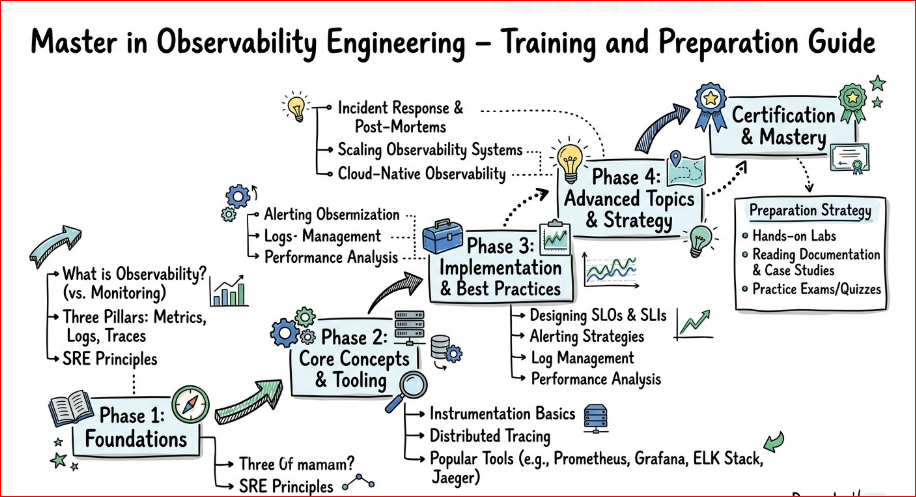
Modern systems are complex, distributed, and always-on. When they fail, everyone feels it—users, businesses, and engineering teams. Observability is how you truly understand what is happening inside those systems, beyond basic monitoring and dashboards. The Master in Observability Engineering (MOE) certification from DevOpsSchool is designed for engineers and leaders who want to make reliability, visibility, and performance a core strength of their organization. This guide will help you understand what MOE is, who it is for, how to prepare, and how to connect it with your long-term career path.
What is Master in Observability Engineering (MOE)?
The Master in Observability Engineering (MOE) is a specialized certification and training program focused on the principles, tools, and real-world practices of observability across cloud‑native and hybrid environments. It goes beyond traditional monitoring and teaches you how to design systems that are measurable, debuggable, and resilient by default.
You learn how to work with logs, metrics, traces, and events, instrument applications using OpenTelemetry, and use platforms like Prometheus, Grafana, ELK stack, Jaeger, and cloud-native tools to build complete observability solutions.
MOE Certification Table
| Track | Level | Who it’s for | Prerequisites | Skills covered | Recommended order |
|---|---|---|---|---|---|
| Observability / Reliability | Intermediate–Advanced | DevOps, SRE, Platform, Cloud, Security, Data, FinOps, and Engineering Managers working with distributed systems | Basic Linux, one programming/scripting language, familiarity with CI/CD, cloud basics | Observability foundations, logs/metrics/traces, OpenTelemetry, Prometheus, Grafana, ELK, Jaeger, incident response, SLO/SLI, cloud-native observability, AIOps concepts | Take after 6–18 months of experience in DevOps/SRE/Cloud or after a general DevOps certification |
Master in Observability Engineering (MOE) – Detailed Breakdown
What it is
The Master in Observability Engineering (MOE) is a focused certification for engineers who want to design, implement, and operate robust observability systems across modern architectures. It teaches you how to turn raw telemetry data into actionable insights that improve reliability, performance, and incident response.
Who should take it
- DevOps Engineers who manage CI/CD, production environments, and deployment pipelines.
- SREs responsible for SLOs, error budgets, and high availability.
- Platform and Cloud Engineers building Kubernetes clusters, service meshes, and shared platforms.
- Security Engineers who need deep visibility into runtime behavior and anomalies.
- Data Engineers working with metrics, events, and telemetry pipelines.
- FinOps Practitioners who want to correlate cost with performance and usage.
- Engineering Managers leading reliability, platform, or infrastructure teams.
Skills you’ll gain
- Strong understanding of observability fundamentals (metrics, logs, traces, events).
- Designing observability architecture for microservices and cloud-native systems.
- Instrumentation using OpenTelemetry and other standards.
- Building and tuning dashboards in Prometheus, Grafana, and ELK stack.
- Implementing distributed tracing with tools like Jaeger.
- Setting up alerting strategies aligned with SLOs and SLIs.
- Performing root cause analysis and incident investigations using observability data.
- Applying observability in Kubernetes, containers, and multi-cloud setups.
- Using observability to support AIOps and anomaly detection scenarios.
Real-world projects you should be able to do after it
- Design and implement a complete observability stack (Prometheus, Grafana, ELK, Jaeger, OpenTelemetry) for a microservices-based application.
- Instrument a Kubernetes-based platform with metrics, logs, and traces, including service mesh integrations.
- Create SLOs, SLIs, and error budgets for key services and wire them to alerting rules.
- Build dashboards that help teams detect issues before customers are impacted.
- Investigate real production-like incidents (latency, errors, memory leaks, CPU spikes) using observability data.
- Integrate observability pipelines with CI/CD, incident management, and on-call workflows.
- Implement anomaly detection and advanced analysis using observability tools and cloud-native features.
Preparation plan
7–14 days (Fast track)
- Day 1–3: Learn the basics of logs, metrics, and traces; understand why observability is different from monitoring.
- Day 4–7: Install local Prometheus and Grafana, hook them up to a sample app, and explore basic dashboards and alerts.
- Day 8–10: Practice log aggregation concepts using ELK or a similar stack.
- Day 11–14: Implement simple tracing using OpenTelemetry and Jaeger for a small microservice or demo app.
30 days (Standard working-professional plan)
- Week 1: Cover fundamentals, terminology, architecture patterns, and reference designs from the MOE curriculum.
- Week 2: Build an end-to-end observability lab: Kubernetes or VM-based app + Prometheus + Grafana + logs.
- Week 3: Add distributed tracing and service-level indicators; set up SLO dashboards.
- Week 4: Practice troubleshooting scenarios, incident simulations, and performance tuning based on observability data.
60 days (Deep mastery plan)
- First month: Follow the entire MOE curriculum in sequence with labs and assignments, focusing on at least 2–3 toolchains (for example, Prometheus/Grafana and ELK).
- Second month: Apply observability to your real work environment (or a realistic project), design SLOs, run game days, and document incident postmortems driven by observability insights.
Common mistakes
- Treating observability as “just logs and dashboards” instead of an architectural discipline.
- Overcollecting data without clear questions, leading to cost and noise.
- Not defining SLOs/SLIs and tying alerts to them.
- Ignoring tracing and focusing only on metrics.
- Building dashboards only for engineers, not for cross-team collaboration.
- Not integrating observability with CI/CD, incident management, and on-call processes.
- Skipping hands-on labs and relying only on theory.
Best next certification after this
- Same track (Observability/SRE focus): An SRE or reliability-focused certification that goes deeper into incident management, capacity planning, and resilience engineering.
- Cross-track (Security focus): A DevSecOps or cloud security certification where observability is used to detect threats and anomalies.
- Leadership track: A cloud architecture or engineering leadership program focusing on platform strategy, reliability culture, and governance.
Choose Your Path: 6 Learning Paths with MOE
Observability is a core layer that supports multiple career paths. Here is how Master in Observability Engineering (MOE) fits into six major tracks.
1. DevOps Path
- Start with core DevOps concepts and CI/CD.
- Learn containerization, Kubernetes, and cloud platforms.
- Take MOE to embed observability into every stage—from build to production.
- Extend into GitOps, deployment strategies, and progressive delivery, backed by strong dashboards and alerts.
2. DevSecOps Path
- Build a foundation in DevOps + security basics.
- Use observability to detect anomalies, suspicious patterns, and policy violations at runtime.
- Use MOE to understand how telemetry can support runtime security, zero trust, and continuous compliance.
- Move towards security automation and runtime protection solutions.
3. SRE Path
- Learn SRE principles like SLOs, SLIs, error budgets, and incident management.
- Take MOE to get deep skills in metrics, logs, traces, and tooling.
- Use observability as the backbone for SRE practices: alerting, on-call, and postmortems.
- Grow into SRE lead roles, reliability architecture, and chaos engineering.
4. AIOps / MLOps Path
- Build a base in monitoring, logging, and observability data.
- Use MOE to understand telemetry pipelines that feed AIOps platforms.
- Then move into AIOps tools that detect anomalies, auto-correlate events, and recommend remediation.
- For MLOps, use observability to monitor ML pipelines, model drift, and inference performance.
5. DataOps Path
- Learn data engineering, ETL/ELT, and data pipeline tooling.
- Use MOE to treat pipelines as “products” with their own observability: latency, error rates, freshness, and quality metrics.
- Build dashboards for data SLAs and downstream consumer needs.
- Grow into DataOps or Analytics Platform roles with strong reliability practices.
6. FinOps Path
- Start with cloud cost fundamentals, pricing, and usage models.
- Use MOE to build observability over resource usage, performance, and cost drivers.
- Correlate cost data with business KPIs and service-level metrics.
- Grow into roles that combine financial accountability with platform visibility.
Role → Recommended Certifications Mapping (with MOE)
| Role | How MOE helps | Recommended certification path (including MOE) |
|---|---|---|
| DevOps Engineer | Builds robust CI/CD systems with strong observability baked into pipelines and production. | Core DevOps certification → Cloud platform certification → Master in Observability Engineering (MOE) → Advanced DevOps/SRE cert |
| SRE | Uses telemetry for SLOs, error budgets, and incident management. | SRE fundamentals → MOE → Advanced SRE or reliability engineering programs |
| Platform Engineer | Designs shared Kubernetes and platform services with full visibility. | Kubernetes/Platform cert → MOE → Cloud architecture / platform leadership |
| Cloud Engineer | Ensures cloud resources are visible, optimized, and resilient. | Cloud associate/pro cert → MOE → Multi-cloud or specialized cloud-native cert |
| Security Engineer | Uses observability data to identify anomalies and runtime risks. | Security/DevSecOps cert → MOE → Advanced cloud security or threat detection programs |
| Data Engineer | Monitors data pipelines, jobs, and SLAs. | Data engineering cert → MOE → DataOps / analytics platform programs |
| FinOps Practitioner | Correlates cost, performance, and usage through observability. | FinOps essentials → MOE → Advanced FinOps / cloud governance |
| Engineering Manager | Leads teams that rely on observability for reliability and delivery. | General engineering leadership program → MOE → Architecture or platform strategy programs |
Top Institutions for MOE Training and Certification Support
Below are institutions associated with training, guidance, or supporting ecosystems around observability and related domains.
DevOpsSchool
DevOpsSchool is the official provider of the Master in Observability Engineering (MOE) certification. It offers structured online and classroom training, hands-on labs, and guided projects that help you connect observability concepts with real-world systems. Their programs are designed for working professionals who need flexible schedules and industry-relevant content.
Cotocus
Cotocus provides intensive, instructor-led technical training focused on modern DevOps, cloud, and observability tools. They are known for lab-heavy sessions where you spend most of the time working directly on tools and real scenarios. This approach is helpful for engineers who want to become job-ready in a short time frame.
ScmGalaxy
ScmGalaxy offers training, workshops, and mentoring in DevOps, CI/CD, cloud, and observability topics. Their focus is on helping practitioners apply tools and practices to real project situations. You can expect community support, reusable assets, and practical exercises tailored to typical enterprise setups.
BestDevOps
BestDevOps is a platform that aggregates DevOps-focused content, training, and community learning around DevOps and related specializations. It supports learners by sharing best practices, tutorials, and structured learning paths that often include observability as a key pillar.
devsecopsschool.com
devsecopsschool.com focuses on integrating security into DevOps pipelines. Observability is a key component here, because runtime telemetry helps detect vulnerabilities, misconfigurations, and suspicious behavior. Training often connects observability with security controls and continuous compliance.
sreschool.com
sreschool.com specializes in Site Reliability Engineering concepts like SLOs, SLIs, error budgets, and incident management. Observability is treated as a foundational SRE capability, and learners are guided in using telemetry to drive reliability decisions and on-call processes.
aiopsschool.com
aiopsschool.com focuses on AIOps—using AI and ML on operational data. Observability plays a central role because AIOps platforms depend on high-quality telemetry from infrastructure, applications, and services. The training here helps professionals turn observability data into automated insights and remediation strategies.
dataopsschool.com
dataopsschool.com is centered around DataOps practices and tools. Observability of data pipelines, latency, data quality, and freshness is critical in these programs. Trainings help engineers apply observability principles to data workflows, not just application runtimes.
finopsschool.com
finopsschool.com works at the intersection of finance and cloud engineering. It leverages observability to track resource consumption, performance, and cost efficiency. Learners are trained to use telemetry to support cost optimization, budgeting, and financial accountability.
FAQs on Master in Observability Engineering (MOE)
1. What is the Master in Observability Engineering (MOE) certification?
The MOE certification is a specialized program by DevOpsSchool that focuses on observability fundamentals, tooling, and real-world practices for modern distributed systems. It covers topics like metrics, logs, traces, OpenTelemetry, Prometheus, Grafana, ELK, Jaeger, and incident response.
2. How long does the MOE training usually take?
Typical training duration is around 15–20 hours of structured sessions, plus additional time for labs and self-practice, depending on your background and schedule.
3. Do I need prior observability experience before taking MOE?
You don’t need to be an expert, but you should be comfortable with basic Linux, one programming or scripting language, and general DevOps or cloud concepts. Familiarity with monitoring tools is helpful but not mandatory.
4. Is MOE only for SREs?
No. MOE is ideal for DevOps Engineers, SREs, Platform Engineers, Cloud Engineers, Security Engineers, Data Engineers, FinOps practitioners, and Engineering Managers who interact with production systems.
5. How difficult is the MOE certification?
The difficulty is moderate for someone with working experience in DevOps/SRE/Cloud. The key is to commit to hands-on labs and real scenarios instead of only reading theory.
6. What real-world benefits can I expect after MOE?
You should be able to design better observability for your applications, troubleshoot incidents faster, build meaningful dashboards, and align monitoring with SLOs and business goals. This often translates to better reliability, fewer outages, and improved collaboration between teams.
7. How does MOE help my career growth?
Observability is now a core skill for senior DevOps, SRE, Platform, and Cloud roles worldwide. Having MOE on your profile signals that you can handle complex production environments and drive reliability with data.
8. What should I do after completing MOE?
After MOE, you can deepen your path in SRE or reliability engineering, or branch into DevSecOps, AIOps, DataOps, or FinOps roles where observability is a critical enabler.
FAQs focused on: difficulty, time, prerequisites, sequence, value, career outcomes
1. How difficult is the MOE certification?
MOE is medium to high in difficulty. It is not for complete beginners, but it is very doable if you already know basic DevOps or cloud concepts and are ready to practice regularly.
2. Is MOE suitable for someone new to observability?
Yes, as long as you know basic Linux, cloud, and CI/CD ideas. You do not need deep observability experience before starting, because the program starts from core concepts and builds up step by step.
3. How much time do I need to prepare for MOE?
Most working professionals need around 30–60 days of steady study with 1–2 hours per day. If you already work daily with monitoring and logging tools, you may prepare faster with an intensive 7–14 day plan.
4. Can I prepare for MOE while working full-time?
Yes. MOE is designed with working engineers in mind. If you plan carefully and follow a weekly schedule (for example, weekdays for theory and weekends for labs), you can prepare comfortably while working.
5. What are the main prerequisites for MOE?
You should have:
- Basic Linux knowledge
- Basic understanding of cloud (VMs, containers, services)
- CI/CD fundamentals
- Some exposure to monitoring or logging tools
You do not need to be an expert in any one tool, but you should be comfortable with technical environments.
6. Do I need to know programming to clear MOE?
You do not need deep programming skills. It is enough if you can read simple code examples, edit configuration files, and understand basic service structures. The focus is more on observability design and usage than on writing complex code.
7. In what sequence should I take MOE in my learning journey?
A good sequence is:
- Start with a basic DevOps or cloud certification.
- Get some hands-on experience in operations, SRE, or platform work.
- Then take MOE as a master-level specialisation on observability and reliability.
8. Should I do MOE before or after SRE/DevOps certifications?
It is better to do MOE after at least one general DevOps, SRE, or cloud certification. Those will give you a strong base in tools and practices, and MOE will then help you go deep into observability on top of that.
9. What is the real value of MOE for my work?
MOE gives you the ability to see and understand what is happening inside your systems in real time. This means faster incident resolution, fewer surprises in production, better performance, and clearer decisions based on data instead of guesses.
10. How does MOE improve my career opportunities?
With MOE, you can apply for roles that need strong observability and reliability skills. Companies often look for people who can design and lead observability efforts, not just use tools, and MOE helps you stand out in those interviews.
11. What kind of roles can I target after MOE?
After MOE, you can target roles like Observability Engineer, SRE, DevOps Engineer, Platform Engineer, Cloud Operations Engineer, Reliability Specialist, and even Reliability-focused Engineering Manager or Lead.
12. Will MOE help me grow into leadership roles?
Yes. Observability is at the heart of modern engineering decisions. With MOE, you can speak clearly about SLOs, reliability, performance, and incident data with both engineers and business leaders, which is a key skill for tech leads and engineering managers.
Conclusion
Observability is no longer optional. It is the nervous system of every serious digital business. The Master in Observability Engineering (MOE) certification helps you move from scattered logs and ad-hoc dashboards to a structured, powerful observability practice that supports DevOps, SRE, security, data, and cost optimization initiatives in one connected way.
Whether you are a hands-on engineer or a leader, investing in MOE now will strengthen your ability to design reliable systems, respond to incidents with clarity, and build platforms that your teams can trust.