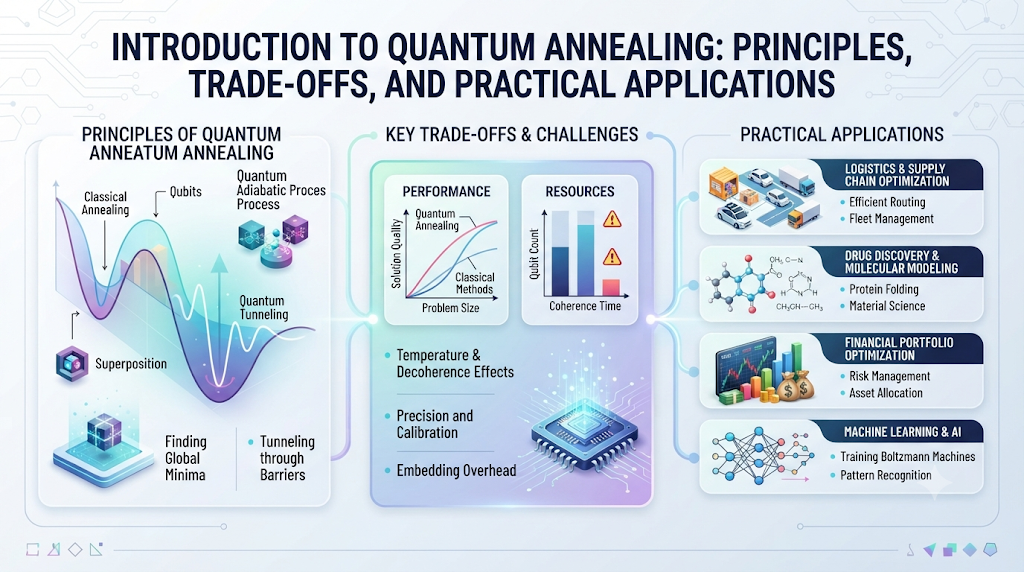
Quantum annealing is a specialized optimization technique designed to solve complex combinatorial problems by leveraging quantum mechanical fluctuations. Unlike gate-based quantum computers designed for universal computation, quantum annealers target a very specific class of problems: finding the global minimum of a cost function across a vast landscape of potential solutions.
For practitioners in computational optimization, operations research, and advanced hardware engineering, understanding quantum annealers requires looking past the marketing hype and examining the underlying physics, operational constraints, and architectural trade-offs.
What Is Quantum Annealing?
At its core, quantum annealing is a metaheuristic inspired by thermal annealing in metallurgy. In traditional metallurgical annealing, a material is heated to a high energy state so its atoms can move freely, then cooled gradually to allow the system to settle into a low-energy, highly ordered crystalline structure.
Quantum annealing replaces thermal fluctuations with quantum fluctuations—specifically, quantum tunneling. Instead of relying on thermal energy to hop over potential energy barriers in a cost landscape, a quantum annealer uses a transverse magnetic field to allow the system to tunnel through barriers.
The Mechanics: Hamiltonians and Adiabatic Evolution
A quantum annealer operates by initializing a physical system in a known, easy-to-prepare ground state (usually a uniform superposition of all possible states represented by a transverse field Hamiltonian $H_0$). The system is then slowly evolved over time toward a problem Hamiltonian $H_1$, whose lowest energy state (ground state) corresponds to the optimal solution of the target optimization problem.
According to the Adiabatic Theorem of quantum mechanics, if this evolution happens slowly enough, the system remains in its instantaneous ground state throughout the process, ending up in the optimal solution state.
Why Quantum Annealing Matters
Classical optimization algorithms (such as simulated annealing, branch-and-bound, or genetic algorithms) often struggle with rugged cost landscapes containing numerous local minima. As problem sizes grow, classical algorithms can get trapped or require exponential time to explore the search space.
Quantum annealing addresses this by exploiting two primary quantum phenomena:
- Superposition: The system evaluates multiple states simultaneously during the annealing process.
- Quantum Tunneling: The system can pass directly through thin, high energy barriers rather than scaling over them, potentially finding shortcuts across complex landscapes.
This makes quantum annealing particularly attractive for NP-hard problems mapped to quadratic unconstrained binary optimization (QUBO) or Ising spin glass models, common in logistics, financial portfolio optimization, and machine learning.
How It Works: The Workflow
Implementing a problem on a quantum annealing hardware architecture follows a structured pipeline:
[ Problem Formulation ] -> [ QUBO / Ising Mapping ] -> [ Hardware Embedding ] -> [ Quantum Annealing Run ] -> [ Readout & Verification ]
- Problem Formulation: Translate a real-world constraint satisfaction problem (e.g., routing delivery trucks or scheduling airport gates) into a mathematical optimization model.
- QUBO / Ising Mapping: Convert the model into a Quadratic Unconstrained Binary Optimization (QUBO) format or an Ising spin glass formulation, which use binary variables ($0$ or $1$) or spins ($\pm 1$).
- Hardware Embedding: Map the logical variables of the problem onto the physical qubits and couplers of the quantum processor (such as a Chimera or Pegasus hardware graph), which often requires multiple physical qubits to represent a single logical variable due to limited connectivity.
- Quantum Annealing Run: Execute the anneal by ramping down the transverse field and ramping up the problem Hamiltonian over a span of microseconds.
- Readout and Verification: Sample the final state of the qubits, measure the energy, and check whether constraints are satisfied. Because noise and decoherence can cause failures, the process is repeated thousands of times to collect a distribution of low-energy candidate solutions.
Advantages, Limitations, and When NOT to Use It
Advantages
- Efficiency on Rugged Landscapes: Well-suited for problems with many local minima where gradient-based or greedy classical algorithms fail.
- Hardware Specialization: Dedicated annealers can process thousands of physical qubits simultaneously for specific graph structures.
Limitations
- Connectivity Constraints: Physical qubits are not all-to-all connected. Embedding dense problems requires chains of physical qubits, consuming valuable hardware resources.
- Thermal Noise and Decoherence: Real-world quantum hardware operates at cryogenic temperatures (millikelvin range), but thermal noise, magnetic flux noise, and control errors still disrupt the fragile quantum state.
- Lack of Universal Speedup: Unlike Shor’s algorithm for factoring, quantum annealing does not offer a proven polynomial or exponential speedup for all classes of optimization problems over the best classical algorithms.
When NOT to Use Quantum Annealing
- Continuous Optimization: Problems requiring high-precision continuous variables (e.g., fluid dynamics equations) are poorly suited for binary quantum annealers and require excessive discretization overhead.
- Small Problem Instances: For small or moderately sized problems, classical solvers (like Gurobi or CPLEX on a standard CPU) often outperform quantum annealers due to zero queue times, lack of embedding overhead, and deterministic execution.
- Problems with Efficient Classical Approximations: If a problem can be solved efficiently via linear programming or polynomial-time algorithms, quantum annealing introduces unnecessary complexity.
Risks and Failure Modes
Operating within the domain of noisy intermediate-scale quantum (NISQ) hardware introduces distinct failure modes:
- Chain Breaks: When logical variables are represented by multiple physical qubits linked together by ferromagnetic coupling, thermal fluctuations can cause the chain to break (different physical qubits in the same chain pointing in opposite directions), invalidating the solution. This requires tuning chain strength parameters carefully.
- Freeze-Out: If the energy gap between the ground state and excited states closes rapidly during the anneal, the system can freeze into a suboptimal state prematurely, regardless of how slowly the anneal is run.
- Calibrated Drift: Hardware calibration parameters drift over time, requiring continuous recalibration of bias and coupling values to maintain fidelity.
How to Verify Results
Because quantum annealers are probabilistic and susceptible to hardware noise, verification is an essential step rather than an afterthought:
- Constraint Checking: Programmatically evaluate every candidate solution returned by the hardware against the problem’s hard constraints (e.g., ensuring a truck does not visit two places at once). Discard invalid states immediately.
- Classical Benchmarking: Compare the energy values of the best solutions found by the annealer against established classical heuristics (like simulated annealing or Tabu search) run on the same hardware or CPU instance.
- Ground State Probability Analysis: Analyze the success probability (the frequency of finding the exact global optimum on repeated runs) as a function of anneal time to determine if the system is operating in the adiabatic regime or entering thermal freeze-out.
Common Mistakes
- Ignoring Embedding Overhead: Assuming that a 5,000-qubit processor can solve a 5,000-variable dense problem. Due to sparse hardware connectivity, dense problems require extensive qubit chaining, drastically reducing the effective problem size capacity.
- Treating the Output as Deterministic: Relying on a single run of a quantum annealer. Because the device samples from a probability distribution, solutions must be gathered over many repetitive reads.
- Neglecting Parameter Tuning: Leaving anneal time, pausing schedules, and chain strengths at default values instead of optimizing them for the specific problem topology.
Quick Reference Checklist
- [ ] Problem formulated as QUBO or Ising model
- [ ] Logical variable graph mapped to physical hardware topology (embedding verified)
- [ ] Chain strength parameters tuned to prevent chain breaks
- [ ] Annealing time and schedule adjusted for the energy gap landscape
- [ ] Post-processing pipeline in place to filter constraint violations
- [ ] Classical heuristic baseline established for performance comparison
Frequently Asked Questions
Q1. What is the difference between gate-based quantum computing and quantum annealing? Gate-based quantum computers use quantum logic gates (like CNOT and Hadamard) to execute universal quantum algorithms, capable of running Shor’s or Grover’s algorithms. Quantum annealers are analog devices specialized strictly for solving combinatorial optimization and sampling problems by finding the ground state of a physical system.
Q2. Are quantum annealers faster than classical computers? It depends heavily on the problem structure and instance. While quantum annealers can outperform classical simulated annealing on specific complex graphs, classical algorithms and specialized solvers often match or exceed current quantum annealers on many standard benchmark problems due to overhead in embedding and hardware noise.
Q3. What programming languages or frameworks are used for quantum annealing? Python is the dominant language in the ecosystem, utilizing specialized software frameworks provided by hardware vendors and open-source libraries that handle graph embedding, QUBO translation, and hardware interfacing.
Q4. Can quantum annealers solve machine learning problems? Yes, quantum annealers can be applied to machine learning tasks that can be framed as energy minimization, such as training Boltzmann machines, clustering, and feature selection, though scaling to large industrial datasets remains an active area of research.
Q5. Why do quantum annealers need to be kept at extremely low temperatures? The devices are chilled to near absolute zero (milli-Kelvin temperatures, colder than interstellar space) to suppress thermal fluctuations. Thermal energy can easily disrupt fragile quantum superposition states and cause premature transitions out of the ground state.
Q6. What does QUBO stand for, and why is it important? QUBO stands for Quadratic Unconstrained Binary Optimization. It is a mathematical formulation where binary variables are optimized to minimize a quadratic objective function. It serves as the standard bridge between high-level optimization problems and the physical spin-glass hardware of quantum annealers.
Q7. What is a “chain break” in quantum annealing? A chain break occurs when a single logical variable is represented by multiple physical qubits linked together, but thermal or quantum noise causes those physical qubits to point in opposing directions. This renders the read-out invalid and requires software post-processing or stronger coupling weights to resolve.
Q8. How many qubits do current quantum annealers have? Modern quantum annealers feature thousands of physical qubits (e.g., over 5,000 qubits in advanced commercial architectures), though the effective capacity for fully connected dense problems is significantly lower due to the physical layout and embedding requirements.
Q9. Is quantum annealing error-corrected? Unlike fault-tolerant gate-based quantum computing, large-scale fault-tolerant quantum error correction is not yet standard for commercial quantum annealers. Instead, practitioners rely on heuristic error mitigation, repetition, and clever hardware graph designs to manage noise.
Q10. What are the best industries for applying quantum annealing today? Industries dealing with massive routing, scheduling, portfolio optimization, and supply chain logistics—such as logistics, telecommunications, aerospace, and financial services—are the primary sectors actively exploring and piloting quantum annealing solutions.
Conclusion
Quantum annealing represents a fascinating intersection of solid-state physics and computational mathematics, offering a non-traditional pathway to tackling complex combinatorial optimization problems. While hardware constraints, embedding overhead, and noise continue to present engineering hurdles, mastering its principles provides practitioners with a powerful alternative heuristic tool for rugged search spaces. To take this further, explore mapping a small-scale routing problem to a QUBO matrix and testing it on an accessible quantum annealing simulator.
