Introduction
Today, we treat infrastructure like software—versioned, tested, and automated. At the heart of this shift is Terraform. If you are a software engineer, a systems admin, or a manager looking to modernize your team, the Hashicorp Certified Terraform Associate is the industry standard for proving you know how to handle cloud resources at scale. This guide is designed to help you understand why this certification matters, how to prepare for it, and where it fits into your long-term career growth.
What is Hashicorp Certified Terraform Associate?
This certification validates your foundational knowledge of Terraform. It proves you understand the difference between Infrastructure as Code and manual configuration. It also shows you can use Terraform CLI, handle state files, and work with modules to create reusable infrastructure.
Who should take it?
- Cloud Engineers looking to automate AWS, Azure, or GCP.
- DevOps Practitioners who want to build CI/CD pipelines for infrastructure.
- Software Engineers who need to manage their own environments.
- Engineering Managers who want to understand the technical capabilities of their teams.
Skills you’ll gain
- Understanding of IaC principles and benefits.
- Mastery of Terraform CLI commands (init, plan, apply, destroy).
- Ability to manage Terraform state and navigate state locking.
- Knowledge of HCL (Hashicorp Configuration Language) syntax.
- Creating and using Terraform modules for scalability.
- Interacting with Terraform Cloud and Enterprise.
Real-world projects you can do after certification
- Multi-Cloud Deployment: Launch a web application across both AWS and Azure using a single workflow.
- Self-Service Infrastructure: Build a library of modules that developers can use to spin up their own databases or servers.
- Automated Compliance: Use Terraform to ensure every server created has the correct security tags and firewall rules.
Certification Overview Table
| Track | Level | Who it’s for | Prerequisites | Skills Covered | Recommended Order |
| Infrastructure | Associate | Engineers, Admins, Managers | Basic Cloud Knowledge | CLI, State, HCL, Modules, Provisioning | Take this first for IaC |
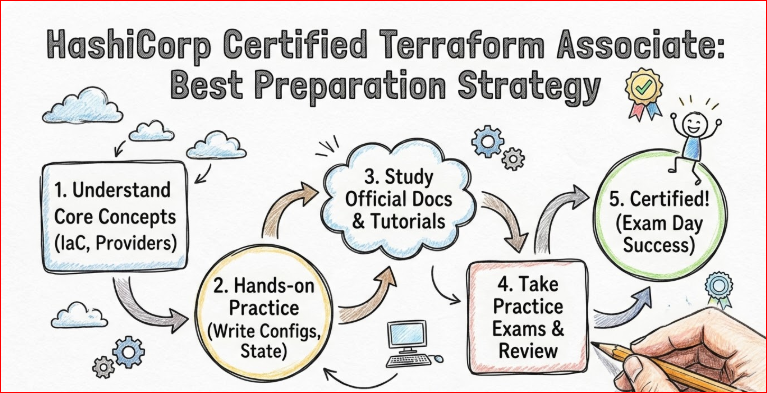
Preparation Plans
Depending on your current workload and familiarity with the cloud, choose the timeline that fits you best.
7–14 Days (The Fast Track)
- Focus: Intensive hands-on labs.
- Day 1-4: Focus on HCL syntax and basic commands.
- Day 5-10: Dive deep into State management and Modules.
- Day 11-14: Practice exams and Terraform Cloud features.
- Requirement: At least 4 hours of study per day.
30 Days (The Standard Pace)
- Focus: Building and destroying real projects.
- Week 1: Theoretical foundations and Terraform architecture.
- Week 2: CLI commands and basic configuration files.
- Week 3: Advanced concepts like Workspaces, Provisioners, and Functions.
- Week 4: Mock tests and reviewing the official documentation.
60 Days (The Deep Dive)
- Focus: Mastering the “why” behind the “how.”
- Month 1: Focus on cloud-specific providers (AWS/Azure) and how Terraform interacts with APIs.
- Month 2: Focus on team collaboration, remote backends, and security best practices.
Common Mistakes to Avoid
- Ignoring the State File: Many beginners treat the state file as a “black box.” Understanding how to recover or move state is crucial for the exam.
- Over-using Provisioners: Don’t use
local-execorremote-execfor things that can be done with native cloud-init or Terraform resources. - Hard-coding Values: Always use variables. Hard-coding IDs or secrets is a major mistake in the real world and on the test.
- Skipping Terraform Cloud: Even if you use the open-source CLI, the exam covers Terraform Cloud features like Sentinels and VCS integration.
Choose Your Path: 6 Learning Journeys
Terraform is the foundation, but where you go next depends on your career goals.
1. DevOps Path
Focus on integrating Terraform into Jenkins or GitHub Actions. Learn to build “pipeline-as-code” where infrastructure updates are triggered by a git commit.
2. DevSecOps Path
Integrate security scanning (like Checkov or Terrascan) into your Terraform workflow. Ensure every piece of infrastructure is scanned for vulnerabilities before it is deployed.
3. SRE (Site Reliability Engineering) Path
Focus on “Infrastructure Observability.” Use Terraform to deploy monitoring tools like Prometheus or Grafana alongside your applications to ensure 99.9% uptime.
4. AIOps / MLOps Path
Use Terraform to manage high-performance computing clusters and GPU instances. Automate the setup of JupyterHub or MLflow environments for data scientists.
5. DataOps Path
Automate the creation of data lakes, Snowflake warehouses, or BigQuery datasets. Terraform ensures your data pipelines have a consistent environment to run in.
6. FinOps Path
Focus on cost optimization. Use Terraform to tag resources for billing and use tools that estimate the cost of a terraform plan before you hit apply.
Role-to-Certification Mapping
| Role | Recommended Focus |
| DevOps Engineer | Terraform Associate + Vault Associate |
| SRE | Terraform Associate + Kubernetes Certification |
| Platform Engineer | Terraform Associate + Provider-Specific Architect (AWS/Azure) |
| Cloud Engineer | Terraform Associate + Cloud Practitioner |
| Security Engineer | Terraform Associate + Vault Operations Professional |
| Data Engineer | Terraform Associate + Big Data Specialty |
| FinOps Practitioner | Terraform Associate + FinOps Certified Practitioner |
| Engineering Manager | Terraform Associate (to understand team workflows) |
Next Steps: What to Take After Terraform Associate?
Once you have cleared the associate exam, you have three main directions to move:
- Same Track (Specialization): Move toward Hashicorp Certified Vault Associate. Security and Infrastructure go hand-in-hand.
- Cross-Track (Broadening): Look into Certified Kubernetes Administrator (CKA). Managing containers is the natural next step after managing the servers they run on.
- Leadership (Architecting): Pursue Professional Cloud Architect certifications from AWS or Google Cloud to understand high-level system design.
Top Institutions for Training and Certification
DevOpsSchool: This platform provides a deep dive into the Terraform ecosystem through instructor-led sessions and extensive lab work. They focus on the full lifecycle of infrastructure, from initial coding to state management at scale, ensuring you are ready for both the exam and production environments.
Cotocus: A highly technical training provider that emphasizes “Learning by Doing.” Their programs are designed for engineers who want to skip the fluff and get straight into complex multi-cloud deployments, making them a top choice for those looking to sharpen their practical skills.
Scmgalaxy: Known for its vast community and library of resources, this institution offers structured learning paths that bridge the gap between traditional software configuration and modern Infrastructure as Code. It is an excellent resource for staying updated on the latest Terraform providers and best practices.
BestDevOps: This institution focuses on career-oriented training, blending technical certification prep with the architectural knowledge needed for high-level roles. Their curriculum is updated frequently to reflect the latest changes in the Hashicorp ecosystem and industry demands.
DevSecOpsSchool.com: If your goal is to integrate security into your automation, this is the place to go. They teach you how to use Terraform not just for deployment, but for building secure, compliant infrastructure from the very first line of code.
SREschool.com: This school focuses on the “Reliability” aspect of Terraform. You will learn how to manage state files safely, implement workspaces for different environments, and use Terraform to deploy the monitoring and observability tools essential for a Site Reliability Engineer.
AIOpsSchool.com: Aimed at the future of operations, this institution teaches you how to use Terraform to provision the heavy-duty infrastructure required for AI and Machine Learning workloads, including GPU clusters and specialized data environments.
DataOpsSchool.com: For data professionals, this school provides a roadmap for using Terraform to automate data warehouses and pipelines. They show you how to treat your data infrastructure with the same rigor and version control as your application code.
FinOpsSchool.com: This institution bridges the gap between engineering and finance. Their training highlights how to use Terraform for cost allocation, resource tagging, and building automated guardrails to prevent unexpected cloud spend.
FAQs: Hashicorp Certified Terraform Associate
1. How difficult is the exam?
It is considered an intermediate exam. If you have used Terraform in a project for 6 months, you will find it manageable. If you are new, you need solid lab practice.
2. How long does it take to prepare?
For an experienced engineer, 2 weeks of focused study is usually enough. For beginners, 4 to 6 weeks is recommended.
3. Are there any prerequisites?
There are no official prerequisites, but a basic understanding of cloud providers (like AWS) and terminal usage is highly recommended.
4. What is the format of the exam?
It consists of multiple-choice, multiple-response, and “fill in the blanks” (drag and drop) questions. It is a proctored online exam.
5. How much does the certification cost?
The price fluctuates slightly based on region, but it is generally around $70 USD.
6. Does the certification expire?
Yes, it is valid for two years. This ensures that you stay up to date with the frequent changes in Terraform versions.
7. Is Terraform Cloud covered in the exam?
Yes. You should understand the basics of workspaces, sentinel policies, and how Terraform Cloud differs from the CLI.
8. Will this help me get a job in India?
Absolutely. Many top Indian tech firms and MNCs specifically look for Terraform skills as a baseline for DevOps and Cloud roles.
9. Can I take the exam if I don’t know HCL?
No. HCL is the language of Terraform. You must be comfortable reading and writing HCL code to pass.
10. Is it better than other IaC certifications?
Terraform is cloud-agnostic, making it more versatile than AWS CloudFormation or Azure Bicep for engineers working in multi-cloud environments.
11. What is the passing score?
Hashicorp does not publish a specific passing percentage, but generally, aiming for 70-75% in practice tests is a safe bet.
12. Can I use the certification for a promotion?
Yes. It proves to management that you can lead automation initiatives and reduce manual errors in the company’s infrastructure.
Testimonials
“I had been using Terraform for a year, but the certification forced me to learn the ‘right’ way to manage state. It immediately improved our team’s deployment speed.” — Senior DevOps Engineer, Bangalore
“As a manager, I took this to understand the language my engineers were speaking. It helped me make better decisions about our cloud budget and tooling.” — Engineering Manager, San Francisco
Conclusion
The Hashicorp Certified Terraform Associate is more than just a badge on your LinkedIn profile. It is a commitment to a modern way of working. In a world where infrastructure is constantly changing, being able to define that infrastructure as code is the most valuable skill an engineer can have. Whether you are just starting your DevOps journey or you are a veteran looking to formalize your years of experience, this certification provides a clear, structured path forward. Start your labs today, and take that first step toward mastering the cloud.