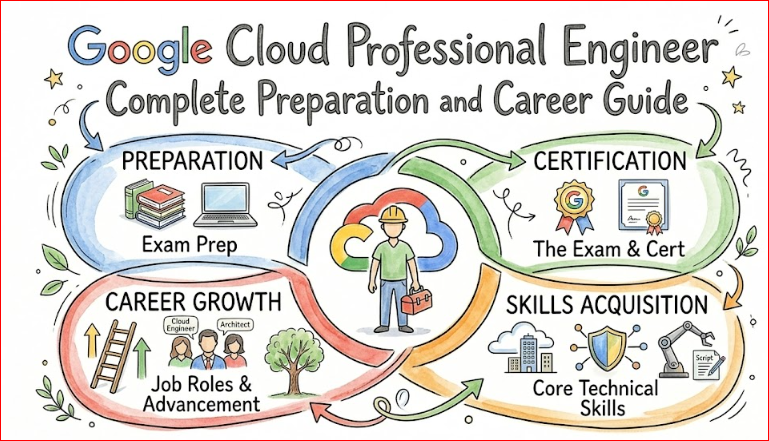
Introduction
The world of cloud engineering is evolving at a breakneck pace, making it essential for working engineers and managers globally to continuously adapt to new paradigms. Mastering a major public cloud is no longer an optional skill; it is the absolute baseline for building scalable, reliable, and secure enterprise applications. Throughout my career mentoring engineers and architecting large-scale operational frameworks, I have watched Google Cloud Platform (GCP) become a dominant, innovative force. Its Kubernetes engine (GKE), advanced data analytics, and developer-friendly tooling make it a top choice for modern engineering teams worldwide. This comprehensive guide is designed to be your ultimate, strategic roadmap for mastering cloud operations on GCP. Whether you are an individual contributor looking to upskill or a manager mapping out a rigorous training program for your team, this breakdown provides absolute clarity. We will thoroughly explore the Google Cloud Professional Engineer program, mapping out exactly what it takes to succeed and how it accelerates your career.
The Certification Landscape
To understand where you are going, you need to see the big picture. Below is a breakdown of the core professional-level tracks within the Google Cloud ecosystem, highlighting how the DevOps engineering path fits into the broader engineering matrix.
| Track | Level | Who it’s for | Prerequisites | Skills covered | Recommended order |
|---|---|---|---|---|---|
| Cloud DevOps & SRE | Professional | DevOps Engineers, SREs, Platform Engineers | Solid understanding of GCP core services, CI/CD, Linux | SRE principles, CI/CD pipelines, GKE, Cloud Monitoring | 1 |
| Cloud Architecture | Professional | Cloud Architects, Engineering Managers | Deep architectural knowledge, GCP Associate | System design, migration strategies, scaling, security | 2 |
| Cloud Security | Professional | Security Engineers, DevSecOps Practitioners | Networking and IAM expertise | Cloud Armor, IAM, VPC Service Controls, Data protection | 3 |
| Data Engineering | Professional | Data Engineers, MLOps, DataOps | Database management, data pipeline knowledge | BigQuery, Dataflow, Dataproc, Machine Learning models | 4 |
Deep Dive: Google Cloud Professional Engineer
What it is
The Google Cloud Professional Engineer certification (Cloud DevOps focus) is a rigorous, industry-recognized credential. It validates your ability to build reliable automated deployment pipelines, implement Site Reliability Engineering (SRE) principles, and monitor high-performance applications on Google Cloud.
Who should take it
This certification is tailor-made for Software Engineers transitioning to infrastructure roles, current DevOps practitioners validating their GCP skills, and Engineering Managers who need a deep technical understanding to guide their cloud-native teams effectively.
Skills you’ll gain
- Designing and implementing automated CI/CD pipelines using Cloud Build.
- Managing infrastructure as code (IaC) using Terraform and Deployment Manager.
- Applying SRE principles to balance service reliability with delivery speed.
- Configuring advanced Kubernetes (GKE) clusters and service meshes.
- Setting up comprehensive observability, including logging, metrics, and tracing.
- Defining and measuring Service Level Indicators (SLIs) and Service Level Objectives (SLOs).
Real-world projects you should be able to do after it
- Migrate a legacy monolithic application into microservices running on GKE.
- Build a fully automated zero-downtime deployment pipeline for a global web application.
- Implement an enterprise-grade monitoring dashboard that alerts teams before users experience downtime.
- Audit and optimize cloud resource usage to align technical performance with business budgets.
Preparation plan
Your timeline depends entirely on your current hands-on experience with GCP and standard DevOps tooling.
- 7–14 days (The Veteran Track): For seasoned practitioners already working heavily in GCP. Focus strictly on taking practice exams, reviewing SRE principles (Google’s SRE book is key), and brushing up on specific GCP-native tools like Cloud Build and Cloud Operations suite.
- 30 days (The Standard Track): For engineers with solid DevOps experience but limited GCP exposure. Spend weeks 1-2 doing hands-on labs with GKE, Terraform, and IAM. Spend weeks 3-4 studying SRE metrics (SLIs/SLOs), deployment strategies (Canary/Blue-Green), and taking mock exams.
- 60 days (The Beginner Track): For software engineers or managers new to operations. Dedicate the first month to foundational cloud concepts, networking, and Linux administration. Use the second month to dive deep into GCP-specific deployment, automation, and observability tools.
Common mistakes
- Ignoring SRE Fundamentals: Many candidates fail because they focus only on tools (Terraform, Jenkins) and ignore Google’s specific Site Reliability Engineering culture and math (error budgets, toil reduction).
- Skipping Hands-on Labs: Reading documentation is not enough. The exam tests practical troubleshooting scenarios that you only understand by actually breaking and fixing things in the GCP console.
- Memorizing instead of Architecting: Rote memorization of commands won’t help. You must understand why you would choose Cloud Run over GKE for a specific workload.
- Overlooking IAM and Security: Access control is woven into every deployment question. Failing to grasp least-privilege principles will cost you easy points.
Best next certification after this
Once you conquer the Professional Engineer credential, your next step should align with your daily responsibilities. I highly recommend looking at cross-track options or leadership certifications to broaden your impact, which we will cover below.
Next Certifications to Take
To keep your momentum going, here are the three distinct directions you can take after achieving your Google Cloud Professional Engineer status:
- Same Track (Deepening Expertise): Certified Kubernetes Administrator (CKA). While not strictly a Google cert, Kubernetes is the heart of GCP DevOps. Mastering raw Kubernetes makes you an unstoppable force on GKE.
- Cross-Track (Broadening Skills): Google Cloud Professional Security Engineer. This transforms you from a DevOps Engineer into a true DevSecOps architect, teaching you how to secure the pipelines and perimeters you just learned how to build.
- Leadership (Scaling Impact): Google Cloud Professional Cloud Architect. If you want to move into management or enterprise architecture, this certification proves you can design highly available, cost-effective systems that align with executive business goals.
Choose Your Path
The beauty of cloud engineering is that it is not a single road. Based on your interests, you can specialize in various high-demand “Ops” disciplines.
1. DevOps
The core foundation of modern engineering. You will focus on breaking down silos between developers and IT, automating CI/CD pipelines, and ensuring fast, reliable software delivery using tools like Git, Jenkins, and GCP Cloud Build.
2. DevSecOps
For those who think like a hacker and build like an engineer. You will integrate security scanning, vulnerability management, and compliance directly into the CI/CD pipeline, ensuring applications are secure by design before they ever hit production.
3. SRE (Site Reliability Engineering)
Google invented SRE. This path is for engineers who treat operations as a software problem. You will focus heavily on system architecture, incident response, SLIs/SLOs, and eliminating manual toil through aggressive automation.
4. AIOps / MLOps
The frontier of operations. AIOps uses machine learning to predict system outages before they happen. MLOps focuses on building the CI/CD pipelines specifically for machine learning models, ensuring data scientists can deploy their algorithms safely and at scale.
5. DataOps
Data is the lifeblood of modern business. DataOps practitioners apply DevOps principles to data engineering. You will build resilient data pipelines, automate testing for data quality, and manage infrastructure for platforms like BigQuery and Dataproc.
6. FinOps
For the financially minded engineer. Cloud costs can spiral out of control easily. FinOps practitioners bridge the gap between engineering, finance, and business, using automation to optimize cloud spend without sacrificing application performance.
Role → Recommended Certifications Mapping
| Role | Recommended certifications (order) |
|---|---|
| DevOps Engineer | Google Cloud Digital Leader → Associate Cloud Engineer → Professional Cloud DevOps Engineer |
| SRE | Associate Cloud Engineer → Professional Cloud DevOps Engineer → (Optional) Professional Cloud Architect |
| Platform Engineer | Associate Cloud Engineer → Professional Cloud DevOps Engineer → (Optional) Professional Cloud Architect |
| Cloud Engineer | Google Cloud Digital Leader → Associate Cloud Engineer → Professional Cloud DevOps Engineer |
| Security Engineer | Associate Cloud Engineer → Professional Cloud Security Engineer → (Optional) Professional Cloud DevOps Engineer |
| Data Engineer | Associate Cloud Engineer → Professional Data Engineer → (Optional) Professional Cloud Architect |
| FinOps Practitioner | Google Cloud Digital Leader → Associate Cloud Engineer → FinOps Certified Practitioner (plus cloud cost governance) |
| Engineering Manager | Google Cloud Digital Leader → (Optional) Associate Cloud Engineer → Professional Cloud Architect (for strategy/architecture oversight) |
Top Institutions for Training and Certification
DevOpsSchool
DevOpsSchool is a premier global training provider renowned for its intensive, real-world project-based learning. They offer highly structured pathways for GCP certifications, ensuring professionals gain practical experience rather than just theoretical knowledge. Their expert instructors bring deep industry context to every session.
Cotocus
Cotocus specializes in IT consulting and high-end technology training for enterprise teams. They are excellent for corporate cohorts looking to upskill their entire engineering department in cloud-native tools, Kubernetes, and automated deployment strategies on Google Cloud.
Scmgalaxy
As a long-standing community and training hub, Scmgalaxy offers incredible resources, forums, and guided courses for Software Configuration Management and DevOps. They are highly recommended for engineers transitioning from traditional sysadmin roles into modern cloud engineering.
BestDevOps
BestDevOps focuses on delivering streamlined, high-impact bootcamps for busy professionals. Their curriculum is highly optimized for exam preparation, ensuring that you grasp the most heavily weighted topics like GKE and CI/CD efficiently.
devsecopsschool.com
When you are ready to add the security layer to your DevOps practices, this institution is the gold standard. They provide specialized training that teaches you how to implement zero-trust architectures and automated compliance checks within your GCP environments.
sreschool.com
Dedicated entirely to Site Reliability Engineering, this platform is perfect for mastering the cultural and technical shifts required by SRE. They go deep into SLIs, SLOs, error budgets, and the exact metrics Google uses to maintain five-nines of availability.
aiopsschool.com
For forward-thinking professionals, this school bridges the gap between artificial intelligence and IT operations. Their training helps you understand how to implement predictive monitoring and automated incident remediation using advanced cloud-native tools.
dataopsschool.com
If your infrastructure relies heavily on big data, this institution trains you on deploying resilient data pipelines. They teach the critical skills needed to apply agile development and DevOps practices specifically to data analytics and machine learning workflows.
finopsschool.com
A niche but highly valuable training center focused on cloud financial management. They teach engineers and managers how to architect for cost-efficiency, ensuring your GCP clusters run lean, saving organizations thousands of dollars in wasted cloud spend.
FAQs: Google Cloud Professional Engineer
1. How difficult is the Google Cloud Professional Engineer exam?
It is considered one of the more challenging professional-level cloud exams. It does not just test tool knowledge; it heavily tests your understanding of Google’s SRE culture, troubleshooting complex production outages, and architectural decision-making.
2. How much time do I need to prepare?
If you have solid GCP and DevOps experience, 2 to 4 weeks of focused study is sufficient. If you are newer to the cloud or operations, plan for 2 to 3 months of rigorous hands-on lab work and study.
3. Are there any strict prerequisites to take the exam?
Google does not mandate any strict prerequisites. However, they highly recommend having at least 3+ years of industry experience, with at least 1 year actively managing solutions on Google Cloud.
4. Should I take the Associate Cloud Engineer exam first?
While not mandatory, it is highly recommended. The Associate exam builds your foundational knowledge of IAM, networking, and basic compute resources, which the Professional exam assumes you already know flawlessly.
5. How long is the certification valid?
The certification is valid for two years from the date you pass the exam. To maintain your status, you must recertify by passing the exam again before your current certification expires.
6. Does this certification require coding skills?
You do not need to be a senior software developer, but you must be comfortable reading code, understanding application architectures, and writing infrastructure as code (YAML, JSON, HCL/Terraform) and scripting (Bash/Python).
7. How will this certification impact my career?
This credential proves you can bridge the gap between development and operations. It routinely unlocks senior engineering roles, higher salary bands, and positions you as a technical leader who can drive enterprise cloud transformations.
8. Is it focused more on Kubernetes or general DevOps?
Both, but Kubernetes (GKE) plays a massive role. You must understand how to deploy, secure, scale, and monitor containerized applications, alongside general CI/CD practices using Cloud Build.
9. Can Engineering Managers benefit from this?
Absolutely. Managers who understand the technical reality of deployment pipelines, error budgets, and cloud architecture are far more effective at leading engineering teams and estimating project delivery timelines.
10. What is the format of the exam?
The exam is a 2-hour, multiple-choice, and multiple-select test. It can be taken either online via a proctored environment or in-person at a testing center.
11. Does the exam focus heavily on open-source tools?
It focuses heavily on GCP-native tools (Cloud Build, Cloud Monitoring), but you must also understand how industry-standard open-source tools like Terraform, Helm, and Prometheus integrate into the Google Cloud ecosystem.
12. How do I maintain hands-on practice without high cloud bills?
Utilize Google Cloud’s free tier, set strict billing alerts, and use ephemeral environments (spin up infrastructure via Terraform, practice, and tear it down immediately). Training institutions like DevOpsSchool also provide lab environments.
FAQs on Google Cloud Professional Engineer
1) What is the Google Cloud “Professional Engineer” certification?
It’s part of the Google Cloud Certifications program at the Professional level, meant to validate real-world cloud skills rather than only theory.
In practice, it checks whether you can make good architecture and operations decisions in realistic scenarios.
2) Who should take it?
It’s a strong fit for working engineers (DevOps/SRE/Platform/Cloud engineers and software engineers) who build, deploy, or run production workloads on Google Cloud.
It’s also useful for engineering managers who want a clear skills benchmark for hiring, team upskilling, and delivery/reliability expectations.
3) Are there any prerequisites?
Google Cloud exams generally don’t enforce mandatory prerequisites—you can register directly.
Still, hands-on experience on Google Cloud and comfort with core cloud concepts significantly improves your chances.
4) How much does the exam cost?
Google Cloud Professional certification exams are priced at $200 USD (plus applicable taxes).
5) How long is the certification valid?
Professional Google Cloud certifications are valid for two years.
After that, you need to recertify to keep the credential current.
6) How do I renew (recertify) after it expires?
Recertification is done by retaking and passing the exam again (Google provides a renewal window and process).
Plan renewal early so you don’t lose active status while waiting for a retake slot.
7) Can I retake the exam if I fail?
Yes—Google allows retakes, but you must follow their official retake rules and waiting periods.
Treat the first attempt as a diagnostic, then focus your next prep cycle on the domains you struggled with.
8) What’s the best way to prepare (especially for working professionals)?
Follow the official exam guidance and combine it with practical, hands-on work—Professional exams are designed to test applied decision-making.
A good approach is: learn the services, do labs/projects, then use timed practice to improve scenario reading and trade-off selection.
Testimonials
“I spent years as a traditional sysadmin and felt my career stagnating. Transitioning to cloud-native technologies seemed overwhelming. Using structured training paths for the Google Cloud Professional Engineer completely changed my trajectory. The focus on SRE principles and Kubernetes didn’t just help me pass an exam; it completely changed how I architect systems at work. I was promoted to Senior SRE within six months.”
— Rahul M., Senior Site Reliability Engineer
“As an Engineering Manager, I was constantly acting as a translator between our development teams and our operations teams. By pursuing the GCP Professional DevOps curriculum, I gained the deep technical context needed to actually help my teams implement CI/CD and define realistic Service Level Objectives. It has drastically reduced our deployment friction and improved team morale.”
— Sarah T., Director of Platform Engineering
Conclusion
The transition from a standard software or systems role into an elite cloud engineering position is not purely about learning new syntax; it is about adopting a new mindset. The Google Cloud Professional Engineer certification is the ultimate proof that you possess that mindset. It validates that you can design resilient systems, automate the repetitive, secure the vulnerable, and scale the successful. Whether you are aiming to become a master SRE, dive into DevSecOps, or lead a high-performing platform team, this credential serves as your foundation. Stop guessing your way through cloud deployments. Invest the time, do the hands-on labs, follow a structured training path, and elevate your career to the next level. The cloud is waiting for you to build it right.