Introduction
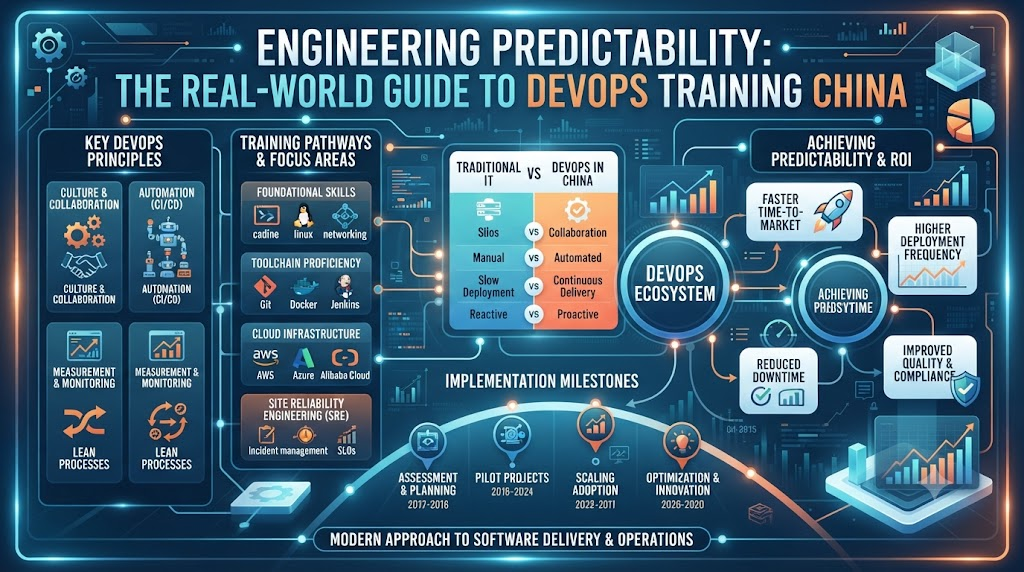
Enterprise engineering teams frequently hit an invisible architectural ceiling. As microservice ecosystems grow, deployments stall behind manual coordination meetings, configuration drift across environments causes recurring outages, and platform teams spend their days fielding repetitive service tickets. Modernizing these environments is not a matter of simply adopting new command-line tools; it requires restructuring how software moves from code to distributed runtimes. Through comprehensive DevOps Training China programs available at DevOpsSchool.cn, senior technical leads, architects, and engineering teams can master the structural disciplines required to operate high-throughput systems. Instead of treating automation as disconnected scripts, this architectural guide examines how to build self-healing infrastructure, design observable delivery pipelines, integrate shift-left security, and construct scalable internal developer platforms.
The System Architect’s View: Deconstructing the Delivery Lifecycle
From a systems engineering standpoint, software delivery is a distributed feedback loop. In traditional organizational structures, handoffs between developers, release managers, network teams, and infrastructure operators introduce operational drag. Every manual handoff introduces queue latency, information loss, and human configuration error.
DevOps reframes software delivery as an automated manufacturing line governed by strict feedback mechanisms:
[System Telemetry] ◄────────────────────────────────────────────────────┐
       │                                                                │
       ▼                                                                │
[Code / Intent] ──► [Build & Verification] ──► [Continuous Delivery] ──► [Distributed Cluster]
When engineering leaders look at systemic delivery challenges, three interconnected objectives emerge:
- Shortening the Change Feedback Cycle: Enabling code updates to be validated against production-like environments in minutes rather than weeks.
- Guaranteeing State Determinism: Ensuring runtime infrastructure matches the exact state declared in version control, eliminating manual production drift.
- Decoupling Deployment from Release: Using techniques like feature toggles, blue-green switches, and canary deployments to separate infrastructure rollouts from user exposure.
Architectural Foundations: Core Disciplines
Modernizing enterprise architectures requires building operational capabilities across five core domains.
+-------------------------------------------------------------------------+
|                  Platform Engineering & Developer Experience            |
+-------------------------------------------------------------------------+
|               DevSecOps                 |              SRE              |
|       (Automated Compliance)            |     (Empirical Reliability)   |
+-----------------------------------------+-------------------------------+
|                      Kubernetes & Service Mesh                          |
+-------------------------------------------------------------------------+
|                    Declarative Infrastructure (IaC)                     |
+-------------------------------------------------------------------------+
1. Container Orchestration & Distributed Runtimes (Kubernetes Training China)
Containers isolate applications from their underlying hosts, but large-scale systems require resilient cluster orchestration. In distributed architectures, Kubernetes functions as a distributed operating system:
- Control Plane Scheduling: Distributes application pods across nodes based on resource requests, limits, node affinity, and anti-affinity rules.
- Traffic Routing & Ingress: Manages external entry points, path-based routing, and dynamic load balancing across volatile pod endpoints.
- Storage Lifecycle Management: Provisions decoupled storage backends via dynamic Volume Plugins, allowing stateful services to recover cleanly across node failures.
- Automated Reconciliation: Controllers run continuous loops to reconcile observed cluster states with target configurations stored in
etcd.
2. Site Reliability Engineering (SRE Training China)
While software development prioritizes feature velocity, Site Reliability Engineering grounds delivery in mathematical operational limits:
- Service Level Indicators (SLIs): Clear, real-time measurements of service behavior (such as 99th-percentile response latency or successful HTTP transaction rates).
- Service Level Objectives (SLOs): Formally defined performance targets set through collaboration between product and operations teams.
- Error Budget Governance: The operational boundary ($1 – \text{SLO}$) that dictates engineering priorities. Depleting the error budget shifts team capacity directly to architectural remediation, bug fixing, and platform resilience.
- Automated Remediation: Building controllers and systems that resolve routine operational alerts without human intervention.
3. Shift-Left Security & Governance (DevSecOps Training China)
Security is often treated as an external audit performed right before a major release. This late check creates friction and requires expensive, time-consuming redesigns. DevSecOps embeds programmatic security validations directly into delivery pipelines:
- Static Security Analysis: Scans code repositories for structural flaws and insecure dependencies during early build phases.
- Supply Chain Integrity (SBOM): Generates immutable Software Bills of Materials to verify third-party dependencies against public vulnerability registries.
- Secrets Management: Injects dynamic, short-lived tokens and encryption keys into workloads at runtime using policy engines, keeping credentials out of repositories and images.
- Policy as Code: Enforces regulatory rules and organizational constraints programmatically before any infrastructure changes are applied.
4. Declarative Infrastructure & Multi-Cloud Strategy (Cloud Computing Training China)
Enterprise infrastructure must avoid manual drift across compute, storage, and networking layers. By adopting declarative Infrastructure as Code (IaC), architects describe desired infrastructure states in version-controlled configuration files. Automated engines evaluate these declarations and provision or modify cloud resources predictably, simplifying operations across hybrid and multi-cloud architectures.
Enterprise Toolchain Matrix
Sustainable technology platforms avoid overlapping tools. Every tool selected should address a specific architectural failure domain:
| Architectural Layer | Core Tooling | Engineering Function | Failure Domain Addressed |
| Source & Configuration | Git, GitLab | Single source of truth for code, configurations, and infrastructure blueprints. | Unauthorized state modifications; lack of audit trails. |
| CI Automation | Jenkins, GitLab CI | Compiles, runs automated test suites, and produces versioned container artifacts. | Defective code regressions reaching staging or production. |
| Continuous Delivery | Argo CD, Flux | Synchronizes live runtime clusters against Git-defined deployment manifests. | Inconsistent staging environments; manual deployment errors. |
| Cluster Orchestration | Kubernetes, Helm | Manages container lifecycles, health probes, service discovery, and self-healing. | Application downtime caused by underlying hardware failures. |
| Infrastructure State | Terraform, Ansible | Provisions networks, storage backends, and virtual instances deterministically. | Undocumented server changes; unrepeatable setups. |
| Telemetry & Tracing | Prometheus, Grafana, OpenTelemetry | Ingests time-series metrics and distributed traces across microservices. | High Mean Time to Resolution (MTTR); blind runtime incidents. |
Strategic Advancements: Platform Engineering and MLOps
Scaling modern engineering organizations often leads to operational bottlenecks. Two disciplines help maintain velocity at scale:
Platform Engineering (Platform Engineering Training China)
Enterprise engineering teams often struggle with cognitive overload when developers are required to configure infrastructure, network policies, and deployment descriptors directly. Platform engineering addresses this issue by designing Internal Developer Platforms (IDPs). These systems provide standardized, self-service APIs and deployment blueprints (“golden paths”) that allow software developers to deploy applications safely within guardrails, preserving architectural consistency without creating manual operations queues.
Machine Learning Operations (MLOps Training China)
Machine learning services present operational challenges that conventional web applications do not share. In addition to maintaining application logic, engineering teams must manage dynamic training datasets, track algorithmic hyperparameters, detect model drift in production, and run continuous retraining loops on scalable compute clusters.
Practical Architectural Scenario: GitOps-Governed Resilient Delivery
This architecture diagram demonstrates a closed-loop GitOps deployment pipeline:
[Developer Terminal]
       │
       ▼ (Feature Branch PR)
[Git Hub / Lab Repo] ──► [Automated CI Verification]
       │                 ├── Static Analysis & Dependency Linting
       │                 ├── Functional Test Execution
       │                 └── Dynamic Container Packaging
       ▼ (Merge to Main)
[Git Environment Manifest]
       │
       ▼ (Continuous Reconcile Loop)
[In-Cluster GitOps Controller]
       │
       ▼ (Atomic State Application)
[Kubernetes Production Mesh]
       │
       ├── Canary Deployments (Gradual Traffic Routing)
       ├── Automated Rollback on Latency Spikes
       └── Telemetry Feeds to SRE Alerting Dashboards
- Pull Request Validation: A developer issues a pull request. The CI engine runs automated linting, test suites, and container vulnerability scans before allowing code review.
- Deterministic Artifact Creation: Merging to the main branch triggers the creation of an immutable container image tagged with the Git commit hash, which is signed and pushed to a secure registry.
- Environment Manifest Update: The CI automation updates declarative deployment manifests in the environment configuration repository with the verified container image tag.
- GitOps In-Cluster Synchronization: A cluster-native controller continuously compares declared Git configurations against live pod states.
- Progressive Canary Verification: The controller rolls out the updated containers to a fractional canary pool. Routing layers route 5% of production traffic to the new instances.
- Automated Health Gating: Distributed tracing checks canary latency against the active SLO. If error rates exceed baseline thresholds, the controller terminates the canary and routes all traffic back to stable pods.
- Promotion to Production: If health metrics match baseline SLOs, the deployment rolls out across all cluster nodes without downtime.
Enterprise Challenges and Strategic Mitigations
| Operational Challenge | Architectural Root Cause | Strategic Mitigation |
| Pipeline Failure Fatigue | Fragile, non-deterministic integration test suites run synchronously in deployment pipelines. | Decouple fast unit tests from long-running functional tests; use mock service virtualization for third-party dependencies. |
| Production Configuration Drift | Ad-hoc manual changes applied directly to live production servers during emergencies. | Remove interactive administrative shell access in production; enforce all state updates via automated GitOps pipelines. |
| Operational Ticket Queues | Centralized infrastructure teams manually provisioning databases and compute instances for product groups. | Introduce Internal Developer Platforms that expose self-service, policy-validated infrastructure templates. |
| Slow Outage Triage (High MTTR) | Uncoordinated metric collections lacking distributed request traces across services. | Implement standardized OpenTelemetry collection across applications to connect infrastructure metrics directly to traces. |
| Late Security Discoveries | Security assessments isolated to manual audits prior to major product releases. | Enforce automated security policies and vulnerability scans within CI pipelines, blocking builds that introduce critical CVEs. |
Architectural Competence vs. Technical Certification
Professional certifications and hands-on architectural experience fulfill distinct roles in building an engineering organization.
Professional Certification (DevOps Certification China)
├── Validates structural understanding of platform components
├── Ensures a shared baseline of engineering terminology
└── Guides structured individual study paths

Production Architectural Experience
├── Resolves complex network splits and distributed concurrency issues
├── Balances architectural trade-offs under real operational constraints
└── Manages incident triage and multi-region disaster recovery
Certifications confirm understanding of platform capabilities, but operating reliable production systems requires deep hands-on experience. Engineers must practice triaging corrupted state stores, managing zero-downtime database migrations, and architecting resilient services that operate reliably during unpredictable hardware and network failures.
Frequently Asked Questions (FAQs)
What is the strategic objective of enterprise DevOps training in China?
Enterprise DevOps training modernizes organizational software delivery. It shifts teams away from slow, manual operational handoffs toward automated, observable, and resilient cloud-native architectures. Training focuses on building reliable delivery pipelines, mastering container orchestration, and treating infrastructure configurations as software code.
How does an enterprise architect view the role of Kubernetes?
An architect views Kubernetes as an abstraction layer across diverse computing platforms. It standardizes compute, networking, and storage interfaces, automates self-healing and service discovery, and provides a dependable API foundation for building internal developer platforms.
Why is error budget governance central to Site Reliability Engineering?
Error budgets establish a clear, data-driven agreement between product development and operations teams. If a service operates well within its budget, teams deploy features quickly. When incidents consume the budget, deployment pauses to prioritize reliability and architectural improvements.
How does DevSecOps change software delivery pipelines?
DevSecOps automates security analysis directly within continuous integration pipelines. By introducing static analysis, open-source license audits, dependency vulnerability checks, and container image scans into early build stages, teams identify and fix issues before code moves toward production.
What is the core purpose of platform engineering in growing organizations?
Platform engineering provides clear “golden paths” and self-service automation tools for software developers. It reduces cognitive overload by allowing developers to provision environments and deploy services safely, without needing to become experts in complex infrastructure and orchestration configurations.
How does Infrastructure as Code prevent production drift?
Infrastructure as Code (IaC) stores declarative infrastructure blueprints inside version control systems. Automated provisioning tools evaluate these files and adjust cloud resources to match the declared state, removing undocumented manual adjustments made directly on running servers.
What role does GitOps play in managing enterprise clusters?
GitOps relies on version-controlled repositories as the single source of truth for infrastructure and application configurations. In-cluster controllers continuously compare desired Git states against running workloads, automatically correcting deviations and maintaining consistent environments.
Why should companies consider corporate DevOps training programs?
Corporate programs align cross-functional engineering teams around shared methodologies, standardized toolchains, and common operational goals. This training breaks down functional silos, reduces deployment errors, and establishes shared practices for operating scalable cloud systems.
How does MLOps differ from standard software DevOps?
Standard DevOps coordinates application code and infrastructure states. MLOps expands these principles to handle machine learning workflows, introducing automated systems to manage training datasets, model registries, drift monitoring, and continuous model retraining on distributed infrastructure.
Can professional certifications substitute for practical production experience?
Certifications validate foundational knowledge of platform architectures and demonstrate commitment to learning. However, operating production systems requires hands-on troubleshooting, real incident triage, and the ability to navigate complex engineering trade-offs under operational pressure.
Conclusion
Modern enterprise systems require resilient architectures, continuous delivery pipelines, and reliable operations. Organizations that rely on manual deployments, undocumented server changes, and siloed teams often experience high operational overhead and frequent downtime. Adopting DevOps as an architectural standard addresses these challenges directly. Treating infrastructure as code, shifting security into early development phases, and measuring production reliability using SRE principles enables engineering teams to deploy changes quickly without compromising stability. Comprehensive programs available through DevOpsSchool.cn offer structured curricula, hands-on architectural labs, and practical guidance to help engineering teams design, build, and maintain scalable cloud-native platforms in production.
