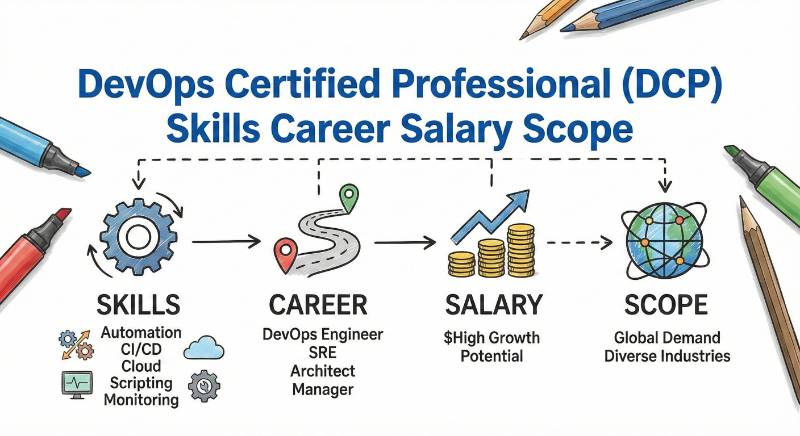
Introduction
The technology industry is currently facing a significant challenge. There is a massive gap between the demand for efficient software delivery and the supply of engineers capable of building the systems to support it. For twenty years, I have watched the industry evolve from manual, siloed operations to high-velocity, automated delivery.
Today, hiring managers are not looking for people who just know buzzwords. They are looking for proven engineering capability. They need professionals who understand the architecture of modern software delivery pipelines and have the hands-on skills to build them.
The DevOps Certified Professional (DCP) program has emerged as a reliable benchmark for these essential skills. This guide provides a realistic overview of the certification, analyzing its role in validating engineering competence for the current global market.
The Market Reality for DevOps Skills
Whether hiring in major Indian tech hubs like Bangalore and Hyderabad, or for remote global roles, the requirement is the same: practical execution. Companies are no longer interested in engineers who only understand one small piece of the puzzle.
Modern engineering organizations require individuals who understand the entire lifecycle of a code change—from version control through automated testing, security checks, and final deployment. The industry needs engineers who can replace manual, error-prone processes with reliable code.
The DCP certification serves as a validation mechanism for this specific skillset. It indicates to an employer that a candidate has moved beyond theoretical knowledge and possesses the fundamental engineering skills required to contribute immediately to a modern DevOps environment.
Certification Overview Matrix
The following table outlines the core parameters of the DCP certification program.
| Track | Level | Who it’s for | Prerequisites | Skills Covered | Recommended Order |
| Engineering | Professional | Software Engineers, System Admins, Release Engineers | Working knowledge of Linux and Git | CI/CD, Containerization (Docker), Infrastructure as Code, Monitoring, Git workflows | Taken after acquiring foundational knowledge. |
Provider: Devopsschool
3️⃣ Analysis: DevOps Certified Professional (DCP)
This section breaks down the practical components of the certification from an industry requirement perspective.
What it is
The DCP is a technical, engineering-focused credential. It validates a professional’s ability to utilize modern tooling to construct, manage, and optimize automated software delivery pipelines.
Who should take it
- Software Developers who need to understand the operational environment their code runs in to write better, more deployable applications.
- System Administrators who must transition their skills from manual server management to automated infrastructure provisioning.
- Cloud Engineers requiring a deeper understanding of the application delivery layer that runs on top of cloud infrastructure.
Skills you’ll gain
- Version Control Best Practices: Managing complex codebases and collaborative workflows using Git.
- Continuous Integration (CI): Automating the build and test phases to catch integration errors immediately using tools like Jenkins.
- Container Fundamentals: Using Docker to ensure application consistency across development, testing, and production environments.
- Infrastructure as Code (IaC): Treating infrastructure configuration as software scripts for repeatable, reliable server setups.
- Deployment Automation (CD): Removing manual intervention from the release process to increase deployment frequency.
- Basic Observability: Implementing monitoring to understand system health and detect issues proactively.
Real-world projects you should be able to do after it
- Design and implement a functional CI/CD pipeline for a standard web application.
- Refactor a legacy application into a containerized format using Docker for improved portability.
- Create scripts to automatically provision standardized development and testing environments.
- Configure fundamental monitoring dashboards to track application uptime and performance metrics.
Preparation plan
- 7–14 Days Plan (Foundations): Solidify prerequisites. Ensure comfort with the Linux command line and core Git operations (branching, merging). Review CI/CD concepts.
- 30 Days Plan (Tooling): Practical application. Dedicate time to hands-on Docker labs. Build basic pipelines in Jenkins. Learn the syntax of configuration management tools.
- 60 Days Plan (Integration): Combine the skills. Build a comprehensive project that triggers a build upon code commit, creates a container, and deploys it to infrastructure provisioned via code.
Common mistakes to avoid
- Tool Focus over Process: Learning how to configure a tool without understanding why it is necessary in the workflow.
- Weak Fundamentals: Attempting advanced automation without a strong grasp of basic Linux networking and administration.
- Passive Learning: Relying solely on video tutorials instead of actively building and troubleshooting lab environments.
Best next certification after this
Upon establishing this engineering baseline, professionals often progress to the Certified DevOps Architect for system design or the Certified DevSecOps Professional for security specialization.
Critical Organizational Functions (Learning Paths)
DevOps is broad. Once core engineering skills are verified, professionals typically align with specific critical functions within an IT organization.
1. DevOps (General Practitioner)
This function focuses on the end-to-end flow of software delivery, acting as the primary bridge between development teams and operational infrastructure.
2. DevSecOps (Security Integration)
Security is a critical business risk. This function embeds security controls directly into the automation pipeline to identify vulnerabilities early in the development lifecycle.
3. SRE (Site Reliability Engineering)
Focused on system stability and availability. This function applies software engineering principles to operational problems to ensure systems can scale reliably.
4. AIOps / MLOps (Emerging Technologies)
This function manages the lifecycle of machine learning models (MLOps) or utilizes AI to enhance IT operations and incident response (AIOps).
5. DataOps (Data Pipeline Efficiency)
Applies DevOps principles to data engineering to reduce cycle times and improve the quality of data analytics pipelines.
6. FinOps (Cloud Cost Optimization)
Addresses the financial impact of cloud usage. This function collaborates with engineering to manage and optimize cloud expenditures.
Role → Recommended Certifications Mapping
Matching certifications to specific job roles ensures the acquisition of relevant skills.
- DevOps Engineer: The DCP is the standard baseline certification for this engineering role.
- SRE (Site Reliability Engineer): Begin with DCP for tooling knowledge, then progress to specialized SRE training.
- Platform Engineer: DCP provides essential knowledge for building internal developer platforms.
- Cloud Engineer: DCP complements vendor-specific cloud certifications by focusing on the application delivery workflow.
- Security Engineer: DCP provides necessary context on the software build process before specializing in DevSecOps.
- Data Engineer: DCP offers foundational automation knowledge applicable to DataOps workflows.
- FinOps Practitioner: Understanding the engineering process taught in DCP is crucial for identifying cost drivers.
- Engineering Manager: While managers should target the Certified DevOps Manager, reviewing DCP content helps in understanding team capabilities.
Professional Growth Progression
Continuous learning is required to remain relevant. After achieving the DCP, professionals typically follow one of three progression paths based on organizational needs.
Path 1: Technical Leadership (Architecture)
Moving from implementation to design. The Certified DevOps Architect certification focuses on designing scalable, resilient systems rather than just building the individual pipelines.
Path 2: Specialization (Security)
Deepening expertise in high-demand areas. Moving to the Certified DevSecOps Professional track addresses the critical market need for secure software delivery.
Path 3: Management (Strategy)
Transitioning from individual contribution to team leadership. The Certified DevOps Manager track focuses on organizational culture, strategy, and metrics.
Notable Training Institutions
For a practical certification like the DCP, the quality of hands-on training is paramount. The following institutions are recognized for providing training and support for this program.
DevOpsSchool
As the provider of the DCP, they offer comprehensive, lab-focused training designed to align strictly with the certification standards and practical job requirements.
Cotocus
Focuses on corporate training and consulting, helping large organizations transition their workforce to modern DevOps practices through rigorous training programs.
ScmGalaxy
A long-standing community resource for build and release engineering. They provide extensive tutorials and training focused on the fundamentals of configuration management and automation.
BestDevOps
Aimed at simplifying complex concepts, offering straightforward training designed to help professionals grasp difficult topics efficiently.
devsecopsschool.com
A specialized institution focused entirely on the integration of security into the DevOps lifecycle, suitable for those pursuing the DevSecOps path later.
sreschool.com
Dedicated to Site Reliability Engineering principles. Their training focuses on the methodologies required to maintain large-scale production systems.
aiopsschool.com
Focuses on the intersection of AI and IT operations, providing training for those looking to leverage emerging technologies in automated workflows.
dataopsschool.com
Specializes in applying DevOps principles to the data engineering lifecycle, teaching how to build reliable, automated data pipelines.
finopsschool.com
Focuses on cloud financial management, training engineers and managers on the necessary skills to track and optimize cloud costs.
General Industry FAQs
Below are pragmatic answers to common questions regarding DevOps certifications in the current market.
1. What is the actual difficulty level?
They are designed for professionals. They assume technical competence. Success requires significant hands-on practice in lab environments, not just memorizing theory.
2. What is a realistic preparation timeline?
For a working professional, consistent study of 60-90 minutes daily for 4 to 8 weeks is a typical timeframe for adequate preparation.
3. Is extensive coding experience required?
No. You must be able to read code logic and write functional scripts (Bash/Python), but full-stack application development experience is not necessary.
4. What is the logical order of certifications?
Establish a strong engineering foundation first (like the DCP). Once the basics are mastered, branch into architecture, security, or management based on career goals.
5. What is the market value in India?
India remains a primary global hub for technical talent. The demand for verified, practical DevOps skills in major tech centers continues to outpace supply.
6. What is the global market value?
The tools and practices covered in the DCP are global standards. The certification is recognized by multinational corporations and aids in global career mobility.
7. Are online options available for training and exams?
Yes. Standard industry practice now includes online training modules and remotely proctored examinations accessible from home or office.
8. Do these certifications expire?
Yes, typically every 2 to 3 years. The rapid pace of technological change requires professionals to validate their skills periodically.
9. Does certification guarantee employment?
No certification guarantees a job. It serves to validate skills on a resume and provides the knowledge base necessary to pass technical interviews.
10. Can entry-level professionals take the DCP?
Yes, but the learning curve is steeper. They will require significant additional time mastering foundational concepts in Linux and networking first.
11. University Degree vs. Certification?
Degrees provide theoretical foundations. Certifications like DCP provide practical, job-specific technical skills required for immediate application.
12. Is hands-on training necessary?
It is highly recommended. DevOps is a practical discipline. Theoretical knowledge without lab experience is rarely sufficient for real-world job performance.
Specific FAQs: DevOps Certified Professional (DCP)
Questions specific to the DCP program nuances.
1. Is the exam theoretical or practical in nature?
The exam tests practical application. Questions are often scenario-based, requiring candidates to determine the correct application of tools to solve specific engineering problems.
2. Is it tied to a specific cloud vendor (AWS/Azure)?
No. The DCP focuses on vendor-agnostic tools (like Docker, Jenkins, Git) that are fundamental to DevOps across all cloud platforms and on-premise environments.
3. Is this relevant for Windows Administrators?
Yes. Modern DevOps tooling is cross-platform. The principles of automation, CI/CD, and Infrastructure as Code are equally applicable to Windows environments.
4. What is the depth of Kubernetes coverage?
DCP covers container fundamentals using Docker thoroughly. It introduces orchestration concepts, but deep Kubernetes expertise is typically reserved for advanced specializations.
5. What is the required passing score?
While subject to variation based on the exam version, the standard passing threshold is typically around 70%.
6. Difference between “Foundation” and “Professional” levels?
Foundation certifications generally cover culture and terminology. The DCP is an engineering certification focused on technical implementation and tooling.
7. Are exam retakes permitted upon failure?
Yes, retake policies are in place, usually requiring a mandatory waiting period between attempts. Verify specific details with the provider.
8. How is certification verified by employers?
Successful candidates receive a digital badge and a unique verifiable ID that can be shared with current or potential employers for instant validation.
Conclusion
From the perspective of someone responsible for building high-performing engineering teams, the value of a certification lies not in the digital badge itself, but in the validated capability it represents. The current job market is saturated with theoretical knowledge; it is starved for practical execution.
The DevOps Certified Professional (DCP) serves as a critical baseline in the hiring process. It indicates to employers that an individual possesses the foundational engineering discipline required to step into a modern software delivery environment and contribute immediately. It helps move a candidate from the “potential” pile to the “capable” pile.
My final advice to engineers and IT managers is based on pragmatism. Do not pursue this certification merely to add an acronym to a resume. Pursue it for the rigorous, hands-on engineering practice required to earn it. In today’s technology market, demonstrated competence is the only currency that matters.