Introduction
Software teams are shipping features faster than ever, but security incidents are also increasing. Many organizations have invested in DevOps and cloud, yet still treat security as an afterthought. This gap creates risk, compliance issues, and stress for engineers and managers.
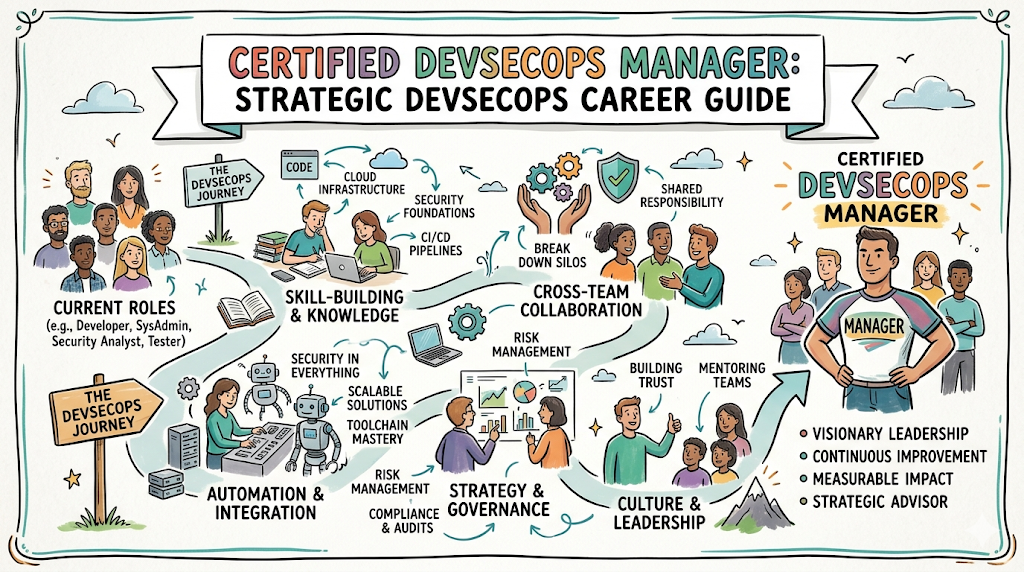
The Certified DevSecOps Manager program helps you move from ad‑hoc security fixes to building a secure delivery system by design. This guide is for working engineers, software developers, and managers in India and across the globe who want to lead DevSecOps strategy, not just follow it.
What it is
The Certified DevSecOps Manager is a manager‑level DevSecOps certification focused on secure software delivery at scale. It covers governance, risk management, compliance, security tooling strategy, and culture change across development and operations.
Who should take it
- DevOps, SRE, platform, and cloud engineers moving into security leadership.
- Security engineers and architects who want to own DevSecOps strategy, not just tools.
- Engineering managers and technical leads responsible for delivery, uptime, and compliance.
- Product and program managers who collaborate closely with security and platform teams.
Skills you’ll gain
- DevSecOps governance and policy design.
- Risk‑based vulnerability management and prioritization.
- Security controls in CI/CD (SAST, DAST, SCA, secrets, containers).
- Compliance mapping (ISO, SOC 2, PCI‑DSS, GDPR, HIPAA) to DevSecOps practices.
- DevSecOps metrics, KPIs, and maturity modeling.
- Leading culture change between development, security, and operations.
- Incident response leadership and post‑incident learning practices.
Real‑world projects you should be able to do after it
- Design and roll out a DevSecOps governance framework for a product or platform organization.
- Define and implement security gates in CI/CD without slowing delivery.
- Build a DevSecOps maturity roadmap with milestones, ownership, and KPIs for leadership reports.
- Map regulatory or internal policies to concrete controls in code, pipelines, and infrastructure.
- Lead cross‑team incident simulations and create reusable playbooks.
Preparation plan (7–14 days / 30 days / 60 days)
7–14 days – Fast‑Track / Executive Sprint
- Ideal if you already live and breathe DevOps and security.
- Spend 3–4 hours daily on the official curriculum and manager‑level topics: governance, risk, compliance, culture.
- Use practice questions and case studies every day to test decision‑making.
30 days – Professional Track
- Week 1–2: review core DevOps and security tooling (pipelines, scanners, cloud basics).
- Week 3: focus on risk management, metrics, and compliance mapping.
- Week 4: practice scenario‑based questions and write simple governance plans for your own context.
60 days – Foundation Builder
- First 30 days: build hands‑on skills with CI/CD, containers, cloud, and basic security tools.
- Next 30 days: go deep into leadership modules, governance frameworks, and sample enterprise case studies.
Common mistakes
- Treating it like a pure technical exam instead of a leadership program.
- Ignoring compliance and governance because they seem “non‑technical”.
- Focusing only on tools and skipping culture and stakeholder management topics.
- Studying in isolation without mapping concepts to your current company or projects.
- Cramming in the last week instead of following a daily, scenario‑based plan.
Best next certification after this
- Same track (DevSecOps): a hands‑on DevSecOps Engineer / Professional‑type certification to deepen technical coverage.
- Cross‑track: an SRE / Observability or Cloud Architect certification to connect security with reliability and architecture.
- Leadership: a cloud or software engineering leadership certification (for example, architect or advanced manager programs) to broaden your impact.
Certification Overview Table
| Certification | Track | Level | Who it’s for | Prerequisites | Skills covered | Recommended order |
|---|---|---|---|---|---|---|
| Certified DevSecOps Manager | DevSecOps | Manager / Master | Managers, tech leads, senior DevOps/SRE/Security professionals | Solid DevOps + security basics, several years in engineering/leadership | Governance, risk, compliance mapping, policy as code, culture, metrics, incident leadership | After DevOps/SRE/Security experience |
| DevOps Engineer‑level cert (e.g., cloud DevOps/CI‑CD) | DevOps | Associate / Professional | DevOps and platform engineers | Basic programming, Linux, cloud fundamentals | CI/CD, containers, IaC, automation | First technical foundation |
| DevSecOps Engineer / Professional‑type cert | DevSecOps | Professional | Hands‑on security engineers, DevOps | DevOps basics, basic security concepts | SAST, DAST, SCA, secure pipelines, shift‑left security | Before or alongside DevSecOps Manager |
| SRE / Observability cert | SRE | Specialist / Professional | SREs, Ops, platform engineers | Cloud + scripting | SLOs, error budgets, incident mgmt, observability | Before/after DevSecOps Manager depending on role |
| AIOps/MLOps‑oriented cert | AIOps/MLOps | Specialist | Data/ML and platform leads | Python, ML basics, cloud | Model lifecycle, monitoring, anomaly detection, automation | After DevOps foundation, in data/AI‑heavy orgs |
| DataOps‑oriented cert | DataOps | Specialist | Data engineers, analytics leads | SQL, ETL, big‑data pipelines | Data pipeline reliability, data security, governance | Parallel with or after DevSecOps Manager |
| FinOps‑oriented cert | FinOps | Practitioner / Professional | Cloud cost owners, managers | Cloud billing basics, finance awareness | Cloud cost optimisation, budgeting, showback/chargeback | After cloud + DevOps foundation, alongside DevSecOps |
Choose Your Path: 6 Learning Paths
1. DevOps Path
- Start with a DevOps engineer‑level certification to build strong CI/CD, automation, and cloud fundamentals.
- Add an SRE/Observability certification to grow into reliability and incident response.
- Then take Certified DevSecOps Manager to layer governance, compliance, and security leadership on top.
2. DevSecOps Path
- Begin with DevOps foundation plus a security basics course.
- Take a DevSecOps Engineer / Professional‑type certification focused on building secure pipelines and automation.
- Move to Certified DevSecOps Manager to move from engineer to strategist and manager.
3. SRE Path
- Build DevOps and cloud fundamentals first.
- Add SRE or Observability certifications for SLOs, error budgets, and incident handling.
- Use Certified DevSecOps Manager to connect reliability with security and compliance across services.
4. AIOps/MLOps Path
- Start with software and DevOps basics, then move into ML and data skills.
- Take AIOps/MLOps certifications that cover ML pipelines, monitoring, and automation.
- Add Certified DevSecOps Manager to support secure, compliant, and governable AI platforms.
5. DataOps Path
- Build strong data engineering fundamentals and pipeline practices.
- Add DataOps training on data reliability, observability, and governance.
- Use Certified DevSecOps Manager to ensure security and compliance across data flows.
6. FinOps Path
- Learn core cloud and DevOps concepts first.
- Take FinOps certifications that focus on cloud cost control and financial governance.
- Combine with Certified DevSecOps Manager to align security, reliability, and cost optimisation at leadership level.
Role → Recommended Certifications
| Role | Recommended certifications sequence |
|---|---|
| DevOps Engineer | DevOps Engineer‑level cert → DevSecOps Engineer / Professional → Certified DevSecOps Manager |
| SRE | DevOps or SRE foundation → SRE / Observability cert → Certified DevSecOps Manager |
| Platform Engineer | DevOps Engineer‑level cert → Kubernetes / cloud platform cert → Certified DevSecOps Manager |
| Cloud Engineer | Cloud associate/architect cert → DevOps Engineer‑level cert → Certified DevSecOps Manager |
| Security Engineer | Security or DevSecOps Engineer cert → Certified DevSecOps Manager → advanced cloud/SRE certification |
| Data Engineer | DataOps or data engineering cert → SRE/Observability cert → Certified DevSecOps Manager |
| FinOps Practitioner | Cloud Fundamentals → FinOps Practitioner cert → Certified DevSecOps Manager |
| Engineering Manager | DevOps/Agile leadership training → Certified DevSecOps Manager → architecture / platform leadership programs |
Next Certifications to Take (Same Track, Cross‑Track, Leadership)
Using guidance from top software engineering certification landscapes, you can plan three clear directions after Certified DevSecOps Manager.
1. Same track (DevSecOps)
- A hands‑on DevSecOps Engineer / Professional‑type program to deepen pipeline security skills.
- Secure SDLC and secure software lifecycle certifications that focus on secure coding and application security across the SDLC.
2. Cross‑track (Cloud, SRE, Data, AI)
- Cloud architect or cloud developer certifications (AWS, Azure, GCP) to expand your architecture view.
- SRE / Observability certifications to improve reliability engineering and incident management.
- Data‑centric or AI‑centric certifications (Data Engineering, AIOps/MLOps) if you work heavily with data platforms or ML systems.
3. Leadership
- Software engineering leadership or professional master‑level credentials that validate broader leadership skills in architecture, project management, and stakeholder communication.
- Specialized leadership programs in cloud, platform, or security strategy to prepare for head‑of‑engineering or C‑level paths.
Top Institutions for Training and Certification Support
These institutions can help with training and guidance for Certified DevSecOps Manager and related paths.
DevOpsSchool
DevOpsSchool provides structured learning paths across DevOps, DevSecOps, SRE, AIOps/MLOps, DataOps, and FinOps. Their programs mix theory, real‑world projects, and mentoring, which is very helpful for working professionals preparing for manager‑level certifications.
Cotocus
Cotocus focuses on hands‑on, industry‑aligned training and corporate enablement programs. They often design customized roadmaps for engineers and managers targeting certifications like Certified DevSecOps Manager along with related cloud and DevOps tracks.
Scmgalaxy
Scmgalaxy covers SCM, DevOps, CI/CD, and emerging DevSecOps practices under one umbrella. Their workshops help you connect source control, automation, and security practices into a single delivery pipeline.
BestDevOps
BestDevOps acts as a knowledge and training hub for DevOps and related domains. It highlights roadmaps, tools, and training offers that align with certifications, helping you choose the right next step in your career.
devsecopsschool.com
DevSecOpsSchool is the official provider of the Certified DevSecOps Manager program. It offers detailed curriculum, governance frameworks, and instructor‑led sessions focused on DevSecOps strategy and leadership.
sreschool.com
SRESchool focuses on Site Reliability Engineering and observability. Combining SRE learning from here with Certified DevSecOps Manager allows you to cover both reliability and security leadership.
aiopsschool.com
AIOpsSchool trains professionals in AIOps and MLOps, including automated operations, ML‑driven monitoring, and intelligent incident response. This pairs well with DevSecOps Manager if you are working in AI‑heavy or large‑scale environments.
dataopsschool.com
DataOpsSchool is focused on DataOps, data pipeline governance, and reliability. This is valuable when your DevSecOps work is closely tied to data platforms, analytics, and regulatory requirements around data.
finopsschool.com
FinOpsSchool offers training on cloud financial management and FinOps practices. Combining FinOps skills with DevSecOps management helps you design secure and cost‑efficient cloud operations.
FAQs About the Certified DevSecOps Manager Program
1. Is Certified DevSecOps Manager difficult?
It is moderately to highly challenging because it tests leadership decisions, not just technical commands. With a good DevOps and security foundation plus 30–60 days of focused preparation, it is very achievable.
2. How much time do I need to prepare?
Most working professionals need 30–60 days with 1–2 hours per day. Senior leaders with a strong background may complete preparation in 7–14 intensive days.
3. What are the prerequisites?
There is no strict formal prerequisite, but you should understand CI/CD, cloud basics, and fundamental security concepts. A prior DevOps or cloud certification is very helpful.
4. Is programming expertise mandatory?
You do not need deep programming skills, but you should be comfortable reading pipelines, policies, and configuration files. The exam focuses on architecture and governance decisions rather than coding exercises.
5. How is this different from a DevSecOps Engineer cert?
Engineer‑level programs are tool‑heavy and hands‑on. Certified DevSecOps Manager focuses on strategy, governance, compliance, and culture for secure delivery across teams.
6. What roles benefit most from this certification?
DevOps engineers, SREs, security engineers, cloud engineers, and engineering managers who want to own DevSecOps strategy benefit the most. It is especially useful for people acting as technical leaders or managers.
7. Does this certification help in small startups?
Yes, because startups need someone to design minimum viable security and compliance without slowing innovation. The program teaches practical ways to balance speed, cost, and security.
8. Is the certification globally relevant?
The content is globally relevant because it uses common cloud practices and universal frameworks. You can map the same principles to local regulations or industry standards in your region.
9. What kind of exam questions can I expect?
Expect scenario‑based questions where you pick the best governance or risk response. Memorisation alone will not work; you must think like a DevSecOps leader.
10. Will it improve my salary and career growth?
Manager‑level security and DevOps skills are in high demand and often come with higher compensation bands. The certification also supports transitions into roles like DevSecOps Manager, Security Engineering Manager, and Platform Security Lead.
11. How often do I need to update my knowledge?
Tools change quickly, but governance and leadership concepts remain stable. You should still review changes in cloud services, security tools, and regulations every year.
12. Is this a good choice for pure software engineers?
Yes, especially if you already design systems or act as a senior engineer. It helps you move from building features to owning secure delivery across the lifecycle.
FAQs Specifically on Certified DevSecOps Manager
1. What is the main objective of the Certified DevSecOps Manager?
The main objective is to train you to design, lead, and govern secure software delivery across teams and platforms.
2. Do I need prior security certifications?
Not mandatory, but having a security or DevSecOps engineer‑level background makes the learning smoother.
3. Is hands‑on lab work included?
Many training providers include labs to show how pipelines and controls work, but the exam itself focuses on leadership scenarios.
4. Will this help with compliance audits?
Yes, the program teaches how to map compliance requirements to DevSecOps controls and evidence.
5. Can I take this while working full‑time?
The 30‑day and 60‑day plans are designed for people with full‑time jobs, assuming 1–2 hours of study per day.
6. Is there a specific technology stack required?
No, the principles are cloud‑ and tool‑agnostic, and you can apply them on AWS, Azure, GCP, or hybrid data centre environments.
7. What if I fail the exam the first time?
Use your first attempt to understand where your judgment or theory is weak, then follow a structured revision plan targeting those areas.
8. What should I focus on in the last week?
Focus on mock exams, governance frameworks, risk‑based decision questions, and revising your notes on culture and compliance.
Conclusion
The Certified DevSecOps Manager program turns DevSecOps from a scattered list of tools into a clear, strategic operating model for your organization. For working engineers and managers, it is a natural next step when you are ready to own security, compliance, and delivery outcomes together.
By combining this certification with DevOps, SRE, AIOps/MLOps, DataOps, and FinOps learning paths, you build a strong, future‑proof profile that is valuable in India and across global markets. With a realistic 30–60 day plan and support from the institutions listed above, you can use this program to move from “doing tasks” to leading DevSecOps strategy for your team and company.