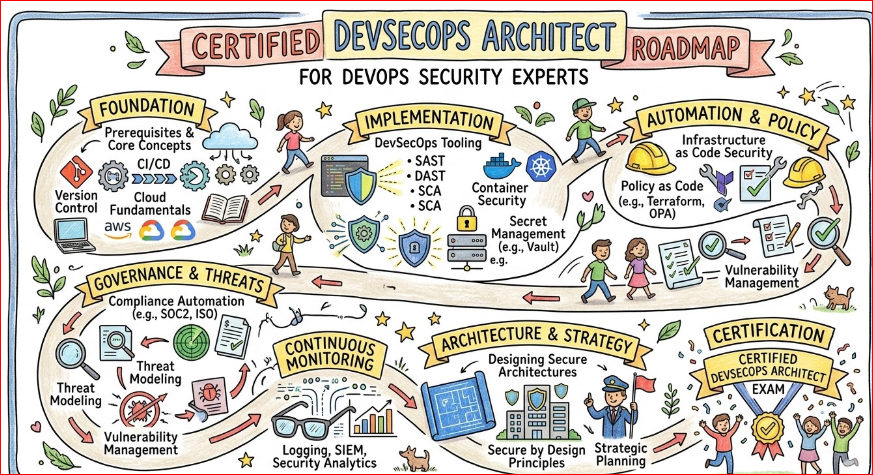
Releases happen daily, infrastructure is in the cloud, and security attacks are growing every week. In this world, old “security at the end” models do not work anymore. Certified DevSecOps Architect is a certification designed for professionals who want to design secure systems, secure pipelines, and secure cloud platforms from the start, not at the end. In this guide, you will learn what this certification is, who should take it, what skills you gain, how to prepare, and how it fits into different career paths in DevOps, DevSecOps, SRE, AIOps/MLOps, DataOps, and FinOps.
What is Certified DevSecOps Architect?
Certified DevSecOps Architect is an advanced-level certification focused on designing and guiding secure DevOps ecosystems across applications, CI/CD pipelines, platforms, and cloud. It proves that you can bring security into architecture decisions, not only into tools and scanners. The program from DevSecOpsSchool covers secure-by-design systems, automated security in CI/CD, cloud-native security, compliance as code, and risk management across modern environments.
What this Certification Covers
What it is
Certified DevSecOps Architect is a specialized certification that validates your ability to design and implement security-first DevOps architectures in enterprises.
It connects security practices with CI/CD, cloud, containers, compliance, and incident response so that security becomes a built-in part of delivery, not a separate phase.
Who should take it
- DevOps Engineers who want to move into security and architecture roles.
- Security Engineers who want to design DevSecOps pipelines and secure platforms, not only run tools.
- SREs and Platform Engineers responsible for production systems, observability, and reliability under strict security and compliance.
- Cloud Engineers working on multi-cloud or hybrid setups with strong security and governance needs.
- Engineering Managers and Architects who want to define secure delivery models and standards for their teams.
Skills you’ll gain
- Ability to design secure CI/CD pipelines with security gates, secrets management, and automated checks.
- Understanding of secure SDLC, threat modeling, SAST, DAST, SCA, and security testing strategy.
- Knowledge of cloud-native security patterns for containers, Kubernetes, serverless, and microservices.
- Experience with security as code and compliance as code, aligned with frameworks like NIST and OWASP SAMM.
- Skills to build monitoring, logging, and incident response workflows that include security signals.
- Ability to create security blueprints, reference architectures, and roadmaps for DevSecOps adoption.
Real-world projects you should be able to do
After this certification, you should be able to:
- Design a complete CI/CD pipeline for a microservices application with integrated SAST, DAST, SCA, and secrets management.
- Define a security architecture for a Kubernetes-based platform, including network policies, RBAC, and image scanning.
- Create a cloud security reference architecture (AWS/Azure/GCP) with IAM, encryption, logging, and compliance controls.
- Build a security and compliance as code setup using IaC tools plus policy engines.
- Design an observability setup that combines metrics, logs, traces, and security events for faster detection and response.
Preparation plan (7–14 / 30 / 60 days)
You can choose a preparation track based on your background and free time.
- 7–14 days (intensive track):
- 30 days (standard track):
- Good for most working engineers with 1–2 hours per day.
- Week 1: DevSecOps basics, secure SDLC, threat modeling.
- Week 2: CI/CD pipeline security, SAST, DAST, SCA, secrets.
- Week 3: Cloud and container security (Kubernetes, serverless, policies).
- Week 4: Compliance as code, observability, incident response, mock exam and revision.
- 60 days (deep-dive track):
- Suitable if you are new to security or architecture.
- 2 months of steady work: basics in month one, advanced architecture design and repeated case studies in month two.
Common mistakes to avoid
- Treating DevSecOps Architect as a “tool certification” instead of an architecture and decision-making role.
- Ignoring fundamentals like threat modeling and secure design, and jumping only into scanners and tools.
- Not connecting architecture decisions with business risk, compliance, and governance needs.
- Studying only theory and not doing end-to-end design exercises or reviewing real architectures.
- Forgetting runtime security, observability, and incident response patterns.
Best next certification after this
After Certified DevSecOps Architect, you can move in three directions:
- Same track: Advanced DevSecOps or security architecture programs, or deeper cloud security certifications.
- Cross-track: SRE, Observability, or Cloud Architect certifications to expand into reliability and platform design.
- Leadership: Product management or security leadership programs that focus on governance, risk, and strategy.
Certification Table
Below is a sample table format you can use in your blog to list the main Certified DevSecOps Architect program (you can expand it later if you want to add related certifications).
| Certification | Track | Level | Who it’s for | Prerequisites | Skills covered | Recommended order |
|---|---|---|---|---|---|---|
| Certified DevSecOps Architect | DevSecOps | Architect / Advanced | Senior DevOps, Security, SRE, Platform, Cloud Engineers, Managers | Strong DevOps and cloud basics, CI/CD experience, basic AppSec | Secure SDLC, CI/CD security, cloud-native security, threat modeling, compliance as code, observability and incident response | Core DevSecOps architecture certification before or alongside advanced cloud/security certs |
Choose Your Path: 6 Learning Paths
DevSecOps architecture sits in the middle of many modern roles. Here are six learning paths and how this certification fits into each.
1. DevOps Path
- Start with core DevOps skills and CI/CD.
- Add Certified DevSecOps Architect to bring security into your pipelines and platforms.
- Later move into SRE or Cloud Architect certifications.
2. DevSecOps Path
- Begin with a DevSecOps foundation or practitioner-level certification.
- Take Certified DevSecOps Architect as your advanced architecture credential.
- Later specialize into cloud security, container security, or application security programs.
3. SRE Path
- Build SRE skills around reliability, SLOs, and incident management.
- Add Certified DevSecOps Architect to design secure and reliable platforms with proper controls and logging.
- Then explore observability or resilience engineering certifications.
4. AIOps/MLOps Path
- Start with MLOps or AIOps foundations (pipelines for ML models, monitoring, automation).
- Use Certified DevSecOps Architect to bring secure pipelines, model security, and compliance into ML workflows.
- Later consider specialist AI security or data security certifications.
5. DataOps Path
- Learn DataOps basics such as data pipelines, data quality, and governance.
- Apply DevSecOps architecture principles to secure data pipelines, access control, and compliance.
- Then move into data platform or data governance certifications.
6. FinOps Path
- Understand FinOps basics such as cloud cost visibility, allocation, and optimization.
- Use Certified DevSecOps Architect to build secure and cost-aware architectures with policy controls and governance.
- Later grow into cloud governance or platform engineering leadership roles.
Role → Recommended Certifications
Here is a simple mapping to show how Certified DevSecOps Architect fits into different roles.
Top Institutions for Training and Certification Support
These institutions can help you prepare for Certified DevSecOps Architect with training, guidance, and practice:
DevOpsSchool
DevOpsSchool provides structured DevSecOps and DevOps training with hands-on labs, projects, and mentoring support.
They focus on real tools and pipelines, which is very useful when you want to become an architect who understands what teams actually run in production.
Cotocus
Cotocus is known for consulting and corporate training in DevOps, cloud, and security.
For this certification, they can help with customized learning plans, architecture workshops, and project-based exercises aligned with enterprise needs.
Scmgalaxy
Scmgalaxy offers courses, workshops, and community programs around DevOps and DevSecOps.
Their focus on practical scenarios, code repositories, and labs makes it easier to connect theory with daily engineering work.
BestDevOps
BestDevOps works as a hub for DevOps and DevSecOps training, news, and resources.
You can use it to find relevant programs, events, and knowledge materials that support your Certified DevSecOps Architect journey.
devsecopsschool.com
DevSecOpsSchool is the official provider of the Certified DevSecOps Architect program.
They offer the main training, syllabus, reference material, and certification exam that directly focuses on DevSecOps architecture roles.
sreschool.com
SRE School focuses on reliability, SRE, and observability-related learning.
Combining their material with Certified DevSecOps Architect helps you design systems that are both secure and reliable in production.
aiopsschool.com
AIOps School covers AIOps, automation, and intelligent operations.
This is useful when you want to extend your DevSecOps architecture with AI-assisted monitoring, anomaly detection, and automated incident response.
dataopsschool.com
DataOps School targets data pipelines, data platforms, and data governance skills.
If you work on data-heavy systems, pairing these skills with DevSecOps architecture helps you secure data flows end-to-end.
finopsschool.com
FinOps School focuses on cloud cost management and financial operations for engineering teams.
When combined with Certified DevSecOps Architect, you can design architectures that are secure, compliant, and cost-aware at the same time.
Next Certifications to Take (Same Track, Cross-Track, Leadership)
After you complete Certified DevSecOps Architect, think in three directions for your next move:
1. Same track (deep DevSecOps)
- Advanced DevSecOps or cloud security specialist certifications.
- Vendor-specific security programs on AWS, Azure, or GCP.
2. Cross-track (breadth)
- SRE, Observability, or Reliability certifications to connect security with uptime and performance.
- Platform Engineering or Kubernetes Architect programs.
3. Leadership (strategy)
- Certifications or programs around security leadership, governance, and risk.
- Product or engineering leadership courses that teach you how to drive change across teams.
FAQs (General – Difficulty, Time, Value, Career)
1. Is Certified DevSecOps Architect difficult?
It is challenging because it focuses on architecture, decisions, and real-world scenarios, not only tools.
However, if you already have DevOps and cloud experience, the difficulty is manageable with a clear plan.
2. How much time do I need to prepare?
Most working professionals need 30–60 days with regular study.
If you are already strong in DevOps and security, you may complete it in 7–14 intensive days.
3. What are the prerequisites?
You should understand DevOps fundamentals, CI/CD, basic application security, cloud basics, and have some real-world project exposure.
4. Do I need to be a security expert before starting?
No. You do not need to be a pure security specialist.
But you must be comfortable with concepts such as vulnerabilities, threats, and secure coding basics.
5. Is this certification good for career growth?
Yes. It opens doors to architect, lead engineer, platform, and security leadership roles, where you own the design of secure systems and pipelines.
6. How does it compare to normal DevOps certifications?
Typical DevOps certifications focus on automation, CI/CD, and operations.
This one adds strong security and compliance focus at the architectural level.
7. Can I prepare while working full-time?
Yes. The 30-day and 60-day plans are designed for working engineers who can study 1–2 hours per day.
8. Does it help if I want to become an architect?
This certification is directly aligned with architecture roles around DevSecOps, cloud, and platforms.
It trains you to think about trade-offs, risk, and design choices at system level.
9. What kind of exam questions can I expect?
You should expect scenario-based questions and case studies where you need to choose the best architecture decision, not only answer definitions.
10. Is it useful outside India?
Yes. The concepts are global: cloud, DevOps, pipelines, and security are the same across regions, and enterprises worldwide look for DevSecOps architects.
11. What is the value for managers?
Managers gain a common language with architects and engineers, can ask better questions, and can design roadmaps that balance speed and safety.
12. How does this certification support long-term career growth?
It helps you move from “doer” roles (only implementing tasks) to “designer” and “decision-maker” roles that define how systems are secured and delivered.
FAQs (Focused on Certified DevSecOps Architect)
1. What exactly does a Certified DevSecOps Architect do?
They design secure CI/CD pipelines, secure cloud and platform architectures, and define how security is embedded into every stage of delivery.
2. Do I need hands-on experience before taking this certification?
Yes, real hands-on experience with CI/CD and cloud makes a big difference, because many topics use real-world patterns and tools.
3. Which industries hire DevSecOps Architects?
Technology, finance, healthcare, e-commerce, telecom, government, and any sector that depends on software and cloud platforms require DevSecOps Architects.
4. Can this certification help me move from security engineer to architect?
Yes. It adds architecture, design, and DevOps pipeline thinking to your existing security skills, which is key for architect-level roles.
5. Will I learn only one toolchain?
No. The focus is on principles, patterns, and architectures.
You will see examples using multiple kinds of tools, but the goal is to design tool-agnostic, scalable patterns.
6. Does this certification cover containers and Kubernetes?
Yes. Container security, image scanning, and cluster security are core topics because many modern systems run on Kubernetes or similar platforms.
7. How does it handle compliance requirements?
You learn to map regulations and standards into automated controls and policies using security as code and compliance as code.
8. Is this certification relevant if my company is still early in DevOps?
Yes. It can help you design the first secure DevOps model correctly, so that future growth is faster, safer, and easier to govern.
Conclusion
Certified DevSecOps Architect is not just another technical badge. It is a way to upgrade yourself from working only on tools and tickets to designing secure, scalable, and compliant systems end-to-end. If you are a DevOps Engineer, SRE, Platform Engineer, Cloud Engineer, Security Engineer, Data Engineer, FinOps Practitioner, or Engineering Manager, this certification can become a central pillar of your career path across DevOps, DevSecOps, SRE, AIOps/MLOps, DataOps, and FinOps.