Introduction
The cloud landscape has shifted dramatically from the days of manual server configuration to the era of total automation. Having seen these transitions firsthand, I can tell you that the ability to treat infrastructure as code is no longer a luxury—it is a baseline requirement. This guide is built to bridge the gap between basic cloud knowledge and the high-level mastery required to manage complex, global environments. For engineers and managers in India and across the globe, the AWS DevOps Engineer – Professional is a career-defining milestone. It validates your ability to design, manage, and scale distributed systems while keeping security and cost in check. This blog provides a roadmap to help you navigate this challenging but rewarding certification process.
The Landscape of AWS Certifications
Understanding the AWS ecosystem is crucial before committing to a professional-level exam. This certification doesn’t exist in a vacuum; it builds upon the foundational and associate levels to ensure you have a “full-stack” understanding of cloud operations. The following table outlines how the DevOps track fits into the broader AWS learning journey for any serious practitioner.
| Track | Level | Who it’s for | Prerequisites | Skills Covered | Recommended Order |
| Cloud Practitioner | Foundational | Beginners, Managers | None | Basic cloud concepts, billing | 1st |
| Solutions Architect | Associate | Designers | 6+ months exp. | Network design, storage | 2nd |
| Developer | Associate | App Developers | 6+ months exp. | SDKs, CI/CD, Serverless | 2nd |
| SysOps Admin | Associate | Systems Admins | 6+ months exp. | Deployment, operations | 2nd |
| DevOps Engineer | Professional | DevOps/SREs | 2+ years exp. | Automation, Governance | 3rd |
Deep Dive: AWS Certified DevOps Engineer – Professional
What it is
This certification is an advanced credential that focuses on the “Operations” side of the cloud, emphasizing automation and high availability. It tests your technical expertise in provisioning, operating, and managing distributed application systems on the AWS platform. It is widely considered one of the most comprehensive exams because it touches every part of the software development lifecycle.
Who should take it
This path is designed specifically for technical professionals who are already comfortable with AWS and want to prove they can handle senior-level responsibilities. It is ideal for DevOps engineers, Site Reliability Engineers (SREs), and software developers who are moving into architectural or lead roles. Managers who want to understand the modern CI/CD landscape also find this certification highly valuable for leading their teams effectively.
Skills you’ll gain
Advanced SDLC Automation: You will master the art of designing and implementing end-to-end delivery pipelines. This goes beyond simple scripts; you will learn how to integrate automated testing, security gates, and multi-stage approvals into AWS CodePipeline, ensuring that code moves from a developer’s branch to a production environment with zero manual intervention.
Infrastructure as Code (IaC) at Scale: You will move past the basics of CloudFormation and Terraform to manage complex, multi-account environments. This involves learning how to use AWS CDK for programmatic infrastructure, creating reusable templates, and managing state across thousands of resources while ensuring that every change is versioned and auditable.
High Availability and Fault Tolerance: One of the most critical skills is learning how to build “self-healing” systems. You will gain the expertise to configure Auto Scaling, multi-AZ deployments, and cross-region replication so that your applications can survive the failure of an entire data center or region without the end user ever noticing a glitch.
Automated Monitoring and Logging: You will learn how to turn data into actionable insights by mastering Amazon CloudWatch and AWS CloudTrail. This includes setting up custom metrics, automated dashboarding, and real-time alerting systems that can trigger Lambda functions to fix common issues automatically before they escalate into outages.
Governance and Compliance Automation: In a professional environment, you can’t manually check every resource for compliance. You will gain the skills to use AWS Config, AWS Organizations, and Service Control Policies (SCPs) to automatically enforce company policies, ensuring that no one accidentally leaves a database open to the public or spins up an unauthorized, expensive resource.
Security and Identity Management: You will develop a deep understanding of how to secure the entire DevOps lifecycle. This includes managing complex IAM policies, implementing “least privilege” access, and using AWS Secrets Manager to ensure that sensitive credentials are never hardcoded and are rotated automatically to prevent security breaches.
Real-world projects you should be able to do
- Zero-Downtime Deployment with Blue/Green Strategy: You will be able to architect a system where a “Green” environment is launched alongside the existing “Blue” production environment. By using AWS CodeDeploy and Route 53 weighted routing, you can shift traffic gradually, test the new version in real-time, and perform an instant rollback if any issues are detected, ensuring 100% uptime for users.
- Enterprise-Scale Automated Governance: Imagine managing 500 AWS accounts; you cannot check them manually. You will build a system using AWS Config and AWS Systems Manager that automatically detects non-compliant resources—like an unencrypted S3 bucket or an open security group—and triggers a “remediation” script to fix the security hole within seconds of it being created.
- Multi-Region Disaster Recovery (DR) Automation: You will design a “pilot light” or “warm standby” architecture that spans across continents. Using Amazon Aurora Global Databases and AWS CloudFormation StackSets, you can build an automated failover process that can move your entire application stack from Mumbai to North Virginia in under 15 minutes during a regional outage.
- Self-Healing Microservices Infrastructure: You will be able to build a containerized environment using Amazon EKS (Kubernetes) or ECS that monitors its own health. By integrating CloudWatch Alarms with Auto Scaling groups, your infrastructure will automatically replace crashed containers or scale up capacity during a sudden traffic spike without any engineer having to wake up at 3 AM.
- Automated Security Vulnerability Scanning in CI/CD: You will integrate security directly into the developer’s workflow. This project involves building a pipeline that uses Amazon Inspector and AWS Secrets Manager to scan Docker images for vulnerabilities and ensure that no sensitive passwords or API keys are ever committed to the code repository, blocking the “build” if any risks are found.
- Centralized Logging and Real-time Analytics Hub: You will create a “single pane of glass” for all your logs. By using Amazon Kinesis to stream logs from thousands of instances into an OpenSearch (ELK) cluster, you can build real-time dashboards that allow your team to visualize errors, track user behavior, and debug complex distributed systems issues in seconds rather than hours.
Preparation Plans
- 14-Day Sprint (The Expert Path): This high-intensity plan is for those who already use AWS every single day. The first week is dedicated to mastering CI/CD hooks and advanced CloudFormation syntax, while the second week focuses on security automation and exhaustive practice exams. It requires a deep dive into the specific “gotchas” that separate a Professional candidate from an Associate.
- 30-Day Path (The Professional Route): This is the most balanced approach, allowing you to spend the first two weeks reviewing core whitepapers and setting up complex labs. The third week is spent on professional-level scenarios like multi-account billing and centralized logging. The final week is reserved for fine-tuning your knowledge and closing any gaps identified during mock tests.
- 60-Day Deep Dive (The Learning Path): Perfect for engineers moving into DevOps from a traditional IT or development background. The first month is spent building a solid foundation in Linux, scripting, and AWS Associate-level concepts. The second month is a slow, methodical climb through the Professional domain areas, ensuring that every theoretical concept is backed by hours of hands-on practice.
Common Mistakes to Avoid
- Underestimating the Depth of Professional Scenarios: One of the biggest pitfalls is approaching this exam like an Associate-level test. While Associate exams focus on what a service is, the Professional exam presents you with multi-layered architectural problems. You must understand how five or six services interact simultaneously; missing a single detail about how SQS handles message visibility or how Lambda scales can lead you to the wrong answer.
- Ignoring Security and Governance Requirements: Many engineers focus purely on “making the code deploy” and ignore the 17% of the exam dedicated to Security and Compliance. In the Professional realm, a solution that works but isn’t secure—such as using long-term IAM credentials instead of IAM Roles or failing to encrypt an S3 bucket—is considered a failure. You must prioritize “Least Privilege” and automated auditing in every scenario.
- Poor Time Management During the Exam: With 75 complex, scenario-based questions and only 180 minutes, you have less than 2.5 minutes per question. Many candidates spend too long reading the introductory “flavor text” of a question. The mistake is not jumping to the actual technical requirement at the end of the prompt first, which often allows you to eliminate two obviously wrong answers immediately.
- Neglecting Hands-on Lab Experience: You cannot pass this exam on theory alone. A common mistake is relying solely on video courses and whitepapers. The exam tests your “muscle memory”—knowing exactly which CodeDeploy hook to use for a specific validation or how to debug a failing CloudFormation stack. Without having broken and fixed these things in a real AWS console, the theoretical questions will feel confusing.
- Overlooking Multi-Account and Multi-Region Strategies: At the Professional level, AWS assumes you are operating at an enterprise scale. Many fail because they only study single-account setups. You must understand how AWS Organizations, Control Tower, and StackSets work together to manage infrastructure across hundreds of accounts and multiple global regions simultaneously.
- Misunderstanding Service Limits and Quotas: A “perfect” architectural solution on paper might fail in reality because of a soft or hard AWS service limit. A frequent mistake is choosing an answer that requires scaling beyond default API rate limits or concurrent execution limits without explaining how to manage those quotas. You need to know when to request a limit increase versus when to re-architect the solution.
Best Next Certification After This
- Same Track (The Security Specialization): AWS Certified Security – Specialty This is the most logical next step if you want to become a DevSecOps expert. While the DevOps Pro exam touches on security, the Security Specialty goes much deeper into data protection, encryption (KMS), and advanced threat detection. It essentially turns you into the “Safety Officer” of the automation world, a role that is highly sought after by banks, healthcare providers, and government agencies.
- Cross-Track (The Architectural Broadening): AWS Certified Solutions Architect – Professional If the DevOps Pro is about “how” to build and run things, the SA Pro is about “why” you choose one architecture over another for a massive enterprise. Holding both Professional certifications is the ultimate “Power Combo” in the AWS world. It proves you have the 360-degree vision required to design a global, multi-tier system and the technical skill to automate its entire lifecycle.
- Leadership Track (The Strategic Management): Certified DevOps Manager (or Certified SRE Foundation) If your goal is to move away from the CLI and into leadership, look toward management-focused certifications. These programs focus on the cultural and process side of DevOps—how to manage “Error Budgets,” how to reduce “Toil,” and how to lead a transformation across an entire organization. It is the perfect bridge for a Senior Engineer looking to become a Director or CTO.
Choose Your Path: 6 Specialized Learning Tracks
- DevOps Path: This is the primary route for those who want to be the engine of modern software delivery. It focuses on the traditional bridge between development and operations, emphasizing speed, agility, and the elimination of manual silos. You will become an expert in the tools that allow a company to ship code dozens of times a day without fear.
- DevSecOps Path: In an era of constant cyber threats, security cannot be an afterthought; it must be part of the code itself. This path focuses on “shifting left,” where security checks are automated directly into the CI/CD pipeline. You will learn how to automate vulnerability scanning and compliance checks so that every release is secure by default.
- SRE (Site Reliability Engineering) Path: This path is for the engineers who care most about the uptime and health of a system. It applies software engineering principles to operations problems, focusing on service level objectives (SLOs) and error budgets. You will learn how to build systems that are not just fast, but incredibly resilient to failure and load.
- AIOps/MLOps Path: As systems grow too large for humans to monitor, we turn to Artificial Intelligence to manage operations. This path covers the use of machine learning to predict outages before they happen and automates the deployment of AI models. It is the cutting-edge frontier for engineers who want to manage “intelligent” infrastructure.
- DataOps Path: Data is the lifeblood of modern business, and it needs its own set of automated operations. This path focuses on creating robust, automated pipelines for data processing and analysis. You will ensure that data flows from sources to dashboards with the same reliability and speed that you expect from application code.
- FinOps Path: The cloud can be expensive if not managed properly, and FinOps is the practice of bringing financial accountability to the cloud. This path teaches you how to optimize costs, manage reserved instances, and ensure that every dollar spent on AWS is providing maximum value. It is a critical skill for senior engineers and managers who handle large-scale budgets.
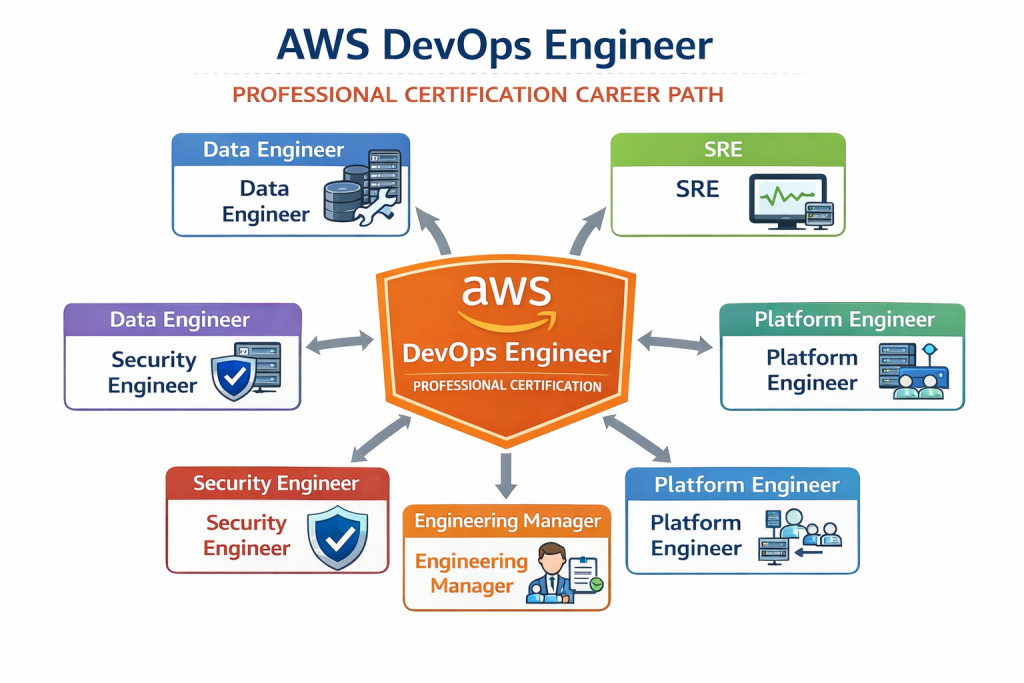
Role → Recommended Certifications Mapping
| Role | Recommended Certifications |
| DevOps Engineer | SysOps Associate → DevOps Professional → Security Specialty |
| SRE | SysOps Associate → DevOps Professional → Advanced Networking |
| Platform Engineer | Solutions Architect Associate → DevOps Professional → Developer Associate |
| Cloud Engineer | Solutions Architect Associate → SysOps Associate → DevOps Professional |
| Security Engineer | Security Specialty → DevOps Professional → Solutions Architect Pro |
| Data Engineer | Data Engineer Associate → Data Analytics Specialty → DevOps Professional |
| FinOps Practitioner | Cloud Practitioner → FinOps Certified → DevOps Professional |
| Engineering Manager | Cloud Practitioner → Solutions Architect Associate → DevOps Professional |
Top Training Institutions for AWS DevOps Professional
- DevOpsSchool: This is a top-tier institution known for its deep focus on hands-on labs and real-world scenarios. They provide over 100+ lab projects and a massive database of interview questions to ensure you are job-ready, not just exam-ready. Their trainers are industry veterans who bring years of practical experience to every session.
- Cotocus: This organization specializes in high-end technical consulting and training that is tailored for corporate environments. They focus on the practical application of AWS tools, ensuring that students can immediately implement what they learn in a production setting. Their curriculum is updated constantly to reflect the latest changes in the AWS ecosystem.
- Scmgalaxy: A well-established community and training hub that offers a vast library of resources for version control and CI/CD. They are particularly strong in teaching the “Source” part of the DevOps lifecycle and have a large network of experts. Their video tutorials and community forums are excellent for self-paced learners who need extra support.
- BestDevOps: They provide streamlined and highly effective training programs that cut through the fluff and focus on the core exam requirements. Their courses are designed for busy professionals who need to maximize their study time without sacrificing depth. They offer great mentorship programs that guide you through every step of the certification journey.
- devsecopsschool: This school is dedicated entirely to the intersection of security and operations, which is a critical part of the Professional exam. They teach you how to integrate security tools into every stage of the pipeline, from code analysis to runtime protection. It is the perfect choice for those who want to specialize in building secure cloud environments.
- sreschool: If your goal is to master reliability and system performance, this institution offers specialized tracks focused on SRE principles. They go beyond the AWS console to teach the underlying philosophy of managing large-scale distributed systems. Their training is highly valued by companies looking for engineers who can handle high-traffic, mission-critical applications.
- aiopsschool: As the industry moves toward automated, AI-driven operations, this school provides the specialized knowledge needed to stay ahead. They focus on using machine learning to enhance monitoring, incident response, and capacity planning. It is an excellent choice for forward-thinking engineers who want to master the next generation of DevOps tools.
- dataopsschool: This institution fills a vital gap by teaching how to apply DevOps principles to data management and analytics pipelines. They focus on the unique challenges of data versioning, quality control, and automated data delivery. Their graduates are highly sought after in industries where data is the primary product or asset.
- finopsschool: Cost management is a massive part of the AWS Professional exam, and this school offers the most in-depth training on cloud economics. They teach you how to analyze bills, optimize resource usage, and communicate cloud value to business stakeholders. It is an essential stop for anyone moving into a senior cloud management or architectural role.
Next Certifications to Take
- Same Track (AWS Certified Security – Specialty): This is the natural progression for any DevOps professional who wants to ensure their pipelines are impenetrable. It deepens your knowledge of IAM, encryption, and logging, making you a much more valuable asset to any security-conscious organization.
- Cross-Track (AWS Solutions Architect – Professional): Taking this certification after the DevOps Pro will give you a complete, 360-degree view of the AWS platform. While the DevOps cert focuses on how to build and run things, the Solutions Architect cert focuses on why you choose one service over another in a complex design.
- Leadership (Certified DevOps Manager): For those looking to move away from the keyboard and into a leadership role, this is the perfect next step. It focuses on the cultural and strategic aspects of DevOps, teaching you how to lead teams and manage large-scale digital transformation projects.
FAQs: Everything You Need to Know
1. How difficult is the AWS DevOps Professional exam compared to Associate levels?
If an Associate exam is a 3 out of 10, the Professional level is a solid 10. It moves away from “what does this service do” and into “here is a complex business failure; how do you automate the fix.” The questions are much longer, and you must be able to synthesize multiple AWS services into a single cohesive solution under intense time pressure.
2. How much time do I realistically need to study?
For a working professional with hands-on AWS experience, I recommend 30 to 60 days of focused study. If you are newer to the platform, you should plan for 4 to 6 months to ensure you have enough time for the hundreds of labs required to build the necessary intuition.
3. Are there any formal prerequisites?
Technically, AWS has removed the requirement to hold an Associate certification first. However, I strongly advise against skipping them. Having the Developer or SysOps Associate provides the foundational “bricks” you need to build the complex “house” that is the Professional certification.
4. What is the best sequence of certifications to follow?
The most effective path is: Solutions Architect Associate → Developer Associate → SysOps Associate → DevOps Professional. This sequence ensures you understand the architecture, the code, and the operations before you try to automate the entire lifecycle at a professional level.
5. Is this certification worth the investment?
Yes, it is consistently ranked among the top-paying IT certifications globally. It is a high-trust signal to employers that you can handle high-stakes, enterprise-level environments, which often leads to a significant salary jump and better job security.
6. What are the common career outcomes after passing?
Holding this badge unlocks senior roles such as Senior DevOps Engineer, Site Reliability Engineer (SRE), and Cloud Infrastructure Architect. It also prepares you for leadership positions where you are expected to design and oversee the entire digital transformation of an organization.
7. Do I need to know a specific programming language?
You don’t need to be a software developer, but you must be comfortable with logic. Most AWS automation relies on Python or Bash, and you will definitely need to master JSON and YAML for Infrastructure as Code (CloudFormation).
8. Can I take the exam in India, and what is the cost?
The exam is available globally, including all major Indian tech hubs, through Pearson VUE. The cost is $300 USD, but remember to check your AWS Certification account for a 50% discount voucher if you have passed an Associate exam recently.
9. How long does the certification stay valid?
It is valid for 3 years. To maintain your status, you can either retake the latest version of the exam or pass one of the higher-level Specialty exams, which will automatically renew your Professional standing.
10. What is the most important skill for the exam: theory or practice?
Practice, without a doubt. The exam tests your ability to solve real-world problems. You can memorize every whitepaper, but if you haven’t actually built a CI/CD pipeline or configured a Cross-Region replica in the console, you will struggle with the scenario-based questions.
11. Is it better to take the DevOps Pro or the Solutions Architect Pro?
It depends on your goal. If you love the “how” and want to be hands-on with automation and pipelines, go for DevOps Pro. If you prefer the “why” and want to design high-level strategies for large migrations, go for Solutions Architect Pro. Most top-tier experts eventually hold both.
12. How does this certification help Software Engineers?
For developers, this certification is the key to becoming a “Full Cycle Developer.” It teaches you how to own your code from the moment you write it until it is running in production, making you an incredibly versatile and valuable member of any modern engineering team.
FAQs on AWS DevOps Engineer – Professional
1. How difficult is the exam compared to the Associate level?
The Professional exam is significantly more difficult because it moves away from simple “feature” questions to complex “scenario” questions. You are often presented with a problem that has multiple correct-sounding answers, and you must choose the most efficient or cost-effective one. It requires a much higher level of critical thinking and a deeper understanding of service limits and integrations.
2. Is there a specific coding language I need to know?
While you don’t need to be a senior developer, you should be comfortable reading and writing Python, Bash, or JSON/YAML. Most of the automation on AWS is done through these languages, especially when working with Lambda functions or CloudFormation templates. Being able to understand logic flow and script basic automation is essential for the hands-on portions.
3. How much weight is given to cost optimization in the exam?
Cost is a major theme throughout the exam, as AWS wants to ensure Professional engineers are building sustainable systems. You will often be asked to identify the least expensive way to achieve a specific technical goal, such as choosing between different storage tiers or compute models. Ignoring the “cost” aspect of a question is a quick way to lose points on the Professional exam.
4. Can I take this exam without having the Associate certification first?
Technically, yes, because AWS removed the hard prerequisite requirements a few years ago. However, I strongly advise against it unless you have several years of intense, hands-on AWS experience across many different services. The Associate-level knowledge provides the building blocks that the Professional exam assumes you already know by heart.
5. What is the best way to handle the long, scenario-based questions?
The key is to read the “last sentence” of the question first to understand exactly what the requirement is (e.g., “least administrative effort” vs “lowest cost”). Then, skim the scenario for keywords like “real-time,” “multi-region,” or “legacy.” This allows you to quickly eliminate answers that don’t meet the core requirement, saving you valuable time during the 180-minute exam.
6. How often is the exam content updated?
AWS updates its exams regularly to include new services and retire older practices, with major revisions like the move from DOP-C01 to DOP-C02. You should always check the official exam guide a few months before your test date to see if new services like AWS Control Tower or Proton have been added. Staying current with the AWS “What’s New” blog is a great way to stay ahead of these changes.
7. Does this certification help in getting remote cloud jobs?
Yes, this is one of the most respected certifications for remote roles because it proves you can work independently on complex infrastructure. Companies hiring remotely need to know that their engineers can manage global systems without constant hand-holding. Having “Professional” on your resume serves as a high-trust signal to recruiters in the global remote market.
8. What is the pass/fail format of the exam?
The exam uses a “scaled score” from 100 to 1000, with a passing score of 750. You will receive your results within a few days, though sometimes it can be as quick as a few hours. The score report will also provide a breakdown of how you performed in each of the different domain areas, helping you see where you were strongest.
Testimonials
“I spent years working as a system admin, but the AWS DevOps Professional certification was the key that finally opened the door to a senior engineering role. It gave me the confidence to lead my company’s migration to a fully automated CI/CD environment.” — Senior DevOps Engineer, Hyderabad
“Earning this certification wasn’t just about the title; it was about the knowledge. The depth of the preparation made me realize how much I was doing manually that could have been automated, saving my team hundreds of hours of work every month.” — Lead Cloud Architect, San Francisco
Conclusion
Mastering the AWS Certified DevOps Engineer – Professional is a significant undertaking that requires a blend of deep technical knowledge and a strategic mindset. It is a journey that will challenge your understanding of the cloud, but the reward is a level of expertise that is in high demand globally. By following a structured preparation plan and focusing on real-world application, you can join the ranks of elite engineers who power the world’s most advanced cloud platforms.