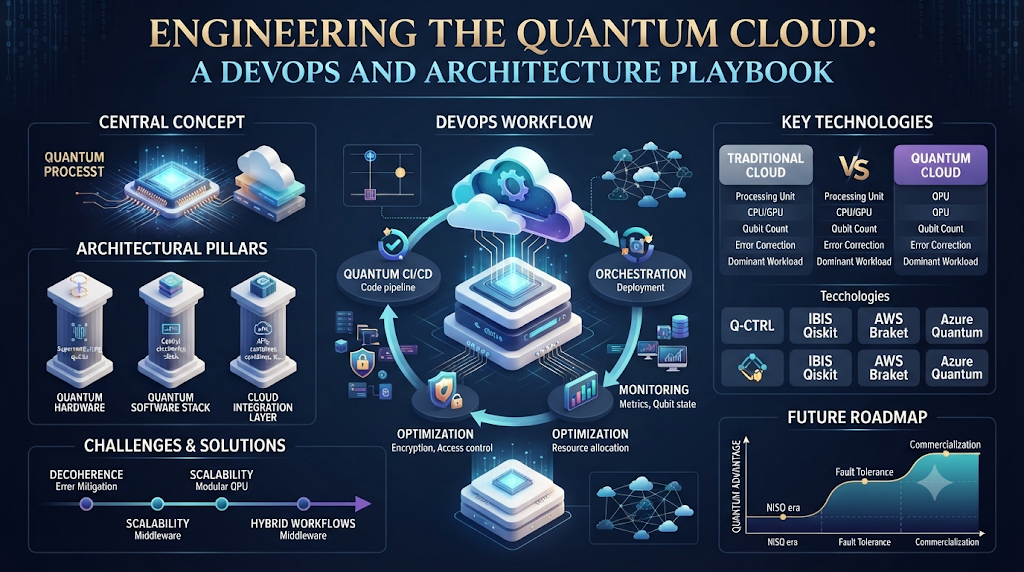
Picture a modern software pipeline where half of your application runs on standard Linux containers in the cloud, while the other half executes inside a cryogenic processor cooled colder than outer space. Connecting these two worlds is the core mission of quantum cloud computing training and modern QuantumOps engineering.
Not long ago, running a quantum experiment meant working inside a specialized physics laboratory. Today, cloud platforms expose quantum processors through standard REST APIs and Python libraries. However, integrating quantum hardware into real enterprise systems requires more than just writing circuits. Cloud architects, software engineers, and IT leaders must manage job queues, hardware noise, hybrid compute loops, and strict cloud budgets.
This guide looks at quantum computing through the lens of cloud infrastructure, DevOps automation, and enterprise system design. You will learn how quantum hardware operates, how hybrid workflows run in the cloud, which tools lead the industry, and how to build practical career skills.
Core Concepts: How Quantum Computing Works Under the Hood
Before designing cloud pipelines or writing quantum code, technical teams need a clear mental model of how quantum processors differ from classical servers.
Classical Bits vs. Quantum Qubits
Standard computers—from mobile phones to cloud data centers—store data in bits. Every bit holds a strict binary value: either 0 or 1. Classical software solves tasks by moving millions of these binary digits through logic circuits.
Quantum processors replace bits with qubits (quantum bits). Instead of locking into 0 or 1 right away, a qubit uses quantum mechanics to hold a mathematical blend of both states while a calculation is underway.
Three key rules govern how qubits behave:
- Superposition: While a quantum program runs, a qubit can exist in a combination of
0and1at the same time. Think of a spinning coin before it hits the table. Once a detector measures the qubit, superposition ends and returns a crisp0or1. - Entanglement: Two or more qubits can become tightly linked together. Changing or measuring one entangled qubit immediately reveals the state of its partner, even across physical distance.
- Interference: Quantum algorithms shape qubit waves so wrong answers cancel each other out, while right answers reinforce one another and appear most often when measured.
Quantum Gates, Circuits, and Simulators
In everyday programming, functions transform variables. In quantum programming, quantum gates alter the state of qubits. Placing multiple gates in a sequence forms a quantum circuit.
Because real quantum hardware is expensive and shared among thousands of users, developers test circuits first on a quantum simulator. A simulator is classical software running on CPUs or GPUs that calculates how an ideal quantum chip would behave.
Practical Use Cases: Where Quantum Cloud Adds Value
Quantum processors will never replace web servers, relational databases, or mobile apps. Classical cloud servers handle routine business logic far faster and cheaper. Instead, quantum chips act as specialized co-processors for specific math challenges.
Organizations investing in quantum computing for IT managers and engineering teams focus on four primary problem areas:
- Supply Chain and Fleet Routing: Calculating the best delivery routes across thousands of vehicles, weather shifts, and time windows overwhelms classical brute-force search. Quantum optimization algorithms explore large solution spaces efficiently.
- Molecular Simulation and Drug Discovery: Modeling how atoms bond inside new medicines or battery materials requires quantum-level math. Quantum chips simulate molecular behavior far more naturally than classical servers.
- Financial Risk and Portfolio Modeling: Banks test quantum circuits to price complex financial derivatives, spot subtle fraud patterns, and stress-test investment portfolios.
- Quantum-Safe Cybersecurity: Powerful future quantum computers could break today’s public-key encryption. Security teams are already upgrading networks to protect sensitive data against future threats.
A Realistic Industry View: Today’s quantum hardware is noisy and still scaling up. Enterprises currently use cloud quantum platforms for research, prototype testing, and workforce upskilling—not to replace daily production servers.
Inside the Cloud Execution Pipeline
When an engineer triggers a quantum job from a CI/CD pipeline or local terminal, the workload moves through seven clear stages:
- Problem Formulation: Engineers translate a business optimization or chemistry problem into a mathematical model suitable for qubits.
- Circuit Development: A developer writes the quantum gates using Python and an open-source software development kit (SDK).
- Local Unit Testing: Automated tests run the circuit on a local simulator to catch logic bugs before spending cloud credits.
- Hardware Transpilation: Every physical quantum chip has unique wiring rules. A transpiler rewrites the abstract circuit so it matches the exact native gates and physical connections of the target chip.
- Authenticated Cloud Submission: The compiled circuit travels through an encrypted API gateway into a cloud job queue.
- Multi-Shot Sampling: Because quantum results follow probability rules, the processor runs the circuit 1,000 to 10,000 times (called shots) to build a clear histogram of outcomes.
- Classical Post-Processing: The cloud returns the bitstring counts, and a classical server extracts the final business answer.
Comparing Major Quantum Cloud Platforms and Toolkits
Cloud providers eliminate the need to buy, cool, or maintain physical quantum chips. Professionals taking a Qiskit programming course or AWS Braket training regularly work across these four platforms:
| Platform / Framework | Core Advantage | Primary Language | Accessible Hardware | Best Fit for Teams |
| Qiskit & IBM Quantum | Deep transpiler control and low-latency runtime | Python | IBM superconducting chips | Developers wanting fine-tuned circuit optimization and runtime speed |
| Amazon Braket | Single API across multiple hardware vendors | Python | IonQ, Rigetti, IQM, QuEra | Cloud teams already managing IAM, S3, and billing inside AWS |
| Microsoft Azure Quantum | Future hardware resource estimation and Q# | Q#, Python | Quantinuum, IonQ, Atom Computing | Enterprise Microsoft teams planning long-term qubit requirements |
| Google Cirq | Low-level gate timing and hardware noise control | Python | Google quantum chips (approved access) + simulators | Engineers testing hardware-specific layouts and pulse schedules |
Qiskit and IBM Quantum
Qiskit is the most widely adopted open-source Python SDK for quantum computing. Paired with IBM Quantum Cloud, it provides standardized tools—called Sampler and Estimator—that streamline how developers collect bitstring probabilities and energy values. Qiskit Runtime places classical containers right beside quantum processors to reduce network lag.
Amazon Braket
Amazon Braket gives AWS engineers a single interface to test circuits on managed simulators and run them on diverse hardware brands, including trapped-ion and superconducting chips. Braket integrates cleanly with AWS IAM for access control, Amazon S3 for result storage, and CloudWatch for operational monitoring.
Microsoft Azure Quantum
Azure Quantum pairs Microsoft’s Q# programming language with cloud access to third-party quantum processors. Its Azure Quantum Resource Estimator helps architects calculate how many physical qubits a future fault-tolerant system will require to solve specific enterprise workloads.
Google Cirq
Cirq is designed around the physical realities of near-term noisy chips. It gives engineers direct control over qubit grid placement and gate schedules so they can reduce errors during execution.
Hands-On Tutorial: Testing Quantum Bit-Flips and Superposition in Python
To see how quantum logic works in code, let us build a circuit that prepares a qubit in superposition, flips its state, and measures the probability distribution using Python and Qiskit.
Prerequisites
- Python 3.10 or newer
- Qiskit SDK installed (
pip install qiskit)
Python Code Example
Python
from qiskit import QuantumCircuit
from qiskit.primitives import StatevectorSampler

# Create a circuit with 2 qubits and 2 classical readout bits
qc = QuantumCircuit(2, 2)

# Flip qubit 0 from state 0 to state 1 using an X gate
qc.x(0)

# Put qubit 1 into a 50/50 superposition using a Hadamard gate
qc.h(1)

# Entangle qubit 0 and qubit 1 with a CNOT gate
qc.cx(0, 1)

# Measure both qubits into the classical register
qc.measure([0, 1], [0, 1])

# Run 1,000 shots on a local state-vector simulator
sampler = StatevectorSampler()
job = sampler.run([qc], shots=1000)
counts = job.result()[0].data.c.get_counts()

print("Circuit output counts:", counts)
How Each Line Works
QuantumCircuit(2, 2)creates two qubits (starting at0) and two standard bits to store final measurements.qc.x(0)applies a Pauli-X gate, flipping the first qubit from0to1.qc.h(1)applies a Hadamard gate to the second qubit, placing it in an equal mix of0and1.qc.cx(0, 1)applies a Controlled-NOT gate. Because qubit 0 is1, it flips qubit 1, linking their outcomes together.StatevectorSampler()runs 1,000 simulated executions on your local CPU.
Expected Output: You will see roughly 500 counts of '01' and 500 counts of '11' (for example, {'01': 504, '11': 496}). Notice that qubit 0 always measures as 1, while qubit 1 splits evenly between 0 and 1.
System Architecture of a Quantum Cloud Stack
From an operations standpoint, a cloud-accessible quantum computer combines four tightly coupled infrastructure layers:
- Cryogenic QPU Layer: Superconducting quantum chips sit inside dilution refrigerators cooled to roughly 15 millikelvin. Extreme cooling prevents ambient heat from destroying delicate qubit states.
- Classical Control Layer: Room-temperature servers and precision pulse generators translate digital circuit commands into microwave or laser signals that manipulate qubits and read back measurements.
- Cloud Orchestration Layer: Job schedulers, circuit compilers, and containerized runtimes manage multi-tenant queues, calibration updates, and telemetry.
- Security and Governance Layer: Enterprise identity providers, role-based access control (RBAC), encrypted APIs, and private network endpoints keep proprietary algorithms and datasets protected.
Hybrid Quantum-Classical Systems in Production
Because current quantum chips cannot host databases, manage user interfaces, or execute complex branching loops, almost every real application relies on hybrid quantum classical computing training and architecture.
In a hybrid workflow, classical cloud servers and quantum processors share responsibilities in a continuous loop:
- Classical Compute Node: Cleans business datasets, initializes circuit parameters, evaluates cost functions, and runs classical optimization algorithms.
- Quantum Processing Unit: Executes parameterized quantum circuits to explore complex mathematical spaces and returns measurement statistics.
This iterative cycle repeats dozens or hundreds of times per job. Cloud frameworks co-locate the classical optimizer and the quantum hardware inside the same data center so network latency does not stall execution.
Evaluating Benefits and Technical Limitations
Technology leaders exploring quantum computing for software engineers and operations teams must balance genuine architectural benefits against physical hardware constraints.
Key Advantages
- On-Demand Hardware Variety: Teams can benchmark superconducting, trapped-ion, and neutral-atom chips through a single cloud bill without buying physical hardware.
- CI/CD and Git Integration: Quantum circuits live in standard Git repositories, run automated unit tests on simulators, and integrate with existing cloud observability dashboards.
- Early Algorithmic Readiness: Organizations build internal domain expertise and test prototypes well ahead of fault-tolerant hardware milestones.
Current Limitations
- Hardware Noise and Decoherence: Qubits lose their quantum state within microseconds. Circuits with too many sequential gates accumulate errors and produce noisy outputs.
- Error Correction Overhead: Creating one reliable, fault-tolerant “logical qubit” currently requires bundling dozens or hundreds of noisy physical qubits together.
- Queue Times and Shot Costs: Shared cloud QPUs often have wait queues, and running thousands of shots per optimization step can drive up cloud bills without proper quotas.
Skills, Roles, and Career Pathways in QuantumOps
Transitioning into quantum cloud engineering builds directly on existing Python, DevOps, and cloud architecture skills rather than requiring a physics PhD.
- Software Engineers: Build proficiency in Python, vectors and matrices, probability, and SDKs like Qiskit or Cirq.
- Cloud and DevOps Engineers: Focus on IAM access policies, containerized hybrid runtimes, automated simulator testing, and cloud cost controls.
- Enterprise Architects: Design secure data pipelines that connect classical cloud storage and APIs with remote QPUs.
Professionals seeking structured training often enroll in a quantum computing certification course or a specialized quantum computing architecture course. At QuantumOps School, advertised learning tracks align directly with four enterprise roles:
- QuantumOps Architect: Covers hybrid cloud system design, hardware modality selection, and enterprise security governance.
- QuantumOps Engineer: Focuses on hands-on circuit coding, transpilation optimization, and automated cloud SDK pipelines.
- QuantumOps Manager: Equips IT leaders to run readiness assessments, manage vendor budgets, and lead cross-functional teams.
- QuantumOps Professional: Establishes core fluency across qubits, gates, simulators, and cloud job execution.
Completing a QuantumOps certification demonstrates practical capability in bridging quantum programming with cloud operations, especially when paired with working GitHub projects.
IT Governance and FinOps for Quantum Workloads
IT managers can keep quantum initiatives secure, predictable, and cost-effective by enforcing four operational rules:
- Mandate Simulator-First Testing: Require developers to validate every circuit on free local simulators before submitting jobs to paid cloud QPUs.
- Set Hard Cloud Quotas: Configure billing alerts and maximum shot limits per workspace so runaway hybrid loops never cause unexpected cloud charges.
- Start Post-Quantum Security Migrations: Audit internal APIs, certificates, and key management systems to plan upgrades toward NIST-standardized post-quantum encryption.
- Build Cross-Functional Pods: Pair business analysts (in logistics, finance, or chemistry) with Python developers and cloud architects so prototypes solve genuine operational bottlenecks.
Common Mistakes to Avoid
- Using Quantum Circuits for Routine Computing: Never send standard sorting, database queries, or web rendering tasks to a QPU. Classical CPUs execute them millions of times faster and cheaper.
- Confusing Ideal Simulators with Real Hardware: A circuit that achieves 100% accuracy on a noise-free laptop simulator will experience gate errors on a real QPU. Always test with hardware noise models enabled.
- Ignoring Chip Connectivity: If two qubits in your code are not physically wired together on the chip, the compiler inserts extra
SWAPgates that add noise and reduce accuracy. - Neglecting Classical Data Latency: Slow serialization or cross-region network hops between your classical server and the QPU can bottleneck hybrid loops.
Best Practices for Cloud Quantum Teams
- Minimize Two-Qubit Gates: Keep circuits shallow and reduce two-qubit gates (
CNOT,CZ), which carry higher error rates than single-qubit gates. - Adopt Portable Standards: Use open formats like OpenQASM 3.0 so your team can benchmark across IBM, AWS, and Azure without rewriting core circuit logic.
- Automate Simulator Checks in CI/CD: Run fast quantum circuit unit tests automatically on every pull request in GitHub Actions or GitLab CI.
- Benchmark Against Classical Solvers: Always measure quantum prototype performance against strong classical algorithms to verify real-world value.
Future Trends in Quantum Cloud Operations
- Logical Qubit Scaling: Hardware providers are shifting focus from raw physical qubit counts toward error-corrected logical qubits capable of running longer programs.
- Tighter HPC and QPU Integration: Supercomputing centers and cloud providers are wiring quantum chips directly into GPU clusters for unified hybrid workloads.
- Domain-Specific Cloud Functions: Vendors are introducing higher-level quantum functions so enterprise developers can solve optimization or chemistry tasks without coding low-level gates.
- Mandatory Quantum-Safe Encryption: Regulatory bodies are setting strict compliance deadlines for migrating enterprise networks to post-quantum cryptography.
How QuantumOps School Supports Learning and Adoption
QuantumOps School helps bridge the gap between emerging quantum technology and everyday IT operations. Through its advertised Architect, Engineer, Manager, and Professional learning paths, the platform offers instructor-led training, hands-on labs, circuit simulations, technical case studies, and capstone projects covering Qiskit, Cirq, AWS Braket, IBM Quantum, and Azure Quantum.
For organizations planning enterprise adoption, QuantumOps School also offers quantum computing consulting services covering quantum cloud integration, hybrid system architecture, workload optimization, and quantum security strategy.
Conclusion
Quantum cloud computing has transformed experimental physics hardware into an accessible cloud service for modern engineering teams. By mastering qubits, circuit transpilation, hybrid loops, and FinOps governance, software engineers and IT leaders can build practical prototypes today while preparing their cloud infrastructure for fault-tolerant quantum systems.
Your next step is straightforward: install Qiskit or the Amazon Braket SDK in Python, run a two-qubit circuit on your local simulator, and observe firsthand how quantum probabilities work.
Frequently Asked Questions (FAQs)
1. What is QuantumOps in cloud computing?
QuantumOps is the set of software engineering, cloud architecture, and IT operations practices used to build, test, deploy, and govern quantum and hybrid quantum-classical workloads in cloud environments.
2. Do software engineers need a physics degree to learn quantum programming?
No. Software engineers can build and execute quantum circuits using Python SDKs like Qiskit and Cirq with a basic grasp of probability, logic gates, and simple linear algebra.
3. How do cloud platforms provide access to quantum processors?
Cloud providers like IBM Quantum, Amazon Braket, and Microsoft Azure Quantum host physical quantum processors in specialized data centers and expose them via secure web APIs and Python SDKs.
4. Why do quantum programs run thousands of shots?
Quantum measurements produce probabilistic outcomes rather than a single fixed number. Running a circuit 1,000 or more times (shots) builds a statistical chart showing the most likely answer.
5. What is the difference between a quantum simulator and a QPU?
A quantum simulator is classical software on a CPU or GPU that calculates ideal circuit results without hardware errors. A QPU (Quantum Processing Unit) is physical quantum hardware that experiences environmental noise and gate errors.
6. Why are hybrid quantum-classical workflows used in practice?
Current quantum chips have limited qubit counts and short coherence times, making them unsuitable for storing files or running classical loops. Hybrid systems let classical servers manage data and optimization while QPUs run targeted quantum circuits.
7. What does a Qiskit programming course teach?
A Qiskit programming course teaches developers how to build quantum circuits in Python, run local simulations, optimize circuits through transpilation, and execute jobs on IBM Quantum cloud backends.
8. How does AWS Braket training help cloud engineers?
AWS Braket training teaches cloud engineers how to write circuits with the Braket SDK, test on managed simulators, access multiple QPU hardware vendors, and control security and costs using AWS IAM and S3.
9. What is transpilation in a quantum cloud workflow?
Transpilation is the compilation step that translates an abstract quantum circuit into the specific native gate set and physical qubit wiring topology of a chosen quantum processor.
10. How can IT managers prepare their teams for quantum computing?
IT managers should begin by auditing systems for post-quantum cryptography upgrades, enforcing simulator-first policies to control cloud costs, and upskilling architects and developers.
11. How do QuantumOps Architect and Engineer roles differ?
A QuantumOps Engineer focuses on coding quantum circuits, running simulations, and automating CI/CD pipelines, while a QuantumOps Architect designs end-to-end hybrid cloud infrastructure, security, and vendor strategy.
12. Will quantum computers replace classical cloud servers?
No. Quantum processors act as specialized accelerators for complex optimization and molecular simulation tasks, while classical servers continue running everyday applications, databases, and websites.
