A system administrator checks the same dashboard every morning. She restarts one service, clears a log folder, and repeats a script she has run a hundred times. These tasks are small. Yet they eat her week, and she knows automation could handle most of them. That is where learning becomes the first step. NoOpsSchool is built around that step. It is an IT education, certification, and consulting platform. Its focus is NoOps, cloud infrastructure automation, and modern software delivery practices. It serves working professionals and organizations alike. Whether you want new skills or help with automation, the platform offers a structured way in.
A Look at What NoOpsSchool Offers
NoOpsSchool is a specialized platform with two clear sides. One side helps people learn. The other side helps organizations act. Learners get training courses, professional certification programs, and educational resources. They also get practical guidance on adopting automated IT operations. Organizations get a path to consulting help and freelance expertise. The platform is based in India. It serves an international English-speaking technical audience through online training and professional services. Its main offering brings courses, certification, and resources together in one place. That mix suits both individual careers and team goals.
Learners and Organizations Side by Side
The platform serves two audiences. Each one uses it in a different way. The table below shows the split.
| Area | For Learners and Professionals | For Organizations |
|---|---|---|
| Main purpose | Build automation skills and earn certification | Reduce manual operational work |
| What the site offers | Training courses, certification tracks, resources | Consulting services and freelance access |
| Skills and topics | Infrastructure as code, Kubernetes, Terraform, GitOps | Provisioning, CI/CD, AIOps, security automation |
| Practical focus | Hands-on labs and real-world scenarios | Assessments and automation strategy |
| Next step | Choose a role-based track | Confirm details with the site |
Read the table from left to right. The left column is about skills. The right column is about applying those skills to real operations. Most readers will fit one side better than the other.
Part One: Learning NoOps from First Steps to Certification
What is NoOps? A simple answer
Many people ask what is NoOps before they sign up for anything. The idea is easy to state. NoOps aims to automate operational work. Teams then spend less time on manual tasks like restarts and checks. That does not mean people leave the room. Someone still owns the system and answers when it fails. NoOps reduces the workload. It does not remove accountability. NoOpsSchool teaches this balanced view. Its courses focus on building and running highly automated cloud environments. The goal is fewer manual jobs, not zero humans.
Tip: Learn the basic idea before you pick a track. It makes the rest easier to follow.
NoOps vs DevOps: one way to look at it
The phrase NoOps vs DevOps often suggests a contest. It is better to see it as one way to look at two related ideas. DevOps is a set of practices that brings development and operations teams together. NoOps aims to automate operational work so teams spend less time on manual tasks. The two ideas connect in practice. Real teams may use parts of both. Neither one removes the need for people. Human oversight and accountability remain in every case. NoOpsSchool teaches automation as a support for people, not a replacement.
Tip: Skip the labels and ask what your team needs. That question is more useful.
Who the programs are built for
NoOpsSchool serves a specific set of working professionals. DevOps engineers, cloud architects, and platform engineers are the core group. Software developers and system administrators also fit well. IT managers round out the list. The programs are designed for people who want to build, run, and improve highly automated cloud environments. That is a practical goal, not a theory. If you already handle systems, you will recognize the problems the courses address. If you manage such a team, you will see how the skills fit together.
Tip: Match the program to the job you do now. It is easier to apply new skills straight away.
NoOps training course content and coverage
A NoOps training course at NoOpsSchool covers a wide set of topics. Each one has a plain purpose. Infrastructure as code means you define servers and settings in files, not by hand. Cloud-native computing means building software that fits cloud platforms well. Kubernetes is a system for running and managing containers at scale. Docker is a tool for packaging software into containers. Terraform is a tool for setting up infrastructure from code. GitOps is a way to manage system changes through a version control workflow. CI/CD automation means testing and releasing software automatically. Serverless architecture means running code without managing servers yourself. Observability means seeing clearly what your systems are doing. AI-powered operations means using smart tools to help with operational work.
Tip: Learn one topic at a time. Depth beats speed when the ideas are new.
Practice through labs and real scenarios
Reading about automation only goes so far. The training materials stress hands-on labs and real-world automation scenarios. That means you practice, not just read. You work through situations that mirror real jobs. Self-healing infrastructure is one theme. The term means systems that detect a problem and correct it on their own. Automated incident response is another. It means the system handles common failures without a person stepping in first. Practical platform engineering concepts round out the material. These are the ideas that hold a platform together. The focus stays on doing, which is how skills stick.
Tip: Treat every lab as a small project. Note what worked and what broke.
NoOps automation tools you will meet
The courses introduce a focused set of NoOps automation tools and technologies. Only a handful of names appear, which keeps things clear. Kubernetes helps you run containers in a managed way. Docker packages an app so it runs the same everywhere. Terraform builds infrastructure from written definitions. GitOps manages changes through a shared workflow. CI/CD pipelines move code from a test stage to release. Each tool has a job, and each one supports the wider idea of less manual work. You do not need to master all of them at once. Start with the one closest to your daily tasks.
Tip: Pick one tool and use it in a lab. Familiarity grows through repetition.
NoOps certification tracks and how they match
Learning is one step. Proving it is another. NoOpsSchool offers NoOps certification tracks that match its learning programs. Each program has a matching track. The site does not describe exam formats or certificate details. It simply offers the tracks as a structured path. For learners, that structure helps. You know which program pairs with which track. You can plan your study around a clear goal. Before you enroll, check the site for current details. That way, your expectations stay accurate.
Tip: Choose your program first. The matching track then follows naturally.
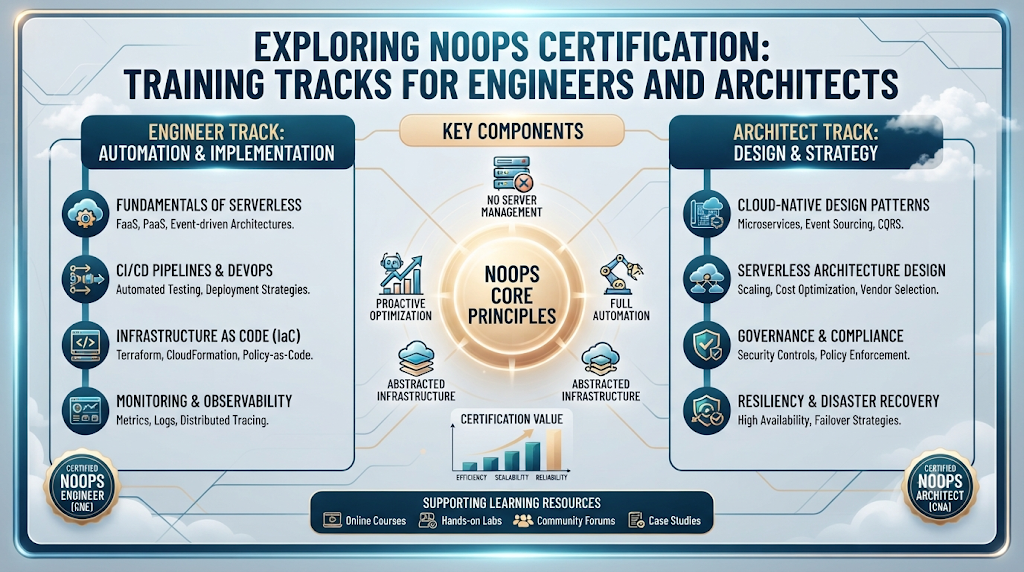
The NoOps Engineer track
The platform offers a learning program and a matching track for NoOps Engineers. The NoOps engineer certification sits alongside that program. The site does not list role-specific content for this track. What it does say is that the programs target people who build and run automated cloud environments. An engineer role fits that description well. If your day involves building systems and keeping them running, this is a natural starting point. The program and its track give you a clear label for your study plan. Confirm current details on the site before you commit.
Tip: Read the program outline on the site first. It will tell you if the fit is right.
The NoOps Architect track
A second program exists for NoOps Architects. The NoOps architect training pairs with a matching certification track. Again, the site does not describe role-specific lessons. It does state that the programs are built for people who design and improve automated cloud environments. Architecture work fits that aim. If you plan systems rather than only run them, this track may suit you. The structure is the same as the other tracks. A program and a matching certification sit side by side. Check the site for the latest information.
Tip: Compare the architect and engineer programs before you choose. The difference matters.
The NoOps Manager track
Managers have their own path too. NoOpsSchool offers a program for NoOps Managers. The NoOps manager certification matches that program. The site does not spell out manager-specific content. What it does say is that IT managers are part of the intended audience. That makes sense. Managers need to understand automation well enough to guide a team. This track gives them a structured way to build that understanding. Before you enroll, confirm the details with the site. Clear expectations lead to better decisions.
Tip: If you lead a team, read the manager program first. It frames the other tracks well.
The NoOps Professional track
A fourth program covers NoOps Professionals. Like the others, it comes with a matching certification track. The site does not list what separates this track from the rest. It simply offers it as one of four separate learning programs. That choice is useful. Different jobs need different depths. Some people want a broad base. Others want a focused path. This track gives you one more option to weigh. Look at all four before you decide. The right fit depends on your current role and your next step.
Tip: List your daily tasks before you pick a track. The match becomes obvious.
Matching an Offering to Your Goal
The platform has several parts. Each one serves a different need. The table below maps them out.
| Offering | What It Covers | Who It Helps |
|---|---|---|
| Training courses | Automation topics with labs and scenarios | Engineers, architects, developers, administrators |
| Certification tracks | Matching tracks for each learning program | Professionals who want a structured goal |
| Educational resources | NoOps concepts, architecture, and tools | Anyone learning the basics |
| Consulting services | Assessments, strategy, provisioning, CI/CD | Organizations reducing manual work |
| Freelance professionals | Terraform, Kubernetes, monitoring, self-healing | Organizations needing specialist skills |
Use this table as a starting point. Confirm current details on the site before you decide.
Part Two: How Organizations Move from Review to Action
NoOps consulting services as advertised
The site advertises NoOps consulting services for organizations. The consulting portfolio covers several areas. It includes operational assessments and automation strategy. Cloud-native modernization and infrastructure provisioning also appear. So do CI/CD implementation, AIOps integration, and security automation. These services suit organizations that want to reduce manual operational work. The site presents them as a portfolio, not a promise of results. Organizations should confirm scope and details with the site. That step keeps expectations grounded.
Tip: List your current manual tasks first. It makes any discussion more concrete.
Assessments and automation strategy
An operational assessment looks at how work gets done today. It asks where manual effort goes and why. Automation strategy then sets a direction. It decides what to automate first and what to leave alone. These two steps belong together. One gives you facts. The other gives you a plan. For organizations, this is a sensible starting point. You cannot fix what you have not measured. The site lists both as part of its consulting portfolio. Confirm the details with the site before you begin.
Tip: Gather your team’s pain points before an assessment. Real examples help.
Cloud-native modernization and provisioning
Cloud-native modernization means updating systems to fit cloud platforms well. Infrastructure provisioning means setting up servers and services in a repeatable way. Both aim at the same end. They reduce hand-built setups that drift over time. For organizations, this work can remove a lot of quiet manual effort. The site lists both in its consulting portfolio. It does not describe methods, tools, or timelines. Those details need to come from the site directly. Ask before you plan.
Tip: Note which systems still need manual setup. That list guides the conversation.
CI/CD, AIOps, and security automation
Three more areas appear in the consulting portfolio. CI/CD implementation means setting up automatic testing and release steps. AIOps integration means using smart tools to help with operational work. Security automation means handling routine security tasks through code. Each term sounds technical. Each one has a simple aim. The aim is less manual work and fewer repeated steps. For organizations, these areas often overlap. The site lists them as separate items. Confirm how they fit your case with the site.
Tip: Pick one area to start. Small, clear steps are easier to manage.
Access to freelance professionals
The site also advertises access to specialized freelance professionals. Organizations that want to hire NoOps freelancers can look at this section. It focuses on specific skill areas. These include Terraform, Kubernetes, cloud platforms, automated monitoring, and self-healing systems. That list is narrow on purpose. It points to hands-on expertise rather than general advice. The site does not describe any hiring process, rates, or terms. Organizations should confirm those details with the site. Treat the section as a starting point for a conversation.
Tip: Write down the exact skills you need. A clear list saves time later.
What NoOps Does and Does Not Do
It helps to set realistic expectations. NoOps reduces operational workload. That is the core promise, and it is a real one. Teams that automate routine tasks free up time for other work. But NoOps does not remove accountability. Someone still owns each system. Someone still answers when things go wrong. Human oversight remains essential. Automation handles the repeatable parts. People handle judgment, design, and decisions. NoOpsSchool teaches this balanced view throughout its material. Keep your goals modest and clear. Aim for less manual work, not for zero people. That mindset keeps projects healthy and teams calm.
Tips for Learners and Organizations
For learners:
- Start with the basics first. A clear grasp of NoOps makes every later topic easier.
- Pick the role track that matches your job. You will apply new skills faster.
- Practice in hands-on labs as you go. Reading alone rarely builds real skill.
- Learn one topic at a time. Depth beats a rushed tour of everything.
For organizations:
- Assess your current manual work first. You need facts before a plan.
- Set realistic goals for automation. Aim to reduce effort, not to remove people.
- Keep humans in the loop. Oversight and accountability still matter.
- Confirm details with the site before you decide. Clear facts lead to better choices.
A Hypothetical Scenario
This example is hypothetical. Imagine a small company whose IT team spends hours each week on repeat tasks. Deployments are slow because steps are done by hand. Monitoring alerts often reach a person late. The team lead starts by listing every manual job. That list becomes the basis for a conversation. Next, the company looks at the consulting portfolio on the site. It reviews the advertised areas, including assessments and automation strategy. The lead also checks the freelance section for specific skills. Nothing is agreed yet. The company simply gathers facts and confirms details with the site. With a clear picture, it can decide what to do next.
Frequently Asked Questions About NoOpsSchool
What does this platform actually do?
It provides IT education, certification, and consulting focused on NoOps and cloud automation. It serves both professionals and organizations.
How would you describe NoOps in simple terms?
NoOps means automating operational work so teams spend less time on manual tasks. People still own the systems and remain accountable.
Do NoOps and DevOps compete with each other?
They are related ideas, and real teams may use parts of both. One focuses on automation, the other on team practices.
Does automation remove the need for people?
No. Human oversight and accountability remain in every case. Automation reduces workload, not responsibility.
Which roles have their own programs?
There are separate programs for Engineers, Architects, Managers, and Professionals. Each one has a matching certification track.
What do the courses actually teach?
Topics include infrastructure as code, containers, Kubernetes, Terraform, GitOps, CI/CD, and observability. Labs and real scenarios support the lessons.
What are self-healing systems?
They detect a problem and correct it on their own. Automated incident response works in a similar way.
What consulting work does the site advertise?
The portfolio lists assessments, automation strategy, modernization, provisioning, CI/CD, AIOps, and security automation. Confirm scope with the site.
What skills appear in the freelance section?
The focus is on Terraform, Kubernetes, cloud platforms, automated monitoring, and self-healing systems. Details should be confirmed with the site.
Where is the platform based, and who does it serve?
It is based in India and serves an international English-speaking technical audience. Training and services are delivered online.
Final Thoughts
NoOpsSchool offers two clear paths. One is for people who want to learn. Courses, labs, and certification tracks give them a structured way to build automation skills. The other is for organizations that want less manual work. Advertised consulting and freelance access give them a way to explore that goal. Neither path promises easy results. Both reward clear thinking and realistic aims. Automation reduces effort, and people still carry responsibility. With that balance in mind, the platform gives both audiences a practical place to start.
