Computers help us write homework, play games, and explore the universe. But regular computers, from pocket smartphones to supercomputers, sometimes run into problems that take too long to solve. To explore these tricky problems, scientists built quantum computers.
Just like an ordinary computer cannot do anything without an operating system and apps, quantum hardware needs instructions to work. This is where quantum computing software comes in. Quantum software gives us the tools to write instructions, design special experiments, and run them on new kinds of machines. Whether you are curious about technology or starting your journey as a developer, understanding quantum software opens the door to an exciting future. You can explore more beginner guides and learning pathways at QuantumUting.com.
What Is Quantum Computing Software?
Quantum computing software is the set of computer programs, tools, and code libraries that allow humans to talk to quantum computers.
Think of a regular computer like a digital piano. When you press a key, it plays an exact note. Regular software is like sheet music written specifically for that piano. A quantum computer behaves more like a wind chime moving in the breeze. Because it behaves differently, regular sheet music does not work. You need a completely new set of instructions.
Quantum computing software provides those instructions. It does not replace your laptop. Instead, you write your code on a regular classical computer. The software package organizes your instructions, translates them into physical signals like microwave pulses or laser beams, and sends them to the quantum machine.
How Is Quantum Software Different from Traditional Software?
Traditional software and quantum software solve problems using fundamentally different rules. Traditional programs operate with certainty; quantum programs work with probabilities.
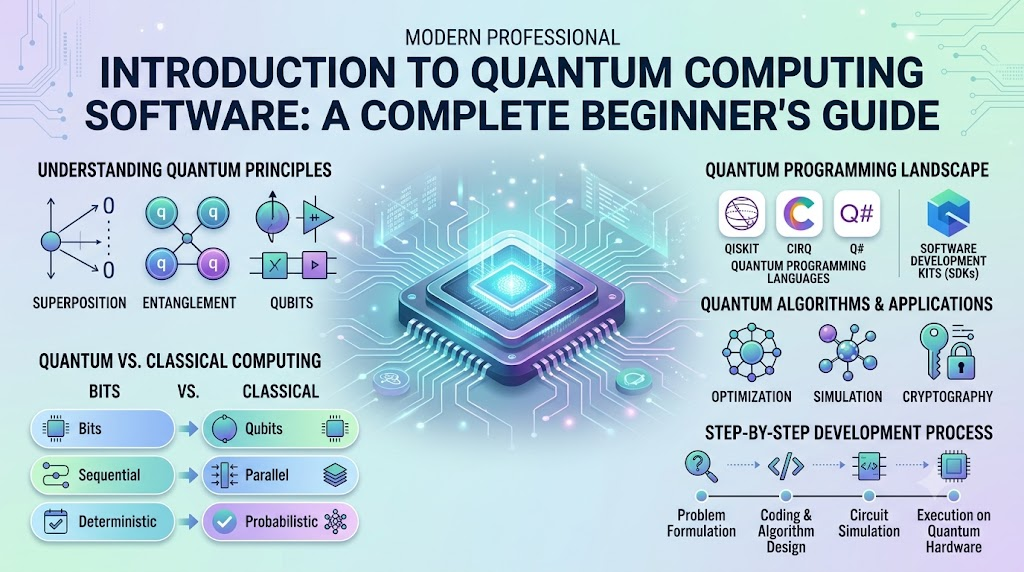
| Feature | Traditional Software | Quantum Computing Software |
| Basic Data Unit | Bit (either 0 or 1) | Qubit (0, 1, or both at once) |
| Operations | Logic gates (AND, OR, NOT) | Quantum gates (Hadamard, CNOT, Phase) |
| Program Output | Deterministic (same input gives same output) | Probabilistic (results are statistical patterns) |
| Testing | Inspect variables step-by-step | Run multiple shots on simulators |
| Hardware Used | Standard silicon chips | Classical computers paired with quantum processors |
Quantum computers are not simply faster regular computers. They are different machines meant for specific mathematical and scientific challenges.
Basic Concepts Needed to Understand Quantum Software
To understand how quantum software works, you need to understand seven core ideas:
- Qubits: A normal bit is like a light switch that is either OFF (0) or ON (1). A qubit is like a spinning coin. While spinning, it is a blend of heads and tails at the same time.
- Superposition: This is the mathematical term for that spinning coin. It allows a qubit to represent possibilities of both 0 and 1 together until measured.
- Entanglement: Two qubits can be linked so closely that what happens to one instantly relates to the other, even if they are pulled far apart. In software, this lets qubits share information instantly.
- Quantum Gates: In regular code, you use logic steps to flip bits. A quantum gate rotates the state of a qubit, changing its probabilities.
- Quantum Circuits: A quantum circuit is a visual and logical timeline. It shows which quantum gates are applied to which qubits over time.
- Quantum Interference: Quantum programs adjust waves of probability. Good paths are amplified (constructive interference), while wrong answers cancel each other out (destructive interference).
- Measurement: When you look at a qubit, the spinning coin lands. Superposition ends, and the qubit settles into a standard 0 or 1.
How Does Quantum Computing Software Work?
Writing a quantum program follows a structured workflow:
- Select a problem: Identify a challenge suited for quantum logic, such as simulating a molecular bond.
- Design an algorithm: Choose a mathematical recipe designed for quantum rules.
- Build the circuit: Write code using a quantum library to define qubits and arrange gates.
- Test on a simulator: Run the code on your normal laptop using software that mimics quantum behavior.
- Compile the circuit: The software simplifies the circuit and translates it into physical signals matched to target hardware.
- Execute on hardware: The instructions run on an actual quantum processor.
- Measure and analyze: The machine measures the qubits hundreds or thousands of times (called “shots”) so your classical computer can build a clear statistical chart of the results.
Main Types of Quantum Computing Software
The quantum software ecosystem contains several key layers:
- Quantum Programming Frameworks: Toolkits that let you write lines of code to define circuits and operations.
- Quantum Simulators: Programs running on classical computers that mimic what a quantum chip would do, allowing testing without physical hardware.
- Quantum Compilers: Translators that take your ideal circuit and rewrite it so specific physical hardware can run it with minimal errors.
- Development Environments: Text editors, notebook extensions, and plugins that provide syntax highlighting and circuit visualizers.
- Algorithm Libraries: Pre-written software modules for chemistry, optimization, or machine learning that save developers from rebuilding foundational circuits from scratch.
- Cloud Platforms: Web services that let developers submit programs over the internet to run on remote quantum computers.
Quantum Programming Languages and Frameworks
In modern software development, people often confuse languages, frameworks, and software development kits (SDKs).
A programming language provides grammar and syntax. An SDK or framework is a pre-built collection of tools written in an existing language to perform specialized tasks. Most quantum software today is built as libraries on top of standard Python, though specialized languages also exist.
Notable Quantum Tools
- Qiskit: An open-source software development kit initiated by IBM. It uses Python to let developers create, optimize, and run quantum circuits on simulators and real hardware.
- Cirq: An open-source Python library developed by Google, focused on writing and running circuits on near-term noisy quantum computers.
- PennyLane: A framework developed by Xanadu that links quantum circuits with classical machine learning libraries like PyTorch and TensorFlow.
- Q# (Q-sharp): A dedicated, standalone quantum programming language developed by Microsoft as part of the Quantum Development Kit.
- OpenQASM: An open quantum assembly language used as an intermediate representation to describe low-level quantum circuits.
- Amazon Braket SDK: A Python-based developer toolkit designed to write circuits that can run across multiple hardware backends through AWS.
- CUDA-Q: An open platform from NVIDIA designed for hybrid quantum-classical computing, integrating quantum hardware alongside GPUs and CPUs.
Choosing a tool depends on your goals: Python users often start with Qiskit or PennyLane, while developers interested in hardware-level instructions explore OpenQASM.
What Are Quantum Simulators?
A quantum simulator is a regular classical program that calculates what a quantum computer would do.
Simulators are essential because real quantum hardware is scarce, sensitive, and expensive. With a simulator, you can run and test code on an ordinary laptop for free.
However, simulators have limits. Every time you add one qubit to a simulation, the classical computer must track twice as much data. Simulating 10 qubits is easy. Simulating 30 qubits requires a powerful workstation. Simulating 50 or more ideal qubits becomes practically impossible for normal classical computers because the memory demands grow exponentially.
What Are Quantum Algorithms?
An algorithm is a step-by-step recipe for solving a problem. A quantum algorithm is a recipe that uses superposition, entanglement, and interference to find solutions.
- Grover’s Algorithm: A theoretical search algorithm that can find an item in an unsorted list faster than a standard computer.
- Shor’s Algorithm: A theoretical algorithm that can find the prime factors of large numbers exponentially faster than known classical methods, which holds major implications for cryptography research.
- Quantum Fourier Transform (QFT): A quantum version of a mathematical tool used to find cycles, periods, and frequencies within data.
- Variational Quantum Eigensolver (VQE): A hybrid algorithm tested on current hardware to estimate the lowest energy state of molecules.
- Quantum Approximate Optimization Algorithm (QAOA): A hybrid method being studied to discover good solutions for complex scheduling and routing challenges.
These algorithms demonstrate theoretical and experimental capabilities; researchers continue testing whether they can provide practical, real-world advantages over modern classical supercomputers.
Applications Under Active Exploration
Researchers are studying quantum computing software across several domains:
- Chemistry and Molecular Modeling: Simulating how atoms bond to aid the discovery of battery materials and chemical catalysts.
- Materials Research: Modeling the properties of novel alloys and superconductors.
- Optimization: Investigating route planning, shipping schedules, and industrial resource distribution.
- Cryptography Research: Designing quantum-safe communication protocols to secure data against future decryption techniques.
- Quantum Machine Learning: Exploring whether quantum states can help spot patterns in complex datasets.
Benefits of Quantum Computing Software
- Low Barrier to Entry: Beginners can write quantum code from a home computer using open-source Python libraries.
- Cloud Access: You do not need to build a refrigerator that cools to absolute zero; cloud platforms let you dispatch code to remote systems over the web.
- Safe Experimentation: Simulators let you test concepts and observe code errors without using actual machine time.
- Hybrid Workflows: Modern frameworks let classical programs handle file management and display charts while the quantum processor solves specialized math.
Challenges in Quantum Software Development
Developing quantum software comes with unique obstacles:
- Quantum Noise: Heat, electromagnetic radiation, and materials imperfections cause qubits to lose their quantum properties (decoherence), introducing errors into calculations.
- Limited Qubit Counts: Today’s processors have limited numbers of usable qubits, restricting the size of practical problems.
- Debugging Limits: In classical software, you can set breakpoints to inspect variables. In quantum software, measuring a qubit collapses its state, destroying active calculations.
- High Simulation Costs: Classical computers cannot simulate large circuits without running out of memory.
- Evolving Toolkits: Quantum frameworks update frequently, meaning tutorials and function calls can change from year to year.
Quantum Software Testing and Debugging
Because you cannot simply pause a quantum circuit mid-flight, developers test their software using alternative methods:
- Simulation Verification: Running small circuits on ideal classical simulators to ensure logic gates produce expected statistical outputs.
- Shot Analysis: Running the circuit hundreds of times to confirm the probability distribution matches mathematical predictions.
- Noise Modeling: Adding simulated hardware errors into testing environments to observe how well the program resists disturbance.
- Unit Testing Components: Testing individual sub-circuits before assembling them into a larger program.
Quantum Software and Classical Computing
Quantum processors do not operate on their own. Every quantum computer relies on classical systems to function.
+-------------------------------------------------------+
|                 Classical Computer                    |
|   1. User writes code (Python / Qiskit / Cirq)         |
|   2. Prepares problem and optimizes circuit           |
+---------------------------+---------------------------+
                            |
           Dispatches instructions (Pulses/Lasers)
                            v
+-------------------------------------------------------+
|               Quantum Processor (QPU)                 |
|   3. Operates quantum gates on physical qubits        |
|   4. Measures qubits into 0s and 1s                   |
+---------------------------+---------------------------+
                            |
             Sends raw measurement data back
                            v
+-------------------------------------------------------+
|                 Classical Computer                    |
|   5. Analyzes probability statistics                  |
|   6. Adjusts parameters and displays final results     |
+-------------------------------------------------------+
In hybrid algorithms like VQE, this loop runs repeatedly: the classical computer adjusts gate settings, sends the updated circuit to the quantum processor, evaluates the results, and tunes the parameters until finding the lowest energy value.
How Beginners Can Start Learning Quantum Software
A direct, step-by-step path to learning quantum software:
- Learn Basic Python: Get comfortable with functions, lists, and loops.
- Review Probability Basics: Understand fractions, percentages, and basic coin-flip odds.
- Learn Fundamental Principles: Study superposition, entanglement, and measurement through books and articles.
- Choose One Framework: Start with a beginner-friendly toolkit like Qiskit or Cirq.
- Build a Single Qubit Circuit: Apply a Hadamard gate to put a qubit into superposition and measure it.
- Use a Simulator: Run your initial code on your local computer to observe probabilistic outcomes.
- Create a Bell State: Build a two-qubit entangled circuit to see how correlated outcomes behave.
- Explore a Small Project: Write a simple program, such as a quantum random number generator.
Common Beginner Mistakes to Avoid
- Expecting a full computer replacement: Quantum computers handle specific mathematical tasks; they do not replace everyday laptops or operating systems.
- Confusing qubits with classical bits: Qubits do not simply hold a 0 and a 1 at the exact same time like two hard drives; they exist in an adjustable probability state.
- Attempting to learn every tool at once: Jumping between Qiskit, Cirq, PennyLane, and Q# simultaneously creates confusion. Master one before branching out.
- Ignoring hardware noise: Programs that run cleanly on ideal simulators may produce noisy, imperfect outputs on physical quantum processors.
- Overlooking basic concepts: Skipping fundamentals like gates and superposition makes code libraries difficult to interpret later.
Best Practices for Quantum Programming
- Work with simulators first: Develop and verify your code locally before queuing jobs on physical hardware.
- Keep circuits shallow: Minimize the number of gates to reduce the chance that environmental noise corrupts your results.
- Run enough shots: Use adequate measurement repetitions (such as 1,024 shots) to collect meaningful statistical patterns.
- Consult official documentation: Because quantum software libraries update frequently, check official project repositories for current syntax.
- Document your circuit designs: Draw out gate diagrams using circuit visualization tools to keep track of operations across your qubits.
Beginner-Friendly Practical Example: A Simple Quantum Coin Flipper
Here is a conceptual walkthrough of a basic quantum circuit (an illustrative experiment):
- Initialize One Qubit: The program creates one qubit, starting with certainty at value
0. - Apply a Hadamard Gate (H): This gate puts the qubit into equal superposition. It is now like a spinning coin with a 50% chance of landing as a
0and a 50% chance of landing as a1. - Measure the Qubit: The program observes the qubit, forcing it to choose a final state.
- Run Repeated Shots: The simulator runs this sequence 1,000 times.
Because the qubit was in equal superposition, the final readout produces roughly 500 counts of 0 and 500 counts of 1. This simple test demonstrates how quantum software builds, manipulates, and measures quantum probability states.
Frequently Asked Questions
What is quantum computing software?
Quantum computing software consists of programming frameworks, libraries, compilers, and simulators used to design, optimize, and execute instructions on quantum computers.
How is quantum software different from traditional software?
Traditional software directs classical bits that must be 0 or 1, while quantum software manipulates qubits that can exist in superpositions of states to evaluate probability patterns.
What is a quantum programming framework?
A quantum programming framework is a software package, typically built inside languages like Python, that provides ready-to-use tools to build and run quantum circuits.
What is a quantum simulator?
A quantum simulator is a classical program running on everyday computers that mathematically models the behavior of qubits and quantum gates without needing real quantum hardware.
Do I need advanced math to begin learning quantum software?
No, beginners can start exploring simple circuits with basic algebra, elementary probability, and introductory Python skills.
Which programming language is most widely used in quantum computing?
Python is the most widely used language in quantum computing because leading frameworks like Qiskit, Cirq, and PennyLane are built as Python libraries.
Can quantum software run without a physical quantum computer?
Yes, beginners and researchers write and evaluate most of their code on classical simulators without connecting to physical quantum chips.
What is the role of a quantum compiler?
A quantum compiler translates high-level circuit instructions into lower-level operations, optimizing gate sequences to suit the specific physical constraints of the target hardware.
Why does environmental noise affect quantum software?
Qubits are sensitive to tiny temperature changes and electromagnetic signals, which cause errors in calculations before a program finishes running.
How can a beginner write their first quantum program?
Install Python, set up an open-source library like Qiskit, write a single-qubit circuit with a Hadamard gate, and run it on a local simulator.
Conclusion
Quantum computing software is changing how we interact with computational science. By combining classical computers with quantum processors, software developers are finding new ways to approach complex problems in physics, materials science, and mathematics. While physical hardware continues to mature, open-source simulators and development frameworks allow anyone to learn, experiment, and write quantum code today. Continuous learning and practical experimentation remain the most effective path forward for aspiring developers.
