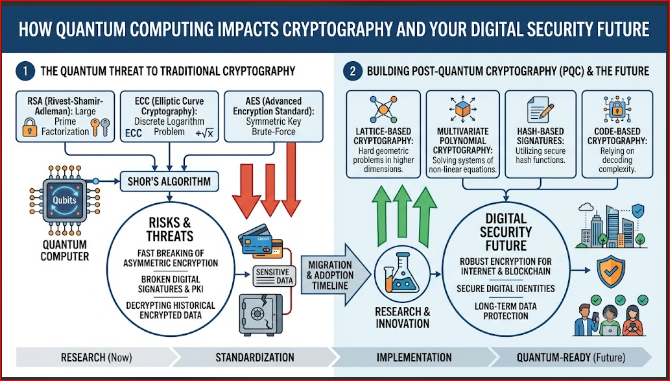
Every time you log into your bank account, send a private text, or buy something online, a silent guardian works behind the scenes. This guardian is encryption. It scrambles your private information into a unreadable code so that hackers cannot steal it. For decades, this system has kept our digital world safe. However, a new technology called quantum computing is emerging. While it promises to solve massive scientific problems, it also introduces a major challenge for cybersecurity. In this article, we will explore exactly how quantum computing impacts cryptography, what it means for your data protection, and how scientists are building a quantum-safe future. To learn more about the fundamentals of these emerging technologies, visit the educational resources at QuantumUting.com.
What Is Cryptography?
Definition and Purpose
Cryptography is the science of hiding information. Its primary purpose is to ensure that only the intended recipient can read a message. Think of it as a highly advanced digital lockbox. You put your data inside, lock it, and send it across the internet. Only the person with the correct key can open it.
Importance in the Digital World
Without cryptography, the modern internet would collapse. It provides the foundation for digital trust. It ensures that your passwords remain private, your medical records stay confidential, and your online financial transactions are secure from prying eyes.
Types of Cryptography
There are two main types of encryption used today:
- Symmetric Cryptography: This method uses the exact same key to lock and unlock data. Imagine a physical safe where both you and your friend have an identical copy of the key. It is incredibly fast and secure, commonly used for protecting large amounts of stored data.
- Asymmetric Cryptography (Public Key Cryptography): This method uses a pair of keys: a public key and a private key. Anyone can use your public key to lock a message, but only your secret private key can unlock it. It is like a mailbox where anyone can drop a letter through the slot, but only the owner has the key to open the box.
Real-World Applications
Everyday examples of cryptography include:
- HTTPS: The padlock icon in your browser address bar that secures your web traffic.
- End-to-End Encryption: The technology that secures chat apps like WhatsApp and Signal.
- Digital Signatures: Electronic verifications used to confirm the identity of software updates or legal documents.
What Is Quantum Computing?
To understand how quantum computing impacts cryptography, we first need to understand what a quantum computer actually is.
[Classical Bit] --------> Can only be 0 OR 1 (Like a standard light switch)

[Quantum Qubit] -------> Can be 0, 1, or BOTH at the same time (Like a spinning coin)
Qubits, Superposition, and Entanglement
Standard computers, like the smartphone or laptop you are using right now, use “bits” to process information. A bit can only ever be a 0 or a 1. Think of it like a light switch that is either off or on.
Quantum computers use qubits (quantum bits). Thanks to the strange rules of physics at a microscopic level, qubits can do things standard bits can never do:
- Superposition: A qubit can be a 0, a 1, or both at the same time. Imagine a coin sitting on a table; it is either heads or tails. But if you spin the coin, it is a blur of both heads and tails at once. That spinning coin is in a state of superposition.
- Entanglement: This is a connection where two qubits become linked. Whatever happens to one instantly affects the other, even if they are far apart. This allows quantum computers to share information instantly and speed up calculations.
How It Differs from Classical Computing
Because of these properties, a quantum computer does not just work faster than a normal computer; it works completely differently. A classical computer checks paths to a solution one by one, like a person trying to find their way out of a maze by exploring every dead end individually. A quantum computer can explore all paths through the maze simultaneously.
How Quantum Computing Impacts Cryptography
Now, let’s connect the dots. The security of almost all modern public key cryptography relies on incredibly hard math problems.
The Vulnerability of Public Key Cryptography
For example, a popular encryption standard called RSA relies on the difficulty of factoring giant numbers. If I ask you to multiply 15 by 7, you can easily calculate that it equals 105. But if I give you the number 18,853 and ask you to find the two prime numbers multiplied together to create it, it would take you a long time with a pen and paper.
For standard computers, doing this with numbers that are hundreds of digits long takes billions of years. Because classical computers find this math practically impossible, your encrypted data stays safe.
The Role of Shor’s Algorithm
This is where the impact becomes clear. In 1994, a mathematician named Peter Shor designed an algorithm—a set of mathematical instructions—specifically for quantum computers.
Known as Shor’s Algorithm, this method allows a sufficiently powerful quantum computer to solve these complex math puzzles almost instantly. It bypasses the digital walls of RSA and other public key systems, easily breaking the lockboxes we rely on every single day.
+-------------------------------------------------------------+
|                     THE QUANTUM THREAT                      |
+-------------------------------------------------------------+
| Classical Computer: Takes billions of years to break RSA    |
|                                                             |
| Quantum Computer + Shor's Algorithm: Breaks RSA in minutes  |
+-------------------------------------------------------------+
Symmetric Encryption vs. Asymmetric Encryption
The threat is not equal across all types of encryption:
- Asymmetric Encryption (RSA, ECC): Highly vulnerable. These systems will be completely broken by advanced quantum computers.
- Symmetric Encryption (AES-256): Highly resistant. Quantum computers do weaken symmetric encryption slightly using a different method called Grover’s Algorithm, but we can easily fix this by simply using longer keys (like upgrading from AES-128 to AES-256).
Current Limitations of Quantum Computers
It is vital to know that your data is not in immediate danger today. The quantum computers that exist right now are small, experimental, and prone to errors. They do not have enough stable qubits to run Shor’s Algorithm against real-world encryption. Experts estimate it will still take years or even decades to build a quantum computer powerful enough to break modern systems.
Quantum-Safe Security Approaches
Because building a new security infrastructure takes a long time, researchers are already designing defensive systems to protect our future data.
Post-Quantum Cryptography (PQC)
Post-Quantum Cryptography involves creating new software-based encryption algorithms. These algorithms rely on entirely different, incredibly complex mathematical problems that neither classical nor quantum computers can easily solve. The goal is to replace old systems like RSA with these new, quantum-resistant math equations without needing to replace our current internet hardware.
Quantum Key Distribution (QKD)
Unlike PQC, which uses math, Quantum Key Distribution uses the laws of physics to protect data. QKD sends encryption keys using particles of light (photons). Because of quantum mechanics, if a hacker tries to spy on or intercept the key while it is traveling, the act of looking at the photons changes their physical state. This alerts both the sender and the receiver that the line is compromised, making the exchange completely secure against eavesdropping.
Hybrid Cryptographic Approaches
Migrating to new systems takes time, so many organizations are using hybrid models. This means wrapping data in two layers of protection: one layer of trusted classical encryption and a second layer of new post-quantum encryption. Even if one layer fails, the other keeps the data safe.
Cryptographic Agility
Cryptographic agility means designing software systems so they can quickly swap out one encryption algorithm for another without breaking the entire system. Think of it like building a car where you can easily swap the engine without needing to redesign the entire vehicle.
Ongoing Standards Development
Government bodies around the world, such as the National Institute of Standards and Technology (NIST), have spent years testing and selecting the best post-quantum algorithms to establish new global security baselines.
Benefits and Challenges
Moving to a quantum-safe world is a massive undertaking that brings both clear advantages and significant difficulties.
Benefits
- Stronger Future Security: We will build systems that protect digital infrastructure for generations.
- Better Long-Term Data Protection: Guarding against “harvest now, decrypt later” tactics, where bad actors steal encrypted data today hoping to unlock it once they get a quantum computer in the future.
- Innovation in Cryptography: Forcing the cybersecurity industry to clean up outdated, legacy code.
Challenges
- Migration Complexity: Replacing encryption across millions of global servers, apps, and devices is a logistical puzzle.
- Performance Considerations: Some quantum-safe algorithms use larger digital keys, which can slow down internet connections or overload low-power devices like smart home accessories.
- Compatibility: Ensuring old devices can still talk to upgraded, quantum-safe networks.
- Cost: The transition requires significant time, training, and financial investments from enterprises.
Real-World Applications
Many different industries are actively preparing for quantum security upgrades:
- Banking: Financial networks are testing hybrid encryption models to protect global wire transfers and high-value transactions.
- Government: Defense and intelligence agencies are prioritizing the protection of state secrets and classified data from long-term decryption threats.
- Healthcare: Hospitals and medical providers are exploring ways to secure patient records so they remain confidential for decades to come.
- Telecommunications: Network operators are testing Quantum Key Distribution across underground fiber-optic cables to build unhackable communication links.
- Cloud Computing: Tech providers are integrating post-quantum algorithms into their cloud environments so businesses can protect their applications early.
Current Industry Efforts
The shift toward quantum security is no longer just a theoretical concept; it is an active global migration.
Organizations are performing detailed security assessments to locate exactly where vulnerable public keys are used within their software. Tech vendors are releasing software updates that include early versions of post-quantum algorithms. National cybersecurity agencies are publishing clear migration playbooks, urging businesses to move away from legacy tools before the next decade begins.
Best Practices for Organizations
If you run an IT team or manage security for an organization, you can take practical steps today:
- Inventory Cryptographic Assets: Find out exactly where your organization uses public key cryptography (like RSA or ECC) to protect data.
- Monitor Evolving Standards: Keep track of official recommendations from groups like NIST to know which algorithms are verified as safe.
- Practice Crypto-Agility: Update your internal applications so that updating an encryption key or algorithm does not cause system downtime.
- Plan Gradual Migrations: Focus on upgrading your most sensitive, long-term data first, rather than trying to fix everything all at once.
- Train Security Teams: Provide your cybersecurity professionals with the training they need to understand quantum-safe concepts.
Future Trends
Looking ahead, we can expect several key developments to reshape our digital ecosystem:
- Mature Quantum Computers: Over the next couple of decades, machines with millions of stable qubits will move from research labs into industrial use.
- Wider Adoption of PQC: Post-quantum cryptography will become the standard default for basic web browsers, apps, and operating systems.
- Quantum Internet Research: Scientists will continue building networks designed to send quantum information safely across long distances.
- AI and Quantum Security: Artificial intelligence will help automate the discovery of vulnerable encryption algorithms across massive corporate networks.
Cryptography Comparison Tables
Classical Cryptography vs. Quantum-Safe Cryptography
| Feature | Classical Cryptography | Quantum-Safe Cryptography | Key Difference |
| Mathematical Basis | Factoring large prime numbers and discrete logarithms. | Complex lattice equations and advanced code-based math problems. | Quantum-safe math is designed to baffle both classical and quantum systems. |
| Quantum Resistance | Highly vulnerable to Shor’s Algorithm (specifically public key systems). | Highly resistant to all known classical and quantum attacks. | Quantum-safe models remain secure even when attacked by advanced qubits. |
| Key Size | Relatively small (e.g., RSA 2048-bit keys). | Typically much larger, requiring more digital storage space. | Larger keys demand more data overhead during transmission. |
| Implementation | Cheap, widely adopted, and highly optimized for speed. | Currently being integrated; requires more processing power. | Transitioning requires code updates and optimization efforts. |
Current Cryptographic Approaches and Their Quantum Readiness
| Cryptographic Approach | Primary Use | Quantum Readiness | Migration Considerations |
| RSA / ECC | Website security certificates, digital signatures. | Vulnerable | Needs to be completely replaced by post-quantum algorithms over time. |
| AES-256 | Secure data storage, government file protection. | Ready | Safe to keep using, but ensure you use 256-bit keys instead of 128-bit keys. |
| NIST PQC Algorithms | Next-generation web browsing and identity protection. | Ready | Currently being rolled out; monitor software updates for compatibility. |
| Quantum Key Distribution | High-security fiber networks (Government/Defense). | Ready | Requires specialized physical hardware, making it expensive for general use. |
Key Takeaways
- Public key encryption (like RSA) keeps our modern internet safe but is highly vulnerable to future quantum computers running Shor’s Algorithm.
- Symmetric encryption (like AES-256) remains highly secure if we utilize larger key sizes.
- Post-Quantum Cryptography (PQC) uses new math problems to protect our software systems without needing to replace existing internet cables.
- Quantum Key Distribution (QKD) uses the laws of physics to prevent eavesdropping on physical communication lines.
- Immediate panic is unnecessary, but early organizational planning is vital because updating global security systems takes years of careful work.
FAQs
Q: Can quantum computers break all passwords today?
A: No. Quantum computers capable of breaking modern encryption do not exist yet. Current quantum devices are experimental and far too small to disrupt daily cybersecurity protocols.
Q: What is the difference between quantum cryptography and post-quantum cryptography?
A: Quantum cryptography uses physical quantum hardware (like lasers and photons) to protect data. Post-quantum cryptography uses secure software algorithms based on math that quantum computers cannot easily solve.
Q: Will I need to buy a new computer to stay safe from quantum hacks?
A: No. Software engineers, web browsers, and operating system developers will roll out these updates automatically behind the scenes, meaning your personal hardware will continue to work normally.
Q: What is Shor’s Algorithm in simple terms?
A: It is a mathematical method designed for quantum computers that allows them to find the prime factors of enormous numbers incredibly quickly, breaking the mathematical foundation of standard public key encryption.
Q: Is blockchain technology safe from quantum computing?
A: Current standard blockchains rely heavily on public key systems that are vulnerable to quantum computers. However, developers are actively creating quantum-safe blockchains using post-quantum algorithms.
:Q: Why should an organization prepare now if the threat is years away?
A: Replacing encryption across a large enterprise takes years of planning, asset mapping, and testing. Starting today avoids emergency migrations and shields against attackers who store encrypted data now to decrypt it later.
Q: Does quantum computing make AES-256 insecure?
A: No. Quantum computers slightly weaken symmetric encryption, but using AES with a 256-bit key provides more than enough mathematical security to keep data completely safe.
Q: What is cryptographic agility?
A: It is the ability of a computer system to rapidly switch between different encryption algorithms without requiring major rewrites to its underlying software infrastructure.
Q: What role does NIST play in quantum security?
A: The National Institute of Standards and Technology (NIST) manages the global process of testing, evaluating, and standardizing the best post-quantum cryptographic algorithms for widespread use.
Q: Can artificial intelligence protect us from quantum threats?
A: AI can help security teams identify vulnerable encryption tools across corporate networks, but we still need the core mathematical principles of post-quantum cryptography to stop quantum attacks.
Conclusion
Quantum computing represents both an extraordinary step forward for human innovation and a major evolutionary shift for cybersecurity. While the power of qubits poses a real threat to the public key encryption methods we rely on today, it also gives us a clear opportunity to build a much more robust digital infrastructure. By understanding the basics of how quantum computing impacts cryptography and focusing on proactive defensive strategies today, organizations can ensure a seamless transition into the quantum era. Taking early, deliberate steps toward quantum-safe cryptography ensures our global data remains safe, private, and secure for decades to come.
