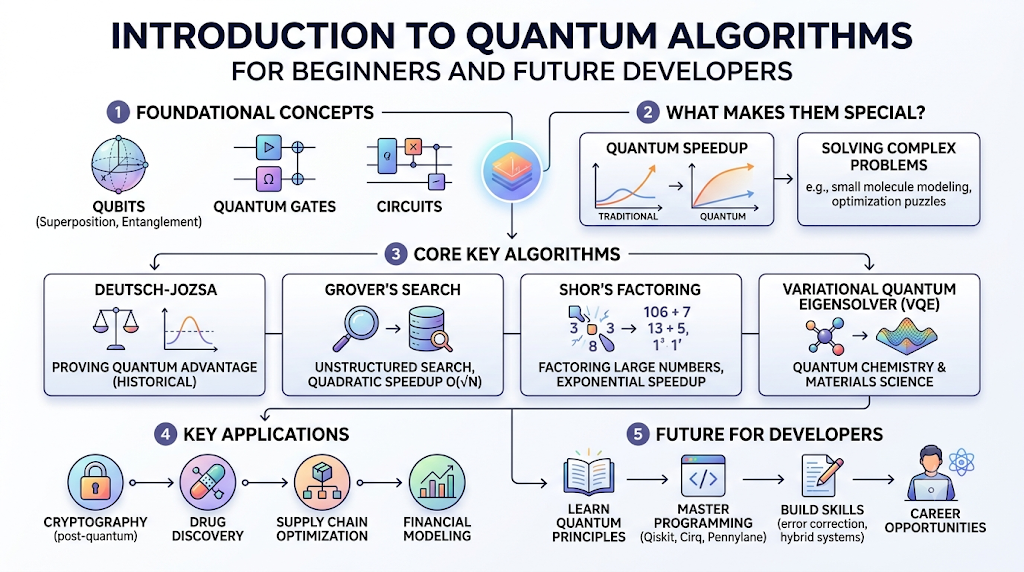
Introduction
Quantum computing is gaining global attention because it offers a new way to solve certain difficult problems. Traditional computers are powerful, but some tasks in cryptography, chemistry, optimization, and scientific research can become extremely complex as the data grows. Quantum computers use the behavior of quantum physics to process information differently. But before anyone starts quantum programming, it is important to understand quantum algorithms. Algorithms are the step-by-step instructions that tell a computer how to solve a problem. For beginners, quantum algorithms may sound difficult at first. Terms like qubits, superposition, entanglement, gates, circuits, and measurement can feel unfamiliar. However, when these ideas are explained using simple examples, they become much easier to understand. QuantumUting.com is an educational learning resource for beginners who want to understand quantum computing concepts in a structured way. You can explore more learning resources at QuantumUting.com. In this article, you will learn what quantum algorithms are, how they work, why they matter, which popular algorithms beginners should know, and how to build a strong foundation before moving into quantum programming.
What Is a Quantum Algorithm?
A quantum algorithm is a step-by-step method designed to run on a quantum computer. It uses quantum concepts such as qubits, superposition, entanglement, quantum gates, and measurement to process information.
In simple words, a quantum algorithm is like a recipe for a quantum computer. It tells the system how to prepare information, transform it using quantum operations, and measure the result.
A classical algorithm works with bits. A bit can be either 0 or 1. A quantum algorithm works with qubits. A qubit can represent 0, 1, or a combination of both until it is measured.
This difference allows quantum algorithms to explore certain problem spaces in a unique way. It does not mean quantum computers are faster for every task. They are useful for selected problems where quantum behavior provides an advantage.
Quantum algorithms matter because they help researchers and developers solve specialized computational problems that may be too slow, expensive, or complex for classical systems.
Quantum Computing Fundamentals
Before learning quantum algorithms, beginners should understand a few basic quantum computing concepts.
Qubits
A qubit is the basic unit of quantum information. It is similar to a bit in classical computing, but it behaves differently.
A classical bit is like a switch that is either off or on. A qubit is more like a spinning coin. While it is spinning, it is not clearly heads or tails. It can hold a combination of possibilities until it is observed.
Qubits are the foundation of quantum algorithms because they allow quantum computers to represent information in a more flexible way.
Superposition
Superposition means a qubit can exist in a combination of 0 and 1 states before measurement.
A simple analogy is a coin spinning in the air. Before it lands, it has the possibility of being heads or tails. Similarly, a qubit can carry multiple possibilities until it is measured.
Superposition helps quantum algorithms explore many possible states during computation.
Entanglement
Entanglement is a special connection between qubits. When two qubits are entangled, the state of one qubit is linked with the state of another, even if they are separated.
For beginners, think of two perfectly connected dice. If one die shows a certain result, the other die’s result is related in a predictable way.
Entanglement allows quantum algorithms to create strong relationships between pieces of quantum information.
Quantum Gates
Quantum gates are operations applied to qubits. They change the state of qubits during computation.
In classical computing, logic gates process bits. In quantum computing, quantum gates process qubits.
Examples of quantum gates include:
- Hadamard gate
- Pauli-X gate
- CNOT gate
- Phase gate
Quantum gates are used to build quantum circuits.
Quantum Circuits
A quantum circuit is a sequence of quantum gates applied to qubits.
You can think of a quantum circuit like a workflow diagram. Qubits enter the circuit, gates transform them, and measurement gives the final output.
Quantum circuits are important because most quantum algorithms are represented as circuits.
Quantum Measurement
Measurement is the process of observing a qubit to get a classical result.
Before measurement, a qubit may exist in a combination of states. After measurement, it becomes either 0 or 1.
This is why quantum algorithms must be carefully designed. The goal is to increase the chance of measuring the correct answer.
How Quantum Algorithms Work
Quantum algorithms follow a structured process. While each algorithm has its own design, most of them use similar stages.
Problem Representation
The first step is to represent the problem in a form that a quantum computer can understand.
For example, if the problem is searching for one correct item in a large list, the algorithm must encode the list and the target condition into quantum form.
This is similar to translating a human question into computer instructions.
Quantum State Preparation
After representing the problem, the quantum system prepares the starting state.
This means setting up qubits in a useful initial condition. Often, gates are applied to place qubits into superposition.
For example, instead of checking one option at a time, a quantum system may prepare a state that represents many possibilities together.
Applying Quantum Gates
Quantum gates are then applied to transform the qubits.
These gates guide the quantum system toward useful answers. In some algorithms, gates amplify the probability of correct answers and reduce the probability of incorrect ones.
This stage is like carefully adjusting a radio signal until the desired station becomes clearer.
Measurement
After the quantum gates are applied, the qubits are measured.
Measurement converts the quantum state into classical information, such as 0s and 1s.
Since quantum measurement is probabilistic, the algorithm may need to run multiple times to increase confidence in the result.
Result Interpretation
The final step is interpreting the measured result.
The output may need to be converted into a meaningful answer. For example, a measured binary result may represent a number, a search result, or a pattern.
This is where quantum computing connects back to real-world problem solving.
QuantumUting.com Guide to Learning Quantum Algorithms
Learning quantum algorithms becomes easier when beginners follow a step-by-step path. QuantumUting.com can be used as a learning resource for building conceptual clarity before moving into advanced topics.
Building Strong Quantum Foundations
Beginners should first understand basic quantum computing concepts. These include qubits, superposition, entanglement, quantum gates, circuits, and measurement.
Without these foundations, quantum algorithms can feel confusing.
A strong foundation helps learners understand not only what an algorithm does, but why it works.
Learning Core Concepts Before Coding
Many beginners try to start quantum programming too early. This can lead to confusion because quantum code is based on concepts that are very different from classical programming.
Before writing code, learners should understand:
- How qubits store information
- Why measurement changes the result
- How gates affect quantum states
- Why circuits are used
- How probability is involved
Conceptual learning makes practical coding easier.
Understanding Quantum Circuits
Quantum circuits are one of the best ways to visualize quantum algorithms.
A circuit shows the flow of qubits and gates. Beginners can use circuit diagrams to understand how an algorithm moves from input to output.
Learning circuits helps students connect theory with practical quantum programming.
Practicing with Quantum Simulators
Quantum simulators allow learners to run quantum circuits on classical computers.
They are useful because real quantum hardware is still limited and not always easily available.
With simulators, beginners can practice:
- Creating qubits
- Applying gates
- Building small circuits
- Running simple algorithms
- Measuring outputs
This makes learning practical and hands-on.
Developing Long-Term Quantum Skills
Quantum algorithms require patience. Beginners should study one concept at a time and avoid rushing into advanced research topics.
A good long-term path includes:
- Learning quantum computing basics
- Understanding quantum circuits
- Studying simple algorithms
- Practicing with simulators
- Exploring real-world applications
- Moving gradually into quantum programming
This approach builds confidence and reduces confusion.
Popular Quantum Algorithms
Several quantum algorithms are important for beginners to know. These algorithms show how quantum computing can solve specific problems differently from classical computing.
Deutsch-Jozsa Algorithm
The Deutsch-Jozsa algorithm is one of the earliest examples showing how quantum computing can solve a problem more efficiently than a classical approach in a specific case.
Its purpose is to determine whether a function is constant or balanced.
For beginners, it is useful because it introduces the idea of quantum advantage in a simple and structured way.
The practical value of this algorithm is mostly educational. It helps learners understand how quantum algorithms use superposition and interference.
Grover’s Search Algorithm
Grover’s search algorithm is designed for searching through an unsorted list.
In classical computing, finding one correct item in a large unsorted list may require checking many items. Grover’s algorithm can reduce the number of checks needed for certain search problems.
A simple analogy is searching for a name in a shuffled stack of cards. A classical method checks one card at a time. Grover’s method uses quantum techniques to increase the chance of finding the correct card faster.
Grover’s algorithm is important for search, optimization, and database-related problem models.
Shor’s Factoring Algorithm
Shor’s algorithm is designed for factoring large numbers.
Factoring means breaking a large number into smaller numbers that multiply together to produce it. This is easy for small numbers but very hard for large ones.
Shor’s algorithm is famous because it has major implications for cryptography. Some security systems depend on the difficulty of factoring large numbers.
For beginners, Shor’s algorithm shows how quantum computing may affect future cybersecurity.
Quantum Fourier Transform
The Quantum Fourier Transform, often called QFT, is a quantum version of a mathematical transformation used to analyze patterns and frequencies.
It is an important building block in several quantum algorithms, including Shor’s algorithm.
Beginners do not need to understand the deep mathematics immediately. At a simple level, QFT helps quantum computers find hidden patterns in data.
It is useful in problems involving periodicity, structure, and signal-like behavior.
Variational Quantum Algorithms
Variational quantum algorithms are hybrid algorithms. They use both quantum computers and classical computers.
The quantum computer prepares and measures quantum states. The classical computer adjusts parameters to improve the result.
This approach is important because current quantum hardware has limitations. Variational algorithms are designed to work with near-term quantum devices.
They are commonly discussed in optimization, chemistry simulation, and machine learning research.
Real-World Applications of Quantum Algorithms
Quantum algorithms are not meant to replace all classical computing. They are designed for specialized problems where quantum behavior may provide value.
Cryptography
Quantum algorithms can affect cryptography by challenging some current encryption methods.
Shor’s algorithm is especially important because it shows how large-number factoring could become easier on powerful quantum computers.
This creates interest in quantum-safe security and post-quantum cryptography.
Drug Discovery
Drug discovery involves studying complex molecules and chemical interactions.
Quantum systems are difficult for classical computers to simulate because molecules themselves follow quantum behavior.
Quantum algorithms may help researchers model molecules more naturally, supporting better understanding of drug behavior and chemical reactions.
Financial Modeling
Financial systems involve risk analysis, pricing models, portfolio optimization, and market simulation.
Quantum algorithms may support certain types of complex calculations and optimization problems.
Although practical use is still developing, finance is one of the areas where quantum computing is actively explored.
Logistics Optimization
Logistics includes route planning, scheduling, supply chain movement, warehouse operations, and resource allocation.
Many logistics problems involve finding the best option from a large number of possibilities.
Quantum algorithms may help explore optimization problems more efficiently in selected cases.
Artificial Intelligence
Quantum computing may support artificial intelligence by improving certain optimization, sampling, and data processing tasks.
Quantum machine learning is still an emerging field, but researchers are exploring how quantum algorithms can support future AI systems.
Beginners should understand that quantum AI is not magic. It is a developing area that combines quantum computing concepts with machine learning methods.
Scientific Research
Quantum algorithms can support research in physics, chemistry, materials science, and complex system modeling.
Scientists may use quantum computing to simulate systems that are too complex for classical computers.
This could help in discovering new materials, understanding natural processes, and solving advanced scientific problems.
Classical Algorithms vs Quantum Algorithms
| Feature | Classical Algorithms | Quantum Algorithms |
|---|---|---|
| Information Unit | Bit | Qubit |
| Processing | Classical computation | Quantum computation |
| Parallelism | Limited by hardware | Quantum state exploration |
| Best Use Cases | General computing | Specialized computational problems |
| Performance | Problem-dependent | Advantage for selected complex tasks |
Classical algorithms are still essential. They power everyday software, websites, mobile apps, enterprise systems, databases, and cloud platforms.
Quantum algorithms are different. They are designed for special problems where quantum behavior can offer a new path to computation.
The future will likely involve both classical and quantum systems working together.
Benefits of Learning Quantum Algorithms
Better Understanding of Quantum Computing
Quantum algorithms help beginners understand the real purpose of quantum computing.
Instead of only learning terms like qubits and gates, students learn how these concepts are used to solve problems.
Preparation for Quantum Programming
Quantum programming becomes easier when learners understand algorithms first.
Programming without algorithm knowledge is like typing instructions without knowing the goal.
A strong algorithm foundation helps developers write better quantum circuits and understand program behavior.
Strong Research Foundation
Quantum computing is a research-heavy field.
Students and researchers who understand quantum algorithms can explore advanced topics such as quantum simulation, optimization, cryptography, and quantum machine learning.
Emerging Career Opportunities
As quantum technology grows, organizations will need people who understand both computing and quantum concepts.
Learning quantum algorithms can prepare beginners for future roles in research, software development, consulting, and technical education.
Future-Ready Technical Skills
Quantum computing is still developing, but learning it early builds future-ready skills.
Beginners who start now can gradually grow from basic concepts to advanced quantum programming and algorithm design.
Common Beginner Challenges
Understanding Quantum Mechanics Concepts
Many beginners struggle because quantum computing is based on physics concepts that feel different from everyday logic.
The best approach is to learn through simple analogies first, then slowly move toward technical explanations.
Visualizing Quantum States
Quantum states are difficult to visualize because they do not behave like normal objects.
Circuit diagrams, Bloch sphere illustrations, and simulator outputs can help beginners build intuition.
Learning New Terminology
Quantum computing has many new terms, such as qubit, superposition, entanglement, interference, amplitude, and measurement.
Beginners should create a personal glossary and revise it often.
Limited Practical Hardware
Real quantum computers are still limited. They may have noise, errors, and restricted qubit counts.
That is why simulators are helpful for beginners. They allow learners to practice without needing direct access to advanced hardware.
Choosing the Right Learning Path
Some learners jump into advanced algorithms too quickly.
A better path is to learn fundamentals first, then circuits, then simple algorithms, and finally advanced applications.
Best Practices for Beginners
Beginners can learn quantum algorithms more effectively by following simple best practices:
- Learn classical computing basics first
- Understand linear thinking before quantum concepts
- Practice with quantum simulators
- Study one algorithm at a time
- Build conceptual understanding before coding
- Use diagrams to understand circuits
- Revise terminology regularly
- Connect every algorithm to a real problem
- Avoid rushing into advanced mathematics too early
- Keep learning consistent and practical
Quantum computing rewards patience. A slow and structured learning path is better than trying to understand everything at once.
Career Opportunities
Learning quantum algorithms can support different career paths in computing, research, and technology.
Quantum Software Engineer
A quantum software engineer builds programs, circuits, and tools for quantum computing platforms.
This role requires knowledge of quantum programming, algorithms, and software engineering.
Quantum Algorithm Researcher
A quantum algorithm researcher studies new ways to solve problems using quantum systems.
This role is suitable for learners interested in mathematics, computer science, and research.
Quantum Application Developer
A quantum application developer focuses on applying quantum methods to real-world domains such as finance, logistics, chemistry, and AI.
This role connects quantum theory with practical industry use cases.
Quantum Computing Consultant
A quantum computing consultant helps organizations understand where quantum computing may be useful.
This role requires strong communication skills and the ability to explain complex concepts simply.
Quantum Information Scientist
A quantum information scientist studies how information behaves in quantum systems.
This career path is often research-focused and may involve physics, computing, mathematics, and engineering.
Future of Quantum Algorithms
Quantum algorithms will continue to evolve as hardware, software, and research improve.
Fault-Tolerant Quantum Computing
Fault-tolerant quantum computing aims to build quantum systems that can handle errors reliably.
This is important because quantum systems are sensitive to noise and disturbance.
When fault-tolerant systems become more mature, larger and more powerful quantum algorithms may become practical.
Hybrid Quantum-Classical Computing
Hybrid computing combines classical computers with quantum processors.
This approach is important because current quantum devices still have limitations.
Many future applications may use classical systems for control and optimization while quantum systems handle specialized computation.
Enterprise Quantum Applications
Businesses are exploring quantum algorithms for optimization, security, simulation, and advanced analytics.
Enterprise adoption will depend on practical value, hardware maturity, cost, and integration with existing systems.
AI-Assisted Quantum Research
Artificial intelligence may help researchers design better quantum circuits, discover new algorithm patterns, and optimize quantum experiments.
This combination of AI and quantum research may speed up innovation.
Quantum Cloud Platforms
Quantum cloud platforms allow users to access quantum processors and simulators through online services.
This makes quantum learning and experimentation more accessible to students, developers, and researchers.
Common Misconceptions
Quantum Algorithms Solve Every Problem Faster
Quantum algorithms do not make every problem faster.
They are useful for selected problem types, such as factoring, search, simulation, and optimization.
Classical computers remain better for many everyday tasks.
Quantum Computers Replace Classical Computers
Quantum computers are not expected to replace classical computers.
Instead, they will likely work alongside classical systems for specialized tasks.
A normal laptop, server, or cloud system will still be important.
Quantum Programming Requires Advanced Physics
Advanced physics helps in deep research, but beginners can start with simple concepts.
Students can learn quantum programming basics using circuits, gates, simulators, and visual examples.
Quantum Computing Is Only for Researchers
Quantum computing is research-heavy, but it is not only for researchers.
Software developers, students, data scientists, cybersecurity professionals, and technology learners can all benefit from understanding quantum algorithms.
FAQ Section
- What is a quantum algorithm?
A quantum algorithm is a step-by-step method designed for quantum computers. It uses qubits, gates, circuits, and measurement to solve specific types of problems. - Are quantum algorithms difficult for beginners?
They can feel difficult at first because the concepts are new. However, with simple explanations, diagrams, and simulators, beginners can learn them step by step. - Do I need advanced mathematics to start learning quantum algorithms?
No. Beginners can start with conceptual understanding first. Advanced mathematics becomes useful later for deeper study and research. - What should I learn before quantum algorithms?
You should understand basic computing, logic, algorithms, probability, qubits, superposition, entanglement, gates, circuits, and measurement. - Is quantum programming necessary before learning quantum algorithms?
No. It is better to understand quantum algorithms conceptually before writing code. This helps you understand what the code is trying to do. - Which quantum algorithm should beginners learn first?
The Deutsch-Jozsa algorithm is a good starting point because it introduces quantum advantage in a simple way. Grover’s algorithm is also beginner-friendly after learning basic circuits. - Why is Grover’s algorithm important?
Grover’s algorithm is important because it shows how quantum computing can improve certain search problems. It is often used to explain quantum speedup in a practical way. - Why is Shor’s algorithm famous?
Shor’s algorithm is famous because it can factor large numbers efficiently on a powerful quantum computer. This has major importance for cryptography and cybersecurity. - Can I practice quantum algorithms without a quantum computer?
Yes. Beginners can use quantum simulators to practice circuits and algorithms on classical computers before using real quantum hardware. - Are quantum algorithms useful for careers?
Yes. Learning quantum algorithms can support careers in quantum software, research, cybersecurity, AI, optimization, scientific computing, and consulting.
Final Summary
Quantum algorithms are the heart of quantum computing. They explain how quantum computers use qubits, superposition, entanglement, gates, circuits, and measurement to solve selected computational problems. For beginners, the best approach is to learn step by step. Start with quantum computing basics, understand circuits, study simple algorithms, practice with simulators, and then move toward advanced topics. Quantum algorithms do not solve every problem faster, and quantum computers will not replace classical computers. Instead, they provide new methods for solving specialized problems in cryptography, chemistry, optimization, finance, AI, and scientific research. Conceptual understanding is more important than rushing into coding. Once you understand how quantum algorithms work, quantum programming becomes much easier.
