Introduction
Quantum measurement is one of the most fascinating ideas in quantum computing because it shows how different the quantum world is from everyday experience. In classical computing, a bit is either 0 or 1. In quantum computing, a qubit can exist in a superposition of possible states until it is measured. This is where Quantum Measurement and Collapsing Qubits becomes important. Measurement turns a quantum possibility into a classical result that we can read. For learners who want to build strong foundations in quantum computing, QuantumUting.com can be used as an educational learning resource for understanding core quantum concepts in a structured way. In this guide, you will learn what quantum measurement means, why qubits collapse, how measurement outcomes are created, and why this concept matters in quantum computing.
What Is Quantum Measurement?
Quantum measurement is the process of observing a quantum system and converting its quantum state into a classical result.
In simple terms, measurement is how we ask a qubit, “What value are you showing now?” The answer we receive is usually a classical value such as 0 or 1.
In classical computing, measurement is simple. If a bit stores 0, reading it gives 0. If it stores 1, reading it gives 1. The act of reading the bit usually does not change its value.
Quantum measurement is different.
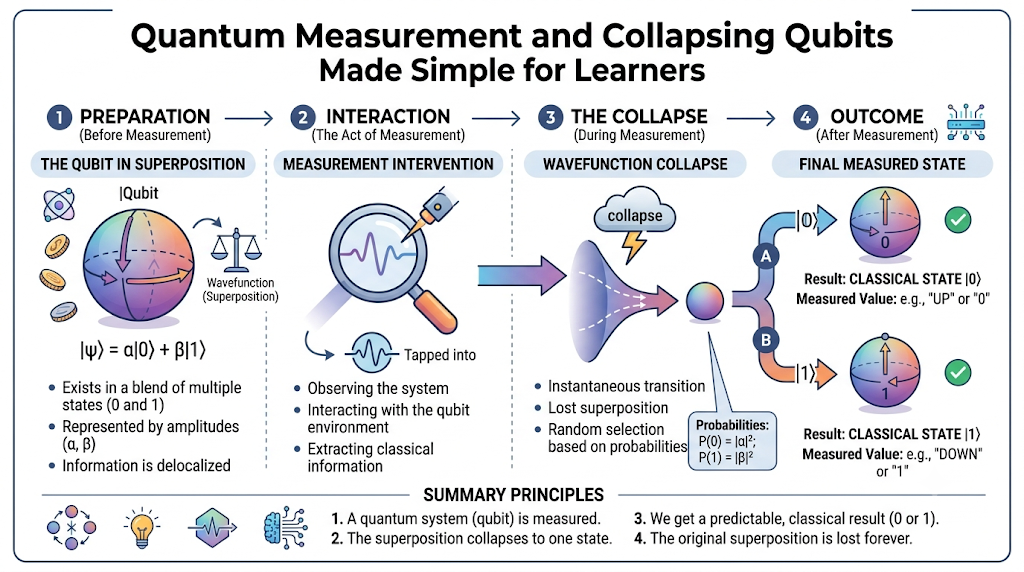
Before measurement, a qubit may be in a superposition, meaning it has a probability of becoming 0 and a probability of becoming 1. Once measured, the qubit gives one definite result.
Purpose of Quantum Measurement
Quantum measurement helps us:
- Extract usable information from qubits
- Convert quantum states into classical data
- Complete quantum algorithm execution
- Verify quantum circuit behavior
- Study quantum systems in physics and computing
Without measurement, quantum computers could process information internally, but we would not be able to read the final answer.
Why Measurement Is Different from Classical Computing
Classical measurement reveals a value that already exists in a definite form.
Quantum measurement does more than reveal. It changes the state being measured.
A helpful analogy is spinning a coin. While spinning, it is not clearly heads or tails from your perspective. When it lands, you see one result. A qubit is not exactly like a spinning coin, but the analogy helps beginners understand how measurement turns possibilities into one outcome.
Understanding Qubits Before Measurement
Before we understand qubit collapse, we need to understand what a qubit is.
A qubit, or quantum bit, is the basic unit of quantum information. It is similar to a classical bit, but it follows the rules of quantum mechanics.
Classical Bits vs Qubits
| Feature | Classical Bit | Qubit |
|---|---|---|
| Basic value | 0 or 1 | Combination of 0 and 1 before measurement |
| Behavior | Definite | Probability-based |
| Information type | Classical information | Quantum information |
| Measurement result | Same stored value | One definite classical outcome |
| Used in | Classical computers | Quantum computers |
A classical bit is like a light switch. It is either off or on.
A qubit is more like a carefully balanced system that can hold a blend of possible outcomes until measurement occurs.
Superposition Explained
Superposition means a qubit can exist in a combination of possible states before measurement.
For example, a qubit may have some probability of being measured as 0 and some probability of being measured as 1.
This does not mean the qubit is secretly choosing one value in advance. It means the qubit is described by a quantum state that contains multiple possibilities.
A simple mental image:
Before measurement:

Qubit state
   |
   |-- possibility of 0
   |
   |-- possibility of 1

After measurement:

Observed result = 0 or 1
Superposition is one of the main reasons quantum computing can behave differently from classical computing.
Probability Amplitudes
In quantum computing, probabilities come from something called probability amplitudes.
A probability amplitude is not the same as ordinary probability. It is a value that helps determine the chance of a measurement outcome.
For beginners, the main idea is simple:
- A qubit has amplitudes connected to possible outcomes.
- These amplitudes determine measurement probabilities.
- When measured, only one result appears.
- Repeated measurements on similarly prepared qubits reveal a probability pattern.
For example, if many identical qubits are prepared the same way and measured, some may produce 0 and some may produce 1 depending on their probability distribution.
Quantum States
A quantum state describes the full condition of a quantum system.
For a single qubit, the state tells us how likely it is to be measured as 0 or 1. For multiple qubits, the state can describe more complex relationships, including entanglement.
A quantum state is not just a stored number. It is a mathematical description of possibilities, relationships, and measurement behavior.
Why Measurement Changes a Qubit
Quantum measurement changes a qubit because the act of measurement forces the quantum system to give a definite classical result.
Before measurement, the qubit can be in superposition. After measurement, the result becomes definite.
This change is often called wavefunction collapse.
The Idea of Wavefunction Collapse
Wavefunction collapse means a quantum system changes from a superposition of possible states into one observed outcome after measurement.
For a qubit, this usually means:
Before measurement:
Qubit = superposition of 0 and 1

Measurement happens

After measurement:
Qubit = 0 or 1
The word “collapse” can sound dramatic, but beginners should not think of it as magic. It is a way to describe how quantum possibilities become a single measurable result.
Observation and Probability
Measurement outcomes are probabilistic.
This means quantum theory can tell us the chance of each outcome, but it does not usually tell us with certainty which result will appear in a single measurement.
For example:
Prepared qubit:
70% chance of measuring 0
30% chance of measuring 1

Single measurement:
Result may be 0 or 1
If we prepare and measure many qubits in the same state, the results should approximately follow the expected probability pattern.
Measurement Outcomes
For a basic qubit measured in the standard computational basis, the outcome is usually:
- 0
- 1
Once the outcome is recorded, it becomes classical information.
This is important because humans and classical computers read final results as classical data. Quantum computers may use quantum behavior during computation, but measurement converts the answer into a usable form.
Why Superposition Cannot Be Directly Observed
Superposition cannot be directly observed because measurement itself changes the quantum state.
You cannot look at a qubit and see “the full superposition” the way you might inspect a classical object. When you measure it, you get one result.
This is one of the most important beginner lessons in quantum computing:
Quantum states can be prepared, transformed, and measured, but measurement gives only classical outcomes.
Step-by-Step Quantum Measurement Process
Quantum measurement becomes easier to understand when we break it into stages.
1. Preparing the Qubit
First, a qubit is prepared in a known starting state.
Most simple quantum circuits begin with a qubit in state 0.
Initial state:
Qubit = 0
This is similar to resetting a device before starting an experiment. You want to know where the system begins.
2. Creating Superposition
Next, a quantum gate may be applied to create superposition.
For example, a common beginner circuit uses a Hadamard gate to place a qubit into a balanced superposition.
Conceptually:
Before gate:
Qubit = 0

After gate:
Qubit = possibility of 0 + possibility of 1
This does not mean the qubit is simply confused. It means its quantum state now contains amplitudes for more than one possible measurement outcome.
3. Performing the Measurement
Now the qubit is measured.
Measurement asks the quantum system to produce a classical answer.
Measure qubit
      |
      |-- result may be 0
      |
      |-- result may be 1
The result depends on the probability distribution created by the qubit state.
4. Collapse Into a Classical State
After measurement, the qubit collapses into the measured state.
If the result is 0, the qubit is now associated with state 0.
If the result is 1, the qubit is now associated with state 1.
Before measurement:
Superposition

After measurement:
Measured state
This is the core idea behind qubit collapse.
5. Recording the Result
Finally, the measurement result is recorded as classical data.
In a quantum circuit, this is often stored in a classical register.
Quantum result → Classical bitThis final step allows the result to be used, displayed, analyzed, or passed into another classical process.
QuantumUting.com Guide to Understanding Quantum Measurement
QuantumUting.com can help beginners approach quantum measurement by focusing on concepts before heavy mathematics. Quantum computing becomes easier when learners build mental models step by step.
Visualizing Superposition
A good way to begin is by visualizing a qubit as a state with multiple possible outcomes.
Instead of thinking, “The qubit is both 0 and 1 like a normal object,” it is better to think:
“The qubit has a quantum state that gives probabilities for 0 and 1 when measured.”
This avoids many beginner misunderstandings.
Understanding Probability
Probability is central to quantum measurement.
Beginners should practice reading measurement results as patterns rather than single guarantees.
For example, if a circuit is run many times, the result distribution may show how the quantum state behaved before measurement.
Many repeated measurements:

0 → appears often
1 → appears less often

Conclusion:
The qubit state had a higher probability of producing 0
Avoiding Common Misconceptions
One common mistake is thinking that a qubit stores unlimited classical information because it can be in superposition.
This is not correct.
A qubit may have a rich quantum state, but when measured, it gives a limited classical result. For a single qubit measured normally, that result is 0 or 1.
Practicing with Quantum Simulators
Quantum simulators are helpful for beginners because they let learners build circuits and observe measurement outcomes without needing real quantum hardware.
A simulator can help students understand:
- How gates change qubit states
- How measurement produces probability-based results
- How repeated circuit runs reveal patterns
- How noise-free simulation differs from real hardware behavior
Building Strong Quantum Foundations
To understand measurement well, learners should first become comfortable with:
- Classical bits
- Qubits
- Superposition
- Probability
- Quantum gates
- Measurement basis
- Simple quantum circuits
Strong foundations make advanced topics like entanglement, quantum algorithms, and error correction easier to understand.
Factors That Influence Quantum Measurement
Quantum measurement is affected by several important factors. These factors influence how accurate, stable, and useful the measurement result will be.
Measurement Basis
The measurement basis defines the perspective from which a qubit is measured.
Most beginner examples use the standard basis, where results are 0 or 1. However, quantum states can be measured in different bases.
This matters because the same qubit state can produce different result patterns depending on how it is measured.
A simple analogy is looking at an object from different angles. The object is the same, but what you observe depends on your viewing direction.
Quantum Noise
Quantum noise refers to unwanted disturbances that affect qubits and measurement results.
Noise may come from:
- Temperature changes
- Electrical interference
- Imperfect control signals
- Hardware instability
- Environmental interactions
Noise can cause measurement errors or make results less reliable.
Decoherence
Decoherence happens when a quantum system loses its delicate quantum behavior because of interaction with its environment.
Qubits are sensitive. If they interact too much with the outside world before measurement, their quantum state can degrade.
This is one reason quantum computers are difficult to build and operate.
Entanglement
Entanglement is a special quantum relationship between qubits.
When qubits are entangled, measuring one qubit can be connected to the state of another qubit. This does not mean information travels in an ordinary classical way, but it does mean the measurement results are correlated.
Entanglement is important in quantum algorithms, quantum cryptography, and quantum information science.
Hardware Limitations
Real quantum hardware is not perfect.
Measurement can be affected by:
- Qubit quality
- Control precision
- Readout accuracy
- Device calibration
- Environmental isolation
- Error correction capability
Because of these limitations, real quantum computers often need repeated runs and statistical analysis.
Quantum Measurement in Real-World Applications
Quantum measurement is not just a theory topic. It is essential in practical quantum computing and quantum technology.
Quantum Algorithms
Quantum algorithms use superposition, interference, and measurement to solve certain problems in new ways.
Measurement is usually the final step where the quantum result becomes classical information.
For example, a quantum algorithm may process many probability amplitudes internally, but the final answer must be measured and read.
Quantum Cryptography
Quantum measurement plays an important role in quantum cryptography.
In some quantum communication systems, measurement can reveal whether someone has disturbed a quantum state. This property can help detect unwanted observation.
The key idea is that measurement affects quantum systems, and this effect can be used for secure communication designs.
Quantum Error Correction
Quantum error correction protects quantum information from noise and decoherence.
Measurement is used carefully in error correction because directly measuring data qubits can destroy useful superposition. Instead, special measurement methods are used to detect errors without fully exposing the protected quantum information.
This is one of the most important areas in building reliable quantum computers.
Scientific Research
Quantum measurement helps scientists study atoms, photons, superconducting circuits, trapped ions, and other quantum systems.
By measuring quantum behavior, researchers can test theories, improve hardware, and explore new technologies.
Optimization Problems
Some quantum approaches are designed to explore complex solution spaces. Measurement is used to sample possible answers.
The quality of the final result depends on how the quantum state was prepared, transformed, and measured.
Common Misconceptions About Qubit Collapse
Quantum measurement can be confusing, so beginners often form incorrect ideas. Let us clear up the most common misconceptions.
Collapse Is Not Magic
Wavefunction collapse may sound mysterious, but it is not magic.
It is a scientific concept used to describe how a quantum system produces one observed result from a set of possible outcomes.
The mystery comes from the fact that quantum systems do not behave like everyday objects.
Measurement Does Not “Destroy” Information
Measurement changes the quantum state, but saying it “destroys information” is too simple.
Measurement converts quantum information into classical information. Some details of the original quantum state may no longer be available after measurement, but the result itself becomes usable data.
Probability Does Not Mean Random Guessing
Quantum probability is not the same as guessing without knowledge.
Quantum states follow precise rules. These rules allow scientists and engineers to calculate expected measurement probabilities.
The result of one measurement may be uncertain, but the overall pattern is not meaningless.
Observation Has a Precise Scientific Meaning
In quantum mechanics, “observation” does not always mean a human looking at something.
It means an interaction or measurement process that extracts information from the quantum system.
A measuring device can perform observation even when no person is watching at that exact moment.
Quantum Measurement vs Classical Measurement
| Feature | Classical Measurement | Quantum Measurement |
| State Before Measurement | Definite | Probability-based |
| Measurement Outcome | Predictable | Probabilistic |
| Effect of Measurement | Minimal | Changes the observed quantum state |
| Information Representation | Bits | Qubits |
Classical measurement is like checking the value already written in a notebook.
Quantum measurement is more like asking a delicate system to choose one visible outcome from a set of possibilities described by its quantum state.
Practical Challenges in Measuring Qubits
Measuring qubits accurately is one of the hardest parts of building quantum computers.
Decoherence
Qubits can lose their quantum properties quickly when they interact with their surroundings. This makes timing very important.
The measurement must happen before the quantum state becomes too damaged.
Noise
Noise can distort results.
Even if the quantum circuit is designed correctly, hardware noise may cause unexpected outcomes.
This is why quantum programs are often run many times to estimate reliable result patterns.
Hardware Stability
Quantum hardware must be extremely stable.
Small changes in temperature, electromagnetic fields, or control signals can affect qubits.
Stable hardware improves measurement reliability.
Error Rates
Measurement errors happen when the system reports the wrong result.
For example, a qubit that should be read as 0 may be incorrectly read as 1.
Reducing error rates is essential for practical quantum computing.
Calibration
Quantum devices require careful calibration.
Calibration helps ensure that gates, measurements, and control systems behave as expected.
Without calibration, measurement results can become misleading.
Best Practices for Learning Quantum Measurement
Learning quantum measurement becomes easier when you follow a structured path.
- Master classical computing concepts first: Understand bits, logic gates, and binary values before moving into qubits.
- Understand superposition before measurement: Measurement only makes sense when you know what is being measured.
- Learn probability fundamentals: Quantum results are probability-based, so probability is essential.
- Practice using quantum simulators: Simulators help you test circuits and see result distributions.
- Study simple quantum circuits before advanced algorithms: Start with one-qubit and two-qubit examples.
A strong beginner should not rush into complex algorithms too early. Quantum computing becomes clearer when foundational ideas are built slowly and carefully.
Common Beginner Mistakes
Confusing Probability with Uncertainty
Probability in quantum computing does not mean “we simply do not know.”
It reflects the structure of the quantum state and follows precise quantum rules.
Thinking a Qubit Stores Infinite Information
A qubit can exist in superposition, but measurement gives a limited classical result.
A single measured qubit gives 0 or 1, not unlimited data.
Misunderstanding Wavefunction Collapse
Collapse does not mean the qubit physically breaks.
It means the quantum state changes after measurement into a definite observed result.
Ignoring Measurement Basis
Beginners often assume measurement always works the same way.
In reality, the basis matters. Measuring in different bases can produce different probability patterns.
Skipping Quantum Fundamentals
Some learners jump directly to algorithms without understanding states, gates, and measurement.
This often leads to confusion later.
Career Opportunities
Understanding quantum measurement is useful for several career paths in quantum computing and quantum information science.
Quantum Software Developer
Quantum software developers write programs and circuits for quantum computers. They need to understand how measurement affects algorithm output.
Quantum Computing Researcher
Researchers study quantum systems, algorithms, hardware behavior, and theoretical models. Measurement is central to experimental and theoretical research.
Quantum Algorithm Engineer
Quantum algorithm engineers design and test algorithms. They use measurement results to evaluate performance and correctness.
Quantum Hardware Engineer
Hardware engineers work on building and improving physical qubits. Measurement accuracy, readout systems, and noise reduction are major parts of the role.
Quantum Information Scientist
Quantum information scientists study how information behaves in quantum systems. Measurement, entanglement, and state transformation are core topics in this field.
Future of Quantum Measurement
Quantum measurement will continue to play a central role as quantum technology improves.
Fault-Tolerant Quantum Computing
Fault-tolerant quantum computing aims to build quantum systems that can continue operating correctly even when errors occur.
Reliable measurement is necessary for detecting and correcting those errors.
Better Qubit Technologies
Different qubit technologies are being developed, including superconducting qubits, trapped ions, photons, and other systems.
Each technology has its own measurement challenges and advantages.
Improved Error Correction
Better error correction methods will require advanced measurement techniques.
The goal is to protect quantum information without accidentally destroying the useful quantum state.
Advanced Quantum Sensors
Quantum measurement is also important in quantum sensing.
Quantum sensors use delicate quantum effects to measure physical quantities with high sensitivity.
Scalable Quantum Systems
As quantum computers grow, measurement systems must scale too.
Large quantum systems need fast, accurate, and reliable measurement across many qubits.
FAQ Section
- What is quantum measurement in simple terms?
Quantum measurement is the process of checking a quantum system and getting a classical result. For a qubit, measurement usually gives 0 or 1. - What does qubit collapse mean?
Qubit collapse means a qubit changes from a superposition of possible states into one definite measured result. - Is a qubit both 0 and 1 before measurement?
A beginner-friendly way to say it is that a qubit has probabilities for 0 and 1 before measurement. It is not simply a normal object holding two classical values. - Why does measurement change a qubit?
Measurement interacts with the quantum system and forces it into a definite classical outcome. This changes the original quantum state. - Can we see superposition directly?
No. When we measure a qubit, we get one result. Superposition is understood through preparation, circuit behavior, and repeated measurement patterns. - Why are quantum measurement results probabilistic?
Quantum states contain probability amplitudes. These amplitudes determine the chances of different measurement outcomes. - Does measurement destroy the qubit?
Measurement does not necessarily destroy the physical qubit, but it changes the quantum state being measured. - What is the difference between quantum measurement and classical measurement?
Classical measurement usually reveals a definite value. Quantum measurement produces a probabilistic result and changes the observed state. - Why is measurement important in quantum algorithms?
Quantum algorithms use quantum states during computation, but measurement is needed to read the final result as classical information. - How can beginners practice quantum measurement concepts?
Beginners can use quantum simulators, build simple circuits, run repeated measurements, and compare result distributions.
Final Summary
Quantum measurement is one of the most important foundations of quantum computing. It explains how qubits move from superposition to definite classical outcomes. Before measurement, a qubit is described by a quantum state with probability amplitudes. After measurement, it produces a result such as 0 or 1. This process is often called wavefunction collapse. Understanding measurement helps learners make sense of quantum algorithms, quantum cryptography, quantum error correction, and real quantum hardware behavior. For beginners, the best path is to first understand classical bits, qubits, superposition, probability, and simple circuits. Once these concepts are clear, advanced quantum computing topics become much easier to approach.
