Introduction
Imagine a supercomputer that doesn’t just work faster than your laptop, but operates on an entirely different set of physical laws. The world of traditional technology is reaching its physical limits, sparking global excitement around quantum computing. This next frontier of computational power promises to solve problems that would take a classical computer millennia to process. At the heart of this revolution lies a mind-bending physics phenomenon known as quantum entanglement. Far from being a mere theoretical quirk, it is a foundational pillar of modern quantum computation. For students, developers, and tech enthusiasts looking to master these emerging concepts, educational resources like QuantumUting.com provide crucial insights into how quantum information processing operates. In this guide, you will learn exactly how quantum entanglement enables computation, why it acts as a computational force multiplier, and how it transforms classical problem-solving.
3. What Is Quantum Entanglement?
Quantum entanglement is a phenomenon in quantum mechanics where two or more particles become interconnected. When this happens, the physical state of one particle instantly dictates the state of the other, no matter how far apart they are—even if they are on opposite sides of the universe.
Historically, this concept deeply troubled early physicists. Albert Einstein famously dismissed it as “spooky action at a distance” because it seemed to violate the classical rule that nothing can travel faster than light. However, decades of experiments have proven its reality.
In classical physics, if you have two separate spinning coins, flipping one tells you absolutely nothing about the other. In the quantum world, entangled particles act like a single, unified system. This absolute correlation is completely unique to quantum technology and forms the bedrock of advanced quantum information processing.
Understanding Quantum Computing Fundamentals
Classical Computing Basics
Classical computers use silicon chips and microscopic transistors to process information. Everything your phone or computer does is broken down into bits. A classical bit is binary; it can exist only as a 0 (off) or a 1 (on) at any given moment.
Quantum Computing Basics
Quantum computing abandons traditional binary constraints. Instead of processing data linearly, it leverages the strange rules of quantum mechanics to evaluate massive amounts of data simultaneously. This fundamental shift allows systems to tackle complex, interconnected variables all at once.
Qubits and Quantum States
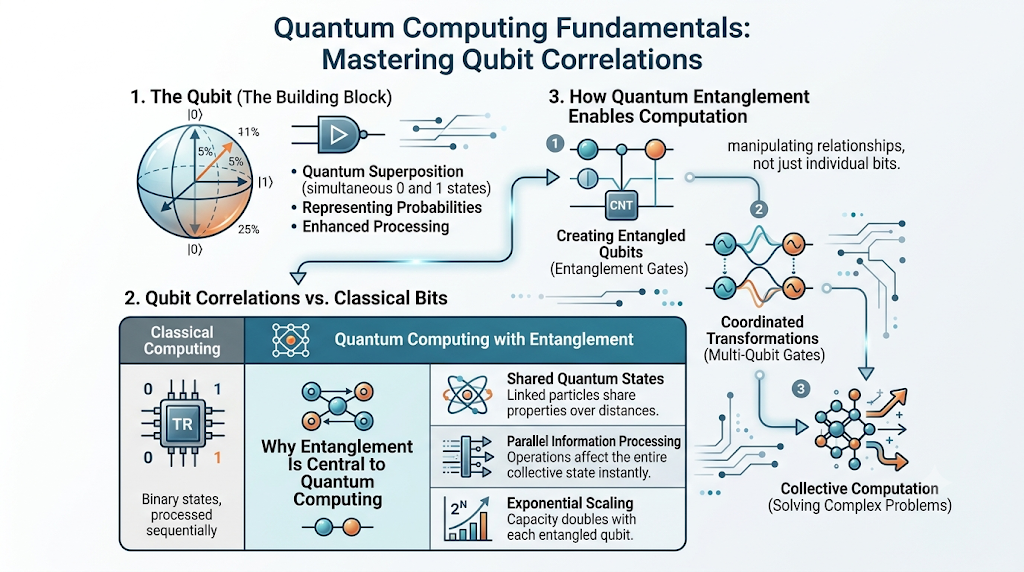
The fundamental unit of quantum information is the qubit (quantum bit). Unlike a rigid classical bit, a qubit can exist in a state of superposition. This means it can represent a 0, a 1, or any fractional combination of both at the same time until it is measured.
Information Processing Differences
Because qubits hold multiple states simultaneously, a quantum processor handles data exponentially. While a classical system must check every door in a maze one by one, a quantum system can explore multiple paths at the same time, radically changing how we evaluate algorithmic data.
5. Why Entanglement Is Central to Quantum Computing
To understand why entanglement is central to quantum computing, we must look at how qubits talk to each other. Without entanglement, qubits would just be isolated components acting independently in their own superpositions.
Shared Quantum States
Entanglement binds qubits into a single, shared quantum state. Instead of treating ten qubits as ten separate pieces of data, an entangled system weaves them into a collective framework.
Coordinated Information Processing
When qubits are entangled, changing the state of one qubit instantly influences the entire group. This creates a highly coordinated system where data moves and transforms collectively, rather than sequentially.
Enhanced Computational Possibilities
By linking qubits, the computational capacity of the machine scales exponentially. It allows the computer to hold a vast web of interrelated possibilities simultaneously, which is impossible with standard binary architecture.
Efficient Problem Solving
Because an entangled system changes as a cohesive whole, a quantum algorithm can alter the states of millions of possibilities with just a few operations. This collective manipulation drastically shortens the time required to solve intricate mathematical equations.
How Quantum Entanglement Enables Computation
Creating Entangled Qubits
Engineers create entanglement by passing particles like photons or ions through specialized hardware gates, such as a Controlled-NOT (CNOT) gate. This forces the physical states of the target qubits to link up intimately.
Information Correlation
Once linked, the qubits hold a deep correlation. If an algorithm requires a calculation that influences one variable, the entangled partner adjusts instantly to match the new mathematical landscape.
Quantum Gate Operations
Quantum gates manipulate the probabilities of qubits. When these gates act on entangled pairs, they don’t just change individual data points—they manipulate the mathematical relationships between the points, executing complex logic across multiple variables simultaneously.
Multi-Qubit Processing
As you add more qubits to an entangled web, the system’s capacity grows rapidly. While 2 classical bits can hold only 1 of 4 possible positions at a time, 2 entangled qubits hold all 4 positions simultaneously.
Parallel Computational Possibilities
With 300 perfectly entangled qubits, a system can hold more simultaneous states than there are atoms in the observable universe. This massive parallel capacity is how quantum entanglement enables computation at an unprecedented scale, allowing complex algorithms to navigate immense search spaces instantly.
Entanglement vs Classical Information Processing
| Feature | Classical Computing | Quantum Computing with Entanglement |
| Information Unit | Binary Bit (0 or 1) | Qubit (0, 1, or both simultaneously) |
| Data Processing | Sequential and linear | Simultaneous and collective |
| Component Relations | Components act independently | Components are deeply correlated |
| Scaling Capacity | Scales linearly ($N$ bits = $N$ inputs) | Scales exponentially ($N$ qubits = $2^N$ states) |
| State Dependencies | Reading one bit reveals nothing about others | Reading one qubit instantly clarifies its partner |
The Relationship Between Superposition and Entanglement
Understanding Superposition
Superposition allows a single qubit to explore multiple options at once. Think of it like a spinning coin that represents both heads and tails while it is in motion.
Combining Superposition with Entanglement
If superposition opens up multiple individual possibilities, entanglement connects those possibilities together. Superposition gives the qubits their options, while entanglement creates a coordinated dance between those options across the entire system.
Computational Advantages
This combination is what gives quantum computing its true power. Superposition populates the computational space with all possible answers, and entanglement allows the quantum gates to sift through and sort those answers collectively.
Practical Implications
Without superposition, entanglement would have no diverse states to link. Without entanglement, superposition would just be a collection of uncoordinated, independent coins spinning in the dark. Together, they form a highly functional computing engine.
Quantum Algorithms That Benefit from Entanglement
Search Algorithms
Grover’s Algorithm uses quantum states to search unsorted databases significantly faster than classical alternatives. Entanglement ensures that checking one path updates the probabilities across all other paths simultaneously.
Optimization Algorithms
The Quantum Approximate Optimization Algorithm (QAOA) helps industries find the most efficient solution among millions of choices. Entanglement allows the system to map out and adjust all competing variables at the same time.
Cryptographic Applications
Shor’s Algorithm can factor massive numbers exponentially faster than classical systems, threatening traditional encryption. It relies entirely on the deep mathematical relationships enabled by entangled quantum states.
Simulation Problems
Simulating molecular interactions requires tracking how every electron interacts with every other electron. Because nature is fundamentally quantum, entangled qubits can naturally mimic these complex molecular bonds.
Benefits of Entanglement in Computation
- Increased Computational Power: The ability to process data exponentially rather than linearly.
- Faster Problem Solving: Complex calculations that would take thousands of years on a standard server take mere minutes.
- Advanced Simulations: The capacity to model accurate quantum environments, chemical reactions, and biological systems.
- Enhanced Optimization: Streamlining massive global networks, from supply chains to financial portfolios, with minimal latency.
- Complex Data Analysis: Finding subtle, hidden patterns across multi-dimensional datasets that classical machine learning misses.
Challenges of Using Quantum Entanglement
The Fragility of Quantum Systems: Entanglement is incredibly delicate and difficult to maintain over long periods.
- Decoherence: Any interaction with the outside environment—like a tiny shift in temperature—causes qubits to lose their quantum properties and decay back into standard 0s and 1s.
- Noise: Electromagnetic interference and stray radiation introduce errors into the calculations, corrupting the entangled data.
- Error Correction: Because you cannot copy or look at an entangled qubit without destroying its state, designing quantum error correction requires massive hardware overhead.
- Hardware Limitations: Maintaining entanglement requires extreme environments, often requiring dilution refrigerators to cool processors down to near absolute zero.
- Scalability Challenges: Linking a few qubits is relatively simple, but scaling up to thousands of stable, entangled qubits remains an engineering hurdle.
Real-World Applications of Entanglement-Based Computing
- Drug Discovery: Simulating molecular structures to discover lifesaving medications in days instead of decades.
- Financial Modeling: Running deep risk-analysis models and optimizing global investment portfolios in real time.
- Materials Science: Designing lighter, stronger materials and highly efficient solar cells by understanding atomic interactions.
- Artificial Intelligence: Accelerating the training of complex neural networks using quantum-enhanced machine learning.
- Logistics Optimization: Instantly calculating the most efficient delivery routes and global supply chain strategies to minimize fuel and time waste.
Common Misconceptions About Quantum Entanglement
- The Faster-Than-Light Communication Myth: A common misconception is that entanglement allows us to send messages faster than light. It does not. While the correlation between particles is instantaneous, you still need a classical communication channel to interpret the results.
- The “Infinitely Faster” Misunderstanding: Quantum computers are not universally faster at everything. For everyday tasks like browsing the web or writing documents, they offer no advantage over your smartphone.
- The Replacement Theory: Quantum systems will not replace classical computers. Instead, they will act as specialized co-processors designed specifically for heavy mathematical lifting.
Future of Quantum Entanglement Research
As quantum technology matures, research labs are focusing on building advanced quantum processors capable of maintaining entanglement for longer durations.
Scientists are also developing early-stage quantum networks. These networks use entangled photons to transmit highly secure data, laying the groundwork for a secure, distributed quantum internet. Over time, enterprise adoption will grow as cloud-based quantum systems become accessible to global industries.
Career Opportunities in Quantum Computing
As the industry expands, several career paths are opening up for qualified professionals:
- Quantum Software Developer: Designing the code and platforms that interface with quantum hardware.
- Quantum Research Scientist: Investigating new ways to create, stabilize, and manipulate entangled states.
- Quantum Systems Engineer: Building the physical containment systems, lasers, and refrigerators that protect qubits.
- Quantum Algorithm Developer: Creating specialized mathematical models that utilize entanglement for specific business problems.
- Quantum Operations Specialist: Managing cloud-based quantum infrastructure and maintaining server uptime.
Best Practices for Learning Quantum Computing
If you want to enter this field, avoid diving into complex physics equations right away. Instead, follow a structured learning path:
- Understand computing fundamentals: Solidify your grasp of classical logic gates, linear algebra, and binary systems first.
- Learn qubit concepts first: Master the basics of single-qubit states and superposition before moving on to multi-qubit systems.
- Study quantum circuits: Visually map out how data flows through gates using open-source tools like IBM’s Qiskit.
- Use quantum simulators: Run early algorithms on classical web simulators to see how inputs change without needing real quantum hardware.
- Build foundational knowledge gradually: Use structured training sites to stay updated on emerging engineering methodologies.
FAQ Section
- Does quantum entanglement allow for instant communication?
No, it does not. Even though measuring one particle instantly determines the state of its entangled partner, you cannot use this to transmit actual data without a classical signal, which is strictly limited by the speed of light.
- Why is quantum entanglement so difficult to maintain?
Qubits are highly sensitive to their surroundings. Any microscopic interference from heat, light, or magnetic fields can cause decoherence, which breaks the delicate entangled state.
- What is the difference between superposition and entanglement?
Superposition allows a single qubit to exist in multiple states at once. Entanglement links the states of multiple qubits together so that they act as a coordinated system.
- Can classical computers simulate quantum entanglement?
They can simulate very small groups of qubits, but because the complexity scales exponentially, simulating more than a handful of entangled qubits quickly overloads even the world’s most powerful supercomputers.
- How does an engineer actually entangle two qubits?
Engineers bring qubits close together and apply controlled physical forces—such as targeted laser pulses or microwave pulses—through a quantum logic gate to link their properties.
- Will quantum computers replace our everyday laptops?
No, traditional laptops are perfectly optimized for daily tasks. Quantum computers will serve as specialized tools for massive data optimization, simulation, and scientific research.
- What programming languages are used for entangled systems?
Python is the most common language, used alongside specialized quantum frameworks like Qiskit (IBM) and Cirq (Google) to design quantum circuits.
- Is quantum computing safe for modern encryption?
Future quantum computers running Shor’s Algorithm could break standard RSA encryption. Because of this, scientists are already actively developing quantum-resistant cryptographic algorithms.
- Do I need a PhD in physics to work in quantum computing?
Not necessarily. While research roles require advanced degrees, companies increasingly hire software developers, systems engineers, and product managers who understand quantum logic.
- Where can I go to learn more about quantum computing fundamentals?
Educational platforms like QuantumUting.com offer clear guides, breakdowns, and beginner-friendly tutorials to help you understand basic and intermediate quantum mechanics concepts.
Final Summary
Quantum entanglement is far more than an abstract physics curiosity; it is the core engine that enables true quantum computation. By weaving individual qubits into highly correlated, collective networks, entanglement bypasses linear limits to unlock exponential data processing speeds. While engineering challenges like decoherence and hardware scaling remain formidable, the potential rewards across medicine, logistics, and artificial intelligence are massive. To stay ahead of these developments and dive deeper into the mechanics of next-generation technology, explore the educational paths and resources over at QuantumUting.com. The quantum era is unfolding now—and building your foundational knowledge today is the best way to prepare for tomorrow.
