Introduction
The technology landscape is shifting toward complex, distributed systems that require a high degree of resilience and automated management. Becoming a Certified Site Reliability Architect is no longer just an option for senior engineers; it has become a necessity for those looking to lead platform engineering teams. This guide is designed for professionals who want to move beyond basic automation and into the realm of designing self-healing, scalable architectures. By following the path set by Sreschool, you can ensure that your career remains aligned with the needs of modern, high-traffic enterprises. We will explore how this certification provides the mental models and technical frameworks needed to make informed decisions in a cloud-native world.
What is the Certified Site Reliability Architect?
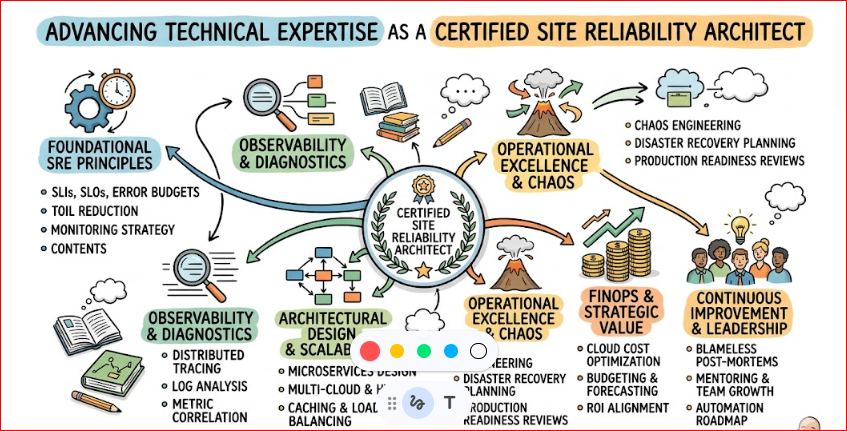
The Certified Site Reliability Architect designation represents the pinnacle of operational excellence and architectural design in the DevOps ecosystem. Unlike basic certifications that focus solely on tool syntax, this program exists to bridge the gap between software development and systems engineering at scale. It emphasizes a production-first mindset, teaching engineers how to build systems that are not just functional but also observable and maintainable.
The curriculum is built around real-world scenarios that engineers face in large-scale enterprise environments, such as managing microservices sprawl and stateful containers. By focusing on architectural patterns rather than just individual tools, it aligns perfectly with modern engineering workflows. This certification validates your ability to manage the entire lifecycle of a service, ensuring that reliability is baked into the design phase rather than being an afterthought.
Who Should Pursue Certified Site Reliability Architect?
This certification is specifically designed for working professionals who are already familiar with the basics of cloud computing and Linux administration. Software engineers looking to transition into infrastructure roles and DevOps practitioners aiming for lead positions will find the content highly relevant. It is also an ideal path for SREs who want to formalize their experience and move into high-level architectural design roles.
Beyond individual contributors, engineering managers and technical leads can benefit from this certification to better understand the trade-offs involved in system reliability. The program has significant relevance in both the Indian tech hub and the global market, where companies are hunting for talent that can handle multi-region deployments. Whether you are a beginner looking for a roadmap or a seasoned veteran seeking validation, this path offers a clear trajectory for professional growth.
Why Certified Site Reliability Architect is Valuable and Beyond
In an era where downtime can cost millions of dollars per hour, the demand for reliability experts is at an all-time high. Organizations are moving away from traditional “ops” teams and toward SRE models that prioritize automation and error budgets. This certification ensures that you remain relevant even as specific tools like Kubernetes or Terraform evolve, by teaching you the underlying principles of distributed systems.
The longevity of this certification comes from its focus on enterprise adoption and sustainable engineering practices. It provides a significant return on time and career investment by making you a “T-shaped” professional with deep expertise in reliability and broad knowledge across the stack. As enterprises continue to migrate to hybrid and multi-cloud environments, the ability to architect for reliability becomes a permanent, high-value skill set.
Certified Site Reliability Architect Certification Overview
The Certified Site Reliability Architect program is delivered through the curriculum found at Certified Site Reliability Architect and is hosted on the Sreschool platform. This program is structured as a professional-grade assessment that moves beyond simple multiple-choice questions to evaluate practical problem-solving skills. It is designed to be rigorous, ensuring that those who earn the title have a true mastery of site reliability principles.
The certification is owned and maintained by industry experts who understand the nuances of production environments. The structure includes various modules covering everything from service level objectives to advanced incident response strategies. In practical terms, it functions as a comprehensive validation of an engineer’s ability to reduce toil and increase the velocity of development teams without sacrificing system stability.
Certified Site Reliability Architect Certification Tracks & Levels
The certification is organized into three distinct levels: Foundation, Professional, and Advanced. The Foundation level introduces the core concepts of SRE, such as error budgets and the elimination of toil, making it suitable for those new to the role. The Professional level dives deeper into implementation, focusing on observability, automation, and the orchestration of complex workloads across different cloud providers.
The Advanced level is where the true architectural focus lies, challenging candidates to design systems that can survive catastrophic failures. These levels align with typical career progression, moving from an individual contributor role to a lead or architect position. Specialization tracks are also available, allowing professionals to focus on specific domains like FinOps or DevSecOps while maintaining a core focus on reliability.
Complete Certified Site Reliability Architect Certification Table
| Track | Level | Who it’s for | Prerequisites | Skills Covered | Recommended Order |
| Core SRE | Foundation | Junior Engineers | Basic Linux/Cloud | SLIs, SLOs, Toil | First |
| Engineering | Professional | SREs/DevOps | 2+ Years Experience | Observability, CI/CD | Second |
| Architecture | Advanced | Senior Architects | 5+ Years Experience | Disaster Recovery | Third |
| Security | Specialist | Security Engineers | Core SRE Knowledge | Chaos Security | Optional |
Detailed Guide for Each Certified Site Reliability Architect Certification
Certified Site Reliability Architect – Foundation Level
What it is
This level validates a professional’s understanding of the fundamental principles that govern Site Reliability Engineering. It ensures the candidate speaks the same language as global SRE teams regarding reliability metrics and culture.
Who should take it
It is suitable for junior DevOps engineers, system administrators, and software developers who want to understand how production systems are managed. It is also a great starting point for recent graduates entering the cloud space.
Skills you’ll gain
- Defining and measuring Service Level Indicators (SLIs).
- Understanding the concept of Error Budgets and how to use them.
- Identifying and reducing manual toil through basic automation.
- Basic incident response and post-mortem documentation.
Real-world projects you should be able to do
- Setting up a basic monitoring dashboard for a web application.
- Writing a post-mortem report for a simulated service outage.
- Automating a recurring manual task using shell scripts or Python.
Preparation plan
- 7-14 Days: Focus on reading the SRE Handbook and understanding core definitions.
- 30 Days: Complete the foundational lab exercises provided on the hosting platform.
- 60 Days: Deep dive into case studies and take practice assessments to build confidence.
Common mistakes
- Focusing too much on specific tools rather than understanding the SRE philosophy.
- Ignoring the cultural aspect of blameless post-mortems.
Best next certification after this
- Same-track option: Professional Level SRE
- Cross-track option: DevOps Foundation
- Leadership option: Team Lead Essentials
Certified Site Reliability Architect – Professional Level
What it is
This certification validates the ability to implement SRE principles using modern cloud-native tools. It moves from theory to the actual execution of reliability strategies in a live environment.
Who should take it
Intermediate engineers with a few years of experience in DevOps or systems engineering should pursue this level. It is meant for those who are responsible for the uptime of production services.
Skills you’ll gain
- Advanced observability using metrics, logs, and traces.
- Implementing automated canary deployments and blue-green strategies.
- Managing infrastructure as code with high availability in mind.
- Advanced capacity planning and performance tuning.
Real-world projects you should be able to do
- Building a full-stack observability pipeline for a microservices app.
- Implementing an automated rollback mechanism based on SLO breaches.
- Designing a terraform-based multi-zone infrastructure deployment.
Preparation plan
- 7-14 Days: Review advanced networking and container orchestration concepts.
- 30 Days: Work through hands-on labs involving Kubernetes and Prometheus.
- 60 Days: Build a project that demonstrates the use of error budgets in a CI/CD pipeline.
Common mistakes
- Underestimating the complexity of distributed tracing.
- Failing to align monitoring with actual business outcomes.
Best next certification after this
- Same-track option: Advanced Architect Level
- Cross-track option: DevSecOps Professional
- Leadership option: Technical Project Management
Certified Site Reliability Architect – Advanced Level
What it is
The Advanced level validates the expertise required to design and govern large-scale systems. It focuses on the strategic side of reliability, including multi-cloud architecture and organizational resilience.
Who should take it
Senior engineers, Principal SREs, and aspiring Architects who need to lead large-scale transformations. It is for those who make high-level decisions about technology stacks and architectural patterns.
Skills you’ll gain
- Designing multi-region and multi-cloud disaster recovery strategies.
- Creating organizational policies for reliability and engineering standards.
- Advanced chaos engineering and resilience testing.
- Managing the cost of reliability and alignment with FinOps.
Real-world projects you should be able to do
- Designing a global load-balancing strategy for a tier-1 service.
- Conducting a site-wide chaos engineering experiment.
- Developing a long-term reliability roadmap for an entire engineering org.
Preparation plan
- 7-14 Days: Study high-level system design patterns and failure modes.
- 30 Days: Analyze complex architectures of companies like Netflix or Google.
- 60 Days: Prepare a comprehensive architectural proposal for a distributed system.
Common mistakes
- Over-engineering solutions for problems that do not require high complexity.
- Neglecting the financial impact of over-provisioning for reliability.
Best next certification after this
- Same-track option: Specialized Chaos Engineering
- Cross-track option: Cloud Solutions Architect
- Leadership option: CTO/Engineering Director Track
Choose Your Learning Path
DevOps Path
The DevOps path focuses on the integration of development and operations through continuous delivery and automation. It emphasizes the speed of delivery while maintaining a baseline of quality through automated testing. Professionals on this path will learn how to build pipelines that are both fast and resilient. It is the perfect starting point for those who enjoy coding but also want to have a say in how software is deployed.
DevSecOps Path
The DevSecOps path integrates security into the heart of the DevOps and SRE workflows. Rather than treating security as a final gate, this path teaches how to automate security checks within the pipeline. It covers vulnerability scanning, compliance as code, and secure infrastructure design. This is essential for engineers working in regulated industries like finance or healthcare where security is paramount.
SRE Path
The SRE path is the most direct route to mastering the Certified Site Reliability Architect core competencies. It focuses heavily on the operational health of services, using software engineering to solve infrastructure problems. Engineers on this path will master observability, incident response, and the art of balancing innovation with stability. It is ideal for those who thrive on making systems work under heavy pressure.
AIOps Path
The AIOps path explores the use of artificial intelligence to enhance IT operations and reliability. This involves using machine learning models to predict outages, automate root cause analysis, and manage large volumes of log data. Professionals here will learn how to move from reactive monitoring to proactive, intelligent operations. It is a forward-looking path for those interested in the intersection of data science and systems engineering.
MLOps Path
The MLOps path focuses on the operational challenges specific to deploying and maintaining machine learning models in production. This includes managing model versioning, data drift, and the unique scaling requirements of GPU-heavy workloads. It bridges the gap between data scientists and SREs, ensuring that AI models remain reliable and performant. This is a high-growth area as more enterprises integrate AI into their core products.
DataOps Path
The DataOps path applies SRE and DevOps principles to data engineering and data pipelines. It focuses on ensuring data quality, availability, and low latency for analytical and operational data stores. Engineers will learn how to automate the movement and transformation of data while maintaining high reliability. This is crucial for organizations that rely on real-time data for decision-making and customer experiences.
FinOps Path
The FinOps path centers on the financial management of cloud resources, ensuring that reliability does not come at an unsustainable cost. It teaches engineers how to optimize cloud spend, implement showback/chargeback models, and align engineering decisions with business budgets. This path is increasingly important as cloud bills become a significant portion of enterprise operating expenses. It helps architects build cost-aware systems.
Role → Recommended Certified Site Reliability Architect Certifications
| Role | Recommended Certifications |
| DevOps Engineer | Foundation SRE, CI/CD Specialist |
| SRE | Professional SRE, Chaos Engineering |
| Platform Engineer | Advanced SRE, Kubernetes Architect |
| Cloud Engineer | Foundation SRE, Cloud Native Professional |
| Security Engineer | DevSecOps Specialist, SRE Foundation |
| Data Engineer | DataOps Specialist, Professional SRE |
| FinOps Practitioner | FinOps Specialist, SRE Foundation |
| Engineering Manager | SRE Foundation, Leadership Track |
Next Certifications to Take After Certified Site Reliability Architect
Same Track Progression
Once you have completed the advanced level, the next step is to seek out highly specialized certifications in niche areas of reliability. This might include deep dives into specific service meshes or advanced chaos engineering certifications. Staying within the same track allows you to become a subject matter expert that organizations look to for solving their most difficult scaling challenges. It is about moving from an architect to a distinguished engineer.
Cross-Track Expansion
For those who want to broaden their horizons, expanding into DevSecOps or MLOps is a logical next step. Having a strong foundation in reliability makes you a much better security or machine learning engineer, as you understand how these components affect the overall system health. This cross-pollination of skills makes you incredibly versatile and valuable in small, high-growth startups and large enterprises alike. It allows you to lead cross-functional teams with confidence.
Leadership & Management Track
If your goal is to move into management, the next certifications should focus on technical leadership and business strategy. Understanding SRE principles gives you a massive advantage as a manager, as you can advocate for “error budget” time for your team to fix technical debt. You will be able to bridge the gap between business requirements and engineering reality, making you a strong candidate for Director or VP of Engineering roles.
Training & Certification Support Providers for Certified Site Reliability Architect
DevOpsSchool
DevOpsSchool provides an extensive array of training programs specifically designed to help engineers master the complexities of modern software delivery. Their approach combines theoretical knowledge with a heavy emphasis on hands-on labs, ensuring that students can apply what they learn in real-world environments. They offer a collaborative learning atmosphere where industry veterans share their experiences and mentor the next generation of DevOps leaders. With a focus on the entire lifecycle of an application, DevOpsSchool remains a top choice for those looking to build a solid foundation in automation and culture.
Cotocus
Cotocus is known for its boutique approach to technical training, focusing on niche areas of cloud-native engineering and site reliability. They provide high-quality content that is constantly updated to reflect the latest trends and tool versions in the industry. Their training modules are designed to be concise yet deep, catering to busy professionals who need to gain high-value skills quickly. Cotocus emphasizes the practical application of architectural principles, making it an excellent resource for those preparing for advanced-level certifications. Their reputation for excellence is well-earned through years of dedicated professional support.
Scmgalaxy
Scmgalaxy serves as a massive community and knowledge hub for professionals interested in configuration management and DevOps. They offer a wealth of tutorials, forums, and training programs that cover every aspect of the software supply chain. Their training is particularly strong in the areas of version control, CI/CD, and build automation, which are critical components for any site reliability expert. By providing a platform for knowledge sharing, Scmgalaxy helps engineers stay connected with the latest industry standards and best practices. It is a vital resource for anyone looking to stay ahead in the fast-paced world of technology.
BestDevOps
BestDevOps focuses on delivering premium certification prep and training for engineers who want to stand out in a competitive job market. Their curriculum is designed by working professionals who understand what it takes to succeed in high-stakes production environments. They offer personalized guidance and a roadmap that helps students navigate the various levels of DevOps and SRE certifications. BestDevOps is committed to the success of its students, providing them with the tools and confidence needed to pass rigorous exams. Their focus on quality over quantity makes them a preferred choice for serious career climbers.
devsecopsschool.com
This provider is the go-to resource for engineers who want to specialize in the intersection of security and operations. They offer deep-dive courses on how to integrate security into every stage of the development pipeline, moving beyond simple compliance. The training covers advanced topics like container security, automated vulnerability management, and secure cloud architecture. By focusing on the “Security as Code” philosophy, devsecopsschool.com prepares professionals to handle the growing threats in a cloud-native world. Their curriculum is essential for anyone looking to add a strong security layer to their SRE or DevOps expertise.
sreschool.com
As the primary host for the site reliability curriculum, sreschool.com offers the most direct and comprehensive path to becoming a certified architect. Their training is built from the ground up to address the specific challenges of maintaining high-availability systems. They provide a structured environment where students can master everything from basic SLIs to complex disaster recovery strategies. The platform is designed to be intuitive and performance-focused, ensuring that every learner can track their progress effectively. For those serious about a career in SRE, this is the definitive starting point for their journey.
aiopsschool.com
Aiopsschool.com is dedicated to the emerging field of using artificial intelligence to optimize IT operations. Their training programs teach engineers how to leverage machine learning models to analyze massive amounts of telemetry data and predict potential failures. They cover the integration of AI tools with existing monitoring and alerting systems to reduce noise and improve response times. This school is at the forefront of the next wave of operational excellence, providing the skills needed to build truly “intelligent” systems. It is an ideal resource for forward-thinking engineers looking to specialize in high-scale automation.
dataopsschool.com
Dataopsschool.com focuses on bringing the discipline of SRE and DevOps to the world of data engineering. They provide training on how to build and maintain reliable data pipelines, ensuring that data is always accurate and available for business use. Their courses cover topics like data quality testing, automated data orchestration, and the monitoring of large-scale data warehouses. By treating data as a first-class citizen in the operational world, they help organizations avoid the pitfalls of “data downtime.” This school is essential for engineers who want to manage the backbone of modern data-driven enterprises.
finopsschool.com
Finopsschool.com addresses the critical need for financial accountability in the cloud. Their training helps engineers and architects understand the cost implications of their technical decisions and how to optimize infrastructure for both performance and price. They offer courses on cloud cost management, allocation, and the implementation of a culture of financial responsibility within engineering teams. As cloud budgets continue to grow, the skills taught here are becoming mandatory for senior leadership roles. Finopsschool.com provides the bridge between the CFO’s office and the engineering department, ensuring sustainable growth for the organization.
Frequently Asked Questions (General)
1. What is the primary difference between DevOps and SRE certifications?
DevOps focuses more on the culture and the pipeline for delivering software quickly, whereas SRE is a specific implementation of DevOps that focuses on using software engineering to maintain system reliability and performance.
2. How much experience do I need before starting this certification?
While there is no strict barrier, it is highly recommended that you have at least 1-2 years of experience in a cloud or systems engineering role to get the most value out of the curriculum.
3. Is this certification recognized globally?
Yes, the principles taught in this program are based on industry-standard practices used by major tech companies worldwide, making the certification highly valuable in any market.
4. How long does it typically take to complete the architect level?
Most professionals take between 3 to 6 months to move from the foundation level to the advanced architect level, depending on their prior experience and study schedule.
5. Are there any specific coding languages I should know?
A good understanding of Python, Go, or Shell scripting is very beneficial, as automation is a core component of the site reliability architecture role.
6. Does this certification cover multi-cloud strategies?
Yes, the professional and advanced levels specifically address how to maintain reliability across different cloud providers like AWS, Azure, and Google Cloud.
7. What is the renewal process for this certification?
Certifications usually require a periodic check-in or proof of continued learning every couple of years to ensure that your skills stay current with evolving technology.
8. Will this certification help me get a salary increase?
While no certification guarantees a raise, being a certified architect in this field often leads to higher-paying roles due to the high demand for specialized reliability expertise.
9. Can I jump straight to the advanced level?
It is generally recommended to follow the sequence, but if you have significant industry experience, you may be able to challenge the professional level directly after the foundation.
10. What kind of study materials are provided?
You will typically get access to interactive labs, video lectures, and a comprehensive set of reading materials that cover both the theory and practice of SRE.
11. Are the exams purely theoretical?
No, the exams for the professional and advanced levels include practical components where you must solve real-world problems in a simulated environment.
12. How does this certification handle the human side of SRE?
The curriculum includes modules on blameless culture, incident communication, and how to manage team burnout, which are all critical for a successful architect.
FAQs on Certified Site Reliability Architect
1. How does this certification address modern container orchestration?
The program places a heavy emphasis on Kubernetes and other container tools, teaching you how to design these environments for maximum uptime and scalability. You will learn how to manage complex service meshes and ensure that your containerized applications meet their service level objectives.
2. What role does observability play in the architect level?
Observability is a cornerstone of the architect certification. You will move beyond simple monitoring to understand the full context of system failures through distributed tracing and advanced log analysis. This allows you to build systems that are inherently easier to debug and maintain in production.
3. Is chaos engineering a major part of the curriculum?
Yes, the advanced levels introduce chaos engineering as a proactive way to build resilience. You will learn how to design and run controlled experiments to uncover hidden weaknesses in your architecture before they turn into real outages, which is a key skill for any architect.
4. How does the program help with incident response?
The certification provides a structured framework for managing incidents, from initial detection to the final post-mortem. It teaches you how to act as an incident commander and how to automate the repetitive parts of the response process to reduce mean time to recovery.
5. Can this certification help in transitioning from a traditional SysAdmin role?
Absolutely. It provides a clear roadmap for shifting from manual operations to an automated, software-defined approach. It gives you the modern vocabulary and toolset needed to thrive in a cloud-native environment, making it an excellent bridge for career transformation.
6. Does the curriculum include financial optimization?
Yes, especially at the higher levels, you will learn how to align reliability goals with business costs. This ensures that you are not just building reliable systems, but cost-effective ones that provide the best possible return on investment for your organization.
7. What are the prerequisites for the Advanced level specifically?
Candidates should ideally hold the Professional level certification and have several years of experience managing production workloads. A deep understanding of distributed systems and high-level architectural patterns is necessary to succeed at this final stage of the program.
8. How is the certification updated to stay relevant?
The hosting platform regularly updates the curriculum and exam questions based on feedback from industry leaders and changes in the technology landscape. This ensures that the skills you gain are always aligned with current enterprise needs and best practices.
Conclusion
From the perspective of a mentor who has seen the industry evolve over two decades, the shift toward reliability engineering is one of the most significant changes in the history of IT. The role of the Certified Site Reliability Architect is not just a trend; it is the logical conclusion of our move toward increasingly complex, automated systems. If you are looking for a way to future-proof your career, focusing on the principles of resilience and scalability is the smartest move you can make.
While the journey to becoming an architect is rigorous and requires a significant commitment of time and energy, the rewards are substantial. You gain a level of technical depth and strategic clarity that sets you apart from the average engineer. More importantly, you gain the ability to lead organizations through their most difficult technical challenges. For those who are passionate about building systems that last, this certification is undoubtedly a worthwhile investment in your professional future.
