Introduction
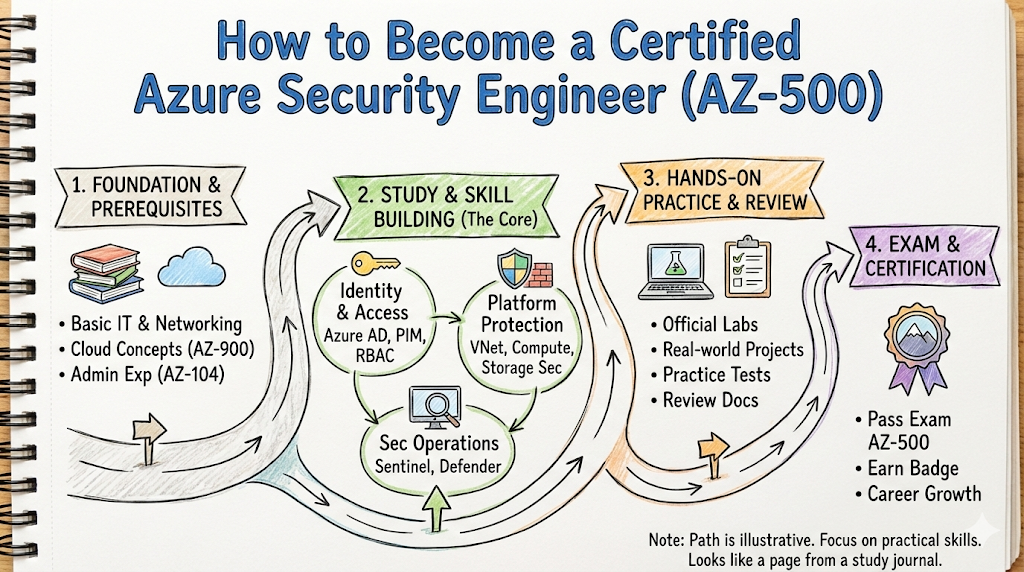
Security is no longer something we can add at the end of a project; it must be built directly into the foundation of every application, infrastructure, and deployment pipeline. As an engineering mentor who has guided countless teams through complex cloud transformations, I can tell you that professionals who understand how to secure cloud environments are the most valued members of any IT organization. If you are a working engineer or an engineering manager looking to validate your cloud security skills, the Azure Security Engineer Associate (AZ-500) certification is your golden ticket. It proves you know how to protect data, manage access, and secure complex networks within Microsoft Azure. This master guide will break down everything you need to know about the Azure Security Engineer Associate (AZ-500) certification. We will cover the specific skills you need, the hands-on projects you should build, and the exact roadmap to pass the exam and advance your career.
The Azure Certification Landscape
To understand where the Azure Security Engineer Associate (AZ-500) fits into your career, it helps to look at the broader certification track. This matrix outlines the core certifications that lead up to and follow the AZ-500, showing you exactly how to map out your learning journey from beginner to expert.
| Certification Name | Track | Level | Who It Is For | Prerequisites | Skills Covered | Recommended Order |
|---|---|---|---|---|---|---|
| Azure Fundamentals (AZ-900) | Cloud Basics | Beginner | Non-technical staff, absolute beginners | None | Cloud concepts, core Azure services, basic security | 1 |
| Azure Administrator Associate (AZ-104) | Cloud Admin / Infrastructure | Associate | Cloud Administrators, Systems Engineers | AZ-900 (Optional) | Compute, storage, networking, identity management | 2 |
| Azure Security Engineer Associate (AZ-500) | Cloud Security / DevSecOps | Associate | Security Engineers, DevSecOps, SREs | AZ-104 (Highly Recommended) | Identity, platform protection, data security, SecOps | 3 |
| Azure DevOps Engineer Expert (AZ-400) | DevOps / Engineering | Expert | DevOps Engineers, Platform Engineers | AZ-104 or AZ-204 | CI/CD, source control, continuous security, SRE practices | 4 |
| Microsoft Cybersecurity Architect (SC-100) | Security Architecture | Expert | Security Architects, Lead Engineers | AZ-500 or SC-200 | Zero Trust architecture, security strategy, governance | 5 |
Deep Dive: Azure Security Engineer Associate (AZ-500)
When I work with enterprise teams, I always look for engineers who hold the AZ-500 certification. It shows they understand that a simple misconfiguration can lead to a massive data breach, and they have the technical depth to prevent it. Here is a complete breakdown of what this certification entails and how to achieve it.
What It Is
The Azure Security Engineer Associate (AZ-500) is a specialized certification by Microsoft that validates your expertise in cloud security. It tests your ability to implement security controls, maintain an organization’s security posture, and identify and remediate vulnerabilities within the Azure cloud environment.
Who Should Take It
- Security Engineers who want to specialize their skills specifically within Microsoft Azure infrastructure.
- Cloud Administrators looking to upgrade their careers and transition into higher-paying security or architecture roles.
- DevOps Engineers who want to evolve into DevSecOps by learning how to securely configure CI/CD pipelines and infrastructure as code.
- Software Engineers building modern applications on Azure who need to understand secure coding practices and access management.
- Engineering Managers who need a deep technical understanding of cloud security to guide their teams effectively and review pull requests safely.
Skills You Will Gain
Passing this exam means you have mastered the core pillars of modern cloud security. You will gain hands-on expertise in the following areas:
- Managing Identity and Access: Deep understanding of Azure Active Directory (now Entra ID), Role-Based Access Control (RBAC), conditional access policies, and enforcing multi-factor authentication.
- Implementing Platform Protection: Securing virtual networks, configuring Network Security Groups (NSGs), setting up Azure Firewall, and managing Web Application Firewalls (WAF) to protect against common web exploits.
- Securing Data and Applications: Encrypting sensitive data at rest and in transit, managing storage account security, and securely storing passwords and certificates using Azure Key Vault.
- Managing Security Operations: Configuring Microsoft Defender for Cloud, setting up automated alerts, monitoring security logs, and using Microsoft Sentinel for advanced threat hunting and incident response.
Real-World Projects You Should Be Able to Do After It
Certifications are only truly valuable if you can apply the knowledge to real business problems. After preparing for the Azure Security Engineer Associate (AZ-500), you should comfortably be able to build the following projects:
- Project 1: Secure Hub-and-Spoke Network Architecture. Design a network where all traffic routes through a central Azure Firewall, ensuring strict traffic filtering and isolation between different application tiers.
- Project 2: Zero Trust Identity Implementation. Set up conditional access policies that automatically block logins from unknown locations and force multi-factor authentication for highly privileged administrative roles.
- Project 3: Automated Secret Management. Configure a custom web application to pull database connection strings dynamically and securely from Azure Key Vault, eliminating hardcoded secrets in the source code.
- Project 4: Threat Detection System. Deploy Microsoft Defender for Cloud across multiple subscriptions and configure automated logic apps that trigger an email to the engineering team whenever a high-severity vulnerability is detected.
Preparation Plan
Your study timeline depends heavily on your current daily work and prior cloud exposure. Here is how I advise my mentees to structure their preparation:
- 7–14 Days (The Fast Track): This rapid pace is only for engineers who already work full-time managing Azure Security. Focus entirely on taking practice exams, reviewing Microsoft Learn documentation for recent feature updates, and brushing up on niche areas you do not use daily, like Microsoft Sentinel configurations.
- 30 Days (The Standard Path): Ideal for Cloud Administrators or DevOps Engineers who use Azure regularly but are not full-time security experts. Dedicate two hours a day: week one to Identity, week two to Networking, week three to Data Security, and week four to Security Operations and taking full-length mock exams.
- 60 Days (The Beginner Path): Designed for Software Engineers or those relatively new to cloud infrastructure. Spend the first 20 days doing hands-on labs to understand basic Azure services, then spend 30 days covering the AZ-500 syllabus deeply. Use the final 10 days for extensive practice tests and reviewing your incorrect answers.
Common Mistakes
- Skipping Hands-On Practice: You simply cannot pass this exam just by reading documentation or watching videos. You must log into the Azure Portal, configure these services yourself, and see how they interact.
- Ignoring Azure Entra ID (Active Directory): Identity is the new security perimeter in cloud computing. Many candidates fail because they do not fully understand the complex details of conditional access, enterprise applications, and managed identities.
- Confusing Microsoft’s Security Tools: Microsoft offers a vast array of security products, such as Defender, Sentinel, and Monitor. A very common mistake during the exam is not knowing exactly when to use which specific tool for a given scenario.
- Rushing the Exam Questions: The questions on the AZ-500 are often scenario-based, lengthy, and complex. Reading too quickly causes candidates to miss critical architectural details, like specific “least privilege” or compliance requirements hidden in the text.
Best Next Certification After This
Once you achieve the AZ-500, the absolute best next step is the Azure DevOps Engineer Expert (AZ-400) certification. Combining deep security knowledge from the AZ-500 with the advanced automation and CI/CD skills from the AZ-400 makes you an incredibly valuable, highly paid DevSecOps Expert.
Choose Your Path: How AZ-500 Fits Your Career
Security touches every single IT domain today, and it is no longer isolated to a single department. Depending on your specific career track, here is exactly how the Azure Security Engineer Associate (AZ-500) will elevate your daily work and project delivery:
DevOps
In DevOps, the ultimate goal is rapid deployment speed. However, speed without built-in security is a recipe for disaster. The AZ-500 teaches DevOps engineers how to securely configure infrastructure as code (IaC) and ensure that the environments they deploy are tightly locked down from day one.
DevSecOps
For professionals aiming for a DevSecOps role, this certification is non-negotiable; it forms your core technical foundation. You will learn exactly how to integrate tools like Azure Key Vault into your pipelines, ensuring secrets are never exposed, and how to automate continuous security scanning using Defender for Cloud.
SRE (Site Reliability Engineering)
Reliability and security are deeply and fundamentally connected, as a security breach often causes massive system downtime. SREs benefit immensely from the AZ-500 by learning how to monitor security logs, build resilient networks against DDoS attacks, and ensure platform protection mechanisms are highly available.
AIOps / MLOps
Machine learning models rely on processing massive, often sensitive datasets. Securing that training data and the underlying infrastructure is critical. MLOps engineers can use AZ-500 knowledge to ensure their data lakes are protected with private endpoints and that their compute clusters are completely isolated from the public internet.
DataOps
DataOps practitioners handle vast amounts of sensitive customer information daily, requiring strict governance. This certification teaches you exactly how to implement column-level security, enforce transparent data encryption, and guarantee secure, audited access to services like Azure SQL and Cosmos DB.
FinOps
Security configuration directly and significantly impacts cloud costs. Over-provisioned firewalls or ignored security alerts can lead to massive resource spikes, such as those caused by a crypto-mining attack. FinOps practitioners with AZ-500 knowledge can much better align security budgets with actual risk management.
Role → Recommended Certifications Mapping
| Your IT Role | Recommended Certification Path | Why This Path Matters |
|---|---|---|
| DevOps Engineer | AZ-104 (Admin) → AZ-400 (DevOps) → AZ-500 (Security) | Ensures you can build infrastructure fast while embedding security directly into your CI/CD pipelines. |
| Site Reliability Engineer (SRE) | AZ-104 (Admin) → AZ-500 (Security) → AZ-400 (DevOps) | Combines deep platform security with automation to prevent breaches that cause massive system downtime. |
| Platform Engineer | AZ-104 (Admin) → AZ-500 (Security) → CKS (Kubernetes Security) | Perfect for securing complex internal developer platforms and containerized microservices running on AKS. |
| Cloud Engineer | AZ-900 (Fundamentals) → AZ-104 (Admin) → AZ-305 (Architecture) | Builds the foundation from basic cloud administration all the way up to enterprise-level cloud architecture. |
| Security Engineer | AZ-104 (Admin) → AZ-500 (Security) → SC-100 (Cyber Arch) | The core track for mastering Azure security configurations and advancing to a Zero Trust strategy architect. |
| Data Engineer | DP-900 (Data Fund.) → DP-203 (Data Eng.) → AZ-500 (Security) | Crucial for learning how to securely manage data lakes, implement column-level security, and protect pipelines. |
| FinOps Practitioner | AZ-900 (Fundamentals) → FinOps Certified → AZ-500 (Security) | Helps align strict security budgets with risk management and prevents massive cost spikes from attacks. |
| Engineering Manager | AZ-900 (Fundamentals) → AZ-500 (Security) → AZ-400 (DevOps) | Gives leadership the technical vocabulary to review secure architectures and confidently lead engineering teams. |
Next Certifications to Take After AZ-500
Once you have conquered the Azure Security Engineer Associate (AZ-500), you should not stop learning; the cloud evolves rapidly. Here are three distinct, strategic directions you can take to continuously grow your career and salary:
1. Same Track (Deep Azure Security)
Microsoft Cybersecurity Architect (SC-100): If you want to stay strictly within the Microsoft ecosystem and move up to a senior architect level, this is the perfect next step. It focuses less on hands-on portal configuration and much more on designing enterprise-wide Zero Trust strategies and governance frameworks.
2. Cross-Track (Multi-Cloud / Container Security)
Certified Kubernetes Security Specialist (CKS): In modern enterprise environments, Azure workloads frequently run on Azure Kubernetes Service (AKS). The CKS is an incredibly respected, highly technical, hands-on certification that proves you can secure complex containerized applications at an advanced level.
3. Leadership Track (Vendor-Neutral Strategy)
Certified Information Systems Security Professional (CISSP): If your long-term goal is to become a Chief Information Security Officer (CISO) or a high-level Engineering Director, the CISSP is the global gold standard. It teaches you the business, legal, and risk management side of cybersecurity beyond just technical implementation.
Top Institutions for AZ-500 Training and Certification
Self-study is great, but having expert, structured guidance drastically accelerates your career growth. Over the years, I have seen these specific institutions consistently provide excellent, hands-on training for the Azure Security Engineer Associate (AZ-500).
- DevOpsSchool: This is a premier global training institute known for its highly practical, lab-heavy approach to learning. They focus on real-world enterprise scenarios rather than just textbook theory, making their candidates highly job-ready from day one.
- Cotocus: Excellent for specialized IT consulting and tailored corporate training. Cotocus provides highly customized learning paths for entire engineering teams, ensuring that the AZ-500 training aligns perfectly with the company’s internal project requirements and specific security policies.
- Scmgalaxy: A fantastic, community-driven platform that offers deep technical resources, forums, and peer support. Their training programs are heavily focused on configuration management, automation, and securing complex software supply chains within Azure.
- BestDevOps: Known for delivering comprehensive, intensive bootcamp-style training that pushes engineers to their limits. They expertly blend general cloud infrastructure learning with strict security best practices, ensuring students understand the full, holistic picture of cloud computing.
- devsecopsschool.com: For engineers specifically looking to merge traditional security with modern CI/CD, this institute provides incredible niche training. They teach all core AZ-500 concepts through the highly relevant lens of automated deployment pipelines and shifting security left.
- sreschool.com: Passionately focused on building highly reliable, fault-tolerant systems at scale. Their unique training shows exactly how Azure security concepts—like aggressive DDos protection and WAF tuning—directly impact platform uptime and preserve error budgets.
- aiopsschool.com: As artificial intelligence rapidly becomes mainstream, this platform teaches forward-thinking engineers how to secure AI workloads. They focus heavily on using machine learning tools to automate threat detection and response within the Azure ecosystem.
- dataopsschool.com: A fantastic, highly specialized choice for data engineers and database administrators. They heavily emphasize the data protection domains of the AZ-500 exam, teaching students how to build secure, compliant, and highly performant data pipelines.
- finopsschool.com: This unique institute successfully bridges the gap between technical cloud security and business finance. They teach engineers how to design highly secure architectures in Azure without accidentally blowing up the company’s monthly cloud consumption budget.
Frequently Asked Questions (FAQs) on AZ-500
Here are the most common, pressing questions my mentees ask me before they begin their Azure Security Engineer Associate (AZ-500) journey, along with the honest answers you need.
1. Is the AZ-500 exam difficult?
Yes, it is widely considered one of the tougher associate-level exams Microsoft offers. It requires a deep, practical understanding of networking, identity, and governance; because the questions are scenario-based, you cannot just memorize facts, you must understand how to solve real architectural problems.
2. How much time do I need to prepare for AZ-500?
For most working engineers with some existing cloud experience, 30 to 45 days of consistent study (about 1.5 to 2 hours a day) is the perfect sweet spot. Absolute beginners with no prior cloud exposure should plan for a full 60 days of intensive study.
3. Do I need to pass AZ-104 before taking AZ-500?
Microsoft does not legally require AZ-104 as a prerequisite to sit for the AZ-500 exam. However, I highly recommend taking AZ-104 first; you simply cannot secure a virtual network or a storage account if you do not first understand how to create and manage them properly.
4. Does AZ-500 involve coding?
No, you do not need to be a software developer or know how to write complex applications to pass this exam. However, you absolutely should be comfortable reading JSON (for ARM templates and Azure Policies) and running basic management scripts in PowerShell or the Azure CLI.
5. What is the value of the AZ-500 for my career?
The value is massive, as cloud security is currently a top priority for every CTO globally. Having this specific certification puts your resume at the very top of the pile for DevSecOps, Cloud Engineer, and Security Architect roles, which usually leads to a significant salary bump.
6. Can a Software Engineer benefit from this certification?
Absolutely; modern software engineers are increasingly expected to write secure code and manage complex application identities themselves. AZ-500 teaches you exactly how to use Key Vault, manage App Registrations, and implement secure API management for your applications.
7. How long is the certification valid?
Like all role-based Microsoft certifications, the AZ-500 certification is valid for exactly one year from the date you pass. You can easily renew it for free online by taking an unproctored assessment on Microsoft Learn before it officially expires.
8. Is it better to learn AWS Security or Azure Security?
This depends entirely on your company’s tech stack or your local job market, as both are highly valuable. However, Azure is currently dominating the large enterprise space, meaning the AZ-500 is incredibly valuable for corporate, banking, and government sectors.
9. What are the passing marks for the AZ-500 exam?
You need a minimum score of 700 out of 1000 to successfully pass the exam. The exam usually contains between 40 and 60 questions, and the scoring is scaled based on the difficulty of the specific questions you receive.
10. Are there lab questions on the exam?
Microsoft frequently rotates the exam formats and testing interfaces without warning. You should absolutely prepare as if you will get live lab questions where you must log into the Azure portal and configure actual settings to solve a problem.
11. How does AZ-500 differ from SC-200 (Security Operations Analyst)?
The AZ-500 is very broad; it covers securing the entire Azure infrastructure, including networking, data, and compute resources. The SC-200 is very narrow and focuses almost entirely on advanced threat hunting and daily monitoring using Defender and Sentinel.
12. Will AZ-500 help me get a job if I have zero IT experience?
Honestly, no; the AZ-500 is absolutely not an entry-level certification. If you have zero IT experience, you should start with the AZ-900 (Azure Fundamentals) and land an entry-level helpdesk or Junior Admin role before targeting associate-level security certs.
Testimonials
Do not just take my word for it; the results speak for themselves. Here is what working professionals have directly experienced in their careers after completing the Azure Security Engineer Associate (AZ-500) program:
“Moving from a standard SysAdmin role to a dedicated Cloud Security team felt incredibly intimidating at first. Preparing for the AZ-500 gave me a structured, logical path to follow. The hands-on labs with Azure Firewall and Entra ID gave me the exact skills I needed to pass my technical interview, and I am now working full-time in DevSecOps.”
— Rohan M., DevSecOps Engineer
“In my current role, platform uptime is absolutely everything. I used to view security as a frustrating roadblock to deploying our code fast. The AZ-500 taught me how to actually automate security checks and implement strict guardrails using Azure Policy, so now, our deployments are both lightning-fast and highly secure.”
— Priya S., Site Reliability Engineer (SRE)
“As an Engineering Manager, I desperately needed to ensure my team was building safe, compliant cloud architectures. Taking the time to study for the AZ-500 myself gave me the deep technical vocabulary to review pull requests effectively and challenge my architects to build better, more resilient Zero Trust networks.”
— David L., Engineering Manager
Conclusion
Securing the cloud is not an optional, “nice-to-have” skill anymore; it is the absolute core of modern IT operations and software delivery. The Azure Security Engineer Associate (AZ-500) is one of the most comprehensive, practical, and globally respected certifications you can earn to prove your technical worth in this industry. Whether you are a DevOps engineer aggressively looking to “shift left,” a Cloud Admin wanting a major promotion, or an Engineering Manager guiding a large team, mastering the concepts in the AZ-500 will completely change how you approach infrastructure.