Introduction
I have spent a long time watching the world of technology change. I remember when “security” was just a locked door on a server room. Today, everything has moved to the cloud, and the risks have changed. Security is no longer an afterthought; it is the most important part of any system you build. Whether you are an engineer or a manager in India or working with a global team, you must know how to protect your data. The AWS Certified Security – Specialty is the best way to prove you have these skills. It shows that you don’t just know how to use the cloud, but you know how to defend it. In this guide, I will break down everything you need to know about this certification. We will keep it simple and focus on what really matters for your career.
The AWS Certification Landscape
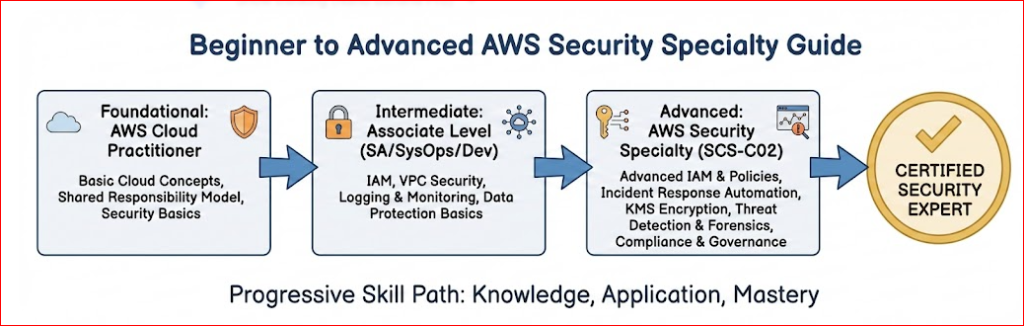
Before we zoom in on the Security Specialty, it’s important to see where it fits in the broader AWS ecosystem. AWS uses a tiered approach, starting from foundational concepts and moving into deep, technical specialties. This structure allows professionals to build a solid base in architecture or operations before focusing on high-stakes domains like security. By following this roadmap, you ensure that your specialized skills are built on a rock-solid understanding of how the cloud actually works.
| Track | Level | Who it’s for | Prerequisites | Skills Covered | Recommended Order |
| Cloud Practitioner | Foundational | Beginners, Managers | None | Basic Cloud & Billing | 1st |
| Solutions Architect | Associate | Engineers, Architects | Basic AWS knowledge | Designing systems | 2nd |
| Developer | Associate | Developers | Coding skills | Building cloud apps | 2nd |
| SysOps Admin | Associate | Admins, SREs | Ops background | Monitoring systems | 2nd |
| Solutions Architect | Professional | Senior Architects | 2+ years AWS exp | Complex designs | 3rd |
| DevOps Engineer | Professional | DevOps/SRE | 2+ years AWS exp | Automation & CI/CD | 3rd |
| Security | Specialty | Security Experts | Associate skills | IAM, Encryption, IR | 4th |
| Data Engineer | Associate | Data Engineers | Data background | Data Pipelines | 2nd |
| Advanced Networking | Specialty | Network Engineers | Pro-level skills | Complex Networks | 4th |
| Machine Learning | Specialty | ML Engineers | Python/ML background | AI & ML Models | 4th |
Deep Dive: AWS Certified Security – Specialty
What it is
The AWS Certified Security – Specialty (SCS-C02) is a top-level technical exam that proves you can protect complex data and systems. It focuses on the most critical parts of the cloud, such as preventing cyber-attacks, keeping data private through encryption, and managing who can access your resources. This is not just a test of facts; it is a test of how well you can solve real-world security problems in a high-pressure environment.
Who should take it
This certification is designed for security professionals, senior engineers, and managers who want to be recognized as cloud security leaders. It is especially useful for those in the DevOps space who want to move into DevSecOps, where security is built directly into the software lifecycle. If you are responsible for keeping a company’s digital assets safe from global threats, this is the credential you need to prove your worth.
Skills you’ll gain
- Identity Management: You will learn how to use IAM and Organizations to ensure that every user and service has exactly the right amount of access—no more, no less.
- Data Encryption: You will master the use of secret keys (KMS) to lock your data at rest and while it moves across the network, making it useless to hackers.
- Infrastructure Defense: You will gain the skills to build digital walls using Firewalls, WAF, and Shield to stop automated attacks and DDoS attempts.
- Detection and Monitoring: You will learn to set up 24/7 watchdogs like GuardDuty and Security Hub that alert you the moment something looks suspicious.
- Incident Response: You will develop the ability to build automated systems that can detect a security breach and fix it instantly without human intervention.
Real-world projects you should be able to do after it
- Self-Healing Security: Build a system that notices when a server is behaving strangely and automatically shuts it down while alerting the team.
- Centralized Compliance: Set up a single dashboard that tracks every AWS account in your company to make sure they all follow the same security laws and rules.
- Zero-Trust Architecture: Create an environment where every single request is verified and encrypted, ensuring that a breach in one area doesn’t lead to a total disaster.
- Automated Auditing: Use tools like AWS Config to automatically record every change made to your cloud setup, making it easy to pass security audits and stay safe.
Preparation Plan
Choose the path that works best for your current knowledge and daily schedule.
The “Rapid Fire” Plan (7–14 Days)
This plan is only for people who already work in cloud security every single day and just need to learn the exam format. You should spend 4–5 hours a day reviewing the official AWS Security whitepapers and taking as many practice exams as possible. Focus on the areas where you feel less confident, especially complex topics like cross-account encryption and Service Control Policies (SCPs).
The “Balanced” Plan (30 Days)
This is the most popular choice for working engineers who want to pass the exam without feeling overwhelmed. Spend about an hour each weeknight and four hours on weekends building labs and reading deep-dive guides. Split your month into four themes: Identity (IAM), Infrastructure (Networking), Detection (Monitoring), and Data Protection (Encryption) to ensure you cover every topic.
The “Deep Diver” Plan (60 Days)
If you are a manager or an engineer moving from traditional IT to the cloud, this 60-day path gives you the time to truly learn. Spend the first 30 days earning an Associate-level certification to learn how AWS works at a basic level. Use the second 30 days to follow the “Balanced” plan, spending extra time in the AWS console building the security tools yourself until you know them by heart.
Common Mistakes
- Thinking it’s just about theory: Many people fail because they study the books but don’t spend time actually clicking through the AWS console to see how things work.
- Skipping the fine print in IAM: IAM is a huge part of the exam, and questions often trip you up on the difference between “Deny” and “Allow” rules.
- Getting confused by Encryption: You must understand how KMS keys work in detail, including how to share them between different AWS accounts safely.
- Ignoring the “Shared Responsibility” model: You must know exactly what AWS protects and what you are responsible for protecting to answer the questions correctly.
Choose Your Path: 6 Learning Tracks
1. The DevOps Path
This path is for those who focus on building and deploying software quickly and reliably. By adding the Security Specialty, you learn how to make sure that speed doesn’t lead to security holes. You will become an expert in building pipelines that are both fast and safe from the very beginning.
2. The DevSecOps Path
This is currently the most in-demand role in the tech world because it combines coding, operations, and security. You learn how to “shift security left,” meaning you fix problems while the software is still being written rather than waiting until it’s finished. It’s the best way to become a high-value specialist in modern cloud engineering.
3. The SRE Path
Site Reliability Engineers use the Security Specialty to make sure that security incidents don’t cause the system to crash or slow down. You will focus on building “resilient” systems that can survive a cyber-attack and keep running smoothly. This path is all about the intersection of system health and system safety.
4. The AIOps/MLOps Path
As more companies use Artificial Intelligence, the data used to train those models becomes incredibly valuable and sensitive. This track teaches you how to keep your AI models and data lakes safe from hackers who want to steal or mess with your intellectual property. It is the future of security in an AI-driven world.
5. The DataOps Path
Data is the most valuable asset any company has, and this path is dedicated to keeping it safe. You will learn how to manage massive amounts of information while ensuring that every bit of it is encrypted and only accessible by the right people. This is perfect for engineers working in banking, healthcare, or any data-heavy field.
6. The FinOps Path
Cloud security isn’t just about stopping hackers; it’s also about stopping financial waste. Hackers often steal AWS accounts to mine Bitcoin, leading to bills worth thousands of dollars. This path teaches you how to use security tools to manage costs and prevent financial surprises for your company.
Role → Recommended Certifications
To help you and your team visualize the best path forward, I have organized the certifications into a clear mapping based on current industry standards. This table aligns technical roles with the specific AWS certifications that provide the most value for that career track.
| Job Role | Associate Level | Professional Level | Specialty Level |
| DevOps Engineer | Developer Associate | DevOps Engineer – Pro | Security Specialty |
| SRE | SysOps Admin Associate | DevOps Engineer – Pro | Security Specialty |
| Platform Engineer | Solutions Architect Associate | Solutions Architect – Pro | Security Specialty |
| Cloud Engineer | Solutions Architect Associate | DevOps Engineer – Pro | Advanced Networking |
| Security Engineer | Solutions Architect Associate | N/A (Specialty Focus) | Security Specialty |
| Data Engineer | Data Engineer Associate | N/A (Specialty Focus) | Data Analytics / Security |
| FinOps Practitioner | Solutions Architect Associate | N/A (Governance Focus) | Security Specialty |
| Engineering Manager | Solutions Architect Associate | Solutions Architect – Pro | Security Specialty |
Top Training Institutions
- DevOpsSchool: This is one of the world’s leading schools for hands-on technical training with live instructors. They don’t just teach you the exam; they teach you the job by using real-world projects and 24/7 lab access. It is the best place to go if you want to become a true security expert who can handle any challenge.
- Cotocus: They specialize in helping entire companies train their staff for the cloud. Their training is very practical and focuses on the specific security needs of large businesses and enterprises. It is a great choice for teams that need to improve their security skills together.
- Scmgalaxy: This is a fantastic resource for engineers who like to learn from a community of peers. They provide a huge library of tutorials, guides, and open-source tools that help you understand the “how” behind AWS security. It’s perfect for those who want to supplement their learning with real-world troubleshooting.
- BestDevOps: If you are a busy professional who needs to get certified quickly, this school offers focused and efficient bootcamps. They strip away the fluff and focus purely on the most important technical concepts you need to pass the exam. They are known for high-quality practice tests that feel just like the real thing.
- DevSecOpsSchool: As the name suggests, they are the top choice for anyone who wants to focus specifically on the mix of security and automation. Their courses teach you how to write code that checks your security automatically every time you make a change. It is the ideal school for the modern “Security as Code” expert.
- Sreschool: This school focuses on the reliability and safety of systems. They teach you how to use AWS security tools to not only stop hackers but also to keep your website or app running 100% of the time. It is perfect for engineers who care about both safety and performance.
- Aiopsschool: This is a forward-thinking school that teaches you how to use Artificial Intelligence to improve your security work. You will learn how to use AI tools to find threats faster than a human ever could. It’s the right place for engineers who want to stay on the cutting edge of technology.
- Dataopsschool: They are the experts in teaching you how to keep massive data pipelines safe and encrypted. Their training covers everything from securing data in S3 to managing complex database permissions. If you work with big data, this is where you should go to learn security.
- Finopsschool: This unique school teaches you how security, governance, and money are all connected. You will learn how to set up rules that prevent hackers from running up massive AWS bills. It is the go-to place for anyone who wants to manage the financial risks of the cloud.
General Career & Certification FAQs
- Is the AWS Security Specialty a hard test? Yes, it is one of the most technical AWS exams and requires you to solve difficult scenario-based problems.
- How much time should I set aside for study? Most people need about 1 to 2 months of regular study to feel fully prepared.
- Do I need to be a great coder? No, but you should be comfortable reading simple scripts and understanding how data is structured.
- Which AWS cert should I take first? I always recommend the Solutions Architect Associate as it gives you the best foundation for everything else.
- Is this certification useful for jobs in India? Absolutely; India is a global cloud hub, and companies are desperate for certified security experts.
- How long does the certification last? It is valid for three years, after which you need to take the test again to stay current.
- Will this help me earn more money? Yes, specialty certifications are highly valued and often lead to significant salary increases.
- Is it worth it for managers who don’t code? Yes, because it gives you the knowledge to lead security reviews and make smart decisions for your team.
- What is a passing grade? You need to score at least 750 out of 1000 points.
- Can I take the exam online? Yes, you can take it from home or your office as long as you have a quiet room and a webcam.
- What kind of questions are on the test? They are all multiple-choice or multiple-response, focusing on how you would handle specific technical situations.
- Is this better than a general security cert like CISSP? They are different; this one proves you are an expert on AWS specifically, while CISSP is more about general security management.
AWS Security Specialty Specific FAQs
- What is the most important part of the exam?
IAM (Identity and Access Management) is the core of almost every question on the test. - Do I need to know a lot about networking? Yes, you must understand how to secure virtual networks using tools like NACLs, Security Groups, and WAF.
- Is encryption (KMS) a big topic? Yes, you need to know how to manage secret keys and how to use them to lock different types of data.
- Do I need to know about third-party security tools? While the exam focuses on AWS tools, knowing when to use outside tools for things like virus scanning is helpful.
- What exactly is “Incident Response”? It is the process of detecting a threat, stopping it, and figuring out how to prevent it from happening again.
- Are there labs during the exam? Not usually, but you need to have “hands-on” experience to understand the complex scenario questions.
- What is the “Least Privilege” principle? It is the golden rule of security: only give people the minimum access they need to do their specific job.
- How does AWS help with compliance? AWS provides tools like Artifact and Config that help you prove to auditors that your systems follow the law.
Next Certifications to Take
- Same Track (Deep Expertise): AWS Certified Advanced Networking – Specialty for those who want to master the “plumbing” of the cloud.
- Cross-Track (Broaden Influence): AWS Certified DevOps Engineer – Professional to learn how to automate all of your security work.
- Leadership (Management Path): CISSP for those who want to move into high-level executive security roles like a CISO.
Testimonials
“Getting the AWS Security Specialty changed my life. I was a general cloud engineer, but now I lead a security team and handle some of the most complex challenges in our company.”
— Anjali R., Senior Cloud Architect
“I thought I knew security until I took this exam. The depth of knowledge I gained about IAM and encryption has made me the go-to expert in my office for anything security-related.”
— David M., Engineering Manager
Conclusion
The journey toward achieving the AWS Certified Security – Specialty is a defining moment for any professional aiming to lead in the modern cloud landscape. It is more than just a credential; it is a rigorous validation of your ability to design, secure, and defend complex infrastructures against an ever-evolving threat landscape. By mastering the intricate balance between identity management, data protection, and automated incident response, you transition from being a cloud practitioner to a trusted security guardian. As organizations globally prioritize resilience and compliance, the expertise you gain through this certification—and the strategic training from institutions like DevOpsSchool—positions you at the absolute forefront of the industry. Ultimately, this path is about building the confidence to navigate high-stakes security challenges with precision, ensuring that the innovation of tomorrow is built on the unshakeable foundation you create today.