Introduction
Cloud adoption looks easy from the outside, but inside most companies it becomes complex very quickly. Teams struggle with identity and access rules, network design, governance, security controls, reliability targets, and cost spikes—all at the same time. This is exactly where a strong Azure Solutions Architect becomes valuable: someone who can turn business needs into a clear, safe, and scalable cloud design that engineering teams can build and operate with confidence. The Azure Solutions Architect Expert certification is designed for professionals who want to lead these architecture decisions on Microsoft Azure. It is not only about knowing Azure services; it is about making smart trade-offs between security, performance, availability, and cost. In this guide, you will learn what the certification covers, who should take it, how to prepare step by step, and how to map it to real roles like DevOps, SRE, DevSecOps, DataOps, and FinOps. You will also get practical learning paths, a role-to-certification map, common mistakes to avoid, FAQs, and next steps to grow your cloud career.
Why this certification matters right now
Most teams are moving from “just deploy” to “design for reliability, security, and cost.” Architects are expected to make decisions that reduce outages, prevent security gaps, and keep bills under control. In many companies, solution architects also guide DevOps, SRE, security, and data teams to align on a single platform plan. This certification sits exactly at that intersection: design + governance + operations.
What is Azure Solutions Architect Expert?
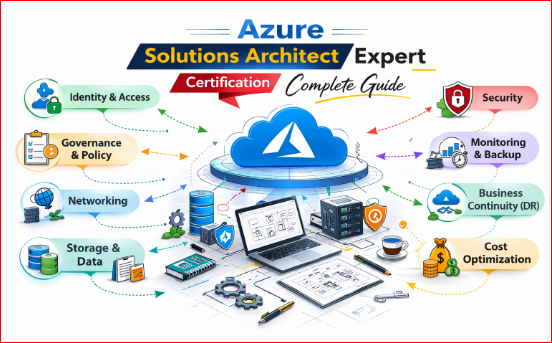
The Azure Solutions Architect Expert credential validates your ability to design Azure infrastructure solutions across identity, governance, networking, storage, business continuity, and monitoring.
Microsoft’s current exam for this credential is AZ-305, and the certification requires you to also hold Azure Administrator Associate (commonly earned via AZ-104).
In simple terms, this certification proves you can turn business requirements into an Azure blueprint that engineers can implement safely and reliably.
Who should take this certification?
This certification is best for people who already work with Azure and want to move from “building resources” to “designing systems.” If you are a Cloud Engineer aiming for architecture responsibilities, it’s a strong next step. It also fits DevOps/Platform engineers who want to own platform design choices, not just pipelines and automation. Managers can use it to better evaluate architecture decisions, vendor proposals, and cloud cost-risk tradeoffs. If you are new to Azure, it is better to first build hands-on confidence with core Azure services and administration fundamentals before targeting expert-level design skills.
What you’ll learn and be able to do
You will learn how to design identity and access models, governance controls, and monitoring strategies that scale across teams and subscriptions.
You will also learn to design networking and connectivity (including hybrid patterns), storage and data options, and business continuity plans that match real business needs.
Most importantly, you will learn how to make architecture decisions with clear reasoning: security impact, reliability impact, performance impact, and cost impact—so your designs don’t fail in production.
Certification overview and official references you provided
Note: Microsoft’s current credential path references AZ-305 and a prerequisite administrator certification.
Your provided course page focuses on AZ-300 & AZ-303 wording.
In practice, you should align your learning to the current Microsoft skills measured (design identity/governance/data/business continuity/infrastructure) while using your provided program link for your official program reference.
Table of certifications
| Certification | Track | Level | Who it’s for | Prerequisites | Skills covered | Recommended order |
|---|---|---|---|---|---|---|
| Azure Solutions Architect Expert | Architecture | Expert | Architects, senior cloud/platform engineers, technical leads | Strong Azure fundamentals; typically Admin Associate for the credential | Identity, governance, monitoring, storage, BC/DR, infrastructure design | After admin-level Azure skills |
| Azure Fundamentals | Foundations | Beginner | Freshers, managers, non-cloud engineers moving to Azure | None | Cloud basics, core Azure services, pricing concepts | 1st step for beginners |
| Azure Administrator Associate | Operations | Intermediate | Cloud engineers, sysadmins, platform ops | Basic Azure fundamentals | Resource management, networking, compute, storage, monitoring | Before Architect Expert |
| Azure DevOps Engineer Expert | DevOps | Expert | DevOps/Platform engineers owning CI/CD + governance | DevOps + Azure admin/dev experience | CI/CD design, release strategies, security in pipelines | After admin + devops basics |
| Azure Security Engineer Associate | Security | Intermediate | Security engineers, cloud engineers focused on security | Azure fundamentals + security basics | IAM, security controls, posture, threat protection | Before deep cloud security roles |
| Azure Data Engineer | DataOps | Intermediate | Data engineers, analytics platform engineers | Data fundamentals + Azure basics | Data pipelines, storage patterns, governance basics | After fundamentals |
| Azure AI/ML Engineer | AIOps/MLOps | Intermediate | ML engineers, AI platform teams | ML basics + Azure fundamentals | Model deployment, ML services, responsible AI basics | After fundamentals |
| Azure Networking Specialty (or deep networking path) | Platform | Advanced | Network-focused cloud engineers | Strong networking fundamentals | Hub-spoke, hybrid connectivity, routing, security patterns | After admin-level |
| FinOps on Azure (cost governance path) | FinOps | Advanced | FinOps practitioners, engineering managers | Azure billing basics | Cost allocation, tagging, budgets, optimization, governance | After fundamentals |
Mini-sections for the certification (consistent format)
What it is
Azure Solutions Architect Expert validates your ability to design Azure solutions that are secure, resilient, and scalable.
It focuses on architecture decisions across identity, governance, networking, storage, monitoring, and business continuity—so teams can build systems that work in real production.
Who should take it
Take this if you already work with Azure and are responsible (or soon will be) for architecture choices. It is ideal for engineers moving into solution architect roles and for leads who design reference architectures.
If you are a manager, it helps you review cloud designs, cost risk, and security trade-offs with confidence. It’s not the best first certification if you have never built anything on Azure.
Skills you’ll gain
- Designing identity, governance, and monitoring patterns that work across subscriptions and teams
- Choosing the right storage, compute, and network designs for different workloads
- Planning business continuity and disaster recovery based on RTO/RPO needs
- Designing secure connectivity and access patterns for hybrid and cloud-first systems
- Building architecture documentation that engineers can actually implement
Real-world projects you should be able to do after it
- Design a hub-and-spoke Azure network with secure routing, segmentation, and shared services
- Build a multi-environment landing zone with policies, RBAC, logging, and naming standards
- Create a business continuity plan with backup, DR strategy, and failover testing process
- Design a secure identity architecture for apps, admins, and workloads using least privilege
- Produce an architecture pack: diagrams, decision records, and rollout steps for teams
Preparation plan (7–14 / 30 / 60 days)
7–14 days (fast-track, revision mode): Focus on exam skill areas, review architecture scenarios, and do targeted labs for weak areas. You should already be comfortable in Azure before this plan.
30 days (balanced plan): Cover one major domain per week (identity/governance, data/storage, infrastructure/networking, BC/DR + monitoring). Add hands-on labs every weekend to “lock” concepts.
60 days (career-transform plan): Build 2–3 end-to-end case projects (landing zone, hybrid network, DR plan). Add design documentation practice and do mock reviews as if you are presenting to a CTO.
Common mistakes
- Studying only theory and skipping hands-on lab work for identity, networking, and monitoring
- Treating security as a last step instead of a design input from day one
- Over-designing (too complex) or under-designing (no governance) because you ignore trade-offs
- Memorizing services without understanding when and why to choose them
- Not practicing scenario-based questions, which is how architecture exams test thinking
Best next certification after this
If you want to deepen your build-and-run skills, take a DevOps-focused certification next to connect architecture with delivery. If you want stronger security ownership, go for a cloud security credential and build secure reference designs.
If your role is moving into leadership, add a program-management or architecture governance track that strengthens stakeholder communication, risk management, and cost accountability.
Choose your path (6 learning paths)
DevOps path
Start by mastering Azure foundations, then focus on CI/CD design and deployment strategies that match the architectures you design. Your goal is to connect architecture with automation: landing zones, pipelines, deployment gates, and release safety.
A good DevOps path also includes observability and incident readiness so deployments don’t break reliability.
DevSecOps path
This path makes security a design rule, not a checklist. Focus on identity architecture, least privilege, policy-driven governance, secrets management, secure networking, and threat detection workflows.
The goal is to design systems where compliance and security controls are built into the platform by default.
SRE path
SRE aligns architecture decisions with availability, latency, and incident recovery. Focus on monitoring design, SLO thinking, capacity planning, resiliency patterns, and DR testing.
You should be able to explain reliability trade-offs clearly: what you protect, what you measure, and how you recover.
AIOps/MLOps path
Here you connect architecture with AI workloads and operational intelligence. Focus on designing secure data flows, model deployment patterns, monitoring for drift, and platform automation for ML pipelines.
A strong AIOps/MLOps path also includes observability and cost control because ML can burn money fast if not governed.
DataOps path
DataOps is about reliable, governed data pipelines and platforms. Focus on storage choices, data lifecycle, security boundaries, and monitoring pipelines like you monitor apps.
Your target outcome is to design data platforms that are scalable, auditable, and stable for analytics and downstream systems.
FinOps path
FinOps turns architecture decisions into controlled cloud spending. Focus on tagging standards, cost allocation, budgets, optimization patterns, and policy guardrails.
The key outcome is making cost visible and predictable without slowing down engineering velocity.
Role → Recommended certifications mapping
| Role | Recommended certifications |
|---|---|
| DevOps Engineer | Azure Solutions Architect Expert, Azure DevOps Engineer Expert, Azure Administrator Associate |
| SRE | Azure Solutions Architect Expert, Azure Administrator Associate, Observability + reliability deepening |
| Platform Engineer | Azure Solutions Architect Expert, Azure Administrator Associate, Advanced networking/governance skills |
| Cloud Engineer | Azure Administrator Associate, Azure Solutions Architect Expert, Security foundations |
| Security Engineer | Azure Security Engineer Associate, Azure Solutions Architect Expert, Governance/policy focus |
| Data Engineer | Azure Data Engineer, Azure Solutions Architect Expert (for platform design), Security foundations |
| FinOps Practitioner | FinOps on Azure path, Azure Solutions Architect Expert (for cost-aware design), Governance skills |
| Engineering Manager | Azure Solutions Architect Expert (decision literacy), FinOps basics, Security governance mindset |
Next certifications to take (3 options)
Same track (Architecture deepening)
After you complete the architect expert path, deepen your specialization in one domain you design often—networking, security, or data architecture. This helps you become “the go-to” architect for a high-impact area.
This is especially useful in enterprise environments where architecture is split into platform, security, and data towers.
Cross-track (Build + Operate)
Pair architecture skills with a delivery track (DevOps) or reliability track (SRE). This makes you valuable because you can design the system and also guide how it ships safely and runs reliably.
Cross-track certifications strengthen practical credibility: teams trust architects more when they can also implement.
Leadership track (Decision + Governance)
If your next move includes leading teams, focus on architecture governance, risk management, stakeholder communication, and cost ownership. Strong leaders translate architecture into business language.
This path is ideal for engineering managers, platform leads, and solution leads working across multiple teams.
Top institutions that help with training and certification
DevOpsSchool
DevOpsSchool focuses on structured learning with practical labs and real project thinking, which is critical for architecture preparation. It’s useful if you want guided coverage across identity, governance, networking, and reliability.
It also fits working professionals because it is designed around industry job outcomes and implementation confidence.
Cotocus
Cotocus is helpful for learners who want architecture concepts explained with practical examples and real enterprise patterns. The focus is usually on making complex ideas simple and building strong fundamentals.
This works well for engineers transitioning into architect responsibilities.
ScmGalaxy
ScmGalaxy is known for training support around DevOps and cloud learning journeys with a career-focused approach. It can be helpful if you want structured guidance, practice planning, and consistent mentoring.
It also supports learners who prefer step-by-step progression.
BestDevOps
BestDevOps typically supports practical readiness, especially for engineers who want architecture plus delivery awareness. It is useful if you want to connect “design choices” with how platforms are built and operated.
That blend matters a lot in modern cloud roles.
devsecopsschool.com
This is useful if your architecture goals include security-first design and governance. It helps reinforce how identity, policy, secure networking, and compliance fit into architecture decisions.
It’s a strong add-on if you want DevSecOps ownership.
sreschool.com
SRESchool helps you connect architecture with reliability outcomes like SLOs, monitoring design, incident response, and DR strategy. This is valuable because the best architects design for operations, not just deployment.
Great for engineers targeting platform reliability roles.
aiopsschool.com
AIOpsSchool supports learning paths where operations intelligence, automation, and AI-enabled monitoring become part of the platform strategy. It’s useful if you want to blend architecture with modern observability and automation thinking.
This is relevant in large environments with complex incident patterns.
dataopsschool.com
DataOpsSchool supports architecture thinking for data platforms, pipelines, and governance. It helps you understand storage patterns, lifecycle management, and reliability for data workflows.
This is ideal if you design analytics or data-heavy solutions on Azure.
finopsschool.com
FinOpsSchool builds the mindset and methods for cost visibility, allocation, and optimization. This matters because many architecture choices directly impact cloud spending.
It’s a good track for architects who want to be trusted with cost governance.
Career-focused FAQs
- Is Azure Solutions Architect Expert hard?
Yes, it’s challenging because it is scenario-based and tests design trade-offs, not just definitions. If you have hands-on Azure experience and can reason about choices, it becomes manageable. - How long does it take to prepare?
Most working professionals need 30–60 days for solid preparation, depending on how much real Azure work they already do. If you are new to Azure, you should first build admin-level confidence. - Do I need Azure Administrator certification first?
For the Microsoft credential, an administrator certification is required to earn the Solutions Architect Expert title, even if you can sit the exam earlier. - Can managers take this certification?
Yes, especially engineering managers and delivery managers who review designs and budgets. It improves your ability to evaluate architecture, risk, and cloud costs with clarity. - What background is most helpful?
Strong fundamentals in networking, identity, security, and operations help a lot. Architecture is often about connecting these domains into a consistent design. - What should I focus on most?
Identity and governance, networking patterns, business continuity, monitoring strategy, and secure design trade-offs are the most common make-or-break areas. - Is hands-on practice really necessary?
Yes. Architecture questions often assume you understand how services behave in real environments. Labs build the intuition needed for scenario questions. - What roles benefit most after certification?
Solutions Architect, Cloud Architect, Platform Architect, Senior Cloud Engineer, and Cloud Lead roles benefit directly. It also strengthens DevOps/SRE leadership paths. - Does this certification help salary and growth?
It can, especially when paired with proven project experience and clear architecture documentation skills. Certifications open doors, but real-world design ability closes the deal. - What is the best sequence if I’m coming from DevOps?
Start from Azure fundamentals (if needed), build admin skills, then do architect design. After that, move to DevOps expert-level delivery or security specialization. - How do I prove skills beyond the certificate?
Create a portfolio: landing zone design, DR plan, secure identity model, monitoring strategy, and cost governance plan. Document decisions and trade-offs like a real architect. - What is the biggest reason people fail?
They memorize services but cannot explain why one design is better than another under real constraints (security, cost, reliability, time).
FAQs on Azure Solutions Architect Expert
- What exactly does this certification validate?
It validates your ability to design Azure infrastructure solutions across identity, governance, storage, networking, monitoring, and continuity planning. - Do I need deep coding skills?
No deep coding is required, but you must understand how applications and infrastructure interact. Basic scripting and automation awareness helps. - Is it useful for DevSecOps roles?
Yes, because it strengthens identity, governance, and secure architecture decisions. DevSecOps benefits when security is built into design. - Is it useful for SRE roles?
Yes, because it improves reliability design thinking: monitoring, failure planning, and recovery strategies. - How should I study: by services or by scenarios?
Start by learning services, then shift quickly to scenarios and trade-offs. Architecture success comes from decision-making, not lists. - What should I do in the last week before the exam?
Review weak domains, do quick labs, and practice scenario questions. Focus on identity/governance, network patterns, and BC/DR. - What kind of projects help most?
Landing zone + governance, hybrid connectivity design, DR strategy with testing steps, and observability design for a production workload. - What should I do after I pass?
Use it to lead design reviews, mentor teams, and build reference architectures. Combine it with one specialization (DevOps, security, data, or FinOps).
Testimonials
Amit, Cloud Engineer
“This journey helped me move from deployment tasks to true design thinking. I started writing architecture notes, and my team began trusting my decisions more. The biggest change was learning how to design identity, governance, and DR from day one.”
Neha, Platform Engineer
“I used to focus only on pipelines and automation. After preparing for architect-level topics, I understood how network patterns, policies, and monitoring fit together. That improved the stability of our platform releases.”
Rohit, Engineering Manager
“I didn’t take it just for a certificate. I took it to understand what good architecture looks like and how to ask better questions. It helped me guide discussions on risk, cost, and platform standards.”
Conclusion
Azure Solutions Architect Expert is a strong milestone if you want to move into architecture and leadership decisions in cloud. It builds the habit of thinking in systems: identity and governance first, network and security boundaries next, and then reliability, monitoring, and continuity planning.
If you prepare with hands-on labs and real scenarios, you don’t just pass an exam—you become the person who can design platforms teams can trust. Start with your current role (DevOps, SRE, security, data, or FinOps), follow a clear path, and build 2–3 real case projects. That practical proof, along with the certification, is what creates real career momentum.