Introduction
The tech world moves fast, but the principles of delivering good software remain the same: speed, reliability, and quality. As someone who has watched the industry shift from manual server setups to fully automated cloud environments, I can tell you that the Azure DevOps Engineer Expert (AZ-400) is one of the most practical certifications you can pursue today. It represents the pinnacle of Microsoft’s DevOps track, proving you can handle complex, enterprise-level delivery cycles. It isn’t just about passing an exam; it’s about mastering the bridge between development and operations. Whether you are a Software Engineer in Bangalore or a Platform Manager in London, this guide will help you understand how to navigate this certification and what it means for your career. Mastering these tools allows you to lead teams toward a culture of continuous improvement and high-velocity deployment.
What is the Azure DevOps Engineer Expert (AZ-400) Certification?
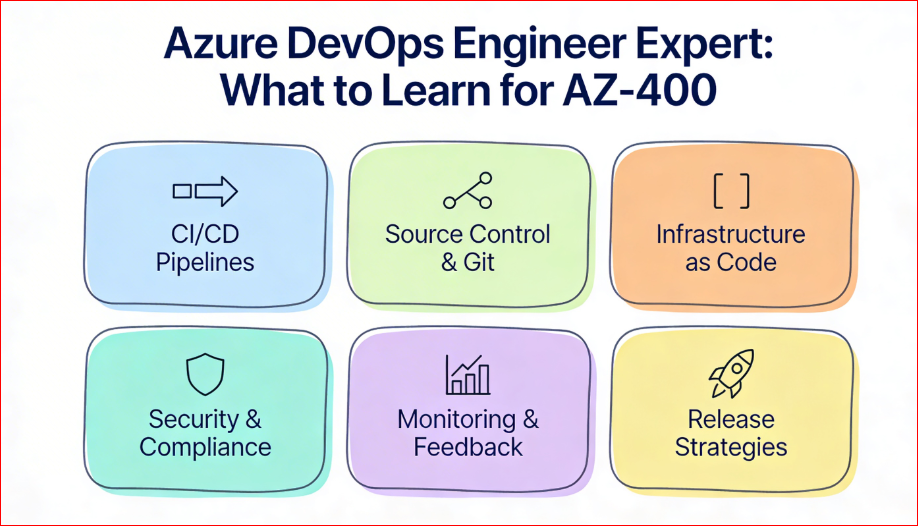
This is an expert-level certification designed for those who design and implement strategies for collaboration, code, infrastructure, source control, security, compliance, continuous integration, testing, delivery, monitoring, and feedback. It serves as a professional seal of approval, indicating that you are capable of managing the entire application lifecycle from start to finish. By earning this, you prove your ability to use Azure technologies to optimize the flow of value to end-users.
It focuses heavily on the “how-to” of DevOps using Microsoft Azure technologies, but the logic you learn applies to almost any modern engineering environment. You will spend a lot of time learning how to unify people, processes, and products to enable continuous delivery. It is widely considered the gold standard for anyone working within the Microsoft ecosystem.
Who Should Take It?
- Software Engineers: If you want to move beyond writing code and start managing how that code reaches the user, this is your path. It helps you understand the bigger picture of deployment, scaling, and system health.
- DevOps Engineers: To validate your existing skills and learn the “Microsoft way” of scaling infrastructure. This certification gives you a structured framework to improve your current workflows and automate repetitive tasks.
- System Administrators: Those looking to transition into cloud-native automation and Infrastructure as Code (IaC). It provides the necessary tools to move away from manual configurations and toward repeatable, code-based environments.
- Engineering Managers: To understand the technical depth required to build high-performing engineering teams. Knowing the capabilities of Azure DevOps allows you to set realistic goals and choose the right tools for your developers.
Skills You Will Gain
- Instrumentation Strategy: Learning how to monitor your applications and infrastructure to catch bugs before users do. You will master logs, telemetry, and dashboards to ensure you have full visibility into your system’s performance.
- Site Reliability Engineering (SRE): Implementing strategies that keep systems up and running under high load. You will learn about error budgets, service level objectives (SLOs), and how to handle incidents with minimal downtime.
- Security and Compliance: Integrating security into the pipeline (DevSecOps) rather than treating it as an afterthought. This includes managing secrets, scanning for vulnerabilities, and ensuring your code meets industry standards automatically.
- Source Control Management: Mastering Git branching strategies and complex code integration. You will learn how to manage large-scale repositories and implement robust pull request workflows to maintain code quality.
- Continuous Deployment: Automating the release process so that “Deployment Day” is no longer a stressful event. You will gain expertise in release gates, blue-green deployments, and canary releases to minimize risk.
Real-World Projects You Can Lead After Certification
- Automated CI/CD Pipelines: Building a zero-touch deployment system for a global e-commerce site. You will be able to set up triggers that move code from a developer’s machine to production without manual intervention.
- Infrastructure as Code (IaC): Using Bicep or Terraform to spin up entire environments in minutes. This allows you to treat your servers and networks just like software, making them version-controlled and easily reproducible.
- Containerization Strategy: Migrating legacy applications to Docker and Azure Kubernetes Service (AKS). You will learn how to wrap applications in containers to ensure they run consistently across different environments.
- Automated Security Scanning: Setting up pipelines that automatically block code with known vulnerabilities. By integrating tools like WhiteSource or SonarQube, you ensure that every line of code is checked for safety before it ever goes live.
Preparation Plan
Depending on your current workload and experience, here is how I recommend you tackle the study process:
- The 14-Day Sprint (For Experts): Focus strictly on the exam objectives and take practice tests daily. Spend 4 hours a day mapping your existing knowledge to Azure-specific tools and focusing on areas where your experience might be thin.
- The 30-Day Path (For Working Professionals): Dedicate 1-2 hours each evening to steady learning. Use the first two weeks for theory and the last two weeks for hands-on labs in the Azure portal to reinforce what you’ve read.
- The 60-Day Journey (For Beginners): Take it slow to build a strong foundation. Spend the first month understanding the fundamentals of Azure Administration (AZ-104) or Development (AZ-204), then dive into the AZ-400 specific content in the second month.
Common Mistakes to Avoid
- Ignoring the Prerequisites: You cannot get the “Expert” badge without first passing either AZ-104 (Admin) or AZ-204 (Developer). Many people study for AZ-400 first and then realize they cannot claim the title because they missed the foundational step.
- Skipping the Labs: Theory will help you pass a quiz, but only hands-on practice will help you pass the actual exam. Microsoft expects you to know exactly which commands to run and which settings to toggle in the Azure portal.
- Memorizing vs. Understanding: Azure updates its UI and tools frequently, so rote memorization won’t last long. Focus on the underlying logic of the workflow, as that principle remains the same even if the buttons change.
Next Best Certification
After completing AZ-400, the Azure Solutions Architect Expert (AZ-305) is the most logical step if you want to move into high-level design and decision-making. If you prefer security, the Azure Security Engineer Associate (AZ-500) is an excellent choice to deepen your DevSecOps knowledge. For those interested in data, the Azure Data Engineer Associate (DP-203) helps you apply DevOps principles to massive data sets.
Master Table: Azure DevOps & Related Certifications
| Track | Level | Who it’s for | Prerequisites | Skills Covered | Recommended Order |
| DevOps | Expert | Engineers/Architects | AZ-104 or AZ-204 | CI/CD, Instrumentation, SRE, Compliance | 2nd or 3rd |
| Administrator | Associate | IT Professionals | None | VM Management, Networking, Storage | 1st |
| Developer | Associate | Coders/SDEs | None | Azure Functions, SDKs, Cloud Storage | 1st |
| Security | Associate | Security Analysts | None | Identity, Threat Protection, Encryption | 2nd |
Choose Your Path: 6 Specialized Learning Tracks
If you want to specialize, here is how you should layer your learning:
1. The DevOps Path
Focus on the core loop of Plan, Develop, Deliver, and Operate. This is the “General Practitioner” route that makes you valuable to any company using the cloud, focusing on the foundational tools like Azure Pipelines and Boards.
2. The DevSecOps Path
Add a heavy layer of security to your automation skills. You’ll learn how to inject automated testing, secret management, and vulnerability scanning into the heart of every pipeline to ensure compliance at every stage.
3. The SRE (Site Reliability Engineering) Path
This is for those who love system stability and performance. You will focus on post-deployment activities: advanced monitoring, automated scaling, and implementing error budgets to ensure the “lights stay on” even during massive traffic spikes.
4. The AIOps/MLOps Path
For those working with data scientists and AI models. You’ll learn how to automate the training, testing, and deployment of Machine Learning models, treating them with the same rigor and versioning as standard software code.
5. The DataOps Path
Focused on the flow and quality of data. You’ll manage pipelines that move data from various sources into Azure Data Factory or Synapse, ensuring that data is clean, reliable, and ready for use by business analysts.
6. The FinOps Path
The newest and increasingly popular path focusing on financial accountability. You focus on cost management—ensuring that the cloud bill doesn’t spiral out of control while maintaining the performance and availability your users expect.
Role → Recommended Certifications Mapping
Gemini said
| Role | Recommended Certifications & Learning Path |
| DevOps Engineer | Start with AZ-104 (Azure Administrator) to understand the infrastructure basics, then move to AZ-400 (Azure DevOps Expert) to master the full automation and orchestration lifecycle. |
| SRE (Site Reliability Engineer) | Follow the AZ-104 → AZ-400 path, then add AZ-305 (Solutions Architect Expert) to understand how to design systems for maximum resilience and uptime. |
| Platform Engineer | Complete AZ-104 → AZ-400 and supplement with Kubernetes certifications (like CKA) to build the internal platforms that other developers use to deploy code seamlessly. |
| Cloud Engineer | Focus heavily on AZ-104 and then dive deep into networking with AZ-700 (Network Engineer) to master the connectivity and traffic management of complex cloud environments. |
| Security Engineer | Begin with AZ-104 for a baseline, then complete AZ-500 (Security Engineer Associate) to specialize in identity, access management, and threat protection across the Azure landscape. |
| Data Engineer | Focus on the DP-203 (Azure Data Engineer Associate) to learn how to build and maintain the large-scale data systems that power modern business intelligence. |
| FinOps Practitioner | Start with AZ-104 to understand what drives cloud costs, then take specialized Cloud Economics courses to learn how to optimize spending and maximize business value. |
| Engineering Manager | Take AZ-900 (Azure Fundamentals) to get the vocabulary, then move to AZ-400 to understand the high-level workflows and challenges your teams face daily. |
Next Certifications to Take
Once you are an Azure DevOps Expert, where do you go?
- Same Track (Deep Dive): Explore specialized Azure certifications like AZ-700 (Network Engineer) to master the plumbing of the cloud. This ensures you can troubleshoot not just the application, but the network paths it travels on.
- Cross-Track (Broaden): Look at AWS Certified DevOps Engineer – Professional. In today’s market, being “Multi-Cloud” makes you an incredibly valuable asset to companies that want to avoid vendor lock-in.
- Leadership (Growth): Pursue the Certified Information Systems Security Professional (CISSP) or an MBA in Technology Management. These credentials help you transition from being a technical expert to a strategic leader in the organization.
Where to Get Training?
Choosing the right training partner is vital. You need mentors who have spent years in the trenches and can explain the “why” behind the tools. Here are the top institutions that provide specialized training for the AZ-400:
- DevOpsSchool: A veteran in the field, offering deep-dive practical labs and mentorship from industry experts. They specialize in real-world scenarios that go beyond the exam syllabus to prepare you for actual job duties.
- Cotocus: Known for their hands-on approach and real-world project simulations. Their training focuses heavily on the practical application of Azure DevOps tools in modern, fast-paced business environments.
- Scmgalaxy: A great community-driven platform with extensive resources on version control and configuration management. They provide a wealth of documentation and tutorials that are perfect for those who like to learn at their own pace.
- BestDevOps: Focuses on the core principles of the DevOps lifecycle with a clear path to certification. Their curriculum is designed to be streamlined and efficient, making it ideal for busy professionals.
- DevSecOpsSchool.com: The place to go if you want to emphasize the security aspect of your Azure journey. They teach you how to bake security into the pipeline from day one, rather than trying to fix it later.
- Sreschool.com: Dedicated to the reliability side of engineering and maintaining complex systems. They focus on monitoring, alerting, and automated recovery, which are critical skills for high-availability cloud environments.
- Aiopsschool.com: Specializes in the intersection of Artificial Intelligence and Operations. They provide the training needed to manage modern AI workloads and automate IT operations using machine learning.
- Dataopsschool.com: Ideal for those looking to manage big data pipelines using DevOps principles. They bridge the gap between data engineering and deployment automation, ensuring smooth data flow.
- Finopsschool.com: Focuses on cloud financial management and cost optimization strategies. This training helps you prove your value to the business by showing exactly how you are saving the company money on cloud spend.
FAQs for Azure DevOps Engineer Expert (AZ-400)
1. How difficult is the AZ-400 exam?
It is an expert-level exam that tests your ability to apply concepts to real-world scenarios. It doesn’t just ask what a tool is; it asks how to use it to solve a specific problem, requiring both technical knowledge and strategic thinking.
2. How much time does it take to prepare?
For someone already working in the cloud, 30 to 45 days is usually enough to cover all the exam objectives. For a complete beginner, it may take 3 to 6 months to build the necessary foundational knowledge first.
3. What are the prerequisites?
You must pass either the AZ-104 (Azure Administrator) or AZ-204 (Azure Developer) before you can earn the official Expert badge. This ensures you have the base knowledge of the platform before you start automating it.
4. Do I need to know how to code?
You don’t need to be a professional software developer, but you should be comfortable with scripts like PowerShell or Bash. You will also need to understand YAML, as it is the primary language used to define modern pipelines.
5. In what sequence should I take the exams?
Most people find it best to start with AZ-104 to understand how the infrastructure works. Once you have that foundation, moving into AZ-400 feels much more natural as you learn how to automate that same infrastructure.
6. Is this certification worth it in the current market?
Absolutely, as Azure is growing faster than almost any other cloud provider. Companies are desperate for people who can bridge the gap between dev and ops, and this certification proves you have that exact skill set.
7. Does this certification expire?
Yes, Microsoft certifications are valid for one year to ensure your skills stay current with their rapid updates. However, you can renew them for free by passing a relatively simple online assessment before they expire.
8. Can I get a job just with this certificate?
A certificate gets you the interview; your skills and experience get you the job. This certification proves you have a solid foundation, but you should always back it up with a portfolio of real-world projects.
9. How many questions are in the exam?
The exam usually contains between 40 to 60 questions, which can be a mix of formats. You might see multiple-choice, drag-and-drop, and detailed case studies that require careful analysis.
10. Is there a lab portion in the exam?
Microsoft occasionally includes live labs where you must perform actual tasks in the Azure portal. While these aren’t always present, you should be fully prepared to navigate the interface and execute tasks under a time limit.
11. What is the passing score?
The passing score is 700 out of 1000, which is standard for most Microsoft technical exams. However, because the questions are weighted, you should aim for a deep understanding of every topic to be safe.
12. Will this help me get a salary hike?
In many regions, especially in India and the US, certified DevOps engineers see a 20-30% increase in salary compared to non-certified peers. It is one of the most effective ways to prove your value to current and future employers.
FAQs on Azure DevOps Engineer Expert (AZ-400)
1. Is the AZ-400 exam worth it for a senior professional? Absolutely. Even with years of experience, this certification validates your ability to adapt to the cloud-native era. It proves you understand how to integrate modern tools like Azure Pipelines and GitHub Actions into a cohesive strategy, making you a more valuable leader or architect in the eyes of global recruiters.
2. Can I skip the associate-level exams and take the AZ-400 directly? Technically, you can sit for the AZ-400 exam at any time, but Microsoft will not award you the “Expert” badge until you have passed either AZ-104 (Administrator) or AZ-204 (Developer). It is a two-step process to get the full recognition, so plan your study path accordingly to avoid disappointment.
3. How much coding knowledge is actually required? You don’t need to be a full-stack developer, but you must be comfortable reading and editing code. The exam expects you to understand Git workflows, write YAML files for pipeline definitions, and use CLI or PowerShell scripts for automation. If you can handle basic scripting, you have enough of a foundation to succeed.
4. What is the most difficult part of the AZ-400 exam? Most candidates find the “Case Studies” to be the most challenging. These are long, complex scenarios that require you to analyze a company’s current problems and choose the best architectural solution. It tests your ability to think like a consultant rather than just a technician who memorizes facts.
5. How long is the AZ-400 certification valid? Like most technical certifications today, it is valid for one year. Microsoft has moved to an annual renewal model to ensure experts stay current with the cloud’s rapid changes. The good news is that the renewal process is free, shorter than the original exam, and can be done online from your home.
6. Does the exam cover open-source tools or just Microsoft products? While the focus is on Azure DevOps, the exam also covers many popular third-party and open-source tools. You will see questions about GitHub, Docker, Kubernetes, Terraform, and even security scanning tools like SonarQube. This reflects the reality of modern engineering, where we often use a mix of different technologies.
7. How does the AZ-400 help in a DevSecOps career? The AZ-400 has a dedicated section on security and compliance. You will learn how to implement “shifting left”—the practice of catching security flaws early in the development cycle. By mastering automated secret management and vulnerability scanning within Azure, you become a key player in any DevSecOps initiative.
8. What is the difference between Azure DevOps and GitHub in the exam? Microsoft owns both, and the exam increasingly covers how they work together. You’ll need to know when to use Azure Boards for planning versus GitHub Issues, and how to trigger Azure Pipelines from a GitHub repository. Understanding the integration between these two platforms is a major part of the modern DevOps expert’s toolkit.
Testimonials
“I was a traditional SysAdmin for years, feeling stuck in manual tasks. Taking the AZ-400 through DevOpsSchool changed how I looked at my career, and I’m now a Lead DevOps Engineer at a top fintech firm.” — A. Kumar, Senior Engineer
“The structured learning path for AZ-400 helped me bridge the gap between my development skills and the operations side. It’s the most practical exam I’ve ever taken, and it directly helped me lead a major migration project.” — S. Sharma, Software Architect
Conclusion
The journey to becoming an Azure DevOps Engineer Expert is a marathon, not a sprint. It requires a significant mindset shift from “doing things” to “automating things” so that systems can scale and heal themselves. By following the paths laid out in this guide and leveraging the right training resources, you can position yourself at the forefront of the engineering world. The cloud isn’t going anywhere, and the need for experts to manage it is only going to grow in the coming years.