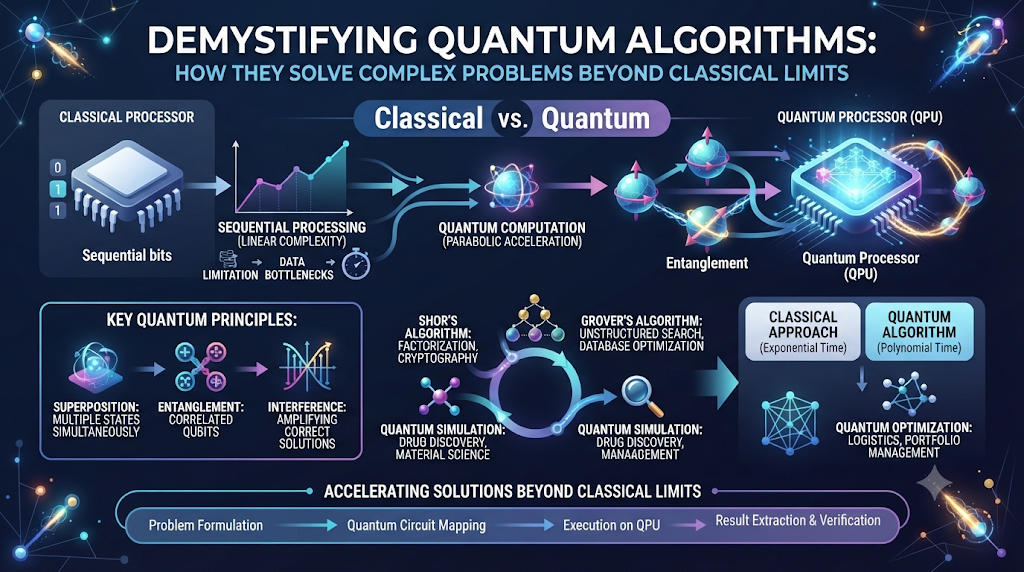
Classical computers have shaped the modern digital age, relying on bits that process information as binary states of either 0 or 1. While this architecture powers everything from smartphones to global financial networks, it faces a fundamental scaling wall when confronted with complex, combinatorial, and simulation-heavy problems. Quantum computing introduces a paradigm shift. By harnessing the principles of quantum mechanics—specifically superposition and entanglement—quantum algorithms approach computational problems through entirely different mathematical channels, enabling solutions to problems that would take classical supercomputers millennia to resolve.
The Core Mechanics: Why Quantum Systems Differ
To understand how quantum algorithms solve complex problems, it is necessary to examine the fundamental unit of quantum information: the qubit. Unlike a classical bit, a qubit can exist in a linear combination of states 0 and 1, a phenomenon known as superposition. Furthermore, qubits can become entangled, meaning the state of one qubit instantaneously influences the state of another, regardless of physical distance.
These properties scale the state space exponentially. While $n$ classical bits can represent one of $2^n$ states at any given moment, $n$ qubits can represent a superposition of all $2^n$ states simultaneously. Quantum algorithms are mathematically engineered to manipulate these superpositions, amplifying the probability amplitudes of correct answers while executing destructive interference to cancel out incorrect pathways.
Fundamental Classes of Quantum Algorithms
Quantum algorithms generally fall into a few distinct algorithmic families, each designed to exploit specific quantum mechanical advantages.
1. Amplitude Amplification and Search (Grover’s Algorithm)
Unstructured search problems traditionally require linear time complexity, checking database entries one by one in the worst-case scenario. Grover’s algorithm provides a quadratic speedup for unstructured search problems, reducing the search time from $O(N)$ to $O(\sqrt{N})$. While not an exponential speedup, this efficiency leap has massive implications for cryptography, database optimization, and machine learning pattern matching.
2. Quantum Fourier Transform and Periodicity (Shor’s Algorithm)
Shor’s algorithm is perhaps the most famous quantum algorithm, capable of finding the prime factors of an integer in polynomial time. Classical RSA encryption relies on the premise that factoring large composite numbers is computationally intractable. Shor’s algorithm translates the factoring problem into a period-finding problem, solving it efficiently using the Quantum Fourier Transform (QFT).
3. Variational Quantum Algorithms (VQAs)
Designed for the current era of Noisy Intermediate-Scale Quantum (NISQ) hardware, hybrid quantum-classical algorithms like the Variational Quantum Eigensolver (VQE) use classical optimizers to adjust parameters on a quantum circuit. These algorithms are heavily utilized in quantum chemistry, materials science, and molecular modeling.
Practical Applications in Complex Problem Solving
Quantum algorithms excel in specific domains where classical algorithms bottleneck due to computational explosion.
Molecular Simulation and Drug Discovery
Simulating the quantum mechanical behavior of electrons in molecules is exponentially difficult for classical computers because the complexity scales exponentially with the number of electrons. Quantum hardware can natively simulate quantum systems. Algorithms designed for molecular modeling allow researchers to calculate ground-state energies of complex molecules with high precision, accelerating drug design and catalyst development for carbon capture.
Optimization and Logistics
Global supply chain routing, portfolio optimization, and smart grid management require navigating vast combinatorial landscapes. Quantum Approximate Optimization Algorithms (QAOA) explore numerous potential configurations simultaneously, identifying optimal or near-optimal solutions far faster than classical heuristic search methods.
Cryptography and Post-Quantum Security
The emergence of cryptographically relevant quantum computers poses a theoretical threat to modern public-key cryptography. Consequently, organizations are actively migrating toward post-quantum cryptography (PQC) standards—mathematical algorithms designed to run on classical computers that remain secure against both classical and quantum attacks.
Limitations, Trade-Offs, and Real-World Constraints
Despite their theoretical power, quantum algorithms are bound by severe hardware and physical constraints.
- Noise and Decoherence: Qubits are exceptionally fragile. Interactions with the external environment cause decoherence, leading to computational errors. Quantum error correction (QEC) requires thousands of physical qubits to create a single logical, error-corrected qubit, vastly increasing hardware requirements.
- Data Input Bottlenecks: Loading classical data into a quantum state (quantum random access memory or QRAM bottlenecks) can sometimes negate the speedup advantages of an algorithm if not managed carefully.
- Algorithmic Suitability: Quantum computers are not universal speedup devices. They do not accelerate everyday tasks like word processing, web browsing, or standard database queries. Classical computers remain superior for routine, deterministic operations.
Verification and Validation in Quantum Computing
Validating the output of a quantum algorithm presents a unique verification challenge. When a quantum computer solves a problem too complex for a classical supercomputer to verify directly, practitioners rely on proxy benchmarks, randomized benchmarking, shadow tomography, and problem structures with known classical validation shortcuts. Success metrics focus on circuit fidelity, gate error rates, and coherence times rather than raw clock speed.
Frequently Asked Questions
Q1. Are quantum computers just faster versions of classical computers?
No. Quantum computers operate on entirely different mathematical principles rooted in quantum mechanics. They are not simply “faster”; they solve specific classes of problems using superposition and interference, while performing worse or identically to classical computers on routine tasks.
Q2. What is quantum supremacy?
Quantum supremacy is the milestone achieved when a programmable quantum device successfully performs a computational task that is practically impossible for any classical supercomputer to complete within a feasible timeframe.
Q3. Will quantum computers break all existing encryption?
They threaten specific types of asymmetric encryption, such as RSA and Elliptic Curve Cryptography, via Shor’s algorithm. However, symmetric encryption (like AES-256) remains largely secure, and the industry is actively transitioning to post-quantum cryptography standards.
Q4. Can I run quantum algorithms on my personal computer?
You cannot execute native quantum operations on classical hardware, but you can run quantum algorithms using software development kits and simulators that model quantum circuits on classical CPUs and GPUs.
Q5. What is a qubit and how does it differ from a bit?
A classical bit can only be 0 or 1 at any given time. A qubit can exist in a superposition of both states simultaneously, allowing quantum algorithms to process vast arrays of possibilities in parallel.
Q6. What are NISQ devices?
NISQ stands for Noisy Intermediate-Scale Quantum. It describes the current generation of quantum hardware, which features tens to hundreds of qubits but lacks full error correction, making them susceptible to environmental noise.
Q7. How do quantum algorithms handle errors?
Because qubits are prone to decoherence, quantum error correction encodes logical information across multiple physical qubits to detect and correct bit-flip and phase-flip errors without destroying the quantum state.
Q8. Are quantum computers already being used commercially?
Commercial applications are currently in exploratory, proof-of-concept phases. Industries such as pharmaceuticals, finance, and logistics are using quantum simulators and early NISQ hardware to test algorithms for future deployment.
Q9. Do quantum algorithms require specialized programming languages?
Yes. Programming quantum hardware involves specialized frameworks and languages—such as Q#, Qiskit, and Cirq—that allow developers to construct quantum gates and manipulate probability amplitudes.
Q10. What is the biggest hurdle facing quantum computing today?
Scaling the number of reliable qubits while maintaining low error rates and long coherence times remains the primary engineering challenge for realizing fault-tolerant quantum computing.
Conclusion
Quantum algorithms represent a fundamental shift in how we approach intractable computational challenges. While significant hardware hurdles remain before fault-tolerant systems become ubiquitous, understanding their underlying mechanics and operational boundaries prepares engineering and scientific leaders for the next era of computational capability. Focus initial adoption efforts on simulation-heavy or high-complexity optimization problems where quantum advantage offers a clear architectural justification.
