Introduction
You build a quantum circuit. It runs fine. You stare at the counts and wonder what they mean.
The answer you need hides inside a gate, and you cannot read it directly. That hidden answer is a phase. A phase is a tiny turn that a gate adds to a qubit state. Think of a clock hand spinning behind a wall.
Quantum phase estimation, or QPE, fixes this problem. It turns the hidden phase into plain bits that you can measure and read. Shor’s factoring method uses this idea. Quantum chemistry uses it to find the energy of a molecule.
This guide explains QPE in simple words. We wrote it for builders at QuantumUting.com, where we break hard quantum topics into small, clear steps. You will see the idea, the circuit, a worked example, and the mistakes that trip up most learners.
No heavy math background is needed. If you know what a qubit is, you can follow along. Every new word gets a plain meaning right away.
What Is Quantum Phase Estimation?
Quantum phase estimation is a quantum method that finds the phase of a gate’s eigenvalue and writes it as binary digits. That is the short answer.
Now the plain version. A gate, often called U, changes a qubit state. Most states change in messy ways. A few special states change in a simple way. The gate only spins them by a fixed amount.
We call these special states eigenvectors. We call the spin amount the eigenvalue. In math, we write it like this:
U|u⟩ = e^(2πiφ)|u⟩
Here, |u⟩ is the eigenvector. The number φ (say “fye”) sits between 0 and 1. QPE finds φ.
Why You Cannot Read the Phase Directly
A single phase turn is invisible to a normal measurement. Measure |u⟩ before the gate or after it, and you see the same odds. The spin leaves no mark.
So QPE uses a trick. It copies the spin onto a second group of qubits. Then it uses interference to turn the spin into clear bits. Interference means waves add up or cancel out.
The Big Idea: A Quantum Stopwatch
Picture a clock hand that moves a fixed amount each tick. You want to know how far it moves per tick. One tick gives a rough guess. Two ticks give a better one. Four ticks give an even better one.
QPE works the same way. It applies the gate once, then twice, then four times, then eight times. Each doubling reveals one more binary digit of φ.
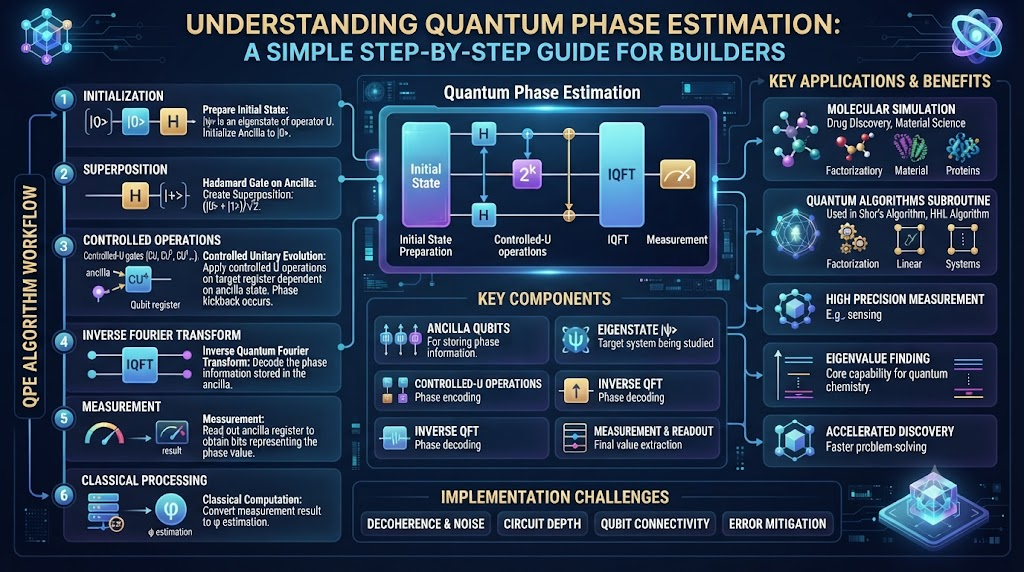
The Parts of a QPE Circuit
The circuit uses two groups of qubits, called registers.
- The counting register has t qubits. It stores your answer.
- The target register holds the eigenvector |u⟩.
The circuit then runs four stages.
Stage 1: Put the Counting Qubits in Superposition
Apply a Hadamard gate to each counting qubit. Superposition means the qubit holds 0 and 1 at once. Now the register tries every possible answer together.
Stage 2: Apply Controlled Powers of the Gate
Counting qubit number j controls U raised to the power 2^j. The first qubit controls one copy of U. The next controls two copies. The next controls four, and so on.
Because |u⟩ is an eigenvector, each controlled gate only adds a phase. That phase moves onto the control qubit. We call this phase kickback.
Stage 3: Apply the Inverse Quantum Fourier Transform
After kickback, the counting register holds the phase as a wave pattern. The inverse quantum Fourier transform, or inverse QFT, turns that pattern into binary digits. Skip it, and you read nonsense.
Stage 4: Measure
Measure the counting qubits. The bitstring gives you a whole number m. Your estimate is φ ≈ m / 2^t.
A Tiny Worked Example
Take the S gate. It leaves |0⟩ alone and multiplies |1⟩ by i. The number i equals e^(2πi × 1/4). So for the target state |1⟩, φ equals 1/4.
Use t = 2 counting qubits. Run the four stages. The counting register lands on the bitstring 01 every time. That means m = 1. Your estimate is 1 / 2² = 1/4. It is exactly right.
Now try the T gate. Its phase is 1/8. With t = 3, you read 001. The pattern stays the same, and you add one qubit. Also, check your tool’s bit order, because many tools print bits in reverse.
When the Phase Is Not a Neat Fraction
Most real phases are not exact binary fractions. Take φ = 1/3. Two or three bits cannot write it exactly.
The circuit then spreads its answers around the true value. The closest estimate shows up at least about 40% of the time. A result within one step of the truth shows up at least about 81% of the time. You fix this by adding more counting qubits.
How Many Counting Qubits Do You Need?
Each extra counting qubit doubles your resolution. But it also doubles the work. Look at this table.
| Counting qubits (t) | Smallest step (1/2^t) | Total U applications |
|---|---|---|
| 3 | 0.125 | 7 |
| 4 | 0.0625 | 15 |
| 6 | 0.0156 | 63 |
| 8 | 0.0039 | 255 |
| 10 | 0.00098 | 1,023 |
Use this rule to plan. To get n correct bits with success chance 1 − ε, pick t = n + ⌈log₂(2 + 1/(2ε))⌉.
Here is an example. You want 3 correct bits with 90% success. So ε = 0.1, and log₂(7) is about 2.8, which rounds up to 3. You need t = 6 counting qubits.
QPE vs. Iterative QPE vs. Variational Methods
Standard QPE is not your only choice. Other methods trade width for depth or precision for noise safety.
| Method | Counting qubits | Circuit style | Noise needs | Best for |
|---|---|---|---|---|
| Standard QPE | t qubits | One long, deep run | Error-corrected machines | High precision, clean theory |
| Iterative QPE | 1 qubit, reused | Many shorter runs | Mid-circuit measurement | Small devices, saving qubits |
| Variational (VQE) | None | Shallow circuits | Handles some noise | Rough energy estimates today |
Iterative QPE finds one bit at a time. It uses a single counting qubit and measures it again and again. The total gate count stays similar, but you need fewer qubits.
Variational methods skip phase reading altogether. They search for a low energy by trial and error. They run on today’s devices, but they give no precision guarantee.
Why QPE Matters
QPE sits underneath many famous quantum methods. It helps factor large numbers, find molecule energies, and solve linear equations. It also supports counting and risk estimation tasks.
That wide reach explains why teams study it first. Learn QPE well, and many other methods start to make sense.
Real-World Stories and Case Studies
- Kitaev’s idea (1995): Alexei Kitaev showed how to measure a phase with repeated runs. Later QPE versions grew from this work.
- Shor’s factoring: Later work showed that order finding in Shor’s method equals phase estimation of a modular multiplication gate. This view made the method easier to teach.
- Factoring 15 (2001): An IBM team factored 15 on a small NMR device with seven spins. It proved the idea works in a lab.
- Hydrogen molecule (2010): Researchers used a small photon-based device to estimate the ground-state energy of molecular hydrogen. It was a tiny but real chemistry test.
- Big molecules: Researchers who studied the iron-molybdenum cofactor, a molecule key to nitrogen fixation, estimated that QPE-style methods need large, error-corrected machines.
- Linear equations: The HHL method uses QPE to read the eigenvalues of a matrix. Then it uses them to solve equations.
- Quantum counting: Researchers joined Grover’s search with QPE to count how many answers exist. They no longer needed to list them.
- Amplitude estimation: This method uses QPE ideas to estimate odds faster than random sampling. Finance teams study it for risk tasks.
- Classroom labs: Many courses ask learners to run QPE on the S gate and T gate first. These exact fractions give clean results and build trust.
- Noise on real devices: On today’s hardware, small QPE circuits often work for one or two bits. Deeper circuits drown in noise, so teams test iterative versions.
Common Mistakes and Pitfalls
- Using the wrong input state: If your target state is not an eigenvector, you get a mix of phases. Prepare a state with strong overlap, and expect results weighted by that overlap.
- Using too few counting qubits: Your answer comes out blurry. Use the qubit rule above before you build.
- Forgetting the inverse QFT: Some builders use the forward QFT by mistake. The bits then come out scrambled. Check the direction twice.
- Mixing up bit order: Many tools print the lowest bit first. Read your bitstring in the right order before you convert it.
- Confusing φ with an angle: The phase is 2πφ in radians. Keep φ as a fraction between 0 and 1 in your notes.
- Ignoring the cost of U^(2^j): Repeating U again and again takes exponential time. Build powers with shortcuts, such as fast modular exponentiation.
- Running too few shots: A handful of shots can mislead you. Run enough shots to see a clear peak.
- Testing only neat fractions: Exact fractions hide problems. Also test a phase like 1/3 and watch the spread.
- Skipping noise checks: A clean simulator proves little. Compile for your device and check the final circuit depth.
- Trusting one shot: A single result is just one sample. Use the most common outcome and report your confidence.
Step-by-Step Implementation Roadmap
- Pick the gate U and the expected phase. Write down the answer you hope to see. A known phase gives you a test.
- Prepare the eigenvector. Build the state that U only spins. For learning, use |1⟩ with the S or T gate.
- Choose your accuracy. Decide how many correct bits you want and how often you want success. Then compute t.
- Build the counting register. Apply a Hadamard gate to each counting qubit.
- Add controlled powers of U. Use U, U², U⁴, and so on. Link each power to its own counting qubit.
- Apply the inverse QFT. Use it on the counting register only. Double-check the qubit order.
- Measure the counting qubits. Run many shots and record the bitstring counts.
- Test on an ideal simulator first. Confirm the peak lands where you expect. Fix bugs before you add noise.
- Convert bits to a phase. Turn the most common bitstring into m, then compute φ = m / 2^t. Map φ to your energy or period.
- Add noise, then scale. Test with a noise model. If results fall apart, try iterative QPE and grow from there.
10 Detailed FAQs
1. What does quantum phase estimation do?
Quantum phase estimation finds the phase that a quantum gate adds to one of its special states. It writes that phase as binary digits you can measure. You can then use the number to find energies, periods, or matrix values.
2. Why does QPE need an eigenvector?
An eigenvector only changes by a phase when the gate acts on it. That clean change lets the phase move to the counting qubits without messing up the target. Without it, the answer splits into several phases at once.
3. What is phase kickback?
Phase kickback happens when a controlled gate acts on an eigenvector. The target state stays the same, but the phase jumps onto the control qubit. QPE depends on this move to copy the hidden phase into the counting register.
4. How accurate is QPE?
Accuracy grows with the number of counting qubits. Each extra qubit halves the smallest step size. With t qubits, the step is 1/2^t. You also add a few extra qubits to raise your chance of success.
5. Why does QPE use the inverse QFT?
After kickback, the counting register holds the phase as a wave pattern. The inverse QFT reads that pattern and turns it into a clean binary number. It works like a decoder. Without it, your measurement shows random-looking bits.
6. Can I run QPE on today’s quantum computers?
You can run small demos on today’s devices, usually with one or two bits of accuracy. Deep circuits suffer from noise. Iterative QPE helps because it uses fewer qubits. Full-scale QPE needs error-corrected machines.
7. How does QPE connect to Shor’s method?
Shor’s method needs the period of a repeating function. You can view that period as the phase of a modular multiplication gate. QPE reads that phase, and a short classical step turns it into the factors.
8. How does QPE differ from the quantum Fourier transform?
The QFT is one building block. It changes data from one form to another. QPE is a full method that uses the inverse QFT as its last stage. QPE also needs Hadamard gates and controlled powers of U.
9. How do I turn the measured bitstring into a number?
Read the bitstring as a whole number m, in the correct bit order. Then divide m by 2^t, where t is your count of counting qubits. For example, 011 with t = 3 gives 3/8, or 0.375.
10. Is QPE useful for quantum chemistry?
Yes. The energy levels of a molecule match the eigenvalues of its energy operator. QPE can read those values with high precision. But big molecules need very large, error-corrected machines, so today’s work focuses on small tests.
Final Recommendation and Next Steps
Start small. Run QPE on the S gate and the T gate in a simulator. These two tests teach you the whole circuit in one afternoon.
Next, test a phase that is not a neat fraction, like 1/3. Watch the results spread around the true value. Then add counting qubits and watch the peak sharpen. This builds a real feel for precision.
Then check your costs. Count the controlled gates and the circuit depth after compiling. Depth, not qubit count, often breaks QPE on real hardware.
If noise hurts your results, try iterative QPE. It uses one counting qubit and measures it many times. It trades width for repeated runs. Many teams start here for a good reason.
Keep the big picture in mind. Full QPE shines on future error-corrected machines. Today’s devices mostly handle small demos and shallow variants. Plan your work with that gap in view.
Finally, pick one use case, such as a molecule energy or order finding, and rebuild it from start to end. Write each step in your own words. Teach it to a friend, because that is the best test. Then come back to QuantumUting for your next topic.
