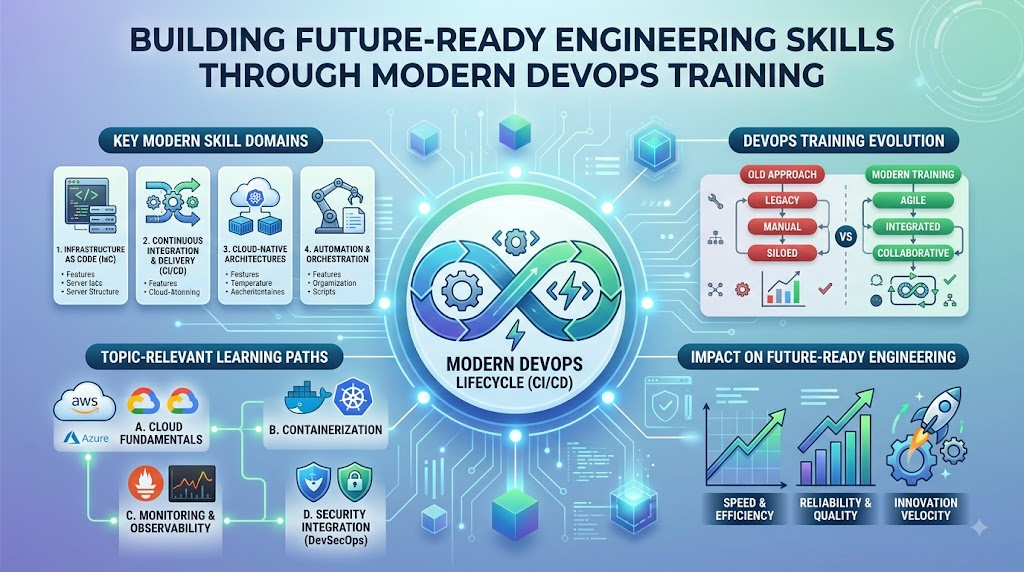
Introduction
Software development and IT operations have changed significantly with the growth of cloud computing, automation, containers, continuous delivery, and modern security practices. Engineering teams are now expected to release applications efficiently while maintaining reliability, security, scalability, and operational control. Learning these practices can be challenging when professionals rely only on scattered tutorials or tool-specific documentation. A structured learning program can provide a clearer path by connecting concepts, tools, practical exercises, and real operational scenarios. A capable DevOps Trainer can help learners understand this bigger picture. Instead of focusing only on commands or product features, effective training should explain how technologies work together across development, infrastructure, security, and production operations.
What a DevOps Trainer Really Provides
A DevOps Trainer plays an educational role in helping professionals understand modern software delivery and operational practices.
The subject can include source control, CI/CD, cloud infrastructure, automation, containers, Infrastructure as Code, monitoring, security, and troubleshooting. Depending on the learner’s goals, the program may also extend into Kubernetes, DevSecOps, SRE, or MLOps.
There is an important difference between explaining a technology and teaching someone how to use it effectively.
For example, learners may understand the definition of CI/CD after a theoretical session. Practical training takes the next step by showing how to create a pipeline, execute automated tests, deploy an application, inspect a failed job, and improve the workflow.
The same principle applies to cloud and infrastructure technologies. Rather than memorizing commands, learners should understand why a particular approach is used, what problems it solves, and what limitations or operational considerations may exist.
Teaching ability is also essential. Someone may have extensive technical knowledge but lack the ability to communicate concepts clearly. An effective trainer should be able to adjust explanations according to learner experience and make complex subjects easier to understand.
Why Organizations Need Structured DevOps Learning
Technology adoption often happens faster than employee skill development. A company may introduce a new cloud platform, container environment, CI/CD system, or Infrastructure as Code framework while teams are still learning how to use it effectively.
This can create gaps between technology investment and practical capability.
Structured DevOps learning can help organizations create a shared understanding of modern engineering practices. Developers, infrastructure engineers, security professionals, and operations teams can better understand how their responsibilities connect.
For example, implementing CI/CD requires more than configuring a pipeline tool. Teams also need to understand source control, testing, artifact management, deployment strategies, environment configuration, security controls, monitoring, and rollback procedures.
Training can provide a structured foundation for these areas.
It should not, however, be treated as a replacement for production experience. Real environments involve unexpected failures, legacy systems, technical debt, organizational constraints, and changing priorities. Training works best when it prepares professionals to apply knowledge in those environments.
Corporate DevOps Training: Adapting Learning to the Team
Corporate DevOps Training is designed around an organization’s specific learning requirements.
A general course may introduce a broad range of DevOps technologies, but an enterprise team may need something much more focused. One company might need stronger Kubernetes capabilities, while another may be concentrating on cloud migration, CI/CD modernization, or security automation.
A customized program can take into account:
- Existing technology platforms
- Employee experience levels
- Team responsibilities
- Business requirements
- Current engineering processes
- Cloud adoption plans
- Automation objectives
- Security requirements
Training can also be divided according to job responsibilities.
Developers may spend more time on CI/CD, testing, containers, and deployment. Infrastructure engineers may focus on Terraform, cloud platforms, Kubernetes, and monitoring. Security teams may require more coverage of secure pipelines, vulnerability management, and secrets.
Corporate learning can include workshops, instructor-led sessions, practical labs, assessments, troubleshooting activities, and knowledge-transfer sessions.
The main advantage of customization is relevance. Learners can spend more time on skills that they are likely to use rather than following a fixed syllabus that treats every technology as equally important.
Learning Through an Online DevOps Trainer
An Online DevOps Trainer can provide live instruction through virtual classrooms, making technical learning accessible to professionals in different locations.
This approach can be particularly useful for distributed teams. Employees from multiple offices or regions can participate in the same program without traveling to a common classroom.
Online training may include:
- Live technical demonstrations
- Screen sharing
- Interactive discussions
- Remote laboratories
- Practical assignments
- Instructor feedback
- Recorded sessions
- Troubleshooting exercises
However, online delivery has its own challenges.
Poor connectivity, limited lab access, passive participation, or excessive dependence on presentations can reduce the learning experience. A virtual classroom should not simply reproduce a slide-based classroom session through a video call.
Organizations should therefore examine the structure of the program. Practical exercises, interaction with the instructor, laboratory quality, technical support, and learner participation can all influence the effectiveness of online training.
Finding the Right DevOps Trainer in India
When evaluating a DevOps Trainer in India, organizations should consider more than the number of technologies listed in a trainer’s profile.
DevOps is a broad field. A trainer should ideally understand how development, infrastructure, cloud, automation, security, and operations interact.
Useful evaluation criteria include:
- Practical DevOps experience
- Cloud platform knowledge
- CI/CD expertise
- Kubernetes experience
- Infrastructure as Code
- Monitoring and observability
- Security practices
- SRE principles
- Troubleshooting experience
- Communication skills
- Course design
- Hands-on laboratory quality
Teaching methodology should receive equal attention.
A trainer who understands technology but only provides theoretical lectures may not give learners enough opportunities to develop practical skills. Similarly, a program that focuses heavily on commands without explaining the underlying concepts may leave learners unable to troubleshoot unfamiliar situations.
One useful question to ask is whether the training includes failure scenarios. DevOps engineers frequently deal with failed deployments, broken pipelines, configuration errors, infrastructure issues, resource limitations, and monitoring alerts. Learning how to investigate these situations is an important part of technical development.
Kubernetes Training: From Fundamentals to Operations
A Kubernetes Trainer should help learners move from basic container orchestration concepts toward practical cluster management.
Fundamental topics generally include pods, deployments, services, ConfigMaps, and Secrets. As learners progress, they can explore networking, storage, scaling, Helm, monitoring, access control, security, and troubleshooting.
Hands-on exercises are especially important in Kubernetes because the platform contains many interconnected concepts.
For example, learners might deploy an application, expose it through a service, update its configuration, scale the workload, inspect logs, and diagnose a failed deployment.
Cloud-managed environments can also be introduced using services such as AWS EKS, Azure AKS, and Google GKE.
Production-oriented Kubernetes learning should go beyond application deployment. Topics such as resource management, cluster security, observability, upgrades, resilience, access control, and operational troubleshooting can help learners understand the responsibilities involved in running Kubernetes environments.
The objective is not simply to memorize kubectl commands. Learners should understand what Kubernetes is doing and how to reason about problems within the platform.
What AWS DevOps Training Should Cover
An AWS DevOps Trainer should connect AWS services with practical software delivery and infrastructure workflows.
Depending on the organization’s needs, training can include:
- EC2
- EKS
- ECS
- Lambda
- Terraform
- CloudFormation
- CI/CD pipelines
- Infrastructure automation
- Monitoring
- Deployment strategies
Rather than learning these services independently, learners should see how they fit into a complete workflow.
A practical scenario might start with source code and continue through automated testing, artifact creation, infrastructure provisioning, deployment, monitoring, and troubleshooting.
The correct AWS service depends on the workload and operational requirements. Training should therefore explain selection considerations instead of suggesting that one service is appropriate for every application.
Security, scalability, team capability, infrastructure complexity, and operational requirements can all influence architectural decisions.
Azure DevOps Training and Cloud Delivery
An Azure DevOps Trainer can help teams understand software delivery and infrastructure automation in Microsoft Azure environments.
Common learning areas can include Azure Pipelines, AKS, Infrastructure as Code, release automation, CI/CD, monitoring, and deployment workflows.
Practical exercises can demonstrate how code moves through a delivery pipeline and eventually reaches a cloud environment.
For instance, learners can explore source control integration, automated validation, infrastructure provisioning, application deployment, and post-deployment monitoring.
The focus should remain on understanding delivery principles rather than simply memorizing Azure features. This gives learners a better foundation for handling different project requirements.
DevSecOps Training: Making Security Part of Delivery
Security is increasingly integrated into the software development process rather than being treated as a final review stage.
A DevSecOps Trainer can help teams understand how security activities fit into CI/CD and everyday engineering workflows.
Important learning areas include:
- SAST
- DAST
- Dependency scanning
- Container security
- Secrets management
- Vulnerability management
- Secure CI/CD
- Security automation
- Compliance automation
A major lesson is that security tools are only one part of the process.
A pipeline may identify vulnerabilities, but teams still need to understand the findings, determine their importance, assign remediation work, and track the issue through resolution.
Practical DevSecOps learning should therefore address both technology and process. Learners should understand where controls belong, how they affect delivery, and how teams can respond to security findings without creating unnecessary disruption.
SRE Training and Reliability Engineering
SRE training introduces a systematic way to think about the reliability of software services.
An SRE Trainer may cover:
- SLI
- SLO
- SLA
- Error budgets
- Observability
- Incident management
- Root-cause analysis
- Capacity planning
- Performance engineering
- Reliability automation
These concepts encourage teams to use measurable objectives rather than relying only on subjective opinions about system reliability.
For example, SLOs can define expected service behavior, while error budgets can provide a framework for discussing the relationship between reliability and system changes.
Practical SRE learning should also include incident scenarios. Engineers need to understand how to respond when systems degrade, investigate causes, communicate during incidents, and identify improvements afterward.
MLOps Training for Production Machine Learning
Machine-learning systems bring additional operational considerations to modern engineering teams.
An MLOps Trainer can cover areas such as:
- ML pipelines
- Model deployment
- Model monitoring
- Version management
- Automation
- ML infrastructure
- Cloud environments
- Production operations
- Scalability
MLOps connects machine-learning development with engineering practices used for software and infrastructure operations.
Models, datasets, training processes, and deployment versions may all need to be managed. Monitoring also needs to consider the behavior of the deployed model and the environment in which it operates.
The purpose of MLOps training is not simply to teach another set of tools. It is to help teams understand how machine-learning workloads can be developed, deployed, monitored, and maintained as operational systems.
DevOps Training Technology Areas
| Training Area | Common Technologies / Practices | Learning Focus |
|---|---|---|
| CI/CD | Jenkins, GitHub Actions, GitLab CI/CD, Azure Pipelines | Automated delivery |
| Cloud | AWS, Azure, Google Cloud | Cloud operations |
| Containers | Docker, Kubernetes | Containerized workloads |
| Infrastructure as Code | Terraform, CloudFormation | Automated infrastructure |
| Security | SAST, DAST, secrets management | Secure delivery |
| Monitoring | Metrics, logs, traces | Observability |
| SRE | SLI, SLO, error budgets | Reliability |
| MLOps | ML pipelines, model monitoring | Production ML |
These examples represent common training areas, but they should not be treated as a mandatory technology stack. Organizations should prioritize technologies based on their own environment and objectives.
Why Hands-On Training Makes a Difference
DevOps is an applied engineering discipline, which makes practical learning particularly valuable.
Hands-on exercises allow learners to experience how systems behave when they are configured, deployed, changed, and monitored.
Useful practical activities can include:
- Building CI/CD pipelines
- Provisioning infrastructure
- Deploying containers
- Managing Kubernetes workloads
- Configuring monitoring
- Investigating failed deployments
- Automating repetitive tasks
- Examining security findings
- Troubleshooting infrastructure
For example, a learner who builds a pipeline and encounters a failed deployment has an opportunity to understand the relationship between source code, configuration, artifacts, infrastructure, and deployment environments.
These experiences can also reveal areas where theoretical understanding is incomplete.
Practical training does not need to reproduce an entire enterprise environment. Even focused scenarios can help learners develop better problem-solving habits.
Common Mistakes in DevOps Training
1. Teaching only concepts
Conceptual knowledge is necessary, but it should be supported by exercises that demonstrate how the concepts are applied.
2. Covering too many tools
A large tool list does not necessarily represent a strong course. Learners need context about why a technology is relevant.
3. Weak hands-on exercises
Simple copy-and-paste activities may not develop meaningful troubleshooting or decision-making skills.
4. Outdated material
Cloud platforms, security practices, and DevOps tooling change over time. Training material should be reviewed periodically.
5. Ignoring different experience levels
A beginner may need foundational explanations, while an experienced engineer may need realistic architecture and troubleshooting scenarios.
6. Treating security as optional
Security should be considered throughout software delivery rather than added only after development is complete.
7. Avoiding failure scenarios
Successful deployments teach only part of the story. Learners also need exposure to failures and recovery processes.
8. No connection to real work
Examples should help learners understand how technical practices relate to everyday engineering responsibilities.
9. Excessive scope
Trying to teach every DevOps technology can reduce depth and create cognitive overload.
10. No meaningful assessment
Exercises, practical tasks, and assessments help determine whether learners can actually apply what they have studied.
How to Assess a DevOps Training Program
Organizations can use an objective checklist before selecting a training program.
Consider:
- Trainer’s practical background
- Teaching methodology
- Technical depth
- Hands-on laboratory quality
- CI/CD coverage
- Cloud knowledge
- Kubernetes content
- Infrastructure as Code
- Security coverage
- SRE concepts
- MLOps awareness
- Troubleshooting exercises
- Documentation
- Assessments
- Learning resources
- Post-training support
The curriculum should also match the team’s actual responsibilities.
A platform engineering group may need deeper Kubernetes and Infrastructure as Code knowledge. Developers may benefit more from CI/CD, containers, and deployment practices. A security-focused team may require more detailed DevSecOps coverage.
The best program is therefore not necessarily the one with the largest syllabus. Relevance and practical depth are often more useful than excessive breadth.
Training Area and Learning Need
| Training Area | Typical Learning Need |
| DevOps Training | Understand automation and delivery practices |
| Corporate DevOps Training | Build team-wide DevOps capabilities |
| Online DevOps Training | Learn remotely with flexible access |
| Kubernetes Training | Manage container orchestration environments |
| AWS DevOps Training | Learn AWS-based DevOps workflows |
| Azure DevOps Training | Understand Azure delivery and automation |
| DevSecOps Training | Integrate security into software delivery |
| SRE Training | Learn reliability engineering practices |
| MLOps Training | Operate machine-learning systems in production |
Frequently Asked Questions
What does a DevOps Trainer typically teach?
A trainer can teach DevOps principles, automation, CI/CD, cloud platforms, containers, Infrastructure as Code, monitoring, security, troubleshooting, and operational practices.
What makes Corporate DevOps Training different?
Corporate training is usually adapted to the organization’s technology stack, team responsibilities, employee experience, and business requirements rather than following only a generic curriculum.
How can I evaluate a DevOps Trainer in India?
Review practical experience, technical knowledge, teaching skills, course structure, hands-on labs, cloud expertise, Kubernetes knowledge, CI/CD experience, and troubleshooting exercises.
Is an Online DevOps Trainer suitable for enterprise teams?
Online delivery can be effective for distributed teams when it includes live interaction, practical labs, instructor demonstrations, technical support, and meaningful exercises.
What topics should Kubernetes training include?
Kubernetes learning can include architecture, pods, deployments, services, networking, storage, security, scaling, Helm, monitoring, cluster administration, and troubleshooting.
What can AWS DevOps training cover?
It can cover AWS services such as EC2, EKS, ECS, and Lambda alongside CI/CD, Terraform, CloudFormation, monitoring, automation, and deployment practices.
Why is DevSecOps training useful?
It helps teams understand how security practices such as code scanning, dependency analysis, secrets management, container security, and vulnerability handling can be integrated into delivery workflows.
How do DevOps, SRE, and MLOps learning differ?
DevOps generally emphasizes delivery and collaboration between development and operations. SRE focuses on reliability engineering, while MLOps addresses the operational lifecycle of machine-learning systems.
Conclusion
DevOps training has evolved beyond teaching a collection of automation tools. Modern professionals may need to understand how CI/CD, cloud infrastructure, containers, Infrastructure as Code, security, observability, reliability, and machine-learning operations connect within a larger engineering lifecycle. Selecting an appropriate training approach requires an understanding of the learners and the organization. Experience level, technology stack, team maturity, business objectives, and practical requirements should all influence the curriculum. Hands-on learning should also receive significant attention. Building pipelines, deploying workloads, managing infrastructure, examining monitoring data, and troubleshooting failures can help learners develop practical understanding that theoretical lessons alone may not provide.
