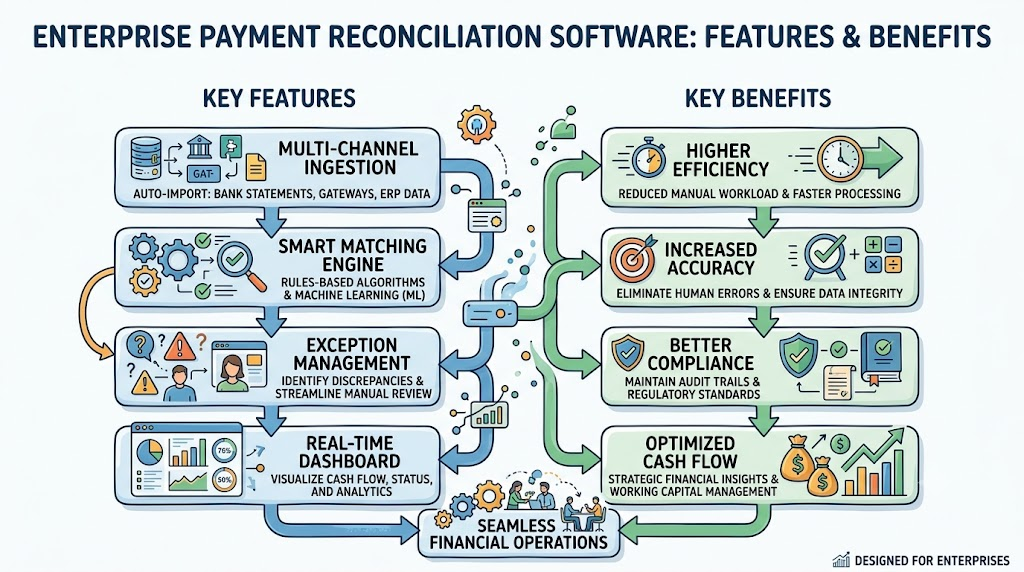
Manual invoicing and fragmented payment tracking silently drain business profitability. When growing organizations rely on disparate spreadsheets, disconnected payment gateways, and manual ledger matching, operational efficiency plummets while Days Sales Outstanding (DSO) skyrockets. Managing accounts receivable across multiple sales channels requires an integrated, resilient framework. Modern organizations require robust invoice and payment management software to unify billing, collection, and ledger matching into a single automated workflow. Automating these touchpoints removes operational friction, minimizes human error, and delivers real-time cash visibility. This comprehensive guide examines how automated billing platforms transform financial management, streamline tax compliance, and build an end-to-end invoice-to-cash pipeline designed for enterprise scale.
What is Invoice and Payment Management Software?
Invoice and payment management software is a centralized digital solution that automates the entire lifecycle of enterprise billing, customer payment collection, and ledger reconciliation.
[Invoice Creation] ➔ [Multi-Channel Distribution] ➔ [Gateway / Link Payment] ➔ [Automated Reconciliation]
Core Architecture Components
- Digital Invoicing Engine: Generates tax-compliant digital invoices, recurring bills, and customized billing schedules.
- Omnichannel Payment Collection: Integrates payment gateways, direct bank transfers, UPI, and dynamic payment links.
- Automated Reconciliation Engine: Matches incoming settlement files against open accounts receivable records in real time.
- Financial Reporting & Analytics: Tracks collection aging, customer balances, cash flow metrics, and audit histories.
By replacing disconnected tools with a unified platform like PayManagerPro, finance teams transition from manual data entry to strategic financial management.
Why Modern Businesses Need Automated Payment Management
Relying on manual processes for recurring payments creates systemic bottlenecks. Modern business growth demands seamless, touchless payment operations.
- Optimized Working Capital: Accelerates cash inflows by providing instant, frictionless digital payment options to buyers.
- Complete Financial Visibility: Eliminates dark data across fragmented payment channels with a centralized multi gateway payment dashboard.
- Drastic Reduction in Manual Effort: Removes manual bank statement cross-referencing, letting accounting teams focus on core strategy.
- Superior Customer Experience: Delivers clear digital invoices, automated reminders, and flexible payment methods that reduce friction for clients.
Key Features of PayManagerPro
PayManagerPro provides end-to-end control over your accounts receivable ecosystem through a feature set built for modern business requirements.
                     ┌── GST Invoicing & Compliance
                     ├── Omnichannel Payment Links
 PayManagerPro Core  ├── Multi-Gateway Dashboard
   Functionality     ├── Automated Settlement Matching
                     ├── Granular Maker-Checker Workflows
                     └── Open REST APIs & ERP Connectors
1. Enterprise GST Invoicing
Generate fully compliant tax invoices instantly. The system enforces correct tax structuring (CGST, SGST, IGST), precise invoice numbering sequences, and smooth e-invoicing data integration.
2. Multi-Channel Payment Links
Generate dynamic payment links automatically tied to specific invoice IDs. Share links via email, WhatsApp, or embedded communications with support for partial payments and explicit expiry limits.
3. Consolidated Multi-Gateway Dashboard
Unify disparate payment providers—including Razorpay, Cashfree, and Paytm—into a single operational view. Monitor transactions, drop-offs, and settled funds across all gateways from one screen.
4. Advanced Automated Reconciliation
Match incoming payments against open invoices using transaction IDs, UTR numbers, and dynamic customer references to resolve exceptions automatically.
5. Granular Approval Workflows & Audit Logs
Protect corporate governance using role-based access controls, maker-checker authorization chains, and immutable audit logs designed for regulatory oversight.
GST Invoice Software in India
Navigating India’s indirect tax framework requires precision. A minor oversight in tax calculation or invoice numbering can trigger compliance audits and delay Input Tax Credit (ITC) realization.
Using specialized GST Invoice Software ensures tax calculation logic aligns automatically with supply rules:
$$\text{Intrastate Supply} = \text{CGST} + \text{SGST}$$
$$\text{Interstate Supply} = \text{IGST}$$
Regulatory Guidelines & Standards
According to guidelines established by the GST Council and the Ministry of Corporate Affairs, compliant business invoices must contain structured fields:
- Standardized HSN/SAC codes for all listed goods and services.
- Sequential, unique invoice numbering restricted to specific financial years.
- Explicit tax breakdowns distinguishing taxable value from applied GST rates.
- Clear vendor and buyer GSTIN credentials alongside verified addresses.
Automating these parameters ensures seamless filing data export for GSTR-1 and GSTR-3B preparation, maintaining full alignment with Income Tax Department standards.
Dynamic Payment Link Management
Traditional manual B2B payment follow-ups slow down cash collection. Utilizing dedicated Payment Links changes static invoices into interactive digital payment experiences.
[System Auto-Generates Link] ➔ [Distributed via WhatsApp/Email] ➔ [Customer Pays via Preferred Method] ➔ [Instant Status Sync]
- Instant Link Generation: Create unique, secure URLs for custom or invoice-backed collection amounts.
- Omnichannel Distribution: Deliver payment notifications automatically through email, SMS, and WhatsApp channels.
- Flexible Payment Models: Enable full or structured partial payments based on agreed commercial terms.
- Real-time Lifecycle Tracking: Monitor link views, payment attempts, and successful settlements instantly.
Automated Payment Collection Strategies
Modern enterprises need flexible collection mechanics to lower transaction failure rates and shorten payment cycles.
By supporting rails regulated by the Reserve Bank of India and developed by the National Payments Corporation of India—including UPI, credit/debit cards, net banking, and corporate e-wallets—businesses significantly reduce payment friction.
Integrating dynamic Automated Collection Systems ensures incoming funds route directly into tracking pipelines, updating customer ledgers in real time.
Comprehensive Invoice Payment Tracking
Unclear accounts receivable pipelines make cash flow forecasting difficult. Specialized invoice payment tracking software offers clear, real-time visibility into your entire collections pipeline.
- Automated Aging Analysis: Categorize receivables into standard aging brackets (0–30, 31–60, 61–90, 90+ days).
- Automated Smart Reminders: Schedule customizable reminder escalations before and after due dates.
- Customer Balance Dashboards: Review total outstanding balances, active disputes, and historical payment performance per buyer.
Automated Payment Reconciliation
Manual bank reconciliation is slow and prone to errors. Bank statements rarely match internal accounting records perfectly due to gateway fees, deductions, and missing customer reference codes.
[Bank Settlement File]   ──┐
                           ├──► [PayManagerPro Matching Engine] ──► [Auto-Reconciled Ledger]
[Internal ERP Invoices]  ──┘
Using dedicated Reconciliation Engines, businesses can set up sophisticated automated matching rules:
- Exact Parameter Matching: Automatically match records using Order IDs, UTR references, and exact payment amounts.
- Partial & Batch Settlement Handling: Break down bulk gateway settlements into individual customer invoice line items.
- Exception Management Workflows: Flag unmatched transactions automatically for quick manual review, preserving complete ledger integrity.
Accounts Receivable Automation
Transitioning to automated accounts receivable software modernizes finance operations, shifting focus from manual data entry to strategic growth.
  ┌────────────────────────────────────────────────────────┐
  │         Accounts Receivable Automation Cycle           │
  ├───────────────┬─────────────────┬──────────────────────┤
  │ 1. Generation │ Digital Draft   │ Tax Validation       │
  │ 2. Dispatch   │ Email Delivery  │ WhatsApp Link        │
  │ 3. Collection │ Gateway Processing │ Multi-Rail Support│
  │ 4. Clearances │ Matching Logic  │ Ledger Update        │
  └───────────────┴─────────────────┴──────────────────────┘
Automating reminders and follow-ups shortens payment collection times while maintaining high customer satisfaction.
The Complete Invoice-to-Cash Lifecycle
The invoice-to-cash process covers every step from generating a bill to settling funds in your account. Automating this entire workflow maximizes operational efficiency.
[Invoice Creation]
       │
       ▼
[Payment Link Dispatch]
       │
       ▼
[Omnichannel Collection]
       │
       ▼
[Bank Settlement]
       │
       ▼
[Auto-Reconciliation]
       │
       ▼
[Financial Reports Engine]
End-to-end automation removes handoff delays between sales, operations, and finance teams, creating an efficient, high-velocity cash lifecycle.
Enterprise Payment Management Infrastructure
Enterprise businesses with complex operations require strong control, security, and hierarchical management capabilities.
- Multi-Branch & Unit Support: Centralize financial oversight across multiple operational locations and legal entities.
- Role-Based Access Control (RBAC): Define granular permissions for finance managers, billing clerks, and external auditors.
- Maker-Checker Authorizations: Enforce dual-approval requirements for refunds, manual write-offs, and critical ledger adjustments.
- Comprehensive Financial Reporting: Access detailed operational analytics, balance aging trends, and settlement velocity metrics via dedicated Reports Modules.
Security, Governance, and Compliance
Financial operations demand strict security standards and compliance management.
- Enterprise Data Protection: Implement end-to-end encryption for stored data and active network transmissions.
- Immutable Audit Logs: Log every invoice modification, collection event, approval, and user action automatically.
- Standardized Regulatory Compliance: Maintain full compliance with evolving GST guidelines and accounting standards.
System Integration Capabilities
To maintain a single source of truth across your finance stack, your billing software must connect seamlessly with your existing tools using scalable API Solutions.
                      ┌── Payment Gateways (Razorpay, Cashfree, Paytm)
  PayManagerPro API ──┼── Enterprise ERP Systems (SAP, Oracle, Tally)
                      └── Core CRM Suites (Salesforce, HubSpot)
Integrating your payment infrastructure with core ERPs and CRMs ensures accurate data synchronization across all business units.
Industry Applications
Different industries face unique operational and billing challenges:
Manufacturing
Manage multi-stage billing, tiered bulk orders, complex credit terms, and high-volume B2B settlements effortlessly.
Healthcare
Streamline patient billing, process insurance claims efficiently, and simplify recurring payment collections.
Education
Automate fee collection cycles, issue structured digital receipts, and track dynamic installment payments across multiple branches.
Logistics & Supply Chain
Accelerate proof-of-delivery payment collections, manage freight billing, and reconcile high-volume branch settlements.
Retail & E-Commerce
Unify online payment gateway processing with offline store sales into a single consolidated financial dashboard.
SaaS & Recurring Subscriptions
Automate recurring customer billing schedules, track failed payment retry workflows, and reduce customer churn.
Professional Agencies
Bill client milestone payments, collect advance retainers, and track project-based billing timelines accurately.
Financial Services
Enforce strict ledger tracking, manage recurring loan collections, and run complete audit trails smoothly.
Manual Processes vs. PayManagerPro
| Feature / Metric | Manual Process | PayManagerPro Platform |
| Invoice Creation | Slow, prone to manual entry errors | Automated, tax-compliant generation |
| Payment Collection | Offline transfers, untracked checks | Omnichannel links, UPI, Cards, NetBanking |
| Reconciliation | Manual spreadsheet matching | Automated real-time settlement matching |
| Financial Reporting | Delayed end-of-month reporting | Real-time, instant analytics and dashboards |
| Error Frequency | High operational risk | Exceptionally low, rules-driven accuracy |
| Processing Time | Hours or days per batch | Instantaneous execution |
Measurable Business Benefits
Moving from manual financial workflows to an automated payment management platform delivers clear, measurable improvements:
- Accelerated Cash Velocity: Reduce overall DSO by making payment channels frictionless and accessible.
- Lower Operational Costs: Reduce the manual administrative hours required for ledger matching and payment follow-ups.
- Fewer Processing Errors: Eliminate manual data entry mistakes across tax calculations and reconciliation ledgers.
- Real-time Financial Intelligence: Empower decision-makers with instant visibility into incoming cash flow and working capital.
Industry Best Practices
- Automate Invoicing Immediately: Trigger invoice generation the moment a deal closes or a product ships.
- Offer Flexible Payment Options: Support UPI, NetBanking, and credit rails to make customer payments quick and effortless.
- Set Up Automated Reminders: Send clear, courteous reminders before payment deadlines to prevent overdue balances.
- Reconcile Settlements Daily: Run daily automated reconciliation cycles to identify and resolve missing payments early.
Common Financial Mistakes to Avoid
- Relying on Manual Ledger Tracking: Using manual spreadsheets leads to data silos, version control issues, and untracked errors.
- Missing Inconsistent Follow-ups: Sporadic manual reminders increase overdue balances and delay payment collections.
- Issuing Duplicate Invoices: Disconnected billing tools cause duplicate invoicing, creating client friction and accounting errors.
- Ignoring GST Nuances: Miscalculating state tax allocations or using incorrect HSN/SAC codes can trigger regulatory penalties.
- Delaying Settlement Reconciliation: Postponing reconciliation creates unallocated cash bottlenecks and skews financial reporting.
Future Trends in Digital Payment Management
The digital payments landscape continues to evolve rapidly. Staying ahead requires adopting platforms designed for upcoming financial technologies:
[AI-Driven Matching] ──► [Smart Reconciliation] ──► [Embedded Finance APIs]
- AI-Driven Exception Matching: Advanced machine learning algorithms resolve complex, non-standard payment reconciliation exceptions automatically.
- Embedded Banking Infrastructures: API-first financial platforms combine corporate banking services directly with internal business software.
- Real-time Settlement Systems: Instant bank settlement rails minimize transit delays, putting money to work immediately.
Frequently Asked Questions
1. How does automated payment tracking prevent duplicate billing errors in high-volume enterprise operations?
Automated payment tracking software assigns a unique digital fingerprint to every generated invoice and transaction record. By syncing billing engines with central payment dashboards in real time, the system automatically flags, blocks, or alerts finance teams if a duplicate invoice or repeated collection request is created.
2. Can PayManagerPro handle recurring subscription billing and automated milestone-based invoices?
Yes. The platform supports automated recurring billing schedules for subscription-based models as well as milestone-based payment triggers for project work. Finance teams can set up custom billing cycles (weekly, monthly, quarterly) or link payment link generation directly to project completion milestones in an ERP or CRM system.
3. What is a maker-checker approval workflow, and why is it essential for enterprise financial compliance?
A maker-checker approval workflow is a governance control where one user creates (makes) an invoice, credit note, or refund request, and a second, higher-level authorized user reviews and approves (checks) it before it is dispatched or settled.
4. How does multi-gateway dynamic routing improve transaction success rates for large B2B collections?
Multi-gateway routing intelligently distributes incoming collections across several integrated payment processors (such as Razorpay, Cashfree, and Paytm) based on real-time gateway performance, processing fees, and transaction volume limits. If one gateway experiences downtime or network congestion, the platform automatically routes the transaction through an active secondary route, maintaining uninterrupted collection operations and high payment success rates.
5. How do dynamic payment links handle partial payments and client milestone settlements?
Dynamic payment links can be configured to accept partial payments or pre-agreed installment amounts while keeping the primary invoice balance active. When a client makes a partial payment, the software immediately updates the outstanding balance, logs the partial settlement in the reconciliation ledger, and generates an updated payment link for the remaining amount, eliminating manual math and endless email chains.
6. What security protocols safeguard client financial data during payment link distribution via messaging platforms?
Payment links distributed via email, WhatsApp, or SMS do not transmit raw payment credentials or sensitive bank account details through the messaging channel itself. Instead, the link directs the client to a secure, 256-bit SSL/TLS encrypted landing page hosted on PCI-DSS compliant infrastructure. This ensures that payment authentication happens strictly within secure banking channels while protecting client data from intercept threats.
7. How does automated Accounts Receivable software reduce Days Sales Outstanding (DSO)?
Automated software reduces DSO by shortening every stage of the collection cycle. It eliminates billing delays through instant invoice creation, offers friction-free digital payment methods, and executes systematic, multi-channel payment reminders before and after due dates. By removing client payment friction and enforcing consistent follow-up schedules, finance teams recover outstanding funds much faster than with manual methods.
8. How are processing gateway fees and bank charges handled during automated ledger reconciliation?
Integrated reconciliation engines automatically calculate and separate net settlement amounts from payment gateway processing fees or MDR charges. When a settlement payout arrives in the company bank account, the system matches the net credit while posting the processing fee to the designated expense ledger item, ensuring internal balance sheets reflect exact cash movements and gross invoice totals accurately.
9. Can PayManagerPro maintain distinct invoicing and tax workflows for businesses operating across multiple legal entities or branches?
Yes. Enterprise payment platforms feature multi-entity architectures that allow businesses to manage separate branches, subsidiaries, or legal entities from a single parent account. Each branch can maintain its own customized invoice numbering sequences, branch-specific GSTIN numbers, dedicated payment gateway configurations, and independent user access rules while consolidating executive reporting at the top level.
10. What happens if a client attempts to pay using an expired payment link?
When an invoice payment link passes its predefined expiration date, the secure payment portal disables collection processing for that specific link. The client receives a clear notification prompting them to request an updated link or contact their account representative. This protects businesses from accepting outdated pricing, enforced credit terms, or delayed payments past contractual windows without explicit finance approval.
Conclusion
Transitioning to modern invoice and payment management software is no longer just an operational upgrade—it is a strategic necessity for growing businesses. Manual billing, fragmented payment gateways, and time-consuming reconciliation processes drain valuable resources and slow down overall cash flow. By centralizing tax-compliant GST invoicing, dynamic payment links, multi-gateway collection tracking, and automated settlement reconciliation into a single platform, businesses can transform their entire financial workflow. Eliminating repetitive administrative tasks empowers finance teams to focus on strategic growth, maintain compliance, and improve working capital visibility.
