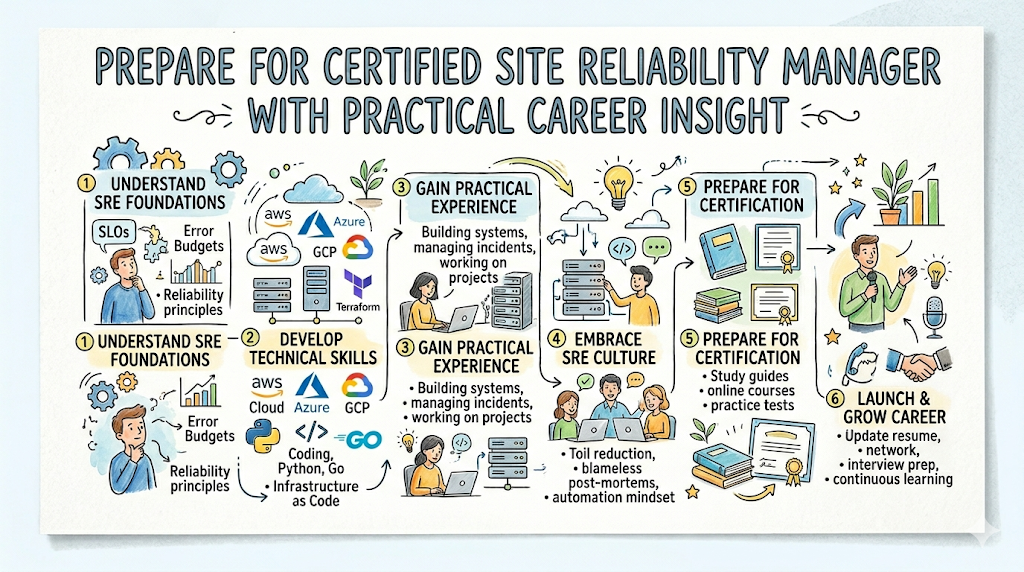
The modern engineering landscape requires more than just technical expertise; it demands a fusion of operational excellence and strategic leadership. If you are looking to bridge the gap between engineering and business reliability, becoming a Certified Site Reliability Manager is a pivotal step for your professional growth. This guide is designed for senior engineers and aspiring leaders who want to understand how to manage reliability at scale while navigating the complexities of cloud-native ecosystems. By following this roadmap, you will gain the insights needed to make informed career decisions and lead high-performing teams at Sreschool or any global enterprise.
What is the Certified Site Reliability Manager?
The Certified Site Reliability Manager is a professional validation designed for those who oversee the health, performance, and scalability of complex software systems. Unlike traditional management tracks that focus solely on people, this certification emphasizes the intersection of technical oversight and operational strategy. It exists to provide a standardized framework for managing Service Level Objectives, error budgets, and incident response protocols in production-heavy environments.
This certification represents a shift from reactive firefighting to proactive reliability engineering by focusing on real-world application rather than abstract theory. It aligns perfectly with modern workflows like Continuous Delivery and Platform Engineering, ensuring that managers can speak the language of both developers and business stakeholders. By achieving this credential, a professional demonstrates their ability to lead teams through the nuances of enterprise-grade cloud operations.
Who Should Pursue Certified Site Reliability Manager?
This certification is ideal for senior software engineers, DevOps specialists, and existing SREs who are transitioning into leadership or management roles. It provides the structural knowledge required to lead platform teams and manage cross-functional reliability initiatives across large organizations. Professionals in cloud architecture and security also find this track beneficial as they look to integrate reliability principles into their specific domains.
Engineering managers and technical leads who are already responsible for production environments will find immediate value in the frameworks provided by this certification. Whether you are operating within the tech hubs of India or working for a global multinational, the skills covered are universally applicable to modern infrastructure. Even for data and security professionals, understanding the management side of reliability is becoming a critical requirement for high-level technical leadership positions.
Why Certified Site Reliability Manager is Valuable and Beyond
In an era where downtime translates directly to massive financial loss, the demand for skilled reliability managers is at an all-time high. This certification provides long-term career longevity by focusing on principles that remain relevant regardless of which specific cloud provider or tooling becomes dominant. Enterprises are increasingly adopting SRE practices, and they need leaders who can implement these cultures effectively without disrupting the pace of innovation.
The return on investment for this certification is reflected in the ability to command higher-level roles and drive significant organizational change. It empowers professionals to stay relevant in an automated world by teaching them how to manage the systems that manage the code. By mastering the art of balancing feature velocity with system stability, you position yourself as a strategic asset to any engineering organization looking to scale responsibly.
Certified Site Reliability Manager Certification Overview
The program is delivered via the provided official training modules and is hosted on the Sreschool platform. This certification is structured to provide a comprehensive look at the management aspects of SRE, moving through various levels of complexity and responsibility. The assessment approach is practical, often involving case studies and management scenarios that reflect the daily challenges of a production environment.
The ownership of the certification rests with a platform dedicated to high-end SRE education, ensuring the content is always aligned with industry shifts. It is not just a one-time test but a journey through foundation, professional, and advanced levels of management expertise. Each level is designed to build upon the last, providing a clear and logical progression for career-minded individuals.
Certified Site Reliability Manager Certification Tracks & Levels
The certification tracks are divided into Foundation, Professional, and Advanced levels to cater to different stages of a professional’s career. The Foundation level focuses on core SRE management concepts, including terminology and basic SLI/SLO construction. This is where most engineers begin their transition into the management mindset, learning how to quantify reliability in a way that business leaders understand.
As you move into the Professional and Advanced levels, the focus shifts toward specialization tracks such as FinOps-led SRE management or AIOps integration. These levels align with career progression from Team Lead to Engineering Manager and eventually to Director of Reliability. Each track ensures that you are not just managing people, but managing the very fabric of the organization’s technical health and operational efficiency.
Complete Certified Site Reliability Manager Certification Table
| Track | Level | Who it’s for | Prerequisites | Skills Covered | Recommended Order |
|---|---|---|---|---|---|
| Core Management | Foundation | Aspiring Managers | Basic DevOps Knowledge | SLO/SLI, Error Budgets, Incident Basics | 1st |
| Operations Lead | Professional | SRE Leads / Managers | 3+ Years Experience | Incident Command, Capacity Planning | 2nd |
| Strategic Director | Advanced | Directors / VPs | 7+ Years Experience | Reliability Culture, FinOps, Scaling | 3rd |
Detailed Guide for Each Certified Site Reliability Manager Certification
Certified Site Reliability Manager – Foundation
What it is
This certification validates a professional’s understanding of the fundamental principles of Site Reliability Management. It covers the core vocabulary and the primary metrics used to measure system health and team performance.
Who should take it
It is suitable for senior engineers looking to transition into leadership or new managers who want a formal framework for SRE operations. It is also great for project managers working closely with SRE teams.
Skills you’ll gain
- Defining Service Level Indicators (SLIs) and Objectives (SLOs).
- Understanding the concept of Error Budgets and how to use them.
- Basic incident management and post-mortem facilitation skills.
- Mapping reliability goals to business outcomes.
Real-world projects you should be able to do
- Create a basic reliability dashboard for a microservice-based application.
- Write a comprehensive post-mortem report for a minor production outage.
- Develop a communication plan for stakeholders during an incident.
Preparation plan
- 7–14 days: Focus on core SRE terminology and the Google SRE workbook fundamentals.
- 30 days: Practice building SLOs for sample applications and reviewing incident management case studies.
- 60 days: Deep dive into organizational culture and the transition from DevOps to SRE management.
Common mistakes
- Overcomplicating SLIs by trying to measure too many metrics at once.
- Failing to align technical reliability goals with the actual customer experience.
- Treating the certification as a purely technical exercise rather than a management one.
Best next certification after this
- Same-track option: Certified Site Reliability Manager – Professional
- Cross-track option: Certified FinOps Practitioner
- Leadership option: Engineering Management Professional
Certified Site Reliability Manager – Professional
What it is
This level validates the ability to implement and oversee SRE practices across multiple teams and complex service architectures. It focuses on the practical application of reliability frameworks in high-pressure environments.
Who should take it
Existing SRE managers, technical leads, and platform architects who have a few years of experience managing production systems should take this level. It requires a solid grasp of architectural trade-offs.
Skills you’ll gain
- Advanced incident command and coordination for large-scale outages.
- Managing toil and automating operational tasks at a team level.
- Capacity planning and performance engineering management.
- Implementing a blameless culture within an engineering organization.
Real-world projects you should be able to do
- Design an end-to-end incident response lifecycle for a global platform.
- Implement a toil reduction roadmap that demonstrates clear ROI.
- Execute a cross-team reliability audit for a legacy system migration.
Preparation plan
- 7–14 days: Review advanced architectural patterns and disaster recovery strategies.
- 30 days: Work through simulation scenarios for incident command and stakeholder management.
- 60 days: Analyze real-world case studies of site reliability failures and the management response to them.
Common mistakes
- Neglecting the people aspect of SRE, such as team burnout and rotation fatigue.
- Using error budgets as a tool for punishment rather than a guide for innovation.
- Failing to automate the tracking of reliability metrics, leading to manual data errors.
Best next certification after this
- Same-track option: Certified Site Reliability Manager – Advanced
- Cross-track option: Certified Cloud Architect
- Leadership option: Master of Engineering Management
Certified Site Reliability Manager – Advanced
What it is
The Advanced level is for those steering the reliability strategy for an entire department or company. It validates expertise in long-term reliability planning, cultural transformation, and cost-efficiency at scale.
Who should take it
This is intended for Directors of SRE, VPs of Engineering, and senior Platform Leaders who are responsible for the entire operational posture of an organization.
Skills you’ll gain
- Strategizing for global scale and multi-region reliability.
- Integrating FinOps with SRE to balance performance and cloud costs.
- Building and scaling SRE organizations from the ground up.
- Influencing executive leadership on the value of reliability investments.
Real-world projects you should be able to do
- Draft a multi-year reliability roadmap for an enterprise-level organization.
- Design a global cost-optimization strategy that does not compromise system uptime.
- Lead a company-wide cultural shift toward proactive reliability engineering.
Preparation plan
- 7–14 days: Focus on executive communication and high-level financial modeling for SRE.
- 30 days: Review global infrastructure trends and legal/compliance aspects of reliability.
- 60 days: Conduct mock strategic planning sessions and peer reviews with other industry leaders.
Common mistakes
- Becoming too detached from technical reality while focusing on high-level strategy.
- Ignoring the impact of organizational silos on reliability goals.
- Underestimating the time required for cultural change in a large enterprise.
Best next certification after this
- Same-track option: Specialty SRE fellowships
- Cross-track option: Certified Information Security Manager
- Leadership option: Chief Technology Officer program
Choose Your Learning Path
DevOps Path
Professionals on the DevOps path focus on bridging the gap between development and operations through automation and continuous integration. For these individuals, the management certification provides the structure needed to oversee complex CI/CD pipelines and ensure that speed does not break the production environment. It teaches them how to govern the automation they build.
DevSecOps Path
The DevSecOps path integrates security into every stage of the lifecycle, making reliability a core component of the security posture. This management certification helps security-focused leaders understand how to balance security patches and audits with the uptime requirements of the platform. It provides a common language for security and operations to collaborate.
SRE Path
For those already in an SRE role, this path is the natural progression toward seniority and management. It moves beyond the daily tasks of coding and infrastructure management into the realm of strategic oversight. This path ensures that SREs can move from individual contributors to influential leaders who shape the reliability culture of the entire company.
AIOps Path
The AIOps path is for those looking to leverage machine learning and artificial intelligence to automate complex operational decisions. As a manager in this track, the certification helps you understand how to govern AI-driven systems and ensure that automated responses align with business SLOs. It is about managing the intelligence that runs the platform.
MLOps Path
The MLOps path focuses on the reliability of machine learning models in production, which is inherently different from traditional software reliability. This certification helps managers handle the unique challenges of model drift, data integrity, and specialized hardware availability. It provides a framework for managing the lifecycle of production-grade AI models.
DataOps Path
DataOps professionals manage the reliability and flow of data pipelines, where downtime can lead to massive business intelligence failures. The management certification teaches these leaders how to apply SRE principles like SLOs and error budgets specifically to data freshness and accuracy. It ensures that the data platform is as reliable as the application platform.
FinOps Path
The FinOps path is dedicated to managing the cloud’s financial health alongside its technical performance. This certification is crucial for managers who need to justify their cloud spend while maintaining high availability. It teaches the art of cost-aware reliability, ensuring that the platform is both stable and economically sustainable for the business.
Role → Recommended Certified Site Reliability Manager Certifications
| Role | Recommended Certifications |
|---|---|
| DevOps Engineer | Foundation |
| SRE | Foundation, Professional |
| Platform Engineer | Foundation, Professional |
| Cloud Engineer | Foundation |
| Security Engineer | Foundation |
| Data Engineer | Foundation |
| FinOps Practitioner | Professional |
| Engineering Manager | Professional, Advanced |
Next Certifications to Take After Certified Site Reliability Manager
Same Track Progression
Deep specialization within the reliability management field involves pursuing higher levels of the core certification or niche certifications in incident command. You might look into advanced disaster recovery planning or specialized high-availability architecture for specific industries like finance or healthcare. This path cements your status as a subject matter expert in reliability leadership.
Cross-Track Expansion
To broaden your skill set, you can explore certifications in related fields like DevSecOps or DataOps to understand how reliability affects different areas of the business. Expanding into Cloud Architecture certifications can also provide the deep technical grounding needed to complement your management skills. This makes you a more versatile leader who can manage diverse engineering departments.
Leadership & Management Track
For those aiming for executive levels, transitioning into general leadership certifications or an MBA can be beneficial. These programs focus on organizational behavior, financial management, and corporate strategy. Combining a technical Site Reliability Manager certification with a formal business leadership credential is a powerful way to reach the C-suite as a CTO or VP of Engineering.
Training & Certification Support Providers for Certified Site Reliability Manager
DevOpsSchool
DevOpsSchool is a premier destination for technical training, providing an extensive catalog of courses that cater to the evolving needs of the modern IT workforce. Their approach to teaching Site Reliability Management is rooted in practical, hands-on experience, ensuring that students can apply what they learn in real-world environments. With a strong emphasis on automation, CI/CD, and infrastructure as code, they prepare managers to lead high-velocity teams. Their instructors are seasoned industry veterans who bring deep insights into the challenges of enterprise-scale operations, making the learning experience both relevant and highly impactful for career growth.
Cotocus
Cotocus specializes in delivering high-end consulting and training services tailored for professionals navigating the complexities of cloud-native ecosystems. They are particularly known for their deep-dive technical workshops and their ability to translate complex architectural concepts into manageable operational strategies. For those pursuing the Site Reliability Manager certification, Cotocus provides a unique perspective that focuses on the synergy between technical precision and leadership. Their training modules are designed to help candidates understand the nuances of incident command and capacity planning, ensuring that they are well-equipped to manage mission-critical production systems for global organizations.
Scmgalaxy
Scmgalaxy has built a massive community-driven platform that serves as a cornerstone for DevOps, SRE, and software configuration management education. Their vast repository of blogs, video tutorials, and forum discussions provides an unparalleled resource for continuous learning. In the context of SRE management, Scmgalaxy offers structured training programs that are highly regarded for their unbiased, community-vetted content. They focus on the actual tools and workflows used in the industry, helping candidates bridge the gap between academic theory and the daily realities of managing complex, distributed software environments in various industry sectors.
BestDevOps
BestDevOps focuses on curating the most effective learning paths for professionals who are serious about mastering the operational side of software engineering. Their curriculum for Site Reliability Management is meticulously structured to guide learners from fundamental concepts to advanced strategic oversight. They pride themselves on providing a learning environment that is both rigorous and supportive, offering comprehensive study guides and simulated lab environments. By focusing on the core pillars of SRE, BestDevOps ensures that their graduates are not just certified but are truly capable of driving reliability and efficiency in any engineering culture.
devsecopsschool.com
Devsecopsschool.com is the leading authority on integrating security into the heart of the DevOps and SRE processes. They recognize that modern reliability cannot exist without a robust security posture, and their training for Site Reliability Managers reflects this integrated approach. Their courses teach managers how to oversee systems that are both resilient to failure and resistant to security threats. By providing specialized modules on automated security auditing and compliance-as-code, they empower leaders to build platforms that meet the highest standards of safety and operational integrity in a cloud-first world.
sreschool.com
Sreschool.com is a dedicated educational hub specifically designed for the Site Reliability Engineering community. As the primary host and delivery partner for the Certified Site Reliability Manager program, they provide a focused and comprehensive learning experience. Their curriculum is built around the core SRE handbooks while incorporating the latest industry innovations in observability and incident management. The platform offers a clear roadmap for career progression, from individual contributor to strategic leader, making it the essential starting point for anyone looking to formalize their expertise in the field of reliability management.
aiopsschool.com
Aiopsschool.com stands at the forefront of the next operational revolution, focusing on the application of artificial intelligence to IT operations. They provide cutting-edge training that helps Site Reliability Managers understand how to leverage machine learning for predictive maintenance and automated problem resolution. Their courses are essential for leaders who want to move beyond manual intervention and build self-healing systems. By teaching the ethics and governance of AI in operations, they ensure that managers are prepared to lead the transition to highly automated, intelligent infrastructure that can scale without proportional increases in human effort.
dataopsschool.com
Dataopsschool.com addresses the critical need for reliability and operational excellence within the data engineering domain. As data becomes the lifeblood of the modern enterprise, the management of data pipelines has become a specialized branch of SRE. This provider offers tailored training that helps managers apply SLOs and error budgets to data accuracy and availability. Their curriculum covers the unique challenges of data governance, lineage, and lifecycle management, ensuring that leaders can deliver high-quality data products with the same level of reliability expected from core software services.
finopsschool.com
Finopsschool.com is the premier resource for learning how to manage the economic aspects of cloud operations. In an era of escalating cloud costs, the ability to balance performance with financial efficiency is a key skill for any Site Reliability Manager. They provide a comprehensive framework for implementing cost-aware engineering and cloud financial management. Their training empowers leaders to collaborate with finance teams, optimize infrastructure spend, and demonstrate the clear financial value of reliability initiatives, making them indispensable assets to the business side of the engineering organization.
Frequently Asked Questions (General)
- How difficult is the Site Reliability Manager certification?
The difficulty level is moderate to high, as it requires a blend of technical understanding and management intuition. It is not just about memorizing facts but applying principles to complex scenarios.
- How much time does it take to prepare for the certification?
Most professionals spend between 30 to 60 days preparing, depending on their existing experience with SRE and management roles.
- What are the prerequisites for the Foundation level?
There are no strict prerequisites, but a basic understanding of DevOps and cloud-native concepts is highly recommended.
- Is this certification recognized globally?
Yes, the principles of Site Reliability Engineering are universal, and this certification is valued by enterprises worldwide.
- Can I take the exam online?
Yes, the certification process is typically handled through online platforms, allowing for flexibility across different time zones.
- What is the ROI of becoming a Certified Site Reliability Manager?
The ROI is high, often leading to roles with higher compensation and greater strategic influence within an organization.
- Do I need to be a coder to pass this certification?
While you don’t need to be an expert coder, you must understand how code interacts with infrastructure and how automation works.
- How often is the certification content updated?
The content is reviewed and updated regularly to ensure it reflects the latest industry standards and cloud-native trends.
- Is there a community or alumni network for this certification?
Yes, most providers offer access to a community of professionals who share insights and career opportunities.
- How does this differ from a standard DevOps certification?
This focus is specifically on the management and reliability of production systems, whereas DevOps is broader and covers the entire lifecycle.
- What kind of roles can I apply for after getting certified?
Roles include SRE Manager, Engineering Manager, Platform Lead, and Director of Site Reliability.
- Is there a renewal process for the certification?
Most certifications require periodic renewal or proof of continuing education to stay active and relevant.
FAQs on Certified Site Reliability Manager
- What is the core focus of the Certified Site Reliability Manager program?
The core focus is on the management of reliability through SLOs, error budgets, and incident response governance rather than just technical implementation.
- How does the program address the People side of SRE?
It teaches managers how to handle team toil, prevent burnout, and foster a blameless culture that encourages learning from failures.
- Are there specific case studies included in the training?
Yes, the training uses real-world scenarios from major tech companies to illustrate the challenges of managing reliability at scale.
- Does the certification cover multi-cloud environments?
Yes, the principles taught are cloud-agnostic and apply whether you are using AWS, Azure, Google Cloud, or on-premises infrastructure.
- What management frameworks are used in the certification?
The program draws from the Google SRE model while incorporating modern leadership practices suited for agile and DevOps environments.
- How are the exams structured?
The exams usually consist of scenario-based questions that test your ability to make management decisions under pressure.
- Is the certification suitable for project managers?
Yes, it is very beneficial for PMs who work with technical teams and need to understand the constraints of system reliability.
- Can this certification help in transitioning from a traditional IT Manager role?
Absolutely, it provides the specific modern framework needed to move from legacy IT management to cloud-native reliability leadership.
Conclusion
If you are looking to advance your career into the upper tiers of engineering leadership, the answer is a resounding yes. The role of the Site Reliability Manager is becoming one of the most critical positions in the modern enterprise, as businesses realize that their growth is tethered to their stability. This certification provides the formal framework and the industry-recognized validation needed to lead this charge.
As a mentor with years of experience seeing teams struggle with production chaos, I can tell you that the difference between a good team and a great one is management. A manager who understands the math of reliability and the culture of blamelessness is worth their weight in gold. Take the time to invest in these skills; the impact on your career and your organization will be profound and lasting.
