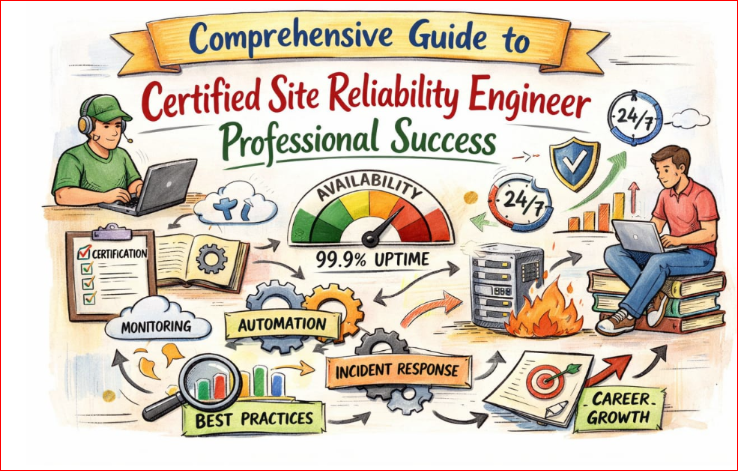
Introduction
The Certified Site Reliability Engineer program is a specialized curriculum designed to bridge the gap between traditional operations and modern software engineering. This guide is written for professionals looking to master the art of maintaining high availability and scalability in complex, cloud-native environments. As enterprises shift toward distributed systems, the role of an SRE has become the backbone of organizational stability and performance.
By following this guide, you will understand how this certification integrates into DevOps, platform engineering, and cloud-native career paths. We will explore the technical depth required to succeed and how Sreschool provides the necessary framework for this journey. This resource helps engineers and technical leaders make informed decisions about their professional development and long-term career trajectory.
What is the Certified Site Reliability Engineer?
The Certified Site Reliability Engineer designation represents a commitment to the principle that operations is an engineering problem. Unlike traditional certifications that focus on specific tools, this program emphasizes the methodology of reliability, scalability, and efficiency. It exists to standardize the skill sets required to manage production environments that are constantly evolving and increasing in complexity.
This program focuses heavily on real-world, production-focused learning rather than just theoretical knowledge. It aligns with modern engineering workflows by teaching candidates how to automate manual tasks, manage incidents effectively, and implement observability. In an enterprise setting, this certification proves that an engineer can balance the need for rapid feature delivery with the absolute necessity of system uptime.
Who Should Pursue Certified Site Reliability Engineer?
Software engineers who want to move deeper into the infrastructure side of the house will find this program incredibly beneficial. It is also ideal for existing DevOps practitioners, platform engineers, and cloud architects who need a structured approach to system reliability. Security and data professionals also benefit, as reliability is a core component of both data integrity and secure system design.
The program is structured to cater to various experience levels, from beginners looking for a foundational start to senior managers overseeing large-scale infrastructure. In the global market, particularly in India’s booming tech hubs, there is a massive demand for certified professionals who can handle high-traffic systems. This certification provides the technical credibility needed to lead teams and manage critical enterprise assets.
Why Certified Site Reliability Engineer is Valuable Today and Beyond
The demand for SREs continues to outpace supply as more companies migrate to microservices and Kubernetes-based architectures. This certification offers long-term longevity because it focuses on engineering principles that remain relevant even as specific cloud providers or tools change. Enterprise adoption of SRE practices is no longer optional; it is a requirement for any business operating at scale.
Investing time in this certification offers a significant return on career investment by positioning you for high-impact roles. It helps professionals stay relevant by shifting the focus from “keeping the lights on” to “engineering the system to be self-healing.” As systems become more autonomous, the skills gained here will be the differentiator between a technician and a principal reliability engineer.
Certified Site Reliability Engineer Certification Overview
The Certified Site Reliability Engineer program is delivered via the official curriculum at Certified Site Reliability Engineer and is hosted on the Sreschool platform. The program uses a multi-level assessment approach that combines conceptual exams with practical, hands-on labs. This ensures that a certified professional does not just know the definitions but can actually execute the tasks.
The ownership of the certification lies with a body of industry experts who update the content to reflect current enterprise practices. The structure is modular, allowing learners to progress through different stages of mastery at their own pace. This practical orientation makes the certification highly respected by hiring managers who value candidates with proven troubleshooting and automation capabilities.
Certified Site Reliability Engineer Certification Tracks & Levels
The certification is divided into three primary levels to accommodate different career stages: Foundation, Professional, and Advanced. The Foundation level introduces core concepts like SLIs, SLOs, and the SRE manifesto. It is the entry point for anyone new to the field or moving from a standard developer role into a more reliability-focused position.
The Professional level dives deep into implementation, covering topics like incident response, post-mortems, and advanced automation. The Advanced level is designed for architects and leads who are responsible for designing resilient systems from the ground up. These tracks align with career progression, moving from individual contribution to system design and technical leadership.
Complete Certified Site Reliability Engineer Certification Table
| Track | Level | Who it’s for | Prerequisites | Skills Covered | Recommended Order |
| SRE Core | Foundation | Junior Engineers, Students | Basic Linux, Networking | SLIs, SLOs, Toil, Monitoring | 1 |
| SRE Implementation | Professional | DevOps Engineers, SysAdmins | SRE Foundation | Incident Management, Automation | 2 |
| SRE Architecture | Advanced | Senior SREs, Architects | SRE Professional | Capacity Planning, Resilience | 3 |
| SRE Leadership | Expert | Engineering Managers, Leads | 5+ Years Experience | Error Budgets, Culture, ROI | 4 |
Detailed Guide for Each Certified Site Reliability Engineer Certification
Certified Site Reliability Engineer – Foundation
What it is
This certification validates a candidate’s understanding of the fundamental principles of Site Reliability Engineering. it covers the vocabulary, the philosophy, and the basic metrics used to measure system health in a production environment.
Who should take it
This is suitable for software developers, system administrators, and recent graduates who want to enter the SRE field. It is the perfect starting point for anyone looking to understand the “Google way” of managing systems.
Skills you’ll gain
- Understanding Service Level Indicators (SLIs) and Objectives (SLOs).
- Identifying and reducing operational toil through automation.
- Basic monitoring and alerting strategies for cloud environments.
- Knowledge of the SRE lifecycle and team structures.
Real-world projects you should be able to do
- Define and document a set of SLOs for a web application.
- Create a basic monitoring dashboard using standard industry tools.
- Identify manual tasks in a workflow and propose an automation plan.
Preparation plan
- 7–14 days: Review the SRE handbook and official study guides provided by the platform.
- 30 days: Complete the foundational video modules and take practice quizzes to identify knowledge gaps.
- 60 days: Engage in basic lab exercises and participate in community forums to discuss core concepts.
Common mistakes
- Focusing too much on specific tools rather than the underlying SRE principles.
- Underestimating the importance of cultural and organizational change in SRE.
Best next certification after this
- Same-track option: Certified Site Reliability Engineer – Professional
- Cross-track option: Certified DevOps Architect
- Leadership option: Engineering Management Foundation
Certified Site Reliability Engineer – Professional
What it is
The Professional level validates the ability to implement SRE practices in a live production environment. It focuses on the technical execution of reliability engineering, including complex automation and incident handling.
Who should take it
Experienced DevOps engineers or those who have completed the Foundation level should pursue this. It is intended for professionals who are actively managing infrastructure and need to improve system stability.
Skills you’ll gain
- Advanced incident response and “blameless” post-mortem documentation.
- Implementing automated canary deployments and rollbacks.
- Configuring advanced observability with tracing and logging.
- Managing error budgets to balance innovation and stability.
Real-world projects you should be able to do
- Set up an automated incident response pipeline for a microservices cluster.
- Perform a deep-dive root cause analysis on a simulated system failure.
- Implement a centralized logging and distributed tracing system.
Preparation plan
- 7–14 days: Focus on incident management protocols and post-mortem templates.
- 30 days: Deep dive into automation scripts and configuration management tools.
- 60 days: Execute full-scale lab simulations involving multi-service outages and recovery.
Common mistakes
- Neglecting the “human” aspect of incident response, such as communication.
- Over-engineering automation scripts that become difficult to maintain.
Best next certification after this
- Same-track option: Certified Site Reliability Engineer – Advanced
- Cross-track option: Certified DevSecOps Professional
- Leadership option: Technical Program Manager
Certified Site Reliability Engineer – Advanced
What it is
This certification validates the expertise required to architect resilient, global-scale systems. It focuses on high-level design patterns, capacity planning, and long-term infrastructure strategy.
Who should take it
This is meant for senior SREs, infrastructure architects, and principal engineers. Candidates should have several years of experience managing large-scale distributed systems in production.
Skills you’ll gain
- Designing for multi-region high availability and disaster recovery.
- Advanced capacity planning using predictive modeling and data.
- Implementing Chaos Engineering practices to test system resilience.
- Optimizing cloud costs while maintaining performance targets.
Real-world projects you should be able to do
- Design a disaster recovery plan for a global, multi-cloud application.
- Conduct a chaos engineering experiment on a production-like environment.
- Build a predictive model for infrastructure scaling based on traffic trends.
Preparation plan
- 7–14 days: Review advanced architectural patterns and disaster recovery strategies.
- 30 days: Study data analysis techniques for capacity planning and cost optimization.
- 60 days: Design and document a complete resilient system architecture for a case study.
Common mistakes
- Designing for theoretical “perfect” reliability rather than cost-effective reliability.
- Ignoring the impact of latency in global, multi-region deployments.
Best next certification after this
- Same-track option: SRE Expert / Fellow
- Cross-track option: Certified Cloud Architect
- Leadership option: Director of Engineering / VP of Infrastructure
Choose Your Learning Path
DevOps Path
The DevOps path focuses on the integration of development and operations through continuous delivery. Candidates following this path should start with the Foundation level to understand how reliability fits into the CI/CD pipeline. The goal is to ensure that every deployment is not just fast, but also stable and observable. This path is ideal for those who want to build the tools that empower developers to own their code in production.
DevSecOps Path
The DevSecOps path integrates security into the reliability framework, ensuring that systems are both stable and secure. Practitioners here learn how to automate security checks and respond to security incidents using SRE principles. It emphasizes that a compromised system is inherently an unreliable system. This path is critical for organizations handling sensitive data or operating in highly regulated industries.
SRE Path
The pure SRE path is for those dedicated to the engineering of production systems. It moves from foundational concepts to advanced architectural design, focusing heavily on reducing toil and managing error budgets. This path is for the specialist who wants to be the ultimate authority on system uptime and performance. It is a deep dive into the technicalities of distributed systems and cloud infrastructure.
AIOps Path
The AIOps path focuses on using artificial intelligence and machine learning to automate IT operations. Engineers in this path learn how to use algorithmic data analysis to predict outages and automate incident resolution. It is the future of SRE, where the scale of data makes manual monitoring impossible. This path requires a strong background in both data science and infrastructure engineering.
MLOps Path
The MLOps path is designed for those managing the reliability of machine learning models in production. It applies SRE principles to the lifecycle of ML models, ensuring that data pipelines and model deployments are robust. Reliability in this context includes monitoring for model drift and ensuring low-latency inference. This is a rapidly growing field as more enterprises move AI models into critical production paths.
DataOps Path
The DataOps path applies SRE methodologies to data engineering and data pipelines. It focuses on the reliability of data delivery, ensuring that data is accurate, available, and timely for downstream consumers. Practitioners learn how to monitor data quality and automate the recovery of failed data jobs. This path is essential for organizations that rely on real-time analytics for decision-making.
FinOps Path
The FinOps path merges SRE principles with financial accountability to optimize cloud spend. Engineers learn how to design systems that are not only reliable but also cost-efficient by analyzing resource utilization data. It treats “cost” as a performance metric that must be monitored and optimized just like latency or error rates. This path is highly valued by management for its direct impact on the company’s bottom line.
Role → Recommended Certified Site Reliability Engineer Certifications
| Role | Recommended Certifications |
| DevOps Engineer | SRE Foundation, SRE Professional |
| SRE | SRE Foundation, SRE Professional, SRE Advanced |
| Platform Engineer | SRE Professional, SRE Advanced |
| Cloud Engineer | SRE Foundation, SRE Professional |
| Security Engineer | SRE Foundation, DevSecOps Professional |
| Data Engineer | SRE Foundation, DataOps Specialist |
| FinOps Practitioner | SRE Foundation, FinOps Professional |
| Engineering Manager | SRE Foundation, SRE Leadership |
Next Certifications to Take After Certified Site Reliability Engineer
Same Track Progression
Deep specialization within the SRE domain involves moving toward the Advanced and Expert levels. This progression ensures you remain at the cutting edge of infrastructure engineering, mastering concepts like global traffic management and complex distributed databases. It is the path toward becoming a Principal or Staff SRE, where your influence extends across the entire organization’s technical strategy.
Cross-Track Expansion
Broadening your skills into adjacent areas like DevSecOps or MLOps makes you a more versatile engineer. By combining SRE reliability with security or data science, you become a “Force Multiplier” who can solve complex, cross-functional problems. This expansion is particularly valuable in smaller organizations or specialized units where a single engineer must handle multiple aspects of the lifecycle.
Leadership & Management Track
For those looking to move away from day-to-day coding, the leadership track focuses on the business value of reliability. You will learn how to build SRE teams, negotiate error budgets with product owners, and align infrastructure costs with business goals. This is the path toward becoming an Engineering Manager or a Director of Infrastructure, where your focus is on people, process, and strategy.
Training & Certification Support Providers for Certified Site Reliability Engineer
DevOpsSchool
DevOpsSchool is a premier training organization that specializes in high-end technical certifications. They offer comprehensive coaching for the SRE track, providing both live instructor-led sessions and self-paced learning. Their instructors are industry veterans who bring real-world scenarios into the classroom. The platform is known for its extensive library of resources and its ability to help students master complex automation tools. For those in India and globally, DevOpsSchool remains a top choice for professional career transformation in the DevOps and SRE space.
Cotocus
Cotocus focuses on providing specialized consultancy and training services for modern cloud technologies. They offer a hands-on approach to SRE training, emphasizing the practical application of tools like Kubernetes and Terraform. Their curriculum is designed to meet the specific needs of enterprises looking to upskill their workforce. Cotocus stands out for its personalized mentoring and its focus on bridging the gap between academic learning and industry requirements. They provide a robust support system for candidates aiming to pass their SRE certification on the first attempt.
Scmgalaxy
Scmgalaxy is a widely recognized community and training hub for software configuration management and DevOps professionals. It provides a wealth of free resources, tutorials, and certification guides that are invaluable for SRE candidates. Their training programs are deeply rooted in the practical aspects of the software development lifecycle. Scmgalaxy has built a strong reputation over the years as a go-to source for technical troubleshooting and best practices. Their support for the SRE certification includes detailed mock exams and community-driven knowledge sharing.
BestDevOps
BestDevOps offers a curated learning experience focused on the most in-demand skills in the infrastructure world. They provide streamlined training modules that cut through the noise and focus on what truly matters for passing the SRE exam. Their platform is designed for busy professionals who need to learn efficiently and effectively. BestDevOps prides itself on its high success rate and the quality of its laboratory environments. They offer a clear roadmap for engineers looking to advance from foundational knowledge to expert-level implementation.
devsecopsschool.com
This platform is the leader in integrating security into the modern engineering workflow. They offer specialized support for SREs who want to master the security aspect of system reliability. Their curriculum covers everything from automated security scanning to incident response for security breaches. Devsecopsschool.com is essential for any professional looking to specialize in the intersection of security and operations. They provide a unique perspective on reliability that includes system integrity and data protection as core pillars.
sreschool.com
Sreschool.com is the primary hosting and delivery platform for the Certified Site Reliability Engineer program. It serves as the central hub for all learning materials, labs, and certification exams. The platform is designed with a focus on user experience and technical depth, ensuring that learners have access to the best possible resources. It offers a structured path from beginner to advanced levels, backed by a community of SRE experts. Sreschool.com is committed to maintaining the highest standards of technical education in the field of reliability engineering.
aiopsschool.com
Aiopsschool.com focuses on the next generation of operations, where artificial intelligence meets infrastructure. They provide training for SREs who want to leverage machine learning to enhance system reliability and automation. Their courses cover data analysis for operations, predictive maintenance, and automated root cause analysis. As systems become too complex for manual management, the skills taught here become increasingly vital. This school is at the forefront of the shift toward autonomous, self-healing infrastructure.
dataopsschool.com
Dataopsschool.com addresses the growing need for reliability in data engineering and analytics. They provide the framework for applying SRE principles to data pipelines, ensuring that data is treated with the same rigor as application code. Their training includes monitoring for data quality, pipeline automation, and managing large-scale data stores. For SREs moving into the data space, this platform provides the specialized knowledge required to succeed. They bridge the gap between traditional database administration and modern data engineering practices.
finopsschool.com
Finopsschool.com is dedicated to the financial management of cloud infrastructure. They provide SREs with the tools and knowledge to monitor and optimize cloud spending without sacrificing performance or reliability. Their curriculum focuses on cost transparency, resource optimization, and the cultural shift required for effective FinOps. As cloud bills become a major expense for enterprises, the ability to manage costs effectively is a key skill. This platform helps engineers become more business-aware and impactful within their organizations.
Frequently Asked Questions (General)
How difficult is the Certified Site Reliability Engineer exam?
The exam difficulty varies by level. The Foundation exam is accessible for those with basic IT knowledge, while the Professional and Advanced levels require significant hands-on experience and a deep understanding of complex systems.
How long does it take to get certified?
Most candidates spend between 30 to 60 days preparing for each level, depending on their existing experience. Dedicated full-time study can shorten this timeframe, but hands-on practice is essential.
Are there any prerequisites for the Foundation level?
There are no formal prerequisites, but a basic understanding of Linux, networking, and at least one programming language is highly recommended to succeed in the labs.
What is the return on investment for this certification?
Certified SREs typically command higher salaries and have access to more senior roles in top-tier tech companies. The ROI is high due to the massive industry demand for these specific skills.
Is the certification recognized globally?
Yes, the certification follows industry-standard SRE principles used by global tech giants, making it highly recognized in India, the US, Europe, and other major tech markets.
Do I need to know how to code to be an SRE?
Yes, coding is a core part of SRE. You will need to write scripts for automation, understand application code for troubleshooting, and potentially contribute to internal tools.
What is the difference between DevOps and SRE?
DevOps is a cultural philosophy of collaboration between dev and ops, while SRE is a specific implementation of that philosophy using engineering practices to manage systems.
Does the certification expire?
Most professional certifications require renewal every 2-3 years to ensure the practitioner remains current with evolving technologies and practices.
Are there hands-on labs in the exam?
Yes, the Professional and Advanced levels include practical assessments where you must solve real-world infrastructure problems in a simulated environment.
Can I skip levels and go straight to Advanced?
It is generally recommended to follow the sequence, but candidates with significant documented industry experience can sometimes apply for an exemption from the foundation requirements.
What tools will I learn during the program?
While the focus is on principles, you will gain exposure to tools like Prometheus, Grafana, Kubernetes, Terraform, and various CI/CD platforms.
How does this certification help an Engineering Manager?
It provides managers with the framework to build and measure the success of their infrastructure teams, focusing on metrics like SLOs and error budgets.
FAQs on Certified Site Reliability Engineer
What is the core focus of the Certified Site Reliability Engineer program?
The core focus is on engineering reliability into systems. This means using software engineering practices to solve operational problems, reducing toil through automation, and using data-driven metrics to manage system health.
How does this certification address incident management?
It teaches a “blameless” approach to incidents, focusing on identifying system weaknesses rather than pointing fingers. You learn how to conduct post-mortems that lead to actual system improvements.
Why is Sreschool the right choice for this certification?
Sreschool provides a dedicated, platform-specific environment that mirrors real-world production setups. Their curriculum is strictly aligned with the actual needs of modern enterprise infrastructure teams.
Can this certification help me transition from a SysAdmin role?
Absolutely. It provides the necessary bridge from manual operations to automated engineering, which is the most common path for SysAdmins looking to modernize their careers.
What role does automation play in the certification?
Automation is central. You are tested on your ability to replace manual, repetitive tasks with code, which is the primary way SREs scale their impact.
How are SLOs and Error Budgets handled in the exam?
You will be required to define these metrics for various scenarios and explain how they influence the balance between feature velocity and system stability.
Is there support for students during the preparation?
Yes, through the various support providers listed, students have access to mentors, community forums, and extensive documentation to guide their learning journey.
Does the program cover multi-cloud environments?
The principles taught are cloud-agnostic, meaning they apply whether you are using AWS, Azure, Google Cloud, or on-premise private clouds.
Conclusion
As a mentor with over two decades in the industry, I have seen many trends come and go, but the need for reliable systems is a constant that only grows in importance. The Certified Site Reliability Engineer program is not a shortcut; it is a rigorous path that demands a shift in mindset from “operator” to “engineer.” If you are looking for a way to future-proof your career in an era of automation and scale, this certification provides the most solid foundation available. The value lies not just in the certificate itself, but in the discipline and technical depth you acquire along the way. Companies are no longer looking for people who can just fix things when they break; they want engineers who can build systems that don’t break in the first place. This program gives you the tools, the vocabulary, and the credibility to be that engineer. It is a significant commitment, but for those serious about their professional growth, the investment is undoubtedly worth it.
