Introduction
In my time working with technology, I have seen the world move from physical servers in dusty basements to the vast, invisible power of the cloud. One thing has remained constant: data is the lifeblood of every business. However, having data is not enough. You need to know how to collect it, clean it, store it, and move it safely. This is where the Data Engineer comes in. Today, companies are drowning in information but starving for insights. They need professionals who can build the “pipes” that allow data to flow from a customer’s click to a manager’s dashboard. AWS (Amazon Web Services) has recognized this massive need and created a specialized certification: the AWS Certified Data Engineer – Associate. This guide is designed to help you understand why this certification is a game-changer. Whether you are a software engineer looking to pivot, a manager trying to upskill your team, or a veteran looking to formalize your knowledge, this is your roadmap. We will skip the fancy jargon and get straight to what matters: how this helps your career and how you can pass the exam.
The AWS Certification Landscape
Before we dive into the specific data track, it is important to see where it fits in the bigger picture. AWS certifications are divided into different levels and tracks.
AWS Certification Summary Table
| Track | Level | Who it’s for | Prerequisites | Skills Covered | Recommended Order |
| Data Engineering | Associate | Data Engineers, SEs | 1-2 years AWS exp | ETL, Data Lakes, Glue | After Practitioner |
| Architecting | Associate | Cloud Architects | Basic Cloud knowledge | VPC, S3, EC2, ELB | First Associate |
| Developing | Associate | Software Developers | Programming skills | Lambda, SDKs, CI/CD | After SAA |
| Operations | Associate | SysOps Admins | Admin experience | CloudWatch, OpsWorks | After SAA |
| Architecting | Professional | Senior Architects | 2+ years Pro exp | Complex migrations | After SAA |
| DevOps | Professional | DevOps/SRE Leads | 2+ years DevOps exp | Automation, Governance | After SysOps/Dev |
Everything About AWS Certified Data Engineer – Associate
This is one of the most practical certifications AWS has released recently. It bridges the gap between basic cloud knowledge and high-level data architecture.
What it is
The AWS Certified Data Engineer – Associate is a credential that proves you can build and maintain data pipelines. It focuses on how to ingest data from different sources, transform it into a usable format, and store it securely. It is about “doing” rather than just “knowing.”
Who should take it
This is for the builders. If you are a Software Engineer who wants to work on backend data systems, a Data Analyst who wants to understand the infrastructure, or a Manager who needs to speak the language of your data team, this is for you. It is also perfect for those already in a Data Engineer role who want to validate their skills on AWS.
Skills you’ll gain
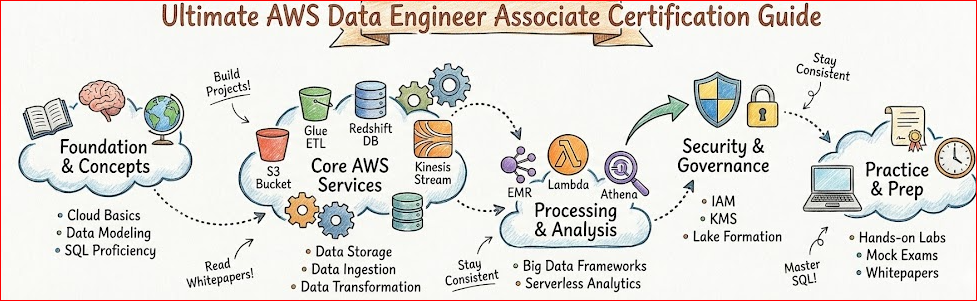
- Data Ingestion: Learning how to pull data from databases, IoT devices, and logs using tools like AWS Glue and Kinesis.
- Data Transformation: Mastering ETL (Extract, Transform, Load) processes to make raw data clean and useful.
- Storage Management: Choosing between S3, Redshift, and DynamoDB based on cost and speed.
- Security & Compliance: Learning how to encrypt data and manage who can see what using Lake Formation and IAM.
- Monitoring & Troubleshooting: Setting up alerts to know when a data pipeline fails and how to fix it quickly.
Real-world projects you should be able to do
- Automated Data Pipeline: Build a system that automatically takes CSV files from an S3 bucket, converts them to Parquet format, and loads them into a data warehouse.
- Real-time Dashboard: Use Kinesis to capture live data from a website and display it on a dashboard with zero delay.
- Secure Data Lake: Set up a central storage area where different departments can only see the data they are authorized to access.
Preparation Strategies (How to Pass)
I have seen people pass this in a week, and others take months. The key is your starting point. Here are three plans depending on your schedule.
Plan A: The 14-Day Sprint (For Experts)
This is for those who already use AWS every day.
- Days 1-5: Read the official exam guide. Focus on the “Data Ingestion” and “Transformation” domains.
- Days 6-10: Do hands-on labs for AWS Glue and Amazon Redshift. These are the “heavy hitters” on the exam.
- Days 11-14: Take at least three full-length practice exams. Review every wrong answer.
Plan B: The 30-Day Standard (For Working Engineers)
This is the most popular path for people with a full-time job.
- Week 1: Introduction to Data Engineering on AWS. Learn about S3 storage classes and IAM security.
- Week 2: Deep dive into Ingestion (Kinesis and AppFlow) and Orchestration (Step Functions).
- Week 3: Transformation and Analytics. Focus on AWS Glue, Athena, and EMR.
- Week 4: Final review, practice exams, and memorizing limits/costs for each service.
Plan C: The 60-Day Deep Dive (For Beginners/Managers)
If you are new to the cloud, take your time.
- Month 1: Focus on the basics of Cloud. Learn how VPCs and Subnets work before touching data.
- Month 2: Follow a structured course. Build small projects for every service mentioned in the exam guide. Don’t move to the next topic until you have built something with your own hands.
Common Mistakes
- Overlooking Costs: AWS cares about how much money you spend. Many exam questions ask for the “most cost-effective” solution, not just the fastest one.
- Ignoring SQL: You don’t need to be a DBA, but you must know how to write and optimize basic SQL queries.
- Skipping Lake Formation: This is a newer service that many older guides miss, but it is very important for the current exam.
Best Next Certification After This
Once you have this under your belt, I suggest looking at:
- AWS Certified Machine Learning – Associate: To learn how to use the data you just engineered.
- AWS Certified Solutions Architect – Professional: To understand the entire AWS ecosystem at a leadership level.
Choose Your Path: Learning Tracks
Data engineering does not exist in a vacuum. It interacts with every other part of the IT department. Here are 6 paths you can follow:
- DevOps Path: Focus on automating the deployment of your data pipelines using CI/CD tools.
- DevSecOps Path: The “security first” approach. You ensure every piece of data is encrypted and every access point is locked down.
- SRE Path: Focus on making sure the data systems never go down. You learn about high availability and disaster recovery.
- AIOps/MLOps Path: This is the future. You build the infrastructure that allows AI models to learn from your data automatically.
- DataOps Path: This is about the “speed of data.” You focus on how to get data from source to user as fast and accurately as possible.
- FinOps Path: The financial side. You become an expert at reducing the AWS bill by choosing the right data storage and processing power.
Role → Recommended Certifications Mapping
If you are currently in one of these roles, here is how you should layer your certifications:
- DevOps Engineer: Data Engineer Associate + DevOps Engineer Professional.
- SRE: Data Engineer Associate + SysOps Administrator Associate.
- Platform Engineer: Solutions Architect Associate + Data Engineer Associate.
- Cloud Engineer: Cloud Practitioner + Solutions Architect Associate + Data Engineer Associate.
- Security Engineer: Security Specialty + Data Engineer Associate.
- Data Engineer: Data Engineer Associate + Solutions Architect Professional.
- FinOps Practitioner: Cloud Practitioner + Data Engineer Associate.
- Engineering Manager: Solutions Architect Associate + Data Engineer Associate.
Where to Get Trained? (Top Institutions)
Finding the right mentor is half the battle. Here are the top institutions that provide excellent training and certification support:
- DevOpsSchool: They offer a very practical approach. Their trainers are experts who focus on the real-world application of AWS services, ensuring you can actually do the job, not just pass the test.
- Cotocus: This institution is known for its intensive bootcamps. They provide a structured environment that is perfect for busy professionals who need to get certified quickly.
- Scmgalaxy: A great resource for community-driven learning. They offer a wealth of blogs, tutorials, and videos that help clarify complex data engineering concepts.
- BestDevOps: They specialize in the intersection of data and automation. If you want to learn how to build self-healing data pipelines, this is the place.
- Devsecopsschool: As the name suggests, they are the leaders in cloud security. They will teach you how to build data lakes that are “unhackable.”
- Sreschool: Focuses on reliability. They are great for learning how to manage large-scale data migrations without any downtime.
- Aiopsschool: Perfect for those looking toward the future. They combine data engineering with artificial intelligence training.
- Dataopsschool: They live and breathe data. Their courses are deeply specialized in the lifecycle of information within the cloud.
- Finopsschool: They teach you the “business of the cloud.” You will learn how to build powerful systems while keeping the CFO happy with the bill.
FAQs on AWS Certified Data Engineer – Associate
Q1: How hard is this exam?
It is moderately difficult. It is harder than the Cloud Practitioner but more focused than the Solutions Architect Associate. If you have hands-on experience with SQL and data, you will find it manageable.
Q2: How much does the exam cost?
The exam fee is $150 USD. If you have passed another AWS exam recently, check your benefits—you might have a 50% discount voucher.
Q3: Can I take this exam without having any other AWS certs?
Yes, there are no mandatory prerequisites. However, having basic AWS knowledge will make your study time much shorter.
Q4: Is this certification better than the Big Data Specialty?
The Big Data Specialty has been retired. The Data Engineer – Associate is its modern replacement. It is more relevant to today’s “serverless” cloud environment.
Q5: What is the most important service to study?
AWS Glue. It appears in almost every domain of the exam, from ingestion to transformation and cataloging.
Q6: Does this cert require coding?
You don’t need to be a software developer, but you should be able to read Python code and write complex SQL queries.
Q7: How long is the certification valid?
It is valid for 3 years. After that, you can recertify by taking the exam again or passing a higher-level Professional exam.
Q8: Will this help me get a job in India?
Absolutely. India has one of the largest demands for data engineers globally. Having an AWS-backed credential makes your resume stand out to recruiters in major hubs like Bangalore, Pune, and Gurgaon.
General FAQs for Career Success
Q1: How do I start a career in data engineering?
Start with the basics of databases (SQL). Then, learn one cloud provider like AWS. Getting this certification is the best way to prove you have done the work.
Q2: Which is better: Data Science or Data Engineering?
Data Scientists analyze data; Data Engineers build the systems that provide that data. Engineers are often in higher demand because, without the “pipes,” the scientists have nothing to work with.
Q3: How much time should I study daily?
Consistency is better than intensity. One hour a day for a month is better than studying for 10 hours straight on a weekend.
Q4: Are practice exams necessary?
Yes. The AWS exam is not just about facts; it is about “scenario-based” questions. Practice exams help you learn how to read between the lines of a question.
Q5: Is it better to be a generalist or a specialist?
Start as a generalist (Solutions Architect) and then specialize (Data Engineer). The market pays a premium for specialists who understand the big picture.
Q6: What is the best way to learn AWS?
Hands-on practice. Sign up for the AWS Free Tier and build a project. Reading a book is only 10% of the journey; doing is 90%.
Q7: Does my college degree matter for this certification?
Not really. While a technical background helps, the cloud is a great equalizer. If you can pass the exam and show you can build pipelines, companies will want to hire you.
Q8: What is the future of Data Engineering?
Automation and AI. We are moving toward “Zero-ETL” and “Serverless” systems. This certification focuses heavily on those modern concepts.
Q9: How do I convince my manager to pay for this?
Show them the “FinOps” benefits. Tell them that by being certified, you can help optimize the company’s AWS spend and build more reliable systems.
Q10: Can I shift from DevOps to Data Engineering?
Yes, it is a very natural shift. Many skills like CI/CD and automation carry over perfectly.
Q11: Is remote work possible in this field?
Very much so. Most cloud data work is done remotely. Since the “servers” are in the cloud, you can manage them from anywhere in the world.
Q12: What is the one piece of advice for the exam day?
Read the questions carefully! Often, the difference between the right and wrong answer is a single word like “most” or “cheapest.”
Next Certifications to Take
After you secure your Associate badge, you have three main paths to consider for your next step:
- Same Track (Deepening Skills): Look into the AWS Certified Machine Learning – Specialty. This allows you to take the data you’ve prepared and build intelligent models with it.
- Cross-Track (Broadening Skills): The AWS Certified Solutions Architect – Professional. This is the “gold standard” of AWS certs. It proves you can design massive, complex systems beyond just data.
- Leadership (Managerial Growth): If you want to move into management, consider a Certified Cloud Finance Manager (FinOps) or a Project Management Professional (PMP) to combine your technical depth with business strategy.
Final Thoughts
The AWS Certified Data Engineer – Associate is more than just a badge on your resume; it is a signal to the industry that you possess the technical maturity to handle the cloud’s most valuable asset—data. In my years of seeing technology cycles come and go, I have learned that while tools like Glue or Redshift may evolve, the demand for engineers who can build secure, scalable, and cost-effective pipelines never fades. By earning this certification, you aren’t just learning how to use AWS services; you are mastering the art of modern data architecture. Whether you are aiming for a promotion, a career pivot, or simply want to sharpen your professional edge, this path offers a clear and rewarding roadmap for any engineer ready to build the infrastructure of tomorrow.
