Introduction
If you have been in this industry for any length of time, you remember when “security” meant a siloed team that said “no” to everything right before launch. We called them the “Department of No.” Developers would throw code over the wall, and security would throw it back. It was slow, painful, and frankly, it doesn’t work anymore.In today’s cloud-native world, releases happen hourly, not quarterly. You cannot wait for a manual security audit. If you are deploying code to Kubernetes clusters or managing cloud infrastructure, you are already making security decisions every day—whether you realize it or not.
This is where the DevSecOps Certified Professional (DSOCP) comes in. It is not just about learning new tools; it is about a fundamental shift in responsibility. It validates that you possess the rare ability to embed security checks directly into the high-speed DevOps pipeline without slowing it down. This certification is the difference between being a standard engineer and being a guardian of your company’s reputation.
Master Certification List
To give you a clear picture of where DSOCP sits in the ecosystem, here is the full breakdown of the certification details.
| Track | Level | Who it’s for | Prerequisites | Skills Covered | Recommended Order |
|---|---|---|---|---|---|
| DevSecOps | Professional | DevOps Engineers, Security Admins, SREs | Basic Linux, AWS/Azure knowledge, Git | SAST, DAST, Container Security, Compliance as Code | Take after “Master in DevOps” or equivalent exp. |
Deep Dive: DevSecOps Certified Professional (DSOCP)
Let’s get specific. The DSOCP isn’t a multiple-choice quiz you can pass by memorizing definitions. It is a rigorous, practical validation of your ability to secure the Software Development Life Cycle (SDLC).
What it is
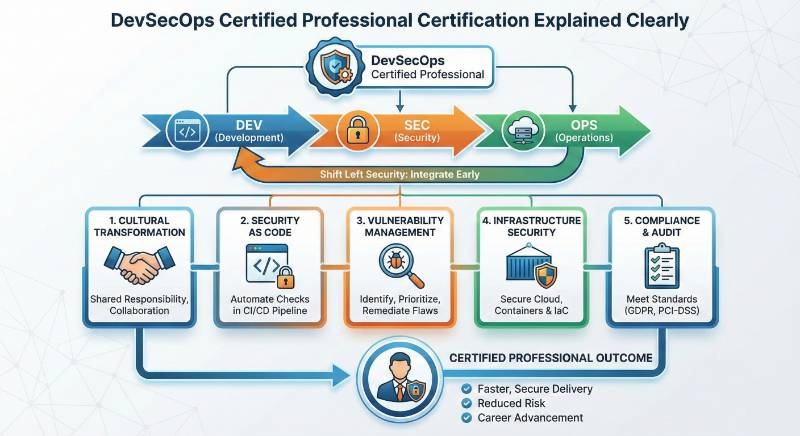
The DSOCP is a structured program that teaches you the “Shift Left” methodology. In traditional models, security testing happened at the end (Right). “Shifting Left” means moving those tests to the earliest stages of development (Left). The certification validates that you can automate security controls so they happen while the developer is coding and building, not days later.
Who should take it
- DevOps Engineers: If you are building pipelines, you need to know how to secure them. This is the natural next step for your career.
- Software Engineers: You want to write code that doesn’t get rejected. Learning SAST (Static Application Security Testing) helps you fix bugs before they leave your laptop.
- Security Professionals: You know policy, but you might struggle with automation. This teaches you how to speak the language of DevOps.
- IT Managers: You need to understand the workflow to hire the right people and build the right culture.
Skills you’ll gain
This certification covers the entire threat landscape of modern software:
- Pre-Commit Security: preventing hard-coded secrets (passwords, API keys) from ever entering your version control system using tools like Talisman or GitLeaks.
- Static Analysis (SAST): Integrating SonarQube to analyze source code for known vulnerabilities without executing the program.
- Dynamic Analysis (DAST): setting up OWASP ZAP to attack your running application automatically to find runtime issues like SQL Injection.
- Container Security: You will learn to scan Docker images for CVEs (Common Vulnerabilities and Exposures) and secure the Kubernetes runtime environment using Falco.
- Infrastructure as Code (IaC) Security: treating your Terraform or Ansible scripts as code and scanning them for misconfigurations before deployment.
Real-world projects you should be able to do after it
Theory is useless without action. After this certification, you will be able to:
- Architect a “Self-Healing” Pipeline: A CI/CD pipeline that detects a vulnerability, fails the build, blocks the deployment, and notifies the developer via Slack—all without human intervention.
- Implement “Compliance as Code”: turning a PDF of security policies into executable code that prevents non-compliant infrastructure from ever being provisioned.
- Secure a Supply Chain: setting up a private artifact repository that quarantines bad libraries so developers can’t accidentally pull infected dependencies.
Preparation Plan
- 7–14 Days (The Sprint): For experienced DevOps leads. Focus entirely on the tools you don’t know. If you know Jenkins, spend your time on OWASP ZAP and Trivy.
- 30 Days (The Standard): The sweet spot. Dedicate Week 1 to Linux/Scripting; Week 2 to SAST/DAST; Week 3 to Containers; and Week 4 to the Capstone Project.
- 60 Days (The Deep Dive): For those new to automation. Spend the first month just learning Linux and Docker basics before even touching the security tools.
Common Mistakes
- Tool Fatigue: Beginners often try to plug in every tool available. This slows down the pipeline and frustrates developers. Start with one SAST and one SCA tool.
- Ignoring Culture: You cannot automate trust. If you don’t teach developers why these checks matter, they will find ways to bypass them.
- Alert Fatigue: If your security tools scream about every minor issue, people will stop listening. Learn to tune your tools to only block on “Critical” and “High” issues initially.
Role → Recommended Certifications Mapping
Not everyone needs every certification. Depending on your current job title (or the one you want), here is exactly what you should prioritize.
| Role | Primary Cert (Must Have) | Secondary Cert (Good to Have) |
|---|---|---|
| DevOps Engineer | Master in DevOps Engineering | DSOCP (DevSecOps) |
| SRE | Certified SRE Professional | CKA (Kubernetes Admin) |
| Platform Engineer | Certified Kubernetes Administrator (CKA) | Terraform Associate |
| Security Engineer | DevSecOps Certified Professional (DSOCP) | CISSP or CKS |
| Data Engineer | Certified DataOps Architect | AWS Data Analytics |
| FinOps Practitioner | Certified FinOps Practitioner | AWS Cost Optimization |
| Engineering Manager | Certified DevOps Manager | Scrum Master / PMP |
Choose Your Path: 6 Specialized Learning Paths
The IT world is huge. DSOCP is a critical milestone, but where does it fit in the bigger picture? Here are the six main career tracks dominating the market.
- DevOps Path:
- Focus: Automation, CI/CD, Cloud Infrastructure.
- Goal: Speed. Delivering software faster.
- Where DSOCP fits: It’s a specialized skill to add after you master the basics of CI/CD.
- DevSecOps Path (The Specialist):
- Focus: Vulnerability Management, Compliance, Threat Modeling.
- Goal: Safety. Ensuring the software is bulletproof.
- Where DSOCP fits: This is your core certification. It is the “must-have.”
- SRE (Site Reliability Engineering) Path:
- Focus: Reliability, Uptime, Scalability, Incident Response.
- Goal: Stability. Keeping the lights on when traffic spikes.
- Where DSOCP fits: Security incidents cause downtime. An SRE with security skills is incredibly valuable.
- AIOps / MLOps Path:
- Focus: Managing AI models in production and using AI to manage IT.
- Goal: Intelligence. Automating complex decisions.
- Where DSOCP fits: AI models can be poisoned or stolen. Securing the “Data Pipeline” is the next frontier of DevSecOps.
- DataOps Path:
- Focus: Data Pipelines, ETL, Data Warehousing.
- Goal: Accuracy. Getting clean data to the business.
- Where DSOCP fits: Data is the new oil, and it needs protection. Applying DevSecOps principles to data flows prevents massive leaks.
- FinOps Path:
- Focus: Cloud Cost Optimization, Unit Economics.
- Goal: Efficiency. Getting the most value for every dollar.
- Where DSOCP fits: Hacked accounts run up massive bills (crypto-mining). Security is cost control.
Top Institutions for DSOCP Training
Choosing the right training partner is as important as the certification itself. Based on market feedback and curriculum depth, here are the top players:
- DevOpsSchool: They are the pioneers in this space. Their training is famous for being “project-based.” You don’t just watch slides; you get sandbox environments to break and fix things. They cover the widest array of tools.
- Cotocus: Highly recommended for corporate teams. If you are a manager looking to train your whole team, their consultancy-style approach works wonders. They focus on real-world case studies.
- Scmgalaxy: A fantastic resource for the self-starter. They have a massive community and repository of tutorials. Their certification program is backed by a very active forum of practitioners.
- BestDevOps: True to their name, they focus on best practices. Their courses are streamlined and exam-focused, great if you are on a tight timeline.
- devsecopsschool: A niche expert. They live and breathe security. Their training goes deeper into the “Sec” part than anyone else, covering advanced threat modeling and ethical hacking for DevOps.
- sreschool: If you are coming from an Operations background, their angle on DevSecOps (focused on reliability and security) will resonate with you.
- aiopsschool & dataopsschool: These are emerging leaders focusing on the intersection of security with AI and Big Data.
- finopsschool: They offer a unique perspective on how security automation can prevent financial waste in the cloud.
Next Certifications to Take
Once you have the DSOCP, you shouldn’t stop. The field moves too fast. Here is how to stack your credentials:
Option 1: Same Track (Deepen Security)
- Certified Kubernetes Security Specialist (CKS): This is the logical next step. It is extremely technical and focuses purely on the container orchestration layer.
- CISSP (Certified Information Systems Security Professional): If you want to move into a CISO (Chief Information Security Officer) role eventually, this is the gold standard for management.
Option 2: Cross-Track (Broaden Skills)
- Certified SRE Professional: Now that you know Security, learn Reliability. The combination of SRE + DevSecOps creates a “Super Engineer” profile.
- AWS/Azure Security Specialty: Get certified in the specific cloud platform your company uses to understand their native security tools.
Option 3: Leadership (Management)
- Certified DevOps Manager: If you want to stop configuring tools and start managing the teams that do, this helps you understand strategy, hiring, and ROI.
Conclusion
The transition from DevOps to DevSecOps is not a trend; it is an evolution. The industry has realized that you cannot bolt security on at the end of the assembly line. It has to be baked in. The DevSecOps Certified Professional (DSOCP) is your proof that you understand this evolution. It tells employers that you are not just a coder or an admin, but a holistic engineer who cares about the safety and integrity of the product. I have seen many technologies come and go, but the need for security has only grown. This certification is one of the best investments you can make for your career . Stop waiting for the security team to save you. Become the security expert your team needs.
